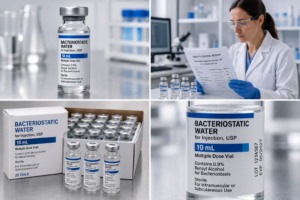
When laboratories, healthcare professionals, and pharmaceutical researchers need a sterile diluent for compatible injectable preparations, choosing the right water matters. Bacteriostatic Water 10ml is a commonly searched product format because it combines sterile water for injection with a preservative intended to inhibit bacterial growth in an appropriately labeled multidose container.
However, not every product described online as bacteriostatic water is necessarily identical. Formulation, packaging, labeling, regulatory status, manufacturer documentation, and intended use should all be considered before purchasing.
Official labeling available through DailyMed describes Bacteriostatic Water for Injection, USP as a sterile, nonpyrogenic preparation containing Water for Injection and benzyl alcohol as a bacteriostatic preservative. Current product labels commonly describe concentrations such as 0.9% (9 mg/mL) or, depending on the product, 1.1% (11 mg/mL).
This comprehensive guide explains what Bacteriostatic Water 10ml is, what it is designed for, how it differs from sterile water, what buyers should look for, and important safety considerations.
Important: Bacteriostatic Water for Injection is a prescription product in the United States and is intended for use according to its official labeling and the instructions of an appropriately qualified healthcare professional. This article is educational and is not a substitute for professional medical advice.
What Is Bacteriostatic Water 10ml?
Bacteriostatic Water 10ml generally refers to a 10-milliliter vial or container of Bacteriostatic Water for Injection, USP.
The term “bacteriostatic” describes the presence of an antimicrobial preservative. Official DailyMed labeling describes bacteriostatic water as sterile and nonpyrogenic Water for Injection containing benzyl alcohol as a bacteriostatic preservative. It is supplied in a multiple-dose container intended for repeated withdrawals when used appropriately.
The key components are:
- Water for Injection: Highly purified water meeting the applicable pharmaceutical standard.
- Benzyl alcohol: A preservative used to inhibit bacterial growth.
- Sterile container: Packaging designed for the labeled pharmaceutical application.
- 10ml volume: A compact presentation that may be convenient for specific applications where the labeled volume is appropriate.
The exact formulation should always be verified against the manufacturer’s current label rather than assumed from the product name alone.
What Does “Bacteriostatic” Mean?
“Bacteriostatic” does not mean that a product is immune to contamination.
Instead, the preservative is intended to inhibit the growth of bacteria under appropriate conditions. It does not replace proper aseptic technique or make an improperly handled vial safe.
The CDC emphasizes that preservatives in multidose vials do not eliminate the need for safe injection practices. Medication containers can become contaminated when proper procedures are not followed.
This distinction is important when evaluating Bacteriostatic Water 10ml online. A high-quality product should not be marketed as though its preservative provides unlimited protection from contamination.
What Is Bacteriostatic Water Used For?
According to official labeling, Bacteriostatic Water for Injection is intended for parenteral use after the addition of drugs that require dilution or dissolution in an aqueous vehicle prior to injection.
In practical terms, its labeled purpose is to serve as a sterile diluent for compatible pharmaceutical preparations.
Depending on the specific medication and its approved labeling, bacteriostatic water may be used in professional healthcare or pharmaceutical settings when the medication manufacturer specifies it as an appropriate diluent.
It should not be assumed that bacteriostatic water is suitable for every injectable medication. Compatibility can depend on the particular drug, formulation, concentration, route, patient population, and manufacturer’s instructions.
For this reason, always check the medication’s official prescribing information before selecting a diluent.
Bacteriostatic Water 10ml vs. Sterile Water for Injection
One of the most important questions buyers ask is whether bacteriostatic water and sterile water are the same thing.
They are not necessarily interchangeable.
Bacteriostatic Water
Bacteriostatic Water for Injection contains a preservative, commonly benzyl alcohol, and is generally packaged as a multidose product. Current DailyMed labeling identifies examples containing 0.9% or 1.1% benzyl alcohol, depending on the product.
Sterile Water for Injection
Sterile Water for Injection does not contain the same bacteriostatic preservative. It is a sterile diluent used when the applicable medication labeling specifies sterile water.
Why the Difference Matters
The presence of benzyl alcohol can make bacteriostatic water inappropriate for certain populations or applications.
For example, official labeling carries a warning against use in neonates, and FDA labeling has specifically described serious risks associated with benzyl alcohol-containing preparations in neonates and low-birth-weight infants.
Therefore, the choice between bacteriostatic water and sterile water should be based on the specific medication’s instructions and the patient’s circumstances—not simply convenience.
Why Is Benzyl Alcohol Added?
Benzyl alcohol is added as a bacteriostatic preservative in applicable formulations.
For example, a current DailyMed label describes a formulation containing 0.9% benzyl alcohol, equivalent to 9 mg/mL. Other current labels describe 1.1% benzyl alcohol, so buyers should verify the exact concentration on the product label.
Its role is to help inhibit bacterial growth in a properly handled multidose container.
However, benzyl alcohol is not a guarantee against contamination. Proper storage, handling, aseptic technique, and compliance with the manufacturer’s labeling remain essential.
Is Bacteriostatic Water 10ml Sterile?
A properly manufactured and labeled Bacteriostatic Water for Injection product is described as sterile and nonpyrogenic in official labeling.
However, “sterile when manufactured” should not be interpreted as “sterile forever.”
Once a vial is accessed, contamination can occur if appropriate practices are not followed. The CDC recommends aseptic technique, appropriate vial handling, and use of a new sterile needle and syringe whenever entering medication containers.
The product’s own labeling should always determine its storage and discard requirements.
What Does 10ml Mean?
The “10ml” in Bacteriostatic Water 10ml refers to the nominal volume of the container.
A 10ml presentation can be attractive to buyers who need a relatively compact amount of diluent rather than a larger container. However, the volume alone does not determine product quality.
When comparing products, look beyond the vial size.
Important considerations include:
- Manufacturer identity
- Current product labeling
- Sterility information
- Preservative concentration
- Lot or batch identification
- Expiration date
- Packaging integrity
- Storage requirements
- Regulatory information
- Availability of appropriate documentation
A smaller vial from a reputable, transparent source can be preferable to a product with unclear provenance or incomplete labeling.
How to Choose Quality Bacteriostatic Water 10ml
If you are evaluating Bacteriostatic Water 10ml, quality verification should be more important than price alone.
1. Check the Product Label
A professional product should have clear labeling identifying the product, concentration, volume, manufacturer or responsible company, lot information, expiration information, and relevant warnings.
Avoid products with vague or incomplete descriptions.
2. Verify the Formulation
Do not assume that every product has the same benzyl alcohol concentration.
Official DailyMed listings show that formulations can differ, including products labeled with 0.9% or 1.1% benzyl alcohol.
3. Look for Appropriate Documentation
Depending on the supplier and intended application, buyers may want access to relevant product documentation, such as:
- Certificate of Analysis where applicable
- Manufacturer information
- Lot or batch details
- Expiration information
- Product specifications
- Storage requirements
- Regulatory labeling
Documentation improves transparency and allows qualified buyers to evaluate the product more effectively.
4. Examine Packaging Quality
The vial should arrive intact and appropriately sealed.
Do not use a product if the container is damaged, leaking, compromised, or otherwise inconsistent with its labeling.
5. Consider Supplier Transparency
A trustworthy supplier should provide accurate product information rather than making exaggerated claims.
Be cautious of websites that promise that bacteriostatic water can be used for every application or that suggest the product eliminates the need for sterile handling.
Storage and Handling Considerations
Proper storage is an important part of maintaining the quality of sterile pharmaceutical products.
Always follow the manufacturer’s current storage instructions because requirements can vary by product.
Before use, qualified personnel should inspect the container and its contents for problems such as:
- Damaged packaging
- Visible particulate matter
- Unexpected discoloration
- Leaking containers
- Compromised seals
- Expired product
The CDC recommends that medication vials be discarded when sterility is compromised or cannot be confirmed.
For multidose containers, the manufacturer’s instructions regarding beyond-use or discard dates should be followed. CDC guidance notes that multidose vials should generally be dated when first opened and discarded according to applicable manufacturer instructions; the commonly referenced 28-day period is not a universal substitute for product-specific labeling.
Safe Handling Matters
Bacteriostatic water should never be treated like ordinary bottled water.
Because it is intended for pharmaceutical use, sterile handling practices are important.
The CDC recommends using aseptic technique when preparing injectable medications and emphasizes that a new needle and syringe should be used every time a medication vial is entered.
Importantly, the presence of a preservative does not make poor injection practices acceptable.
If you are a patient, use injectable products only as directed by your healthcare professional. If you work in a healthcare or laboratory environment, follow your organization’s applicable procedures and the manufacturer’s labeling.
Who Should Not Use Bacteriostatic Water?
One of the most important safety considerations involves neonates.
Current official labeling carries a warning that bacteriostatic water containing benzyl alcohol is not for use in neonates.
FDA labeling has also highlighted the risk associated with benzyl alcohol exposure in neonates and low-birth-weight infants.
This is one reason healthcare professionals should carefully evaluate the appropriate diluent for each medication and patient.
People should also avoid selecting a diluent based solely on online recommendations. The medication’s approved labeling and professional medical guidance should determine whether bacteriostatic water is appropriate.
Common Mistakes When Buying Bacteriostatic Water 10ml
Mistake 1: Choosing Only by Price
The cheapest product is not automatically the best value.
For pharmaceutical products, traceability, labeling, quality controls, and supplier reliability can matter considerably.
Mistake 2: Assuming Every 10ml Vial Is Identical
Two products may both be labeled “Bacteriostatic Water 10ml” while having different manufacturers, formulations, packaging, or regulatory status.
Always verify the actual label.
Mistake 3: Confusing Sterile Water With Bacteriostatic Water
The presence of benzyl alcohol is a major distinction. These products should not automatically be substituted for one another.
Mistake 4: Ignoring Expiration Dates
Sterile pharmaceutical products should be checked for expiration and storage requirements before use.
Mistake 5: Assuming the Preservative Prevents Contamination
It does not.
The CDC specifically emphasizes that preservatives do not replace proper infection-control practices.
Frequently Asked Questions About Bacteriostatic Water 10ml
What is Bacteriostatic Water 10ml?
Bacteriostatic Water 10ml generally refers to a 10ml presentation of Bacteriostatic Water for Injection, USP. Official labels describe it as sterile, nonpyrogenic water containing a bacteriostatic preservative such as benzyl alcohol.
What is bacteriostatic water used for?
It is intended as a sterile diluent for compatible drugs that require dilution or dissolution before injection, according to the applicable medication and product labeling.
Is bacteriostatic water the same as sterile water?
No. Bacteriostatic water contains a bacteriostatic preservative, commonly benzyl alcohol, whereas Sterile Water for Injection does not contain that preservative.
Does Bacteriostatic Water 10ml contain benzyl alcohol?
Applicable formulations do. Current DailyMed labels show products containing 0.9% or 1.1% benzyl alcohol, depending on the specific product. Always check the current label for the product you are considering.
Can bacteriostatic water be used for every injectable medication?
No. Compatibility depends on the specific medication and its labeling. A healthcare professional should determine which diluent is appropriate.
Is bacteriostatic water safe for babies?
Products containing benzyl alcohol carry warnings against use in neonates. FDA labeling also highlights serious risks associated with benzyl alcohol exposure in neonates and low-birth-weight infants.
How long does bacteriostatic water last after opening?
Do not rely on a generic internet rule. Follow the specific manufacturer’s labeling and applicable healthcare-facility requirements. CDC guidance states that multidose vials should be dated when first opened and discarded according to the manufacturer’s instructions or applicable standards.
How should Bacteriostatic Water 10ml be stored?
Follow the storage instructions printed on the specific product label. Storage requirements can vary by manufacturer and formulation.
What should I look for when buying bacteriostatic water?
Look for clear labeling, manufacturer information, lot and expiration details, appropriate packaging, formulation information, and transparent documentation. Purchasing through a reputable, appropriately regulated source is also important.
Internal Linking Opportunities
For a website selling or providing information about Bacteriostatic Water 10ml, strategic internal links can strengthen topical relevance and improve navigation.