
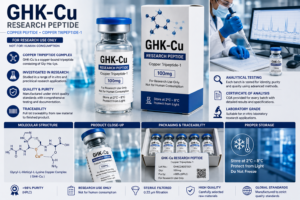
GHK-Cu Research Peptide is a copper-binding peptide complex that has attracted scientific interest across biochemistry, cell biology, tissue-remodeling research, and other experimental fields. GHK refers to the tripeptide glycyl-L-histidyl-L-lysine, while GHK-Cu describes its complex with copper. PubChem lists GHK-Cu as a synonym for copper tripeptide and identifies glycyl-L-histidyl-L-lysine and copper as component compounds.
For a research-focused product page, the goal should be to provide accurate information about the material while clearly separating
, clinical, or administration claims.
This guide examines GHK-Cu research, product identity, analytical quality, purity, Certificates of Analysis, lot traceability, packaging, storage documentation, and responsible research-use considerations.
Research-use notice: This content is intended for educational and scientific research information. It does not provide dosing, injection, reconstitution, or instructions for human or veterinary administration.
What Is GHK-Cu Research Peptide?
GHK is a naturally occurring tripeptide composed of:
- Glycine
- Histidine
- Lysine
The abbreviation is commonly written as Gly-His-Lys or GHK. The peptide has an affinity for copper ions and can form the copper complex known as GHK-Cu.
Scientific literature has investigated GHK and GHK-Cu in experimental systems involving cellular signaling, extracellular-matrix processes, oxidative stress, inflammation-related pathways, and tissue remodeling. However, laboratory and preclinical findings should not automatically be interpreted as established clinical benefits in humans.
Related terms that may appear in scientific or product searches include:
- GHK-Cu
- GHK-Cu peptide
- Copper peptide
- Copper tripeptide
- Copper Tripeptide-1
- Gly-His-Lys
- GHK copper complex
For research documentation, the exact identity of the material should always be confirmed rather than assuming that every product using similar terminology is identical.
Understanding GHK-Cu and Copper Binding
Copper is an essential element involved in numerous biological processes. The interaction between GHK and copper is central to the identity of the GHK-Cu complex.
Research has explored the structural and biochemical characteristics of this interaction using multiple scientific methods. Published literature describes GHK as having a strong affinity for copper and forming a copper complex that has been studied across laboratory and experimental models.
From a research perspective, this creates several areas of interest:
- Peptide–metal interactions
- Molecular structure
- Cellular responses
- Gene-expression research
- Oxidative-stress models
- Extracellular-matrix studies
- Experimental tissue-remodeling pathways
The existence of these research areas does not establish that a specific GHK-Cu product produces the same results in every experimental system.
Research outcomes can vary depending on factors such as:
- Experimental model
- Product identity
- Material characterization
- Formulation
- Study design
- Analytical methods
- Experimental endpoints
A responsible GHK-Cu Research Peptide page should therefore focus on evidence, documentation, and scientific limitations rather than making guaranteed outcome claims.
The GHK-Cu Research Landscape
GHK and GHK-Cu have been studied in laboratory and preclinical settings for several decades.
Published reviews discuss research involving:
- Fibroblast activity
- Extracellular-matrix processes
- Collagen-related pathways
- Oxidative processes
- Inflammation-related mechanisms
- Skin biology
- Gene-expression patterns
- Tissue-remodeling models
A review published in Aging Pathobiology and Therapeutics describes GHK as a copper-binding peptide and summarizes experimental findings involving antioxidant, anti-inflammatory, and tissue-remodeling processes while emphasizing the rationale for continued preclinical and clinical investigation.
However, the strength of evidence varies between research areas.
It is useful to distinguish among three levels of evidence.
Laboratory Research
Laboratory research may investigate isolated molecules, cells, tissues, or controlled biochemical systems.
These studies can help researchers explore:
- Molecular interactions
- Cellular mechanisms
- Gene expression
- Biochemical pathways
However, results obtained in vitro cannot automatically predict outcomes in humans.
Preclinical Research
Preclinical research may include animal models and more complex biological systems.
Such studies can provide valuable information about mechanisms and research hypotheses, but they remain distinct from clinical evidence.
Clinical Research
Clinical research involves human participants and requires appropriate study design, ethical oversight, and analysis.
The presence of promising laboratory findings does not automatically establish clinical safety or effectiveness.
This distinction is particularly important when creating SEO content because online discussions often combine laboratory research, topical cosmetic products, compounded products, and research materials under the same keyword.
GHK-Cu Research Peptide Quality
A product description should not rely exclusively on terms such as:
- Premium quality
- Pharmaceutical grade
- Highest purity
- Laboratory tested
These statements are most useful when supported by relevant documentation.
A stronger approach evaluates several aspects of quality.
1. Product Identity
The exact material should be clearly identified.
Relevant information may include:
- Product name
- Material description
- Molecular information
- Copper-complex identity
- Nominal quantity
- Lot or batch number
For example, GHK-Cu 100mg describes a nominal product presentation, but the quantity alone does not demonstrate identity or purity.
2. Analytical Testing
Analytical testing can help support product characterization.
Depending on the material and testing strategy, relevant approaches may include:
- Chromatographic analysis
- Mass-based analysis
- Identity confirmation
- Impurity evaluation
- Other appropriate analytical procedures
The specific analytical requirements depend on the nature of the material and the intended research application.
3. Purity
A purity percentage can be useful, but it should be interpreted alongside the analytical method and supporting documentation.
4. Lot Traceability
A specific product should be traceable to its corresponding documentation whenever applicable.
5. Documentation Consistency
The following should align:
- Product page
- Product label
- Lot number
- Certificate of Analysis
- Reported specifications
Understanding GHK-Cu Purity
GHK-Cu purity is an important research keyword, but purity should not be treated as the only measure of quality.
Before evaluating a reported purity result, researchers may consider:
- Which method produced the result?
- Does the documentation identify the product lot?
- Is product identity supported?
- Are specifications clearly defined?
- Are results distinguished from acceptance criteria?
- Is the documentation internally consistent?
A product claiming a high purity percentage should still be evaluated within the context of its full analytical profile.
Instead of asking only:
“Which GHK-Cu product has the highest purity?”
A more useful research question is:
What analytical evidence supports the identity and characteristics of this specific GHK-Cu material?
This approach helps researchers focus on documentation rather than marketing language alone.
GHK-Cu Certificate of Analysis
A GHK-Cu Certificate of Analysis, often called a COA, can provide important information about a research material.
Depending on the supplier and testing methods, a COA may include:
- Product identification
- Lot or batch number
- Test date
- Specifications
- Analytical results
- Purity information
- Analytical methodology
- Additional quality observations
How to Review a GHK-Cu COA
Confirm the Product Identity
The material described on the COA should match the physical product.
Match the Lot Number
The lot or batch number on the product should correspond to the documentation being reviewed.
Separate Specifications From Results
A specification identifies an expected criterion, while a result reports the measured outcome.
Review the Analytical Method
Where available, understanding the testing approach provides important context.
Check Documentation Consistency
The product description, packaging, and COA should not contain conflicting information.
For regulated compounding contexts in the United States, FDA notes that bulk drug substances used under section 503A must meet applicable requirements and be accompanied by a valid Certificate of Analysis, among other conditions.
For general laboratory research, the exact documentation and testing appropriate for a material may depend on the research protocol and institutional requirements.
Packaging, Labeling and Lot Traceability
Packaging serves an important role in research documentation.
A GHK-Cu research product may include:
- Product name
- Nominal quantity
- Lot or batch number
- Supplier identification
- Storage information
- Research-use designation, where applicable
Lot traceability can support:
- Experimental recordkeeping
- Analytical-document matching
- Inventory management
- Comparison between research batches
- Investigation of unexpected experimental results
Researchers should inspect incoming materials according to applicable laboratory procedures.
Potential concerns may include:
- Damaged containers
- Missing labels
- Unclear lot information
- Documentation mismatches
- Inconsistent product descriptions
Packaging integrity does not, by itself, establish clinical safety, regulatory approval, or suitability for human administration.
GHK-Cu Research Peptide Storage Considerations
Storage requirements should always be based on the documentation for the specific product.
It is not scientifically appropriate to assume that storage information from one GHK-Cu product automatically applies to another.
Relevant factors may include:
- Product form
- Packaging
- Formulation
- Stability data
- Supplier documentation
- Research protocol requirements
Good laboratory recordkeeping may include:
- Date received
- Lot number
- Documented storage conditions
- Handling history
- Relevant deviations
Follow the current documentation supplied for the specific material.
This page intentionally does not provide instructions for preparation, reconstitution, injection, or administration.
How to Evaluate a GHK-Cu Research Peptide Supplier
When evaluating a GHK-Cu Research Peptide supplier, transparent documentation should be a major consideration.
Clear Product Identification
The product should be consistently described across its:
- Product page
- Packaging
- Specifications
- Analytical documentation
Accessible Quality Information
Relevant documentation should be available for review.
Lot-Level Traceability
Where applicable, researchers should be able to connect a product lot with its supporting analytical records.
Realistic Claims
Scientific research should not be converted into guaranteed medical outcomes.
Clear Research-Use Positioning
Research materials should be clearly distinguished from approved therapeutic products.
Product-Specific Documentation
Storage and handling information should correspond to the actual product rather than generic information copied from unrelated materials.
FDA also emphasizes the importance of knowing the source of bulk drug substances in its compounding guidance, reflecting the broader importance of supplier and documentation transparency.
Research-Use Considerations
A research-use designation should not be used as a substitute for clear scientific communication.
Responsible research planning may involve:
- Defining the experimental objective
- Confirming material identity
- Reviewing analytical documentation
- Recording lot information
- Using appropriate experimental controls
- Following institutional procedures
- Maintaining accurate records
Researchers should comply with applicable laws, institutional policies, ethical requirements, and approved protocols.
A research-use statement does not mean that a material is automatically approved for:
- Human administration
- Veterinary administration
- Disease treatment
- Clinical use
Clear boundaries between research materials and therapeutic products improve both scientific credibility and user trust.
Regulatory and Safety Considerations
Regulatory status depends on the country, intended use, route of administration, and specific product.
For the United States, the current FDA position requires careful interpretation. FDA’s May 14, 2026 update placed GHK-Cu except for injectable routes of administration back into Category 1 under the agency’s interim 503A compounding policy after clarification regarding the nomination. FDA also stated that it intends to consult the Pharmacy Compounding Advisory Committee about potential inclusion of GHK-Cu on the 503A bulks list before the end of February 2027. This status is not the same as FDA approval of a GHK-Cu drug product.
For injectable GHK-Cu, FDA has separately identified potential safety concerns involving immunogenicity, aggregation, peptide-related impurities, and limited human safety data. The fact that the substance was removed from Category 2 after nomination withdrawal does not itself establish that injectable GHK-Cu is safe or FDA-approved.
Therefore, a responsible product page should avoid statements such as:
- “FDA-approved GHK-Cu injection”
- “Proven safe for injection”
- “Guaranteed therapeutic results”
- “Clinically established for every researched application”
Instead, use precise language such as:
- “Subject of laboratory and preclinical research”
- “Available evidence varies by research context”
- “Research findings should not be interpreted as guaranteed clinical outcomes”
- “Regulatory status depends on jurisdiction and intended use”
GHK-Cu Research Peptide Product Checklist
Before selecting a material for a defined research application, consider reviewing the following.
Product Identity
- Is the material clearly identified?
- Is the product description consistent across documents?
Product Presentation
- Is the nominal quantity clearly stated?
- Does the documentation correspond to the product being evaluated?
Analytical Documentation
- Is a COA available where appropriate?
- Does it correspond to the correct lot?
Purity and Testing
- Is purity supported by relevant analytical information?
- Is the testing method identified where available?
Lot Traceability
- Is there a batch or lot number?
- Can the physical material be linked to its documentation?
Packaging
- Is the product clearly labeled?
- Is the packaging intact?
Storage Documentation
- Is current product-specific information available?
Research Positioning
- Does the supplier clearly distinguish research information from medical claims?