
G-HKCu is a copper-binding tripeptide complex associated with the peptide glycyl-L-histidyl-L-lysine, commonly abbreviated as GHK. Scientific literature describes the interaction between GHK and copper ions and has investigated the resulting complex across biochemical, cell-based, and preclinical research settings.
Interest in GHK-Cu spans several areas of scientific research, including peptide chemistry, copper biology, extracellular-matrix research, cell signaling, and skin-related experimental models. However, scientific interest should be distinguished from established clinical effectiveness or approval for a particular medical use.
For researchers, laboratories, and organizations evaluating a
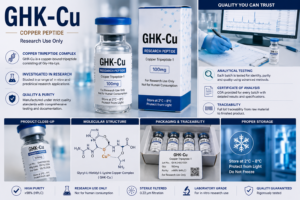
the most useful information often concerns product identity, analytical documentation, purity, lot traceability, packaging, storage, and transparent research-use positioning.
This guide examines those areas while avoiding dosing, injection, reconstitution, or therapeutic instructions.
Research-use notice: This page is intended for educational and research-information purposes. It does not provide instructions for human or veterinary administration and should not be interpreted as medical advice.
What Is GHK-Cu?
GHK refers to the tripeptide glycyl-L-histidyl-L-lysine. The peptide has a strong affinity for copper ions and can form the copper complex commonly referred to as GHK-Cu or copper tripeptide. Scientific publications have investigated this complex in cell cultures, animal models, and other experimental systems.
The term Copper Tripeptide-1 may also appear in scientific, technical, and ingredient-related contexts.
From an SEO and product-information perspective, it is useful to distinguish between:
- GHK — the tripeptide
- GHK-Cu — the copper complex
- Copper peptide — a broader descriptive category
- Copper Tripeptide-1 — a related scientific or ingredient term used in certain contexts
These terms may overlap, but a product page should use precise terminology and clearly identify the exact material being described.
Understanding the GHK-Cu Research Landscape
GHK-Cu has been investigated for decades. Early laboratory studies examined its interaction with fibroblasts, extracellular-matrix components, and connective-tissue processes. Other publications have explored its relationship with collagen synthesis and glycosaminoglycan production in experimental systems.
Reviews have also discussed possible biological mechanisms involving copper binding, gene expression, inflammation-related pathways, oxidative stress, and tissue remodeling. These findings provide research hypotheses, but they should not automatically be translated into guaranteed clinical outcomes.
Research evidence should be interpreted carefully
A result from:
- an in vitro experiment,
- a cell culture,
- an animal model, or
- an exploratory scientific review
does not automatically establish effectiveness or safety in humans.
For that reason, responsible GHK-Cu content should avoid unsupported statements such as:
- “Guaranteed regeneration”
- “Clinically proven anti-aging treatment”
- “Reverses aging”
- “Repairs tissue in humans”
- “Safe for injection”
More accurate research-focused language includes:
- “Investigated in experimental models”
- “Subject of biochemical and preclinical research”
- “Studied for its interaction with copper and cellular processes”
- “Requires careful interpretation when translating preclinical findings”
This distinction supports both scientific credibility and sustainable SEO content.
Why GHK-Cu Product Identity Matters
The product name alone does not establish analytical quality.
A research material should be evaluated using information connected to the specific product and, where applicable, the specific lot.
Important identity considerations may include:
- Exact product name
- Chemical or peptide identity
- Molecular information
- Copper-complex information
- Lot or batch number
- Analytical documentation
- Product presentation
For example, a label stating GHK-Cu 100mg identifies a nominal presentation, but the quantity on its own does not establish:
- purity,
- identity,
- stability,
- analytical quality, or
- suitability for a particular experiment.
Researchers should therefore compare product identity and documentation rather than relying solely on nominal quantity.
GHK-Cu Quality and Analytical Documentation
The phrase GHK-Cu quality should mean more than promotional language.
Terms such as “premium,” “highest quality,” or “ultra-pure” are most meaningful when supported by relevant analytical information.
A quality review may consider several areas.
1. Identity
Does available documentation support the identity of the material?
For a copper-peptide complex, accurate identification of the material and consistency between product specifications and analytical records are especially important.
2. Purity
Is a purity result available, and does the documentation explain the basis of that result?
A purity percentage should not automatically be treated as a complete quality profile.
3. Analytical Methodology
Where available, researchers should review the analytical approach used to generate the reported result.
Depending on the material and documentation, analytical information may involve techniques related to:
- chromatographic analysis,
- mass-based analysis,
- identity confirmation,
- impurity characterization, or
- other relevant quality-control methods.
4. Lot Traceability
Can the physical product be connected to the supporting analytical documentation?
5. Documentation Consistency
The product label, specifications, and supporting records should not contradict one another.
Understanding GHK-Cu Purity
Purity is an important product characteristic, but it should be interpreted in context.
A single number may not answer every relevant question. Researchers may also need to consider:
- Which analytical method was used?
- Does the test correspond to the correct lot?
- What identity information is available?
- Are relevant specifications stated?
- Is there information about impurities or related substances?
- Are product records internally consistent?
Instead of asking only:
“What purity percentage is claimed?”
a stronger research question is:
“What evidence supports the identity and analytical characteristics of this specific material?”
This approach is especially useful when comparing multiple GHK-Cu suppliers or research products.
GHK-Cu Certificate of Analysis
A Certificate of Analysis (COA) can provide useful product information when it is clearly connected to the material being evaluated.
Depending on the product and analytical approach, a COA may include:
- Product identification
- Lot or batch number
- Test date
- Specifications
- Reported results
- Analytical methodology
- Purity information
- Additional relevant analytical observations
How to Review a GHK-Cu COA
Match the lot
The lot or batch number on the documentation should correspond to the physical product.
Review the identity
The material should be clearly identified.
Examine the specifications
Where specifications are provided, distinguish between the acceptance criteria and the reported analytical result.
Review the analytical method
Understanding how a result was obtained provides context for interpreting the data.
Check consistency
Product labels, product descriptions, and analytical documents should align.
A COA should function as a meaningful research record rather than simply as a marketing attachment.
Packaging, Labeling and Traceability
Clear packaging supports product identification and research recordkeeping.
A research-oriented GHK-Cu product may include information such as:
- Product name
- Nominal quantity
- Lot or batch number
- Supplier identification
- Storage information
- Research-use designation where applicable
Traceability can help laboratories connect materials with:
- analytical documentation,
- experimental records,
- inventory systems,
- lot comparisons, and
- reproducibility investigations.
When receiving research material, users should follow their laboratory or institutional procedures for evaluating packaging and documentation.
Potential issues that may require clarification include:
- damaged containers,
- missing identification,
- unclear lot information,
- mismatched documentation, or
- packaging inconsistent with the supplied records.
Packaging integrity alone does not demonstrate clinical safety, regulatory approval, or suitability for a particular use.
GHK-Cu Storage Considerations
Storage information should be based on the documentation associated with the specific product and presentation.
There should not be a universal storage statement copied automatically across every GHK-Cu product page.
Relevant factors may include:
- product presentation,
- formulation,
- packaging,
- stability information,
- supplier documentation, and
- the requirements of the research protocol.
Researchers should follow the current documentation for the exact material being evaluated.
Research records may include:
- receipt date,
- lot number,
- documented storage conditions, and
- relevant handling information.
This page intentionally does not provide reconstitution, injection, or administration instructions.
How to Evaluate a GHK-Cu Supplier
A GHK-Cu supplier should be evaluated using transparent and verifiable information.
Consider the following questions.
Is the product clearly identified?
The product name and specifications should be consistent across the product page, packaging, and available records.
Is lot traceability available?
Where applicable, users should be able to connect a specific product lot with its supporting documentation.
Is analytical information accessible?
Relevant information should be available for review rather than replaced entirely by promotional language.
Are the claims realistic?
Scientific findings should not be transformed into guaranteed human outcomes.
Is research-use positioning clear?
The page should distinguish research material from an approved therapeutic product.
Is storage information product-specific?
Documentation should correspond to the actual material rather than relying on generic instructions copied from another peptide.
Transparency is generally more valuable than exaggerated marketing claims.
Responsible GHK-Cu Research Use
The phrase “for research use” should be accompanied by clear and responsible communication.
Researchers should follow applicable:
- laws and regulations,
- institutional requirements,
- laboratory procedures,
- approved protocols, and
- relevant oversight processes.
Appropriate research planning may involve:
- defining the experimental objective,
- documenting material identity,
- reviewing analytical information,
- maintaining lot traceability,
- establishing suitable controls, and
- recording relevant experimental conditions.
A research-use designation does not itself establish regulatory approval or safety for human administration.
Regulatory and Safety Considerations
Regulatory status depends on the jurisdiction, intended use, and specific product.
For U.S. compounding policy, FDA materials published in 2026 note that GHK-Cu for injectable routes of administration had been removed from Category 2 after nominations were withdrawn, while FDA stated that it intends to consult the Pharmacy Compounding Advisory Committee regarding potential inclusion of GHK-Cu on the 503A bulks list before the end of February 2027. This is a regulatory process update, not approval for medical use.
FDA has also stated that compounded injectable drugs containing GHK-Cu may pose immunogenicity risks associated with aggregation and peptide-related impurities and that human safety data are limited.
For these reasons, responsible website content should avoid claims that GHK-Cu is:
- FDA-approved for injection,
- proven safe for self-administration,
- a guaranteed medical treatment, or
- an established therapy for a disease or condition.
A research-focused product page should prioritize product identity, documentation, analytical information, and applicable limitations.
GHK-Cu Product Specifications Checklist
Before selecting a GHK-Cu research product, consider reviewing:
Product Identity
- Is the exact material clearly identified?
- Are relevant molecular or compositional details available?
Nominal Presentation
- Is the stated product quantity clear?
Analytical Documentation
- Is a COA available?
- Does it correspond to the correct lot?
Purity and Testing
- Is the reported result supported by analytical information?
- Is the testing approach identified where appropriate?
Traceability
- Is a lot or batch number available?
- Can the product be connected to its documentation?
Packaging
- Is the product clearly labeled?
- Is the container and packaging intact?
Storage
- Is current, product-specific storage documentation available?
Research Positioning
- Does the supplier clearly distinguish research information from medical claims?