

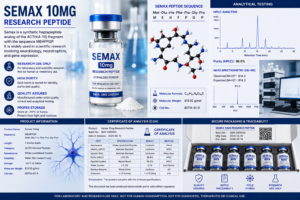
Semax 10mg research peptide is a product category centered on Semax, a synthetic heptapeptide that has been investigated in scientific and preclinical research. A research-focused page should provide clear information about the peptide’s identity, amino-acid sequence, analytical documentation, published scientific literature, and appropriate research-use considerations.
Semax is commonly identified by the amino-acid sequence Met-Glu-His-Phe-Pro-Gly-Pro, abbreviated as MEHFPGP. The U.S. FDA Global Substance Registration System lists Semax as a chemical substance with the molecular formula C37H51N9O10S and a molecular weight of approximately 813.92 g/mol.
Scientific studies have explored Semax in experimental contexts involving neurotrophin-related pathways, gene expression, neurological models, and molecular mechanisms. These studies are important for scientific discussion, but experimental findings should not automatically be presented as established clinical outcomes in humans.
A transparent Semax 10mg research peptide page should therefore focus on several core areas:
- Peptide identity
- Amino-acid sequence
- Molecular characteristics
- Scientific research context
- Analytical testing
- Purity interpretation
- Certificate of Analysis documentation
- Lot traceability
- Responsible research-use language
Research-use notice: Semax 10mg research peptide materials are presented for legitimate scientific and laboratory research. This information does not provide dosing, treatment, reconstitution, or administration instructions for humans or animals.
What Is Semax 10mg Research Peptide?
Semax is a synthetic peptide consisting of seven amino acids. Its sequence is:
Met-Glu-His-Phe-Pro-Gly-Pro
Abbreviated sequence:
MEHFPGP
The FDA substance record identifies Met-Glu-His-Phe-Pro-Gly-Pro as a name associated with Semax and lists its molecular weight as approximately 813.92 g/mol.
The term Semax 10mg research peptide generally refers to a research material described as containing a nominal quantity of 10 milligrams of Semax peptide.
However, the quantity listed on a vial is only one part of product evaluation.
Researchers may also consider:
- Whether the material is clearly identified
- Whether the peptide sequence is documented
- Whether analytical testing is available
- Whether purity is reported
- Whether the documentation is lot-specific
- Whether the physical product can be linked to its analytical records
A research-focused approach places emphasis on identity and documentation, rather than relying solely on a product name or nominal quantity.
Understanding the Semax Peptide Sequence
The molecular identity of a peptide depends heavily on its amino-acid sequence.
The Semax sequence can be represented as follows:
| Position | Amino Acid | Abbreviation |
|---|---|---|
| 1 | Methionine | Met / M |
| 2 | Glutamic acid | Glu / E |
| 3 | Histidine | His / H |
| 4 | Phenylalanine | Phe / F |
| 5 | Proline | Pro / P |
| 6 | Glycine | Gly / G |
| 7 | Proline | Pro / P |
Together, the sequence is:
MEHFPGP
The sequence order is a defining characteristic of the peptide. A change in amino-acid composition or sequence can result in a different molecular entity.
For this reason, consistent documentation is important across:
- Product labels
- Product descriptions
- Certificates of Analysis
- Analytical reports
- Research records
The FDA’s substance record provides a standardized reference point for Semax’s chemical identity and molecular characteristics. However, a substance database entry does not independently verify the quality or identity of every commercial or research sample. Individual lots require their own appropriate documentation.
Semax and ACTH-Derived Peptide Research
Semax is commonly described in scientific literature as a synthetic analogue associated with the ACTH(4–10) region.
Research into ACTH-derived peptides can contribute to investigations involving:
- Peptide structure
- Molecular signaling
- Gene expression
- Neurobiological pathways
- Experimental pharmacology
- Structure–activity relationships
Published studies have investigated Semax in laboratory and animal models. Several studies have examined changes in neurotrophin-related gene expression in rat brain tissue under experimental conditions.
These studies contribute to scientific understanding, but research findings should be interpreted according to their methodology.
For example, a result observed in:
- A cell culture
- An isolated tissue
- An animal model
- A specific experimental injury model
does not automatically predict the same outcome in humans.
This distinction is important for responsible scientific communication and for SEO content that aims to provide useful, accurate information rather than unsupported medical claims.
Why Is Semax Studied?
The Semax 10mg research peptide keyword can support content focused on the broader scientific interest surrounding Semax.
Published research has explored Semax in areas involving:
- Neurotrophin-related research
- Gene-expression studies
- Experimental neurological models
- Molecular signaling
- Peptide biology
- Experimental ischemia models
One published study examined the effects of Semax and its C-terminal peptide fragment PGP on neurotrophin and receptor gene expression in rat brain during experimental incomplete global ischemia. The researchers used real-time RT-PCR to examine changes in neurotrophin-related gene expression.
Another study investigated transcriptional changes involving neurotrophins and their receptors in an experimental rat model of cerebral ischemia.
These findings provide research context, but they should not be converted into claims that Semax is proven to treat, prevent, or cure disease.
A responsible distinction is:
Experimental observation ≠ established clinical outcome
Likewise:
- A molecular mechanism does not automatically establish therapeutic effectiveness.
- Animal research is not automatically equivalent to human evidence.
- Analytical purity does not establish clinical safety.
- Scientific interest does not equal regulatory approval.
Semax and Neurotrophin Research
Neurotrophins are proteins involved in nervous-system biology. Research involving Semax has included investigation into changes in genes associated with neurotrophin signaling.
Published work has examined genes including:
- BDNF — brain-derived neurotrophic factor
- NGF — nerve growth factor
- Neurotrophin receptors such as Trk-related receptors
A study published in Neuroscience Letters examined neurotrophin gene expression in rat brain after experimental Semax exposure and reported region-specific changes in NGF and BDNF expression.
Other studies investigated neurotrophin and receptor expression following experimental cerebral ischemia in rats.
These studies are relevant to understanding why Semax has remained a subject of scientific interest.
However, gene-expression changes should be interpreted carefully.
An increase or decrease in expression of a particular gene does not, by itself, establish:
- A clinical benefit
- Long-term safety
- A specific therapeutic outcome
- Regulatory approval
The biological significance of a molecular observation depends on the broader experimental context.
Semax 10mg Research Peptide and Experimental Models
Preclinical research often uses controlled models to investigate biological questions.
Semax-related studies have included experimental work involving animal neurological models and molecular analysis.
Researchers may use methods such as:
- Real-time PCR
- Gene-expression analysis
- Protein analysis
- Molecular pathway studies
- Tissue analysis
- Experimental animal models
One study examined temporal changes in NGF and BDNF gene expression in different regions of rat brain and retina following Semax exposure.
These studies can help generate hypotheses about biological mechanisms.
However, research results can vary according to:
- Species
- Experimental conditions
- Tissue type
- Timing
- Study design
- Analytical methodology
- Control groups
- Statistical methods
For this reason, a scientific product page should accurately describe published findings as experimental, preclinical, or mechanistic research where appropriate.
Semax 10mg Peptide Identity
Product quality begins with correctly identifying the intended material.
For a Semax 10mg research peptide, useful product information may include:
- Product name
- Peptide sequence
- Molecular characteristics
- Product form
- Nominal quantity
- Lot number
- Analytical documentation
The expected Semax sequence is:
Met-Glu-His-Phe-Pro-Gly-Pro
The FDA substance record lists this sequence as a name associated with Semax and provides additional chemical identity information.
A research supplier should avoid confusing:
Substance identity
with:
Verification of a specific product lot.
A standardized database may define what Semax is, while analytical testing and documentation are used to evaluate characteristics of a particular sample.
Understanding Semax Purity
Semax purity is an important quality-related search term, but purity should not be considered in isolation.
A reported purity value is generally based on a specific analytical method.
For example:
Purity specification: ≥95%
is different from:
Reported analytical result: 97.8%
The first describes an acceptance criterion. The second describes the reported result for a tested sample.
When reviewing Semax purity information, useful questions include:
- Which analytical method was used?
- Does the result correspond to a specific lot?
- Is the test date available?
- Is identity evaluated separately?
- Are the product and documentation clearly connected?
A more complete quality assessment considers:
Identity + purity + analytical method + documentation + lot traceability
This is more informative than relying exclusively on a single purity percentage.
Semax HPLC Analysis
High-performance liquid chromatography, or HPLC, is widely used in analytical chemistry and may be part of a peptide-testing strategy.
Depending on the method, HPLC can help characterize:
- Sample composition
- Chromatographic separation
- Relative peak areas
- Reported purity
A chromatogram may contain a major peak along with additional smaller peaks.
However, interpretation depends on the analytical conditions.
Relevant documentation may include:
- Sample identification
- Lot number
- Method information
- Detection conditions
- Chromatographic profile
- Reported analytical result
A strong Semax 10mg research peptide product page can explain what HPLC analysis is without suggesting that chromatography alone proves every aspect of product quality.
Analytical claims should always be linked to the actual documentation for the specific material where possible.
Mass Spectrometry and Peptide Identity
Mass spectrometry is another analytical technique that may support peptide characterization.
Depending on the method, mass analysis can provide information related to:
- Molecular mass
- Expected molecular characteristics
- Observed mass signals
- Sample identity
The FDA substance record lists Semax with a molecular weight of approximately 813.92 g/mol.
HPLC and mass spectrometry can provide different types of analytical information.
HPLC
May help evaluate chromatographic composition and relative purity according to the specific method.
Mass Spectrometry
May help support molecular characterization using mass-based measurements.
These approaches can be complementary.
However, analytical results should be interpreted within the limitations of the methods used.
Semax COA and Certificate of Analysis
A Semax COA, or Certificate of Analysis, is documentation associated with a tested material.
Depending on the testing process, a COA may include:
- Product identification
- Lot or batch number
- Test date
- Analytical method
- Specification
- Analytical result
- Reported purity
- Additional testing information
The most useful analytical documentation is generally lot-specific.
This means the lot number on the physical product can be connected to the corresponding analytical report.
For example:
Product vial: Lot SX-001
↓
Certificate of Analysis: Lot SX-001
↓
Analytical report: Lot SX-001
This creates a clearer chain of documentation.
A generic COA that cannot be linked to the actual material provides less useful information for traceability.
Lot Traceability and Research Documentation
Lot traceability can help researchers organize experimental materials and records.
A laboratory may document:
- Product name
- Peptide sequence
- Supplier
- Lot number
- Date received
- Analytical documentation
- Storage records
- Experimental project
This creates a connection between:
Research material → Analytical documentation → Experimental records
Traceability can be useful when comparing experimental outcomes across projects.
If different results are observed, researchers may review variables such as:
- Different lots
- Different materials
- Changes in experimental conditions
- Storage history
- Analytical documentation
Lot traceability does not eliminate scientific variability, but it can help make research records more systematic.
Storage and Laboratory Documentation
Storage information should be based on the current documentation associated with the specific material.
Relevant factors may include:
- Product form
- Packaging
- Stability data
- Supplier documentation
- Laboratory procedures
Researchers may maintain records of:
- Date received
- Lot number
- Storage location
- Storage history
- Associated analytical documents
Generic online recommendations should not replace validated laboratory procedures or product-specific documentation.
This page does not provide instructions for reconstitution, dosing, injection, intranasal administration, or other human or veterinary use.
Regulatory and Research-Use Considerations
Regulatory status can vary between jurisdictions and may change over time.
In the United States, Semax-related bulk drug substances were discussed by the FDA’s Pharmacy Compounding Advisory Committee in July 2026 in connection with possible inclusion on the 503A Bulks List. The substances discussed included Semax free base and Semax acetate.
FDA materials describing this process distinguish consideration for the 503A Bulks List from FDA drug approval. Inclusion discussions, advisory processes, or compounding evaluations should not be represented as proof that a substance is an FDA-approved drug.
For current U.S. regulatory information, consult the FDA’s July 2026 Pharmacy Compounding Advisory Committee materials.
A responsible Semax research page should avoid unsupported statements such as:
- “FDA-approved Semax”
- “Clinically proven treatment”
- “Guaranteed results”
- “Safe for human administration”
- “Proven to cure neurological disease”
Scientific literature and analytical documentation should be presented according to the level of evidence they actually provide.
How to Evaluate a Semax 10mg Research Peptide
Researchers evaluating documentation may consider the following checklist.
1. Confirm the Peptide Identity
Does the product clearly identify Semax?
2. Review the Sequence
Does the documentation identify the expected sequence:
MEHFPGP
3. Check the Lot Number
Can the physical material be connected to its analytical records?
4. Review Analytical Documentation
Is a Certificate of Analysis or equivalent analytical report available?
5. Examine Purity in Context
Is the reported purity associated with an analytical method and specific lot?
6. Look for Identity Support
Is molecular characterization addressed separately from chromatographic purity?
7. Check Documentation Consistency
Do the product label, lot number, COA, and analytical information correspond?
This type of evaluation can support better research documentation without making unsupported assumptions about clinical suitability.