
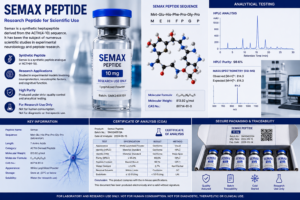
The Semax peptide is a synthetic heptapeptide that has attracted scientific interest in neurobiology, molecular signaling, peptide chemistry, and experimental neurological research. Its amino-acid sequence is Met-Glu-His-Phe-Pro-Gly-Pro, commonly abbreviated as MEHFPGP.
A research-focused discussion of Semax should distinguish between three separate areas:
- Scientific identity — what the peptide is chemically.
- Experimental research — what published studies have investigated.
- Product quality — how identity, purity, and lot-specific documentation may be evaluated.
The FDA’s substance record identifies Semax as a chemical substance with the molecular formula C37H51N9O10S and a molecular weight of approximately 813.92 g/mol.
Scientific studies have investigated Semax in experimental models involving neurotrophic signaling, gene expression, behavioral processes, and neurological injury models. These findings should be interpreted according to the specific experimental system used. Results from animal, cellular, or laboratory research do not automatically establish clinical safety or therapeutic effectiveness in humans.
Research-use notice: This page is intended for scientific and laboratory information. It does not provide medical advice, dosing instructions, reconstitution procedures, or instructions for human or veterinary administration.
What Is Semax Peptide?
Semax is a synthetic peptide commonly described in scientific literature as an analogue associated with the ACTH(4–10) region.
Its sequence is:
Met-Glu-His-Phe-Pro-Gly-Pro
Abbreviated sequence:
MEHFPGP
The sequence contains seven amino acids:
| Position | Amino Acid | Abbreviation |
|---|---|---|
| 1 | Methionine | Met / M |
| 2 | Glutamic acid | Glu / E |
| 3 | Histidine | His / H |
| 4 | Phenylalanine | Phe / F |
| 5 | Proline | Pro / P |
| 6 | Glycine | Gly / G |
| 7 | Proline | Pro / P |
The exact order of amino acids is an essential component of peptide identity. Changes to the sequence may result in a chemically different peptide with different physical or biological characteristics.
The FDA substance database lists Met-Glu-His-Phe-Pro-Gly-Pro among the names and synonyms associated with Semax.
For research purposes, clear identification is important because product names alone may not always provide sufficient information about the precise material being evaluated.
Understanding the Semax Peptide Sequence
The Semax sequence, MEHFPGP, is a useful scientific keyword because researchers may search for the peptide using either its common name or its amino-acid sequence.
A well-documented research material may identify:
- Peptide name
- Amino-acid sequence
- Molecular formula
- Molecular weight
- Lot or batch number
- Analytical documentation
Maintaining consistency between these records can support traceability.
For example, the following information should ideally correspond:
Product label
↓
Product description
↓
Certificate of Analysis
↓
Analytical results
↓
Lot number
This type of documentation does not itself establish biological activity or clinical suitability. However, it can help researchers verify that analytical records are associated with the material being studied.
Semax and ACTH-Derived Peptide Research
Semax is commonly described as a synthetic analogue related to the ACTH(4–10) fragment.
Research involving ACTH-derived peptides can contribute to broader investigations into:
- Peptide structure
- Molecular signaling
- Structure–activity relationships
- Neurobiological processes
- Gene expression
- Experimental pharmacology
Published studies have examined Semax in a variety of laboratory and preclinical contexts. For example, research has investigated interactions with neurotrophin-related pathways and changes in brain-derived neurotrophic factor, or BDNF, in experimental systems.
These findings are scientifically relevant for understanding research hypotheses and molecular mechanisms. However, a responsible scientific summary should avoid converting experimental observations directly into claims of established human benefits.
A proposed biological mechanism is not the same as:
- Clinical efficacy
- Regulatory approval
- Established safety
- A recommended medical use
Why Is Semax Studied?
The
across several scientific areas.
Research topics include:
- Neurobiological signaling
- Neurotrophin-related pathways
- Gene expression
- Experimental neurological injury
- Behavioral research
- Molecular interactions
- Peptide chemistry
One experimental study reported that Semax specifically interacted with components of rat basal forebrain tissue and examined changes in BDNF protein levels.
Other research has explored Semax in behavioral and neurochemical models in laboratory animals.
Additional in vitro research has examined Semax in artificial membrane models involving copper-induced amyloid-beta aggregation. Such work is useful for studying molecular interactions, but in vitro findings should not be presented as evidence of clinical treatment outcomes.
The diversity of these studies helps explain why Semax remains a subject of scientific interest. At the same time, each experiment has its own limitations, methodology, and research context.
Semax and Neurotrophin Research
Neurotrophins are proteins involved in the development, maintenance, and function of nervous-system cells.
Scientific interest in Semax has included research involving:
- BDNF
- Neurotrophin-related signaling
- Receptor interactions
- Experimental brain models
A published study in rat basal forebrain tissue investigated Semax and reported findings involving BDNF protein levels.
This type of work can help researchers formulate questions about peptide signaling and molecular pathways.
However, scientific interpretation requires context.
The outcome of a study may depend on factors such as:
- Species
- Experimental model
- Tissue type
- Exposure conditions
- Timing
- Analytical methodology
- Control groups
- Statistical design
For this reason, a finding observed in one laboratory system should not automatically be generalized to all organisms or clinical settings.
Semax Peptide and Experimental Molecular Research
Peptide research often investigates what happens at the molecular level following interaction with a biological system.
Researchers may use methods such as:
- Gene-expression analysis
- Protein analysis
- Chromatography
- Mass spectrometry
- Cell-based assays
- Animal models
- Molecular imaging
Experimental Semax studies have explored changes involving neurobiological and neurochemical processes.
These investigations can contribute to scientific understanding, but it is important to distinguish between:
Mechanistic research
This investigates possible molecular or biological processes.
Preclinical research
This may involve laboratory, cell, tissue, or animal models.
Clinical research
This involves research in human participants and requires a different level of evidence and regulatory oversight.
A strong research-information page should clearly identify which category a cited study belongs to.
Semax Peptide Quality: Why Identity Matters
For a Semax peptide research product, quality evaluation should begin with identity.
The material should be consistently described across documentation.
Important information may include:
- Semax peptide name
- MEHFPGP sequence
- Product form
- Lot or batch number
- Molecular characteristics
- Analytical testing
The FDA’s substance record provides a standardized chemical identity for Semax, including its molecular formula and molecular weight.
For research organizations and laboratories, this information can be useful when comparing:
- Product documentation
- Supplier records
- Analytical reports
- Experimental materials
However, a substance database entry identifies the chemical substance; it does not automatically verify the identity or quality of a particular commercial sample.
Each individual research lot requires its own relevant documentation.
Understanding Semax Peptide Purity
Semax peptide purity is a commonly used quality term.
A purity value generally reflects the result of a specific analytical method. For example, chromatography may be used to separate components within a sample and estimate relative composition.
However, a purity percentage should not be evaluated in isolation.
If a document states:
Purity: 99%
useful questions include:
- Which analytical method was used?
- Is the result associated with a specific lot?
- How was the result calculated?
- What impurities were detected or evaluated?
- Is peptide identity separately supported?
A more complete evaluation considers:
Identity + purity + analytical method + documentation + lot traceability
rather than relying only on a single percentage.
This distinction is especially important for SEO content because phrases such as “high purity” should be supported by actual product-specific analytical documentation rather than used as unsupported marketing language.
HPLC Analysis and Semax
High-performance liquid chromatography, commonly called HPLC, is widely used in analytical chemistry and peptide characterization.
Depending on the analytical method, HPLC may help evaluate:
- Separation of sample components
- Chromatographic profiles
- Relative composition
- Reported purity
An HPLC chromatogram may display a major peak and additional smaller peaks.
However, the interpretation of a chromatogram depends on the analytical method.
Relevant information may include:
- Column type
- Mobile phase
- Gradient conditions
- Detection wavelength
- Sample preparation
- Analytical calculation method
A chromatogram can provide valuable information about the tested sample, but it should be interpreted within the limits of the method used.
For this reason, a research supplier discussing Semax HPLC analysis should ideally connect analytical data to the relevant lot or batch.
Mass Spectrometry and Semax Identity
Mass spectrometry can provide additional information relevant to molecular characterization.
Depending on the method, analysis may compare:
- Expected molecular mass
- Observed molecular mass
- Molecular ion information
- Other sample characteristics
The FDA substance record identifies Semax with a molecular weight of approximately 813.92 g/mol.
HPLC and mass spectrometry can provide complementary information.
HPLC
May help characterize chromatographic composition and relative purity according to the method.
Mass spectrometry
May help support molecular identity through mass-based analysis.
Neither analytical result should be interpreted beyond the scope of the method used.
For quality-focused content, it is more accurate to describe these methods as components of an analytical testing strategy rather than claiming that a single test establishes every characteristic of a product.
Semax COA: Certificate of Analysis
A Semax COA, or Certificate of Analysis, is a document containing selected information about a tested sample or lot.
Depending on the testing program, a COA may include:
- Product identification
- Lot number
- Analytical tests
- Specifications
- Reported results
- Purity information
- Analytical methods
- Test date
The most useful documentation is generally lot-specific.
This means the lot number shown on the analytical documentation corresponds to the physical research material.
Specifications vs Results
It is important to distinguish between these terms.
Specification
A specification describes an acceptance criterion.
For example:
Purity specification: ≥95%
Result
The result is the measured analytical outcome for the tested sample.
For example:
Reported result: 97.8%
A specification alone does not demonstrate the measured characteristics of every batch.
Researchers reviewing a Semax COA should look for the actual analytical result associated with the relevant lot.
Lot Traceability and Research Documentation
Lot traceability helps create a connection between:
Research material → Analytical documentation → Experimental records
A laboratory may record:
- Product name
- Peptide sequence
- Supplier
- Lot number
- Date received
- COA reference
- Analytical documentation
- Experimental project
This information can support research reproducibility and organization.
For example, if experimental outcomes differ between two projects, researchers may review whether:
- Different lots were used
- Different analytical documentation applied
- Storage histories differed
- Other experimental variables changed
Lot traceability does not eliminate scientific variability, but it can help researchers identify and document relevant variables.
Semax Peptide Regulatory Considerations
Regulatory status depends on the jurisdiction and may change over time.
In the United States, FDA materials state that neither Semax free base nor Semax acetate is a component of an FDA-approved drug, and FDA has considered these substances in the context of its 503A bulk-drug-substance evaluation process.
The FDA’s July 2026 Pharmacy Compounding Advisory Committee meeting included discussion of Semax-related bulk drug substances. Such committee discussions and recommendations are distinct from FDA drug approval.
For current U.S. regulatory information, readers can consult the FDA’s Semax-related meeting materials and the FDA guidance on checking drug approval status.
A responsible product page should avoid unsupported statements such as:
- “FDA-approved Semax”
- “Clinically proven treatment”
- “Guaranteed therapeutic effects”
- “Safe for human administration”
Analytical testing and scientific interest do not, by themselves, establish clinical safety, efficacy, or regulatory approval.
How to Evaluate Semax Research Documentation
A structured review may include the following questions.
1. Is the Material Clearly Identified?
The product should clearly state that the material is Semax and, where relevant, identify the MEHFPGP sequence.
2. Is the Lot Number Available?
The physical product should be traceable to relevant documentation.
3. Is Analytical Documentation Available?
A COA or other analytical report can provide information about the tested sample.
4. Is Purity Reported as an Actual Result?
Distinguish between a specification and a measured result.
5. What Analytical Methods Were Used?
Review available information regarding HPLC, mass spectrometry, or other analytical techniques.
6. Is Identity Addressed Separately?
Purity and identity are related but distinct analytical concepts.
7. Is Documentation Consistent?
Product labels, COAs, and analytical reports should not contain unexplained discrepancies.
Storage and Research Handling Considerations
Storage conditions should follow the current documentation supplied with the specific research material.
Relevant factors may include:
- Product form
- Packaging
- Stability information
- Supplier documentation
- Applicable institutional procedures
Researchers may maintain records of:
- Date received
- Lot number
- Storage history
- Relevant product documentation
Generic online storage advice should not replace product-specific documentation, validated laboratory procedures, or institutional requirements.
This page does not provide instructions for dosing, preparation for administration, or use in humans or animals.