

Bacteriostatic Water: Complete Guide to Uses, Quality and Storage
Introduction
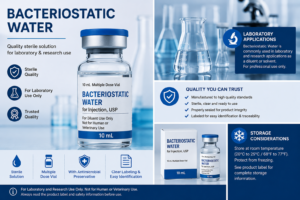
Bacteriostatic Water is a specialized sterile pharmaceutical water preparation distinguished by the presence of a suitable antimicrobial preservative. For laboratories, research environments, pharmaceutical professionals, and informed buyers, understanding the difference between product names, formulations, packaging, quality documentation, and storage instructions is essential before selecting a product.
This guide explains what Bacteriostatic Water is, how it differs from Sterile Water for Injection, what to look for when evaluating quality, and how to review product documentation responsibly. It is intended as educational and product-selection information. It does not provide dosing, reconstitution, or administration instructions, and product use must always follow the manufacturer’s labeling, applicable regulations, and qualified professional guidance.
What Is Bacteriostatic Water?
Bacteriostatic Water for Injection is prepared from Water for Injection, sterilized and suitably packaged, with one or more suitable antimicrobial agents added. The preservative helps distinguish bacteriostatic preparations from sterile water products that contain no antimicrobial agent or other added substance.
The word bacteriostatic describes the role of the preservative in limiting bacterial growth under the conditions for which the product is formulated and labeled. It does not mean that every vial has the same composition, preservative, presentation, intended application, or post-opening instructions. Always verify the exact product label.
Commercially labeled products may use different vial sizes and presentations. Some official labels for Bacteriostatic Water for Injection describe multiple-dose containers and identify benzyl alcohol as the preservative, but the exact formulation and concentration must be confirmed from the specific manufacturer’s documentation rather than assumed from the product category alone.
What Makes Bacteriostatic Water Different?
The key distinction is formulation. Sterile Water for Injection is prepared from Water for Injection, sterilized, and suitably packaged without an antimicrobial agent or other added substance. Bacteriostatic Water for Injection includes one or more suitable antimicrobial preservatives.
That difference can affect product selection, compatibility, labeling, and intended use. A buyer should therefore avoid treating the terms Bacteriostatic Water, Sterile Water, and Water for Injection as interchangeable. Each product should be evaluated according to its official label, formulation, intended application, and relevant quality requirements.
Bacteriostatic Water vs Sterile Water
| Feature | Bacteriostatic Water | Sterile Water for Injection |
|---|---|---|
| Base material | Water for Injection | Water for Injection |
| Antimicrobial preservative | Contains suitable preservative(s) | No antimicrobial agent or other added substance |
| Packaging | Depends on the applicable product and label | Typically supplied according to its applicable monograph and labeling |
| Product selection | Requires review of preservative and compatibility information | Requires review of intended use and product labeling |
The table is a high-level comparison, not a substitute for a manufacturer’s instructions. When compatibility or suitability matters, consult the product’s current documentation and the requirements governing the intended procedure.
How Bacteriostatic Water Is Used in Laboratory and Professional Settings
Searches for Bacteriostatic Water for Research and Bacteriostatic Water for Laboratory Use often reflect a need for a clearly documented sterile aqueous preparation. In professional settings, selection decisions may involve formulation review, material compatibility, packaging format, traceability, and procedural requirements.
For research or analytical workflows, a suitable product should be selected according to the validated method, protocol, material requirements, and applicable institutional controls. A sterile pharmaceutical preparation should not automatically be considered suitable for every laboratory procedure, just as a laboratory-grade material should not automatically be treated as suitable for regulated pharmaceutical use.
Where a specific diluent or solvent is required, the governing protocol and relevant product documentation should define the acceptable material. Do not substitute one water preparation for another simply because the names appear similar.
Understanding Bacteriostatic Water Quality
Bacteriostatic Water Quality is more than the appearance of a vial. A meaningful evaluation considers the complete product record and the information needed to establish identity, condition, and suitability for the intended application.
1. Clear Product Identity
The product name should be specific enough to distinguish the preparation from other sterile waters. Review the complete label, including the formulation statement and any preservative information.
2. Formulation Information
Check the ingredients and preservative listed for the exact product. Do not assume that every product marketed under a similar category uses the same concentration or formulation.
3. Packaging Integrity
Examine the vial, closure, seal, and outer packaging. Damaged containers, compromised seals, leakage, cloudiness, visible particles, or unexplained changes in appearance are reasons to stop and follow the manufacturer’s instructions.
4. Traceability
Lot or batch identification and expiration information support inventory control and traceability. For professional purchasing, these details can also help connect the physical product with supporting documentation.
5. Documentation
Depending on the supplier and application, relevant documentation may include a certificate of analysis, specifications, lot information, storage guidance, safety information, or other quality records. The appropriate document set depends on the intended use and regulatory context.
What to Look for in a Bacteriostatic Water Supplier
When searching for a Bacteriostatic Water Supplier or evaluating Bacteriostatic Water Online, prioritize transparency over marketing language.
Ask practical questions:
- Is the product identity clearly stated?
- Is the vial size and presentation accurately described?
- Are formulation and preservative details available?
- Is lot or batch information traceable where appropriate?
- Are storage conditions clearly provided?
- Is the intended application described without unsupported claims?
- Can relevant product documentation be reviewed?
A trustworthy product page should make it easier to verify facts rather than relying on vague statements such as “premium,” “medical grade,” or “highest quality” without supporting specifications. Clear labeling, consistent technical information, and accessible documentation provide more useful signals for buyers than promotional language alone.
Packaging and Storage Considerations
Proper packaging supports product integrity during transport, storage, and handling. Storage requirements can vary by product, so the label and manufacturer documentation always take priority.
For example, current DailyMed labels for certain Bacteriostatic Water products specify controlled room-temperature storage, while another current label provides additional instructions after opening. These examples demonstrate why a universal storage rule should not be applied to every product. Review the exact label associated with the vial you are evaluating.
General handling considerations include keeping the product in its recommended conditions, protecting it as directed, checking packaging integrity before use, and following institutional procedures for controlled materials. Do not rely on a generic article to determine an individual product’s shelf life or discard period.
Product Specifications at a Glance
Before purchasing or using a product, review:
- Product name and exact presentation
- Vial volume
- Complete formulation and preservative information
- Lot or batch identification
- Expiration or other applicable dating information
- Storage and handling requirements
- Container and closure condition
- Intended application and labeling limitations
- Available quality or technical documentation
For a 10 mL product, the phrase Bacteriostatic Water 10 mL can help users locate a specific presentation, but volume alone does not establish formulation or suitability. The complete label remains the controlling source for product-specific information.
How to Compare Products Responsibly
When comparing products online, use a consistent checklist. Start with the exact product identity, then compare vial size, formulation, preservative information, documentation, storage requirements, and intended application. Avoid comparing products solely by price or by the presence of a familiar keyword.
It is also useful to separate verified specifications from assumptions. If a detail is not available on the label or in supplier documentation, request clarification instead of inferring that the product matches another brand or presentation.
For Research
, suitability should be determined by the specific research protocol and quality requirements. Product pages should not imply that a preparation is appropriate for an application that is not supported by its labeling or documentation.