

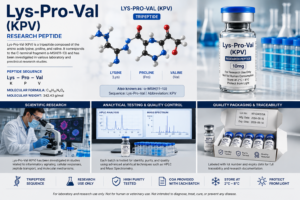
Lys-Pro-Val, commonly abbreviated as KPV, is a tripeptide composed of the amino acids lysine, proline, and valine. It is associated with the C-terminal fragment α-MSH(11–13) and has been investigated in laboratory and preclinical research.
As interest in short peptides and peptide-derived sequences has expanded, Lys-Pro-Val has become a topic of scientific discussion in areas involving cellular signaling, inflammatory models, peptide transport, and molecular mechanisms.
A reliable scientific overview should distinguish clearly between:
- Molecular identity
- Experimental research
- Preclinical evidence
- Human clinical evidence
- Product quality and analytical documentation
This article provides a research-focused overview of Lys-Pro-Val (KPV) and does not provide medical advice, dosing, injection, reconstitution, or instructions for human or veterinary administration.
What Is Lys-Pro-Val?
Lys-Pro-Val is a peptide consisting of three amino acids:
- Lys — Lysine
- Pro — Proline
- Val — Valine
The standard abbreviation is:
KPV
KPV is also described as α-MSH(11–13) because it corresponds to the C-terminal three-amino-acid sequence associated with alpha-melanocyte-stimulating hormone (α-MSH).
The sequence can be represented as:
Lys–Pro–Val
or:
K–P–V
Its small size and relationship to α-MSH have contributed to ongoing scientific interest in its biological properties.
Understanding the KPV Peptide Sequence
Peptides are short chains of amino acids connected through peptide bonds. The Lys-Pro-Val sequence contains three distinct amino acids arranged in a specific order.
Lysine
Lysine is represented by the single-letter abbreviation K.
Proline
Proline is represented by P.
Valine
Valine is represented by V.
Together, these amino acids form:
KPV
The sequence order matters. Changing the arrangement of amino acids creates a different peptide with potentially different chemical and biological characteristics.
For research and product documentation, accurate sequence identification is therefore important.
Lys-Pro-Val and α-MSH(11–13)
Lys-Pro-Val is commonly discussed because of its relationship to α-MSH.
Alpha-melanocyte-stimulating hormone is a peptide that has been extensively investigated for biological activity. Researchers studying shorter fragments of α-MSH identified the C-terminal sequence represented by KPV.
This relationship is why scientific literature may use several related terms when referring to the same or closely related research topic:
- Lys-Pro-Val
- KPV
- KPV peptide
- α-MSH(11–13)
- α-MSH-derived peptide
Using these terms naturally throughout a scientific article helps clarify the relationship between the molecular sequence and the broader research context.
Why Is Lys-Pro-Val Studied?
Researchers have investigated Lys-Pro-Val because short peptide fragments can provide useful information about structure–activity relationships and biological signaling.
Experimental research has explored KPV in areas such as:
- Cellular signaling
- Inflammatory models
- Cytokine-related research
- Peptide transport
- Molecular mechanisms
- Skin and epithelial cell research
- Experimental antimicrobial activity
These areas represent research topics rather than established clinical applications.
A laboratory observation involving KPV may provide useful information for future research, but results from one model do not automatically predict results in another.
For example:
- A cell study is not the same as a human clinical trial.
- An animal model is not proof of human effectiveness.
- A molecular mechanism is not automatically a therapeutic outcome.
Maintaining these distinctions improves both scientific accuracy and the long-term credibility of research-focused content.
The Lys-Pro-Val Research Landscape
The scientific literature surrounding Lys-Pro-Val includes experimental studies examining how KPV behaves in different biological systems.
Researchers have investigated questions such as:
- Does KPV produce measurable effects in specific cell models?
- How does KPV compare with larger α-MSH-derived peptides?
- Which molecular pathways may be involved?
- How is KPV transported across particular biological systems?
- Does biological activity vary depending on the experimental model?
The answers can depend heavily on experimental conditions.
Variables may include:
- Cell type
- Experimental model
- Peptide concentration
- Exposure duration
- Analytical methods
- Experimental controls
Because of these variables, research findings should always be interpreted within the context of the individual study.
Lys-Pro-Val and Cellular Signaling Research
Cellular signaling is one of the areas where KPV has attracted scientific attention.
Researchers use cellular models to investigate how peptides may influence:
- Intracellular signaling
- Gene expression
- Protein activity
- Cellular communication
- Molecular pathways
Studies involving KPV have examined signaling processes associated with inflammation and cellular responses.
However, the biological mechanisms associated with KPV remain an area of scientific investigation.
This means responsible scientific language should use phrases such as:
- “KPV has been investigated for…”
- “Experimental studies have explored…”
- “Researchers have examined…”
- “The mechanism remains under investigation.”
Avoid transforming preliminary experimental findings into statements of established medical benefit.
KPV and Peptide Transport Research
Another area of interest involves how small peptides may move through biological systems.
Peptide transport can influence:
- Cellular uptake
- Distribution in experimental models
- Exposure to specific cell types
- Experimental outcomes
Research has explored whether transport mechanisms may play a role in KPV activity in particular biological systems.
Understanding peptide transport can be important because a peptide’s biological activity depends not only on its chemical structure but also on whether and how it reaches a relevant experimental target.
Transport findings from one model should not automatically be generalized across all tissues or organisms.
KPV and Experimental Inflammation Research
KPV has been investigated in experimental models related to inflammatory signaling.
These studies have contributed to scientific discussion surrounding:
- Cytokine signaling
- NF-κB-related pathways
- Cellular inflammatory responses
- α-MSH-derived peptide activity
Experimental results have generated hypotheses about potential molecular mechanisms.
However, it is important to distinguish:
Experimental observation from clinical evidence.
A finding in a controlled laboratory system may be valuable for scientific research but does not, by itself, establish that KPV is safe or effective for treating a disease in humans.
Lys-Pro-Val Research Quality and Product Identity
For laboratory research, scientific outcomes depend partly on the quality and characterization of the materials being studied.
A Lys-Pro-Val research product should be clearly identified.
Relevant product information may include:
- Product name
- Peptide sequence
- Chemical identity
- Nominal quantity
- Lot or batch number
- Analytical specifications
Researchers should verify that the information provided across product labels and documentation is consistent.
For example, a Certificate of Analysis should be capable of being connected to the corresponding product lot.
Clear identification helps support:
- Experimental reproducibility
- Inventory management
- Batch comparison
- Research documentation
Understanding Lys-Pro-Val Purity
Peptide purity is often an important consideration when evaluating research materials.
However, purity should not be viewed as the only quality indicator.
A reported purity value may be more meaningful when considered alongside:
- Analytical methodology
- Identity confirmation
- Lot-specific results
- Related substances or impurities
- Documentation consistency
Potential analytical methods may include:
- Chromatographic analysis
- Mass spectrometry
- Identity testing
- Impurity characterization
The analytical approach should be appropriate for the material and the intended research application.
Instead of relying only on a percentage, researchers can ask:
What analytical information supports the identity and characteristics of this specific Lys-Pro-Val material?
Analytical Testing for Lys-Pro-Val
Analytical testing can provide useful information about a peptide’s characteristics.
Depending on the testing strategy, documentation may address:
Identity
Does the material correspond to the expected Lys-Pro-Val sequence?
Purity
What does the selected analytical method indicate about the composition of the material?
Molecular Characterization
Are molecular characteristics consistent with the expected peptide?
Lot-Specific Analysis
Can the analytical results be linked to the exact lot being used in research?
These questions are particularly important when comparing materials across different suppliers or experimental batches.
A general statement such as “lab tested” is less informative than documentation that identifies:
- What was tested
- Which method was used
- What result was obtained
- Which lot was analyzed
Lys-Pro-Val Certificate of Analysis
A Certificate of Analysis (COA) can provide structured information about a research material.
Depending on the supplier and testing program, a COA may include:
- Product identification
- Lot number
- Test specifications
- Analytical results
- Purity information
- Test date
- Analytical methods
How to Review a COA
Confirm Product Identity
The product name and sequence should correspond to the physical material.
Verify the Lot Number
The lot number should connect the analytical document with the specific product.
Compare Results With Specifications
A specification describes the expected acceptance criteria.
A result describes the measured outcome.
Review Method Information
Understanding the analytical method provides important context for interpreting the result.
Lot Traceability and Product Documentation
Lot traceability supports organized scientific research.
A research product may include:
- Product identification
- Lot number
- Nominal quantity
- Storage information
- Supporting analytical documentation
Traceability can help researchers:
- Document experimental materials
- Compare different lots
- Investigate unexpected results
- Maintain inventory records
Potential concerns include:
- Missing lot numbers
- Conflicting product names
- Incomplete documentation
- Analytical records that cannot be connected to the material
Packaging and labeling alone should not be interpreted as evidence of therapeutic safety or regulatory approval.
Storage Considerations
Storage requirements can vary according to the specific product.
Relevant factors may include:
- Product form
- Packaging
- Formulation
- Stability information
- Manufacturer documentation
For research purposes, storage and handling should follow the current instructions associated with the specific product and applicable laboratory procedures.
Good research documentation may include:
- Date received
- Lot number
- Documented storage conditions
- Handling records
Generic storage recommendations found online should not automatically replace product-specific documentation.
This article does not provide instructions for reconstitution, injection, or administration.
Research-Use Considerations
Lys-Pro-Val (KPV) should be discussed responsibly within the context of its intended scientific use.
Researchers may consider:
- Clearly defining the experimental objective
- Confirming product identity
- Reviewing available analytical documentation
- Recording lot information
- Establishing appropriate experimental controls
- Following institutional laboratory procedures
- Complying with applicable regulations
Research-use information does not establish that a material is:
- Approved for human use
- Approved for veterinary use
- Clinically proven
- Safe for self-administration
- A treatment for a disease
Scientific research and medical approval are different processes.