

The Semax peptide sequence is a key identifier used in scientific literature, peptide chemistry, analytical documentation, and research databases. Semax is a synthetic heptapeptide, meaning that its primary sequence contains seven amino-acid residues.
The sequence is:
Met-Glu-His-Phe-Pro-Gly-Pro
Using one-letter amino-acid notation:
MEHFPGP
The U.S. FDA Global Substance Registration System and PubChem identify Semax with this sequence. The free-base peptide is listed with the molecular formula C₃₇H₅₁N₉O₁₀S and a molecular weight of approximately 813.92–813.93 g/mol.
Understanding the Semax peptide sequence is useful for several scientific purposes, including:
- Confirming peptide identity
- Comparing research materials
- Reviewing analytical documentation
- Understanding amino-acid composition
- Interpreting mass-spectrometry data
- Reviewing peptide-related literature
- Supporting lot and sample traceability
This guide focuses on scientific identity and research information. It does not provide dosing, administration, or treatment instructions.
Research-use notice: Information about the Semax peptide sequence is intended for scientific and laboratory research purposes. Chemical identity and published experimental findings should not be interpreted as evidence of clinical safety, therapeutic effectiveness, or regulatory approval.
What Is the Semax Peptide Sequence?
The c
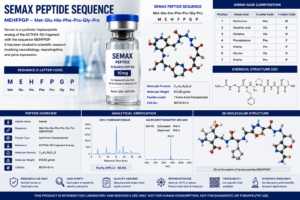
:
Met-Glu-His-Phe-Pro-Gly-Pro
The one-letter abbreviation is:
MEHFPGP
A commonly used condensed representation is:
H-Met-Glu-His-Phe-Pro-Gly-Pro-OH
Official FDA material prepared for a 2026 Pharmacy Compounding Advisory Committee meeting lists the Semax free-base sequence in this condensed form and identifies its molecular weight as approximately 813.93 g/mol.
The sequence contains seven amino acids, making Semax a heptapeptide.
Each amino acid contributes to the overall chemical identity of the molecule. The exact order of those amino acids is also important. Changing the composition or sequence order creates a different molecular entity.
Understanding MEHFPGP
The one-letter notation MEHFPGP provides a compact representation of the seven residues.
| Position | One-Letter Code | Amino Acid | Three-Letter Code |
|---|---|---|---|
| 1 | M | Methionine | Met |
| 2 | E | Glutamic acid | Glu |
| 3 | H | Histidine | His |
| 4 | F | Phenylalanine | Phe |
| 5 | P | Proline | Pro |
| 6 | G | Glycine | Gly |
| 7 | P | Proline | Pro |
Together:
M → E → H → F → P → G → P
or:
Met-Glu-His-Phe-Pro-Gly-Pro
Both PubChem and the FDA’s substance records associate Semax with the MEHFPGP sequence.
The Seven Amino Acids in Semax
1. Methionine — M
Methionine is the first residue in the Semax sequence.
The sequence begins:
Met-Glu-His-Phe-Pro-Gly-Pro
Methionine contains sulfur and contributes to the elemental composition of the complete peptide.
2. Glutamic Acid — E
The second residue is glutamic acid.
This produces the beginning sequence:
Met-Glu
Glutamic acid is one of the acidic amino acids and contributes to the chemical properties of the peptide.
3. Histidine — H
Histidine occupies the third position:
Met-Glu-His
Histidine contains an imidazole-containing side chain, an important structural feature in peptide chemistry.
4. Phenylalanine — F
The fourth residue is phenylalanine:
Met-Glu-His-Phe
Phenylalanine contains an aromatic side chain.
5. Proline — P
The fifth residue is proline:
Met-Glu-His-Phe-Pro
Proline has a distinctive cyclic structure compared with many other amino acids.
6. Glycine — G
Glycine occupies position six:
Met-Glu-His-Phe-Pro-Gly
Glycine is the smallest standard amino acid residue.
7. Proline — P
The final residue is another proline:
Met-Glu-His-Phe-Pro-Gly-Pro
This gives Semax its complete seven-residue sequence:
MEHFPGP
Semax Molecular Formula and Molecular Weight
For the Semax free base, the molecular formula is:
C₃₇H₅₁N₉O₁₀S
The molecular weight is approximately:
813.92–813.93 g/mol
The FDA Global Substance Registration System lists Semax with molecular formula C₃₇H₅₁N₉O₁₀S and molecular weight 813.92 g/mol. PubChem likewise lists the free-base compound at approximately 813.9 g/mol.
Important distinction: peptide vs. salt form
The molecular weight can differ depending on how a research material is represented.
For example, official FDA material distinguishes between:
- Semax free base: approximately 813.93 g/mol
- Semax acetate: approximately 874.0 g/mol
The peptide sequence remains H-Met-Glu-His-Phe-Pro-Gly-Pro-OH, while the associated form changes the overall molecular composition.
This is why researchers should distinguish between the peptide sequence itself and the exact chemical form documented for a particular material.
Why Peptide Sequence Identity Matters
The primary amino-acid sequence is one of the defining characteristics of a peptide.
For Semax, the expected sequence is:
MEHFPGP
This information can help researchers compare:
- Product labels
- Certificates of Analysis
- Supplier documentation
- Scientific publications
- Analytical records
- Research databases
For example, consistent documentation may follow this structure:
Product name
↓
Semax
Sequence
↓
MEHFPGP
Molecular identity
↓
C₃₇H₅₁N₉O₁₀S
Molecular weight
↓
Approximately 813.92 g/mol
Lot number
↓
Linked to analytical documentation
This documentation chain can support research organization and traceability.
However, a database record describing Semax does not independently verify the identity or purity of a specific commercial lot. Product-specific analytical documentation is needed to evaluate a particular sample.
Semax and ACTH-Derived Peptide Research
Semax is commonly described in scientific records as related to the ACTH(4–10) sequence with a Pro-Gly-Pro extension.
PubChem lists Semax among synonyms associated with ACTH (4-7), Pro-Gly-Pro-, while FDA substance information identifies both Semax and Met-Glu-His-Phe-Pro-Gly-Pro as names associated with the substance.
This relationship provides scientific context for research into Semax and related peptide structures.
Research involving ACTH-derived or related peptides may investigate:
- Molecular structure
- Sequence identity
- Structure–activity relationships
- Gene expression
- Neurobiological pathways
- Experimental biological responses
A peptide’s sequence is central to this type of research because even small structural changes can alter the identity and characteristics of the resulting molecule.
Semax Peptide Sequence and Scientific Research
The Semax sequence has been investigated in published experimental research involving neurobiological and molecular questions.
For example, one study examined Semax and the C-terminal peptide PGP in an experimental rat model of incomplete global ischemia. Researchers measured neurotrophin and receptor gene expression using real-time RT-PCR and reported region-specific changes under those experimental conditions.
These findings provide research context for Semax, but it is important to interpret them accurately.
Experimental research does not automatically establish:
- Human clinical effectiveness
- Medical treatment outcomes
- Long-term safety
- Regulatory approval
A molecular or preclinical observation is not equivalent to a proven clinical outcome.
Responsible scientific content should therefore describe such findings as:
- Experimental
- Preclinical
- Mechanistic
- Animal-model research
where appropriate.
Semax Peptide Structure and Primary Sequence
A peptide’s primary structure refers to the linear order of amino acids.
For Semax:
Met → Glu → His → Phe → Pro → Gly → Pro
This linear sequence is:
MEHFPGP
The primary sequence provides a foundation for understanding the molecule’s chemical identity.
However, the behavior of a peptide in an experimental environment may also depend on factors beyond the written sequence, including:
- Chemical form
- Sample composition
- Experimental conditions
- Solvent environment
- Analytical methodology
- Storage history
- Other research variables
Therefore, the sequence is a crucial starting point, but sequence information alone does not describe every characteristic of a physical sample.
How Is the Semax Peptide Sequence Verified?
Peptide identity can be evaluated using analytical techniques appropriate to the research objective.
Potential analytical approaches may include:
- Mass spectrometry
- Liquid chromatography
- Peptide sequencing methods
- Chromatographic comparison
- Other validated analytical techniques
Different methods provide different types of information.
Mass Spectrometry
Mass spectrometry can provide information related to molecular mass and peptide characterization.
For Semax free base, reference records list a molecular weight of approximately 813.92–813.93 g/mol.
A mass-based result may be compared with expected molecular characteristics, depending on the analytical method and the chemical form of the sample.
It is important to remember that:
Expected mass ≠ complete characterization by itself.
A comprehensive analytical strategy may use more than one technique.
Chromatography
Liquid chromatography, including HPLC-based methods, can help separate components in a sample.
Depending on the analytical method, chromatography may be used to examine:
- Sample composition
- Chromatographic profiles
- Relative peak areas
- Reported purity
A chromatographic purity result should be interpreted alongside:
- The analytical method
- Sample identification
- Lot number
- Test conditions
- Other available analytical evidence
HPLC and the Semax Peptide Sequence
HPLC does not directly replace sequence information.
Instead, these forms of information answer different questions.
Sequence
What peptide is expected?
Answer:
MEHFPGP
Mass-based analysis
Does the measured molecular information align with the expected material?
Chromatography
What does the sample’s chromatographic profile indicate under the defined method?
Using multiple analytical approaches can provide a broader understanding of a research material than relying on a single measurement.
Semax Sequence and Certificate of Analysis Documentation
A Certificate of Analysis, or COA, may contain analytical information about a tested sample.
Depending on the documentation, a Semax COA may include:
- Product identification
- Peptide sequence
- Lot or batch number
- Analytical method
- Purity specification
- Reported analytical result
- Test date
- Molecular characterization information
The most useful documentation is generally linked to a specific lot.
For example:
Research material: Lot SMX-001
↓
Certificate of Analysis: Lot SMX-001
↓
Analytical documentation: Lot SMX-001
This creates a clearer connection between the physical material and the analytical records.
A generic document that cannot be associated with a specific product lot provides less traceability.
Purity and Sequence Are Different Quality Concepts
It is important not to confuse peptide sequence with purity.
Sequence identity asks:
Is the intended peptide MEHFPGP?
Purity asks:
What proportion of the tested sample corresponds to the primary component according to the analytical method used?
Both are relevant, but they answer different questions.
A research-quality review may therefore consider:
Sequence identity
+
Molecular characterization
+
Chromatographic analysis
+
Purity results
+
Lot-specific documentation
This provides more useful scientific context than a purity percentage alone.
Semax Peptide Sequence and Lot Traceability
For laboratories working with peptide research materials, lot traceability can support reproducibility and recordkeeping.
Researchers may document:
- Material name
- Semax peptide sequence
- Supplier
- Lot number
- Date received
- Analytical reports
- COA reference
- Experimental project
This creates a traceable relationship:
Material → Identity → Analytical documentation → Research record
If research outcomes differ between experiments, documentation may help researchers determine whether relevant variables included:
- Different lots
- Different sample histories
- Different analytical documentation
- Different experimental conditions
Traceability does not guarantee reproducibility, but it can make research records more systematic and transparent.
Research-Use and Regulatory Considerations
Chemical identity should not be confused with regulatory approval.
An FDA UNII or FDA substance record identifies and standardizes information about a substance, but FDA itself notes that UNII availability does not imply regulatory review or approval.
Similarly, scientific publications about Semax should be interpreted according to the evidence they provide.
A product page discussing the Semax peptide sequence should avoid unsupported claims such as:
- “Clinically proven”
- “FDA-approved treatment”
- “Guaranteed neurological benefits”
- “Proven safe for human administration”
The strongest scientific content separates:
Chemical identity
from
Experimental research
from
Clinical evidence
from
Regulatory status
This distinction improves both scientific accuracy and content quality.