

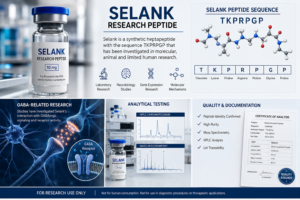
The Selank research peptide is a synthetic heptapeptide that has been investigated in neurobiology, molecular signaling, gene-expression research, animal models, and a limited body of human research.
Selank consists of seven amino-acid residues with the sequence:
TKPRPGP
The FDA Global Substance Registration System identifies Selank as a peptide with this complete seven-residue sequence and lists Selank diacetate as a related salt/solvate form.
Scientific interest in Selank has focused on several research areas, including neurotransmission, GABA-related mechanisms, behavioral models, molecular signaling, and gene expression. The literature includes experimental studies and some human studies, but these different forms of evidence should not be treated as equivalent.
Research-use statement: Selank research peptide information is provided for scientific and educational purposes. Published findings include experimental, animal, and limited human research. These findings should not be interpreted as establishing clinical safety, therapeutic effectiveness, or regulatory approval. No dosing, administration, or treatment instructions are provided.
What Is a Selank Research Peptide?
Selank is a synthetic peptide commonly described in scientific literature as a derivative of the endogenous peptide tuftsin. Its sequence is:
Thr-Lys-Pro-Arg-Pro-Gly-Pro
Using single-letter amino-acid notation:
TKPRPGP
The FDA substance record lists Selank as a peptide with a complete sequence of seven residues and an estimated average molecular weight of approximately 752 Da.
For research purposes, it is important to distinguish between peptide identity and other product characteristics.
A label identifying a material as Selank does not independently establish:
- Sequence accuracy
- Analytical purity
- Molecular identity
- Batch consistency
- Stability
- Biological activity
These characteristics require separate documentation and, where applicable, analytical testing.
Selank Peptide Sequence and Molecular Identity
The Selank sequence contains seven amino acids:
| Position | Symbol | Amino Acid |
|---|---|---|
| 1 | T | Threonine |
| 2 | K | Lysine |
| 3 | P | Proline |
| 4 | R | Arginine |
| 5 | P | Proline |
| 6 | G | Glycine |
| 7 | P | Proline |
Complete sequence: TKPRPGP
Sequence information provides the basic molecular identity expected for Selank. However, comprehensive peptide characterization may involve more than sequence documentation.
A research-oriented analytical profile can include:
- Sequence identification
- Molecular-mass characterization
- Chromatographic analysis
- Reported purity
- Lot or batch identification
- Certificate of Analysis documentation
The goal is reproducibility: researchers should be able to connect the material used in an experiment with the documentation supporting its characterization.
Scientific Background of Selank Research
The scientific literature on Selank includes several categories of research.
These include:
- Molecular and receptor studies
- Gene-expression experiments
- Animal behavioral models
- Neurotransmitter research
- Comparative pharmacology
- Limited human research
A 2
receptor signaling and reported experimental evidence consistent with allosteric modulation under the conditions studied.
This does not mean that all biological effects attributed to Selank have been conclusively established. Rather, it identifies a possible molecular mechanism that remains part of the broader research literature.
Selank and GABA-Related Research
One of the most frequently discussed areas of Selank research peptide literature involves the GABAergic system.
GABA, or gamma-aminobutyric acid, is an important neurotransmitter involved in inhibitory signaling within the nervous system.
Researchers have investigated whether Selank may influence:
- GABA-related receptor activity
- Neurotransmission
- Receptor-associated signaling
- Gene expression
- Interactions with other neuroactive compounds
The 2018 molecular study used radioligand-receptor methods and reported findings suggesting subtype-selective, concentration-dependent allosteric modulation of GABA receptor binding under the experimental conditions examined.
A separate study examined the expression of 84 genes associated with neurotransmission in rat frontal cortex after experimental exposure to Selank or GABA. The researchers reported changes in the expression of multiple genes and proposed a possible connection with GABAergic signaling.
The appropriate interpretation is therefore:
Experimental studies have investigated possible interactions between Selank and GABA-related signaling pathways.
This is more scientifically precise than converting laboratory findings into broad claims about clinical outcomes.
Selank and Gene-Expression Research
Gene-expression research provides another important area for understanding potential molecular mechanisms.
In one experimental study, researchers examined changes in genes associated with:
- GABA receptors
- Transporters
- Ion channels
- Dopamine receptors
- Serotonin receptors
The study reported that Selank was associated with changes in the expression of multiple genes involved in neurotransmission in the experimental rat model.
However, a change in gene expression does not automatically establish a therapeutic or physiological outcome.
Gene-expression experiments are useful for investigating questions such as:
- Which pathways may respond to a peptide?
- Which molecular networks may be involved?
- How do responses change over time?
- Which findings should be investigated further?
They do not independently demonstrate clinical effectiveness.
Animal Research on Selank
A significant portion of the Selank literature involves animal research.
Animal studies have examined:
- Behavioral responses
- Neurotransmitter concentrations
- Receptor binding
- Gene expression
- Comparative biological responses
For example, research in BALB/c and C57BL/6 mice investigated the effects of Selank on neurotransmitter monoamines and their metabolites in brain structures.
Another comparative study investigated differences in pharmacological effects in mice under different experimental conditions and reported changes involving GABA and NMDA receptor binding in specific brain regions.
Animal research is valuable because it allows scientists to investigate complex biological systems. However, animal findings should not automatically be assumed to predict the same outcomes in humans.
Differences may involve:
- Species biology
- Metabolism
- Experimental conditions
- Biological targets
- Study endpoints
For this reason, animal evidence should be described as preclinical evidence.
Human Research and Evidence Limitations
Published human research involving Selank exists but remains comparatively limited.
One PubMed-indexed study from 2008 involved 62 participants and compared Selank with medazepam in people described in the study as having generalized anxiety disorder and neurasthenia. The publication is indexed as a randomized controlled trial, but its size, age, and the broader limitations of the available evidence mean that it should not be treated as equivalent to a large, modern body of replicated clinical research.
Another 2008 publication investigated immunological parameters in patients with anxiety-asthenic disorders.
These publications are scientifically relevant, but responsible interpretation requires attention to:
- Sample size
- Study methodology
- Replication
- Duration
- Population studied
- Outcome measures
- Independent confirmation
A single study—or a small number of studies—does not establish broad clinical effectiveness.
Understanding the Levels of Scientific Evidence
When reviewing Selank research, it is useful to separate evidence by study type.
1. Molecular Research
Investigates mechanisms such as:
- Receptor interactions
- Gene expression
- Cellular signaling
2. Animal Research
Examines biological responses within living animal models.
3. Human Studies
Investigates specific populations under defined study conditions.
4. Broader Clinical Evidence
Requires larger and reproducible research capable of addressing safety and effectiveness for specific outcomes.
These levels should not be combined into a single claim.
For example:
A molecular observation ≠ a proven human outcome.
An animal result ≠ a confirmed clinical benefit.
A limited human study ≠ broad clinical consensus.
This distinction is essential for both scientific accuracy and responsible research communication.
Selank Research Peptide Quality and Documentation
For laboratory research, material characterization can affect experimental reproducibility.
A research-oriented evaluation may include several categories.
Peptide Identity
The expected Selank sequence is:
TKPRPGP
Identity documentation may include sequence information and molecular characterization.
Purity
Purity is usually determined using a specific analytical method.
A reported purity percentage should ideally be accompanied by:
- The analytical method
- Sample identification
- Lot number
- Test results
Purity alone does not provide a complete description of a peptide.
Molecular Mass
Mass spectrometry can help compare observed molecular characteristics with the expected properties of the peptide.
Lot Traceability
Lot or batch identification can connect:
Research sample → analytical test → Certificate of Analysis
This can improve transparency and experimental reproducibility.
Understanding HPLC Analysis
High-performance liquid chromatography, or HPLC, is commonly used for peptide analysis.
Depending on the analytical method, an HPLC report may provide information about:
- Chromatographic peaks
- Peak separation
- Relative composition
- Reported purity
When reviewing an HPLC result, researchers should consider the methodology used.
A purity value should not be viewed in isolation. Important questions include:
- Which sample was tested?
- Which lot was analyzed?
- Which method was used?
- What does the chromatogram show?
- Is the result connected to the supplied material?
For this reason, analytical documentation is often more useful when multiple forms of characterization are available.
Mass Spectrometry and Peptide Characterization
Mass spectrometry can provide additional information about peptide identity.
For Selank, analytical characterization can compare observed molecular properties with those expected from the documented sequence:
TKPRPGP
Mass analysis can support identity characterization, but it is not necessarily a complete substitute for additional analytical methods.
A stronger documentation framework may combine:
Sequence information
+
Chromatographic analysis
+
Mass characterization
+
Lot traceability
Selank COA and Certificate of Analysis
A Certificate of Analysis (COA) may provide analytical information about a particular batch or lot.
Depending on the available testing, a COA may include:
- Product name
- Lot number
- Test date
- Analytical method
- Reported purity
- Identity-related results
- Laboratory information
The most useful documentation is lot-specific.
A simple traceability structure is:
Product Material
↓
Lot Number
↓
Analytical Testing
↓
Certificate of Analysis
This helps researchers determine whether the analytical report corresponds to the material under evaluation.
Storage and Research Documentation
Peptide stability can depend on multiple variables, including:
- Chemical form
- Formulation
- Moisture
- Temperature
- Light exposure
- Storage duration
Research users should therefore rely on product-specific documentation and validated stability information where available.
General assumptions about peptide stability should not replace documented testing.
Accurate records can improve experimental reproducibility by recording:
- Product identification
- Lot number
- Date received
- Storage conditions
- Analytical documentation
How to Evaluate a Selank Research Peptide
A practical research checklist may include the following questions.
Is the peptide identity documented?
Expected sequence:
TKPRPGP
Is analytical testing available?
Look for appropriate identity and composition information.
Is purity accompanied by methodology?
A number alone provides limited context.
Is the documentation lot-specific?
Lot traceability helps connect analytical results to the research material.
Is a COA available?
A useful COA should provide information relevant to the tested sample.
Are research limitations communicated clearly?
Scientific findings should be distinguished from established clinical conclusions.