

TB-500 5 mg is presented by Peptides Grey House as a research-use-only peptide product for qualified laboratory and scientific research environments. This page provides researchers with clear information about product specifications, analytical documentation, peptide quality, identity verification, storage considerations, and responsible laboratory handling.
Researchers evaluating peptide materials need more than a product name and quantity. Reliable sourcing involves understanding available quality documentation, analytical testing, peptide identity, purity information, batch records, and appropriate laboratory practices. Peptides Grey House is committed to providing transparent product information to help research teams make informed sourcing decisions.
For Research Use Only. Not for human or veterinary use. Not intended for consumption, diagnosis, treatment, prevention, or mitigation of any disease or medical condition.
TB-500 5 mg Research Overview
TB-500 is a peptide-related research compound that has been investigated in scientific literature and experimental settings. Because research findings can vary according to experimental design, preparation, analytical methods, and study conditions, information about TB-500 should be evaluated in the appropriate scientific context.
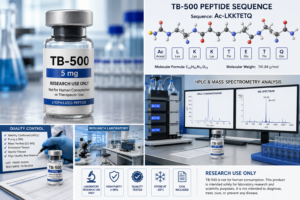
Themat refers to the labeled quant TB-500 5 mg product fority of material supplied for research purposes. Researchers should review the product documentation supplied with the specific batch before beginning laboratory work.
When selecting a research peptide, laboratories commonly consider several factors, including:
- Product identity
- Labeled quantity
- Purity information
- Analytical testing
- Batch documentation
- Molecular characteristics
- Storage requirements
- Handling considerations
- Supplier transparency
These considerations can help research teams establish appropriate quality-control procedures and maintain accurate laboratory records.
TB-500 5 mg Product Specifications
The product specification section should provide researchers with the key information needed to identify and document the material being evaluated.
Product: TB-500
Labeled Quantity: 5 mg
Product Category: Research peptide
Intended Use: Research Use Only (RUO)
Form: Refer to the current product label and batch documentation
Purity: Refer to the applicable Certificate of Analysis
Identity Testing: Refer to available analytical documentation
Storage: Follow the product-specific label and documentation
Human Use: Not intended for human use
Veterinary Use: Not intended for veterinary use
Specifications can vary between products and batches. Researchers should therefore rely on the documentation associated with the actual product and lot rather than assuming that information from another supplier or batch applies universally.
Understanding Peptide Purity
Peptide purity is an important consideration when evaluating research materials. A stated purity percentage generally reflects the proportion of the analyzed material represented by the target compound under a particular analytical method.
However, purity should not be interpreted as the same thing as identity.
A material can demonstrate a high chromatographic purity result while still requiring independent analytical confirmation of its molecular identity. For this reason, experienced research teams may evaluate multiple forms of analytical evidence when reviewing peptide quality.
Important documentation may include:
- HPLC chromatograms
- Purity percentages
- LC-MS results
- Molecular-mass information
- Batch or lot numbers
- Analytical dates
- Testing methodology
- Certificate of Analysis documentation
Researchers should review the complete available documentation rather than relying on a single numerical specification.
HPLC Testing for TB-500 5 mg
High-performance liquid chromatography (HPLC) is widely used as an analytical technique for separating components within a sample. In peptide research, chromatographic analysis can provide information about the relative distribution of components detected under defined analytical conditions.
A typical peptide HPLC report may contain a chromatogram showing one or more peaks. The primary peak can be associated with the target material, while additional peaks may represent related substances, impurities, degradation products, or other detectable components.
When reviewing HPLC documentation, researchers may examine:
- Chromatographic peak distribution
- Reported purity percentage
- Retention time
- Analytical conditions
- Column information
- Detection method
- Sample identification
- Batch or lot reference
Analytical results should always be interpreted within the methodology used to produce them. Different analytical conditions can produce different chromatographic profiles, so researchers should avoid comparing percentages without considering the underlying testing method.
LC-MS Identity Verification
Purity and identity answer different analytical questions.
Liquid chromatography–mass spectrometry (LC-MS) combines chromatographic separation with mass spectrometric detection. It can provide useful evidence regarding the molecular mass associated with material detected in a sample.
For peptide research, LC-MS documentation may help researchers evaluate whether the observed mass is consistent with the expected molecular characteristics of the target compound.
Researchers reviewing LC-MS documentation may consider:
- Observed molecular mass
- Expected molecular mass
- Mass-to-charge ratio
- Chromatographic retention
- Sample identification
- Analytical methodology
- Batch or lot information
LC-MS results should be interpreted by appropriately qualified personnel and within the limitations of the analytical method.
Peptide Purity vs. Peptide Identity
These concepts are related but should not be treated as interchangeable.
Peptide Purity concerns the composition of the analyzed sample and the proportion attributed to the target material under a particular analytical method.
Peptide Identity concerns whether the material corresponds to the expected molecular entity.
In simple terms:
Purity asks: “How much of the analyzed material appears to be the target compound?”
Identity asks: “Does the analyzed material correspond to the expected compound?”
For research teams, evaluating both dimensions can provide a more complete picture of material quality.
Certificate of Analysis (COA)
A Certificate of Analysis (COA) is an important quality document used to communicate analytical information associated with a particular product or batch.
Depending on the supplier and product, a COA may include:
- Product name
- Batch or lot number
- Test date
- Reported purity
- Analytical method
- Identity information
- Testing results
- Specification limits
- Laboratory or testing information
Researchers should verify that documentation corresponds to the specific product and lot being evaluated.
A useful quality-control practice is maintaining the COA together with internal laboratory records so that researchers can trace the material used in an experiment.
Batch Consistency
Batch-to-batch consistency is another consideration when sourcing research peptides.
Research teams conducting repeated experiments may need to compare materials across multiple lots. Differences in manufacturing processes, analytical procedures, storage conditions, or raw materials can influence observed product characteristics.
Maintaining accurate records of:
- Supplier
- Product name
- Lot number
- Date received
- Documentation
- Storage conditions
- Experimental use
can improve traceability within a laboratory environment.
Storage and Handling Considerations
Research peptides can be sensitive to environmental conditions. Appropriate storage and handling should therefore follow the manufacturer’s current product documentation and applicable laboratory procedures.
Researchers should consult the product label and documentation for specific storage requirements rather than relying on generalized recommendations.
Laboratories may also establish procedures addressing:
- Temperature control
- Moisture exposure
- Light exposure
- Container integrity
- Labeling
- Sample identification
- Contamination prevention
- Inventory tracking
Only appropriately trained personnel should handle laboratory research materials, and institutional safety procedures should always take precedence.
Responsible Research Practices
Research materials should be handled within appropriate laboratory environments and according to applicable institutional procedures.
Researchers should maintain clear documentation throughout the material lifecycle, from receipt through laboratory use and disposal.
A laboratory record may include:
- Product identification
- Supplier information
- Batch or lot number
- Quantity received
- Certificate of Analysis
- Storage information
- Experimental reference
- Date of use
- Responsible personnel
- Disposal documentation where applicable
Good documentation supports reproducibility, accountability, and efficient laboratory management.
Why Choose Peptides Grey House?
Peptides Grey House focuses on providing research professionals with transparent product information and a quality-focused purchasing experience.
Researchers can benefit from a sourcing process centered around:
Quality-Focused Information
Clear product specifications and available analytical documentation can make it easier for researchers to evaluate materials before purchasing.
Analytical Transparency
Where applicable, documentation relating to HPLC testing, LC-MS identity analysis, purity, and batch information can help researchers understand the analytical characteristics of a product.
Professional Service
Research teams need dependable communication throughout the purchasing process. Responsive support and clear product information can simplify procurement.
Secure Ordering
A straightforward online ordering experience helps laboratories manage research-material procurement efficiently.
Research-Only Positioning
Peptides Grey House presents research peptide products specifically for legitimate scientific and laboratory research. Products are not marketed as medicines or treatments.
TB-500 5 mg for Laboratory Research
Researchers investigating TB-500-related scientific questions should rely on peer-reviewed literature, validated analytical methods, institutional protocols, and appropriately qualified scientific personnel.
Experimental observations should not automatically be interpreted as evidence of clinical effectiveness or safety in humans.
This distinction is particularly important for peptide-related research because experimental compounds may be discussed online in connection with health, fitness, recovery, or other applications that are outside legitimate laboratory research.
Peptides Grey House maintains a research-focused approach by emphasizing laboratory documentation, analytical quality information, and responsible scientific use.
Selecting a Research Peptide Supplier
Choosing a reliable supplier involves evaluating more than price.
Research teams may consider:
- Product documentation
- Analytical transparency
- Batch traceability
- Identity information
- Purity information
- Supplier communication
- Ordering reliability
- Product labeling
- Storage information
- Research-use positioning
A supplier that provides clear documentation allows researchers to make more informed decisions and maintain better laboratory records.