

Epitalon Molecular Formula: Complete Chemical & Research Guide
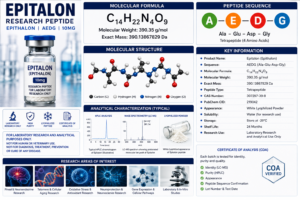
Epitalon (Epithalon) is a synthetic tetrapeptide that has attracted interest in peptide chemistry, cellular research, pineal biology, and aging-related research. For researchers evaluating its chemical identity, one of the most important specifications is the Epitalon molecular formula: C₁₄H₂₂N₄O₉.
Epitalon is also identified by the sequence AEDG,
Epitalon with a molecular weight of 390.35 g/mol, an exact mass of 390.13867829 Da, and the chemical formula C₁₄H₂₂N₄O₉.
This guide explains the molecular formula, peptide sequence, molecular weight, chemical identity, analytical characterization, research context, and important considerations when evaluating an Epitalon research peptide.
Research-use notice: Epitalon products discussed on this page are presented for laboratory research and analytical purposes only. They are not presented as products for human or veterinary administration.
What Is the Epitalon Molecular Formula?
The molecular formula for Epitalon free base is:
C₁₄H₂₂N₄O₉
The formula represents the elemental composition of the Epitalon molecule:
| Element | Number of Atoms |
|---|---|
| Carbon (C) | 14 |
| Hydrogen (H) | 22 |
| Nitrogen (N) | 4 |
| Oxygen (O) | 9 |
The molecular formula is an important chemical identifier because it provides the elemental composition used when calculating molecular mass and interpreting analytical data such as mass spectrometry.
PubChem identifies Epitalon as Ala-Glu-Asp-Gly (AEDG) and reports its molecular weight as 390.35 g/mol.
Epitalon Molecular Formula and Molecular Weight
The molecular formula and molecular weight are closely connected.
For Epitalon free base:
Molecular formula: C₁₄H₂₂N₄O₉
Molecular weight: 390.35 g/mol
Exact mass: 390.13867829 Da
Sequence: AEDG
Peptide length: 4 amino acids
PubChem reports both the molecular weight and exact mass for Epitalon.
The distinction between molecular weight and exact mass is important in analytical peptide research.
Molecular weight is generally expressed in grams per mole and is useful for chemical specifications and calculations.
Exact mass is a more precise calculated value based on the isotopic masses of the constituent atoms and can be useful when interpreting high-resolution mass spectrometry.
For Epitalon, these values should not be confused with values belonging to modified derivatives, salts, or different formulations.
Epitalon Peptide Sequence: AEDG
The Epitalon sequence is:
AEDG
The four letters represent:
- A = Alanine (Ala)
- E = Glutamic acid (Glu)
- D = Aspartic acid (Asp)
- G = Glycine (Gly)
Therefore:
Ala-Glu-Asp-Gly = AEDG
PubChem lists the IUPAC condensed representation as H-Ala-Glu-Asp-Gly-OH and identifies Epitalon as a tetrapeptide.
The short sequence is one reason Epitalon is relatively straightforward to identify at the primary-structure level.
For SEO and product identification, useful related terms include:
- Epitalon sequence
- Epitalon AEDG
- Epithalon AEDG
- Epitalon peptide sequence
- Epitalon molecular structure
- Epitalon molecular formula
Epitalon Chemical Identity
A research product page should distinguish chemical identity from marketing terminology.
Common names associated with this molecule include:
Epitalon
Epithalon
Epithalone
Ala-Glu-Asp-Gly
PubChem lists Epitalon under PubChem CID 219042. It also provides the molecular structure, sequence, formula, exact mass, and other chemical identifiers.
Key chemical specifications
| Specification | Epitalon Free Base |
|---|---|
| Common name | Epitalon |
| Alternative name | Epithalon |
| Sequence | AEDG |
| Peptide type | Tetrapeptide |
| Molecular formula | C₁₄H₂₂N₄O₉ |
| Molecular weight | 390.35 g/mol |
| Exact mass | 390.13867829 Da |
| PubChem CID | 219042 |
| IUPAC condensed | H-Ala-Glu-Asp-Gly-OH |
These values describe the free-base molecule. Researchers should verify the exact chemical form supplied by a vendor before comparing specifications.
Epitalon Free Base vs. Epitalon Acetate
One important consideration for researchers is that Epitalon is not necessarily represented by only one physical form in commercial or regulatory contexts.
The FDA’s 2026 Pharmacy Compounding Advisory Committee materials separately discuss Epitalon free base and Epitalon acetate. The FDA materials note that the two substances can have different chemical and physical characteristics.
This matters because the molecular weight of a peptide product can change when the chemical form changes.
Therefore, researchers should not automatically use 390.35 g/mol for every product labeled “Epitalon.”
For the free base:
C₁₄H₂₂N₄O₉ — 390.35 g/mol
For an acetate form, the molecular composition includes the acetate component and should be evaluated according to the actual product specification.
Why chemical form matters
When comparing two research materials, check:
- Chemical name
- Sequence
- Molecular formula
- Molecular weight
- Salt or counterion
- Modification status
- Certificate of Analysis
- Mass-spectrometry identity
- HPLC or other analytical data
This prevents researchers from comparing chemically different materials as though they were identical.
Epitalon Molecular Structure
The molecular formula tells researchers the elemental composition, while the peptide sequence describes the order of amino acids.
Epitalon’s sequence is:
AEDG
Its structure contains peptide bonds connecting the four amino-acid residues.
For research documentation, molecular structure information can be useful when evaluating:
- Peptide identity
- Molecular modeling
- Mass spectrometry
- Computational chemistry
- Structure-property relationships
- Peptide synthesis
- Analytical method development
PubChem provides both two-dimensional and three-dimensional representations of Epitalon.
Epitalon Research Peptide
The term Epitalon research peptide generally refers to Epitalon material intended for laboratory investigation rather than clinical use.
Epitalon has been investigated in a variety of experimental settings. A 2025 review describes Epitalon as a tetrapeptide and summarizes research involving in vitro, in vivo, and in silico approaches. The review discusses reported areas including antioxidant, neuroprotective, antimutagenic, neuroendocrine, and melatonin-related research while emphasizing that the mechanisms are not fully established.
These findings should be interpreted as research evidence rather than proof of therapeutic effectiveness in humans.
A scientifically responsible product page should distinguish:
Experimental findings → laboratory research
from:
Clinical efficacy → requires appropriate human clinical evidence
That distinction is especially important for SEO content involving peptides.
Epitalon and Cellular Research
Epitalon has been studied in experimental models related to cellular biology and aging.
Research areas associated with the peptide include:
Cellular aging research
Researchers have investigated whether Epitalon can influence cellular pathways associated with aging and cellular maintenance.
Telomere research
Epitalon has also been investigated in experimental telomere-related studies.
Oxidative-stress research
Experimental literature has explored possible relationships between Epitalon and oxidative-stress pathways.
Pineal biology
Epitalon was developed in connection with research involving pineal gland-derived peptide preparations, making pineal and neuroendocrine research another area associated with the scientific literature.
Importantly, these areas should be described as research topics, not established medical indications.
Epitalon Telomere Research
Telomeres are DNA-protein structures associated with chromosome ends and cellular replication.
Because telomere biology is relevant to cellular aging, it has become an area of interest in experimental Epitalon research.
Research involving Epitalon should be evaluated according to:
- Experimental model
- Cell type
- Concentration
- Exposure conditions
- Study design
- Controls
- Analytical method
- Statistical significance
- Reproducibility
Results observed in cultured cells cannot automatically be translated into effects in humans.
For this reason, phrases such as “Epitalon telomere research” are more scientifically appropriate than unsupported claims about extending human lifespan or reversing aging.
Epitalon Analytical Characterization
For laboratory research, chemical identity and quality should be supported by appropriate analytical documentation.
Common analytical approaches for peptide materials include:
HPLC
High-performance liquid chromatography can be used to evaluate chromatographic purity and characterize peptide-related components.
LC-MS / Mass Spectrometry
Mass spectrometry can help evaluate whether an observed molecular mass is consistent with the expected molecular identity.
Peptide identity testing
Identity testing may incorporate sequence-specific or mass-based analytical methods depending on the laboratory and material.
Certificate of Analysis
A Certificate of Analysis (COA) can provide lot-specific information such as:
- Product identification
- Batch or lot number
- Testing date
- Analytical method
- Identity
- Purity
- Molecular mass
- Appearance
- Other applicable specifications
However, a website should never publish invented HPLC results, LC-MS values, purity percentages, lot numbers, or COA data.
If a product page does not have verified lot-specific analytical documentation, it is better to state that the documentation should be requested or verified.
Epitalon COA: What Researchers Should Check
When reviewing an Epitalon COA, compare the document against the product being evaluated.
A useful checklist includes:
1. Product name
Does the COA clearly identify Epitalon/Epithalon?
2. Chemical form
Does it specify free base, acetate, or another form?
3. Sequence
Does the documented sequence correspond to AEDG?
4. Molecular weight
Does the reported molecular mass correspond to the specified chemical form?
5. Purity
Is the purity result supported by an actual analytical method?
6. Identity
Is there evidence of identity testing?
7. Lot number
Does the COA correspond to the actual batch?
8. Testing laboratory
Is the laboratory or analytical provider identified where appropriate?
A COA should be treated as lot-specific documentation, not as generic marketing material.
Epitalon 10mg Research Material
The term Epitalon 10mg generally describes the quantity of peptide material represented by the product label.
For an SEO product page, it is useful to distinguish:
Product quantity: 10mg
from:
Molecular weight: 390.35 g/mol for Epitalon free base
These describe different properties.
The 10mg figure refers to the amount of material, while 390.35 g/mol describes the molecular mass of the free-base molecule.
Researchers should always rely on the actual product documentation for the exact formulation and lot-specific specifications.
Why Epitalon Molecular Formula Matters for Research
The molecular formula is useful for several reasons.
Chemical identification
It provides a concise representation of elemental composition.
Mass calculations
It supports theoretical molecular-mass calculations.
Mass spectrometry
The formula helps establish expected molecular mass characteristics.
Database searching
Researchers can use the formula alongside the name, sequence, CAS number, or PubChem CID to cross-reference chemical information.
Literature research
Searching multiple identifiers can help locate scientific publications and chemical databases.
Product verification
Comparing a vendor’s specifications with established chemical references can help identify discrepancies.
For Epitalon, the combination of:
Epitalon + AEDG + C₁₄H₂₂N₄O₉ + 390.35 g/mol
provides a useful chemical-identification framework for the free base.
Epitalon Research: Current Scientific Context
Epitalon has a relatively long history of experimental research, but its scientific status should be described carefully.
A 2025 review characterized Epitalon as a bioactive pineal tetrapeptide and summarized decades of experimental work. The review identified multiple reported biological effects while also indicating that questions remain regarding its mechanisms and physicochemical characterization.
Regulatory context is also important.
In 2026, the FDA Pharmacy Compounding Advisory Committee considered Epitalon free base and Epitalon acetate in the context of substances nominated for the 503A Bulks List. FDA materials state that neither form is a component of an FDA-approved drug and that there is no applicable USP/NF drug-substance monograph for either form.
Therefore, product pages should avoid presenting Epitalon as an FDA-approved medicine or implying established clinical efficacy.
How to Evaluate an Epitalon Research Peptide
Before selecting a research material, researchers can review the following factors.
1. Chemical identity
Confirm that the product is actually identified as Epitalon/Epithalon and determine the chemical form.
2. Sequence
Confirm AEDG for the unmodified peptide.
3. Molecular formula
For the free base, confirm:
C₁₄H₂₂N₄O₉
4. Molecular weight
For the free base:
390.35 g/mol
5. Analytical documentation
Look for appropriate HPLC, LC-MS, or identity documentation where applicable.
6. Lot-specific COA
A current COA should correspond to the actual lot being evaluated.
7. Research-use labeling
The material should be clearly represented as research material rather than an approved therapeutic product.
8. Transparent specifications
Avoid pages that publish unsupported purity percentages or fabricated analytical results.