

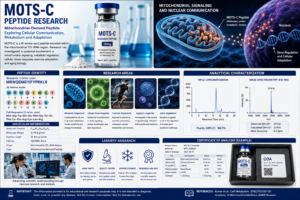
MOTS-C peptide research examines a 16-amino-acid mitochondrial-derived peptide and its possible roles in cellular communication, metabolic regulation, stress adaptation, exercise biology, and aging-related processes.
MOTS-c is associated with a short open reading frame in the mitochondrial 12S rRNA region. Its commonly reported amino-acid sequence is:
MRWQEMGYIFYPRKLR
The peptide consists of:
Met-Arg-Trp-Gln-Glu-Met-Gly-Tyr-Ile-Phe-Tyr-Pro-Arg-Lys-Leu-Arg
Scientific research into MOTS-c has expanded interest in the idea that mitochondria can participate in cellular communication through peptides encoded by the mitochondrial genome. Research reviews describe MOTS-c as one member of a broader group known as mitochondrial-derived peptides.
Research-use notice: This page is intended for scientific and educational purposes. MOTS-C research findings should not be interpreted as established clinical safety, therapeutic effectiveness, or regulatory approval. No dosing, administration, or treatment instructions are provided.
What Is MOTS-C?
MOTS-C is commonly expanded as Mitochondrial Open Reading Frame of the 12S rRNA type-c. It is described as a mitochondrial-derived peptide consisting of 16 amino-acid residues.
Its reported sequence is:
MRWQEMGYIFYPRKLR
Research on mitochondrial-derived peptides has broadened scientific understanding of mitochondrial biology. In addition to their established roles in energy metabolism, mitochondria may participate in signaling processes that influence cellular responses to environmental and metabolic conditions. MOTS-c has been investigated within this broader framework.
The Discovery of MOTS-C and Mitochondrial-Derived Peptides
The discovery and characterization of mitochondrial-derived peptides contributed to a growing area of research examining small peptides encoded by regions of mitochondrial DNA.
MOTS-c has been studied alongside other mitochondrial-derived peptides, including Humanin and small Humanin-like peptides. These molecules have generated scientific interest because they may provide mechanisms through which mitochondria communicate information about cellular state.
Research in this area continues to examine:
- Mitochondrial-to-nuclear communication
- Cellular stress signaling
- Metabolic adaptation
- Gene regulation
- Intercellular communication
- Age-associated biological changes
These are active areas of scientific investigation, and individual findings may vary depending on the experimental model and methodology used.
MOTS-C Peptide Sequence and Molecular Identity
The primary sequence of a peptide is fundamental to its scientific identity.
The commonly reported MOTS-C sequence is:
MRWQEMGYIFYPRKLR
| Position | Amino-Acid Code | Amino Acid |
|---|---|---|
| 1 | M | Methionine |
| 2 | R | Arginine |
| 3 | W | Tryptophan |
| 4 | Q | Glutamine |
| 5 | E | Glutamic acid |
| 6 | M | Methionine |
| 7 | G | Glycine |
| 8 | Y | Tyrosine |
| 9 | I | Isoleucine |
| 10 | F | Phenylalanine |
| 11 | Y | Tyrosine |
| 12 | P | Proline |
| 13 | R | Arginine |
| 14 | K | Lysine |
| 15 | L | Leucine |
| 16 | R | Arginine |
The sequence provides a reference point for peptide synthesis, analytical characterization, and research documentation. Changes to amino-acid composition or sequence order can change molecular properties and potentially affect experimental behavior.
PubChem lists the corresponding MOTS-c peptide identity and molecular information.
MOTS-C as a Mitochondrial-Derived Peptide
MOTS-c is classified in scientific literature as a mitochondrial-derived peptide, or MDP.
Mitochondria are traditionally associated with energy production through processes that support ATP generation. Modern research also examines mitochondria as signaling structures capable of responding to changes in cellular conditions.
MOTS-C research is relevant to questions such as:
- How mitochondria communicate with the nucleus
- How cells respond to metabolic stress
- How mitochondrial signals influence gene expression
- How cellular energy status affects signaling pathways
Experimental studies have reported observations involving MOTS-c movement to the nucleus under certain forms of metabolic stress and associations with changes in gene expression related to stress adaptation. These observations continue to be investigated across different experimental systems.
MOTS-C and Metabolic Research
One of the most frequently discussed areas of
is metabolism.
Early experimental research described MOTS-c in relation to metabolic homeostasis and investigated its interaction with pathways associated with glucose utilization and cellular energy regulation.
Researchers continue to explore questions involving:
- Glucose metabolism
- Lipid metabolism
- Energy sensing
- Metabolic stress
- Mitochondrial signaling
Some experimental models have reported changes associated with metabolic regulation following manipulation or administration of MOTS-c. However, findings from experimental models should not automatically be generalized to human therapeutic outcomes.
Scientific reviews continue to describe metabolic regulation as an important area of MOTS-c research.
Cellular Stress and MOTS-C Research
Cells encounter numerous forms of stress, including nutrient limitations, oxidative conditions, and changes in energy availability.
Research has examined whether MOTS-c participates in cellular responses to these conditions.
Experimental studies have reported that MOTS-c may be involved in signaling responses under metabolic stress and may influence nuclear gene expression in certain experimental contexts.
This has generated interest in:
- Cellular adaptation
- Stress-response pathways
- Mitochondrial-to-nuclear signaling
- Transcriptional regulation
The mechanisms involved remain subjects of ongoing investigation. Scientific results may differ depending on the cell type, experimental conditions, and methods used.
MOTS-C and Exercise Research
Exercise places substantial metabolic demands on skeletal muscle and other tissues.
This makes exercise biology an area of interest for mitochondrial signaling research.
Published studies and reviews have explored associations between MOTS-c and:
- Exercise-related signaling
- Skeletal muscle metabolism
- Cellular adaptation
- Energy regulation
These findings have generated hypotheses about how mitochondrial-derived peptides may participate in responses to metabolic demands.
It is important, however, to distinguish research into exercise-related biology from claims that MOTS-C improves athletic performance.
A scientifically accurate product or research page should describe the evidence as:
Published research has investigated the relationship between MOTS-c and exercise-related molecular and metabolic processes.
This wording reflects the research without implying a guaranteed performance outcome.
MOTS-C and Aging Research
Mitochondrial function is an important topic in aging biology.
As a mitochondrial-derived peptide, MOTS-c has attracted research interest in studies examining age-associated changes in metabolism, mitochondrial signaling, and cellular adaptation.
Research questions include:
- How mitochondrial signaling changes with age
- Whether mitochondrial-derived peptides vary across the lifespan
- How metabolic regulation relates to aging biology
- Whether mitochondrial communication influences cellular resilience
These questions remain under scientific investigation.
Research involving aging biology should not be interpreted as evidence that MOTS-c reverses aging or provides an established anti-aging treatment.
Molecular Pathways in MOTS-C Research
Researchers have explored several molecular pathways potentially associated with MOTS-c activity.
One frequently discussed pathway is AMP-activated protein kinase, commonly known as AMPK. AMPK is involved in cellular energy sensing and is studied extensively in metabolic biology.
Experimental research has investigated relationships between MOTS-c and AMPK-associated signaling.
Other research areas include:
- Nuclear translocation
- Transcriptional regulation
- Cellular energy sensing
- Stress adaptation
- Mitochondrial communication
These pathways are complex, and research findings should be interpreted within the context of individual studies rather than as universal biological outcomes.
Understanding Experimental Research and Human Evidence
One of the most important aspects of scientific communication is distinguishing different levels of evidence.
Cellular Research
Cell-based studies can help researchers investigate molecular mechanisms under controlled laboratory conditions.
Animal Research
Animal studies can provide information about biological systems but may not predict identical outcomes in humans.
Human Observational Research
Observational studies can identify associations but generally cannot establish causation on their own.
Clinical Research
Controlled human trials are designed to investigate safety and effectiveness under specific conditions.
These categories should not be treated as interchangeable.
A finding in a cell culture or animal model does not establish that the same outcome will occur in humans.
For MOTS-C peptide research, this distinction is particularly important because the field includes experimental, preclinical, and emerging human research.
MOTS-C Peptide Quality for Research
Research outcomes can be influenced by the characteristics of the materials used.
For peptide research, important quality categories may include:
- Peptide identity
- Sequence verification
- Reported purity
- Analytical methodology
- Lot traceability
- Storage documentation
A reliable research record should clearly identify the material being studied.
The reported MOTS-C sequence:
MRWQEMGYIFYPRKLR
can serve as one component of molecular identity documentation.
Understanding MOTS-C Purity
Purity is frequently used in peptide research, but it should not be treated as a complete measure of quality.
A purity result generally reflects the output of a particular analytical method.
For example, chromatographic analysis may estimate the relative proportion of a target peak compared with other detected components.
However:
High reported purity ≠ complete proof of identity.
A comprehensive research approach may evaluate:
Expected sequence
+
Molecular mass characterization
+
Chromatographic analysis
+
Lot-specific documentation
Each source of information addresses a different aspect of material characterization.
HPLC Analysis in MOTS-C Research
High-performance liquid chromatography, or HPLC, is widely used in peptide analysis.
Depending on the method, HPLC can provide information about:
- Sample composition
- Peak profiles
- Peak separation
- Relative purity estimates
A meaningful analytical record should identify the method and sample being analyzed.
Useful information may include:
- Sample identification
- Lot number
- Test date
- Analytical conditions
- Reported purity
When evaluating a Certificate of Analysis, researchers should consider whether the documentation can be connected to the specific material or lot being used.
Mass Spectrometry and Molecular Characterization
Mass spectrometry is another analytical technique relevant to peptide characterization.
It can provide information about the molecular mass of a sample and help researchers compare observed characteristics with expected molecular values.
For MOTS-c, the reference peptide is commonly listed with a molecular weight of approximately 2,174.6 g/mol. Different chemical forms, salts, or counterions may affect the overall documented molecular mass.
Mass spectrometry results should therefore be interpreted in relation to:
- The expected peptide sequence
- The molecular form
- Sample preparation
- Analytical methodology
MOTS-C COA and Research Documentation
A Certificate of Analysis, or COA, can provide analytical documentation associated with a specific material.
Depending on the analysis performed, a COA may include:
- Product identification
- Lot or batch number
- Analytical method
- Purity results
- Identity information
- Test date
The most useful documentation is linked directly to the material lot being evaluated.
A simple research documentation structure is:
Peptide Identity → Lot Number → Analytical Testing → COA
This supports traceability and can help researchers maintain organized records.
Research Limitations
Scientific research into MOTS-c remains an evolving field.
Important limitations may include:
- Differences between experimental models
- Limited translation from preclinical research
- Variability in study design
- Differences in laboratory methods
- The need for additional controlled human research
These limitations should be acknowledged when summarizing the scientific literature.
Responsible scientific communication does not simply list promising findings. It also explains where evidence remains incomplete.