

TB-500 5mg Research Peptide: Specifications, Molecular Weight & Research Guide
TB-500 5mg Research Peptide
TB-500 5mg is a research peptide material intended for laboratory and scientific investigation. Researchers evaluating peptide materials typically examine chemical identity, amino-acid sequence, molecular weight, analytical characterization, purity, batch documentation, and other quality-control information before incorporating a research material into an appropriate laboratory workflow.
TB-500 is particularly important to identify accurately because the name is sometimes used interchangeably with thymosin beta-4 in commercial and online discussions. Scientifically, the defined TB-500 compound is an N-terminally acetylated heptapeptide with the sequence LKKTETQ. The FDA’s Substance Registration System identifies TB-500 as the N-terminally acetylated 17–23 fragment of thymosin beta-4.
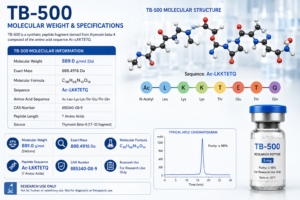
PubChem lists TB-500 under CAS 885340-08-9, with molecular formula C38H68N10O14 and a molecular weight of 889.0 g/mol. Its reported exact mass is approximately 888.4916 Da.
For researchers, these identifiers are useful because a product name alone does not establish chemical identity. Sequence, molecular formula, molecular mass, analytical testing, and batch-specific documentation should be considered together.
Research-use statement: This page is provided for scientific and laboratory research information. TB-500 should not be represented as an approved medication, dietary supplement, or treatment for human or veterinary conditions.
What Is TB-500?
TB-500 is commonly identified as a synthetic peptide fragment related to thymosin beta-4. The defined compound is the N-acetylated sequence:
Ac-LKKTETQ
The sequence contains seven amino-acid residues, with an N-terminal acetyl modification.
The FDA identifies TB-500 as thymosin beta-4 fragment (LKKTETQ), also known as TB-500.
The FDA Substance Registration System further identifies the substance as:
- Preferred substance: TB-500
- UNII: QHK6Z47GTG
- CAS: 885340-08-9
- Sequence: LKKTETQ
- Chemical description: N-acetyl-L-leucyl-L-lysyl-L-lysyl-L-threonyl-L-alpha-glutamyl-L-threonyl-L-glutamine
This information provides a useful foundation for laboratory identification and SEO content because it allows the product page to distinguish the defined TB-500 peptide from full-length thymosin beta-4.
TB-500 Molecular Weight
What Is the Molecular Weight of TB-500?
The molecular weight of the defined TB-500 compound is:
889.0 g/mol
PubChem reports an exact mass of:
888.49164688 Da
The molecular formula is:
C38H68N10O14
and the PubChem CID is:
62707662.
TB-500 Molecular Specifications
| Specification | TB-500 |
|---|---|
| Common name | TB-500 |
| Sequence | LKKTETQ |
| Modification | N-terminal acetylation |
| Molecular formula | C38H68N10O14 |
| Molecular weight | 889.0 g/mol |
| Exact mass | 888.49164688 Da |
| CAS | 885340-08-9 |
| PubChem CID | 62707662 |
| UNII | QHK6Z47GTG |
These values refer to the defined TB-500 parent compound listed by PubChem.
TB-500 Peptide Sequence
The defined TB-500 peptide sequence is:
Ac-LKKTETQ
The unmodified amino-acid sequence is:
LKKTETQ
Expanded, the sequence corresponds to:
N-acetyl-L-leucyl-L-lysyl-L-lysyl-L-threonyl-L-glutamyl-L-threonyl-L-glutamine
PubChem provides the condensed sequence as Ac-Leu-Lys-Lys-Thr-Glu-Thr-Gln-OH.
Sequence information is important when assessing peptide identity. Researchers can compare the expected sequence with analytical information supplied for a particular batch.
For SEO purposes, phrases such as TB-500 peptide sequence, TB-500 research peptide, and TB-500 molecular weight can be incorporated naturally into the page without excessive repetition.
TB-500 vs. Thymosin Beta-4
One of the most important educational sections on a TB-500 product page is the distinction between TB-500 and full-length thymosin beta-4.
TB-500 is the defined N-acetylated heptapeptide fragment LKKTETQ. Full-length thymosin beta-4 is a separate peptide substance. The FDA’s Substance Registration System maintains separate records for TB-500 and thymosin beta-4.
This distinction is important when interpreting scientific publications, product documentation, or analytical results.
A study involving full-length thymosin beta-4 should not automatically be described as a study of TB-500. Researchers should check the actual compound used in the study before drawing conclusions about a particular research material.
Why the Difference Matters
Chemical identity affects:
- Molecular weight
- Amino-acid sequence
- Analytical expectations
- Mass-spectrometry results
- Research interpretation
- Product documentation
- Literature searches
A strong research product page should therefore avoid treating the two compounds as interchangeable.
TB-500 5mg Product Specifications
A concise specification section helps researchers find important information quickly.
Product Overview
Product: TB-500 5mg
Research classification: Research use only
Defined sequence: Ac-LKKTETQ
Molecular formula: C38H68N10O14
Molecular weight: 889.0 g/mol
Exact mass: 888.49164688 Da
CAS: 885340-08-9
UNII: QHK6Z47GTG
PubChem CID: 62707662
The chemical specifications above are based on publicly available PubChem and FDA substance-identification records.
For a specific commercial batch, additional specifications such as purity, peptide content, water content, residual solvents, and analytical results should be taken from the applicable batch documentation rather than assumed from the generic compound record.
TB-500 Purity and Quality Considerations
Purity is an important consideration when evaluating research peptides.
A product’s stated purity percentage should be considered alongside identity testing and batch-specific documentation. Researchers may encounter analytical information generated through techniques such as high-performance liquid chromatography or mass spectrometry.
Important Quality-Control Information
A useful research-peptide quality record may include:
- Product name
- Chemical identity
- Batch or lot number
- Test date
- Reported purity
- Analytical method
- Molecular-mass data
- Appearance
- Peptide-content information
- Testing laboratory
- Storage information
A purity value by itself does not necessarily establish complete chemical identity. Combining chromatographic and mass-spectrometric information can provide a more informative analytical profile.
For commercial product pages, it is preferable to describe actual batch-specific results rather than publishing unsupported purity percentages.
TB-500 Certificate of Analysis
A Certificate of Analysis (COA) can help connect a research material to a specific production batch.
Researchers reviewing a TB-500 COA should check whether the information corresponds to the product being evaluated.
Recommended COA Checks
1. Product identity
Confirm that the compound name matches the material being evaluated.
2. Batch number
Verify that the lot number on the COA matches the product label.
3. Purity
Review the reported analytical purity and method used.
4. Molecular mass
Compare the reported analytical mass with the expected mass for the relevant chemical form.
5. Testing date
Check when the analytical testing was performed.
6. Analytical method
Identify whether HPLC, LC-MS, MS, or another analytical method was used.
This approach gives a research laboratory a more complete picture than relying solely on a product label.
TB-500 Chemical Forms and Molecular Weight
Another important consideration is that the molecular weight can differ when TB-500 is supplied as a salt or other chemical form.
For example, PubChem lists:
- TB-500 parent compound: 889.0 g/mol
- TB-500 acetate: 949.1 g/mol
- TB-500 trifluoroacetate salt: 1003.0 g/mol
Therefore, researchers should not assume that every material labeled “TB-500” will produce exactly the same molecular-weight value in analytical documentation.
The expected molecular mass should be interpreted according to the specific chemical form being tested.
TB-500 Research Background
Research interest in TB-500 is closely associated with thymosin beta-4 biology and the peptide’s defined fragment sequence.
The FDA’s 2026 Pharmacy Compounding Advisory Committee materials identify TB-500 as the N-acetylated heptapeptide N-acetyl-LKKTETQ. Those materials also describe the relationship between the LKKTET portion of the sequence and the actin-binding region of full-length thymosin beta-4.
Importantly, research involving full-length thymosin beta-4 should not automatically be interpreted as evidence about TB-500.
This distinction is especially useful for SEO content because it allows a product page to provide scientific context without making unsupported therapeutic claims.
TB-500 Laboratory Research
TB-500 may be discussed in laboratory contexts involving peptide characterization and analytical research.
Examples of research-oriented activities can include:
- Chemical identity verification
- Molecular-mass analysis
- Peptide characterization
- Chromatographic purity analysis
- Mass-spectrometry analysis
- Comparative peptide research
- Stability investigations
- Analytical-method development
- Reference-material evaluation
The specific research application depends on the laboratory’s scientific objectives, validated procedures, applicable regulations, and institutional requirements.
This page does not provide administration, dosing, or treatment instructions.
TB-500 Analytical Characterization
Analytical characterization is important for researchers who need to confirm the identity and quality of a peptide material.
Mass Spectrometry
Mass spectrometry can help determine whether an observed molecular mass is consistent with the expected compound.
For the defined TB-500 parent compound, PubChem reports an exact mass of approximately 888.492 Da and an average molecular weight of 889.0 g/mol.
Researchers should account for expected adducts, ionization states, and salt forms when interpreting mass-spectrometry results.
Chromatography
Chromatographic methods such as HPLC or UPLC can be used to assess the presence of related components and provide a chromatographic purity measurement.
However, chromatographic purity should be interpreted together with identity testing rather than treated as the sole confirmation of compound identity.
Orthogonal Testing
Where appropriate, researchers can consider multiple analytical approaches to obtain complementary information about a research material.
TB-500 Storage and Handling Considerations
Storage requirements depend on factors including formulation, chemical form, container, environmental conditions, and supplier specifications.
A commercial research page should therefore avoid presenting one universal storage protocol unless it is supported by the specific manufacturer’s validated documentation.
Researchers should:
- Follow the supplier’s current storage instructions.
- Keep the material appropriately sealed.
- Maintain lot and storage records.
- Minimize unnecessary environmental exposure.
- Follow applicable laboratory handling procedures.
- Use validated stability information when available.
Storage information should always be evaluated alongside the actual formulation and batch documentation.