

Epitalon Research Peptide: Epithalon AEDG 10mg Laboratory Research Guide
Epitalon Research Peptide is a synthetic tetrapeptide that has been investigated in laboratory research involving cellular biology, pineal biology, oxidative stress, telomere biology, and aging-related mechanisms. Also known as Epithalon or Epithalone, Epitalon is characterized by the four-amino-acid sequence Ala-Glu-Asp-Gly (AEDG).
For researchers evaluating Epitalon as a laboratory research material, accurate chemical identification and analytical documentation are essential. Epitalon free base has the molecular formula C₁₄H₂₂N₄O₉ and a molecular weight of 390.35 g/mol. PubChem lists an exact mass of 390.13867829 Da.
This guide explains the chemistry, research background, analytical considerations, COA documentation, and important distinctions between Epitalon research material and therapeutic products.
FOR LABORATORY RESEARCH AND ANALYTICAL PURPOSES ONLY. NOT FOR HUMAN OR VETERINARY USE.
What Is Epitalon Research Peptide?
Epitalon is a short synthetic peptide consisting of four amino acids:
Ala-Glu-Asp-Gly
Its one-letter peptide sequence is:
AEDG
The compound is also commonly referred to as Epithalon and Epithalone. PubChem identifies Epitalon as CID 219042 and records the sequence AEDG and molecular formula C₁₄H₂₂N₄O₉.
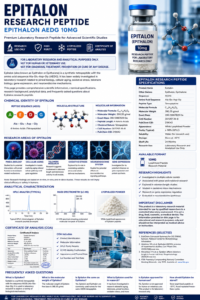
Researchers studying Epitalon may encounter several types of scientific information, including chemical characterization, peptide synthesis, cellular experiments, analytical testing, and literature examining biological pathways.
Importantly, research findings should be interpreted according to the experimental model used. Results from cell cultures or animal studies do not automatically establish efficacy or safety in humans.
Epitalon Research Peptide Specifications
The fundamental specifications for Epitalon free base are:
| Specification | Details |
|---|---|
| Product name | Epitalon |
| Common name | Epithalon |
| Alternate name | Epithalone |
| Sequence | AEDG |
| Amino-acid sequence | Ala-Glu-Asp-Gly |
| Peptide classification | Tetrapeptide |
| Molecular formula | C₁₄H₂₂N₄O₉ |
| Molecular weight | 390.35 g/mol |
| Exact mass | 390.13867829 Da |
| PubChem CID | 219042 |
| CAS | 307297-39-8 |
| Research format | Lyophilized research material |
| Intended purpose | Laboratory research and analytical use |
The molecular weight and exact mass above refer specifically to Epitalon free base.
Researchers should verify the chemical form stated on the product documentation before comparing molecular-weight data.
Epitalon Peptide Sequence: AEDG
One of the most important identifiers for an Epitalon research peptide is its sequence.
Epitalon sequence: AEDG
The letters represent:
- A — Alanine
- E — Glutamic acid
- D — Aspartic acid
- G — Glycine
Therefore:
Epitalon = Ala-Glu-Asp-Gly = AEDG
PubChem records the condensed structure as H-Ala-Glu-Asp-Gly-OH and identifies the sequence as AEDG.
The AEDG sequence is useful when reviewing peptide identity, comparing research literature, interpreting analytical data, or checking supplier documentation.
For SEO purposes, this also creates a strong semantic relationship between:
Epitalon → Epithalon → AEDG → tetrapeptide → peptide sequence
Epitalon Molecular Weight
The molecular weight of Epitalon free base is 390.35 g/mol.
Its molecular formula is:
C₁₄H₂₂N₄O₉
PubChem lists its exact and monoisotopic mass as:
390.13867829 Da.
Molecular weight is particularly relevant when researchers are designing analytical methods, reviewing mass-spectrometry data, or comparing chemical specifications.
Epitalon Molecular Weight at a Glance
Molecular weight: 390.35 g/mol
Exact mass: 390.13867829 Da
Formula: C₁₄H₂₂N₄O₉
Sequence: AEDG
Researchers should not assume that every product marketed under an Epitalon-related name has the same molecular weight. Different chemical forms can have different specifications.
Epitalon Free Base vs. Epitalon Acetate
Chemical form is an important consideration when evaluating an Epitalon product.
Epitalon free base and Epitalon acetate should not be treated as interchangeable analytical materials.
PubChem lists:
| Property | Epitalon Free Base | Epitalon Acetate |
|---|---|---|
| Sequence | AEDG | AEDG |
| Formula | C₁₄H₂₂N₄O₉ | C₁₆H₂₆N₄O₁₁ |
| Molecular weight | 390.35 g/mol | 450.40 g/mol |
This distinction matters for analytical calculations, mass spectrometry, product labeling, and interpretation of certificates of analysis.
A product page should therefore clearly identify whether the material is Epitalon free base or another chemical form.
Epitalon Research Areas
Epitalon has been investigated across multiple areas of experimental biology.
The scientific evidence spans different experimental models, so the strength and relevance of findings vary considerably.
Pineal Biology Research
Epitalon has a research history connected with investigations into pineal biology and related biological processes.
Research literature has explored relationships involving pineal function, neuroendocrine signaling, and melatonin-related mechanisms.
These studies provide a basis for continued laboratory investigation but should not be presented as proof of a therapeutic effect.
Epitalon and Cellular Aging Research
Cellular aging is another area in which Epitalon has received scientific attention.
Researchers have investigated whether Epitalon influences cellular pathways associated with aging, oxidative stress, gene expression, and telomere biology.
A 2025 review describes Epitalon as a highly studied bioactive pineal tetrapeptide and summarizes experimental research covering several biological mechanisms. The review includes in-vitro, in-vivo, and computational research while also highlighting areas where additional physicochemical and structural investigation is needed.
For an SEO product page, it is preferable to describe these topics as research areas rather than promising clinical outcomes.
Epitalon Telomere Research
Telomeres are structures associated with the ends of chromosomes and are an important subject in cellular-aging research.
A 2025 study investigated Epitalon in human cell lines and reported changes in telomere length together with observations involving telomerase-related mechanisms in normal cells and alternative lengthening of telomeres in cancer-derived cell lines.
These findings are scientifically interesting but require careful interpretation.
What the research does not establish
Cell-line research does not establish that Epitalon:
- Extends human lifespan
- Prevents aging
- Treats age-related disease
- Produces a clinical anti-aging effect
- Is safe for human administration
The appropriate SEO language is therefore:
“Epitalon has been investigated in cellular telomere research.”
rather than:
“Epitalon extends human lifespan.”
This distinction improves both scientific accuracy and regulatory positioning.
Epitalon Oxidative Stress Research
Oxidative stress is another research topic associated with Epitalon.
Experimental studies have investigated potential relationships between Epitalon and cellular responses involving oxidative processes.
Researchers may therefore encounter Epitalon in literature related to:
- Oxidative stress
- Cellular defense mechanisms
- Reactive oxygen species
- Cellular aging
- Antioxidant-related pathways
These topics remain appropriate for laboratory investigation but should not be converted into unsupported medical claims.
Epitalon Research Peptide and Analytical Chemistry
Analytical characterization is an important component of research-peptide quality assessment.
A laboratory evaluating an Epitalon sample may consider several complementary analytical approaches.
HPLC Analysis
High-performance liquid chromatography (HPLC) can be used to characterize peptide samples chromatographically.
For a research product, HPLC documentation may provide information about chromatographic purity or related characteristics.
The exact interpretation depends on the method, instrumentation, standards, sample preparation, and reporting criteria.
LC-MS / Mass Spectrometry
Mass spectrometry can provide information useful for assessing molecular identity.
For Epitalon free base, the expected molecular mass should be interpreted in relation to the compound’s chemical form and the analytical method used.
Identity Testing
Identity testing provides another layer of confidence that the material corresponds to the intended research compound.
Using multiple analytical approaches can provide stronger characterization than relying on a single measurement.
Epitalon COA: Certificate of Analysis
A Certificate of Analysis (COA) is an important document when evaluating an Epitalon research peptide.
A professional COA may contain:
- Product name
- Batch or lot number
- CAS number
- Molecular formula
- Molecular weight
- Sequence
- Appearance
- Purity result
- HPLC analysis
- LC-MS or MS identity
- Test date
- Laboratory information
The most important consideration is that the documentation should correspond to the specific lot being supplied.
A generic COA should not be presented as though it represents the analytical results of every batch.
What Researchers Should Check
When reviewing an Epitalon COA, compare:
Product name → chemical form → sequence → molecular weight → lot number → analytical results
This creates a straightforward quality-documentation workflow.
Epitalon Lyophilized Research Peptide
Epitalon research material may be supplied in lyophilized form.
Lyophilization is commonly used for laboratory peptide materials and produces a dry preparation that can be characterized and handled according to appropriate laboratory procedures.
Researchers should follow the supplier’s current documentation for storage and handling.
Storage requirements can vary according to:
- Chemical form
- Formulation
- Container
- Moisture exposure
- Temperature
- Stability characteristics
- Intended research application
It is therefore better to publish verified product-specific storage information than to apply a generic storage rule to every peptide.
Epitalon 10mg Research Peptide
The Epitalon 10mg research peptide format is a convenient product designation for laboratories looking for a defined quantity of research material.
However, the stated quantity should not be confused with analytical purity.
When evaluating a 10mg research product, consider the complete specification package:
10mg quantity + peptide identity + AEDG sequence + molecular weight + analytical documentation + lot information
This provides a more meaningful basis for research-material evaluation than quantity alone.
How to Evaluate an Epitalon Research Peptide
Researchers can use a simple checklist when comparing products.
1. Confirm the Sequence
Verify that the product documentation identifies:
Ala-Glu-Asp-Gly (AEDG)
2. Confirm Molecular Weight
For Epitalon free base:
390.35 g/mol
3. Verify Chemical Form
Determine whether the material is free base, acetate, or another derivative.
4. Review the COA
Check that the COA is connected to the actual product lot.
5. Review Analytical Testing
Look for appropriate HPLC, LC-MS, MS, or other identity/purity documentation.
6. Check Product Labeling
Research materials should be clearly identified as intended for laboratory research.
7. Avoid Unsupported Claims
Scientific literature should be used to explain research context rather than make therapeutic promises.
Why Choose an Epitalon Research Peptide With Clear Specifications?
Transparent specifications make research materials easier to evaluate.
A well-structured product page should make it easy to locate:
- Epitalon sequence
- Molecular formula
- Molecular weight
- Chemical form
- CAS number
- Product quantity
- Analytical documentation
- COA information
- HPLC information
- Research-use statement
This information also creates strong SEO relevance for researchers searching terms such as “Epitalon molecular weight,” “Epitalon sequence,” “Epitalon COA,” “Epitalon HPLC,” and “Epithalon research peptide.”
Epitalon Research: Current Scientific Context
Epitalon continues to appear in scientific literature, particularly in research involving aging-related cellular mechanisms.
The 2025 telomere study is one example of contemporary research investigating molecular and cellular effects in human cell lines. The paper has also received a published correction, so researchers should consult the current PubMed record when reviewing the study.
From a research perspective, this illustrates why product pages should distinguish between:
Research observation
and
Established clinical outcome
A strong scientific product page can discuss published findings while maintaining appropriate limitations.
Regulatory and Research-Use Considerations
The regulatory status of Epitalon should be clearly distinguished from scientific interest.
In July 2026, the FDA Pharmacy Compounding Advisory Committee considered Epitalon free base and Epitalon acetate in connection with evaluation for the 503A Bulks List. FDA materials state that neither form is a component of an FDA-approved drug and that there is no applicable USP/NF drug-substance monograph for either form.
Therefore, an Epitalon research peptide should not be marketed as an FDA-approved medication.
Avoid unsupported statements such as:
- “FDA approved Epitalon”
- “Clinically proven anti-aging peptide”
- “Epitalon treats insomnia”
- “Epitalon extends lifespan”
- “Epitalon prevents disease”
Instead, use scientifically appropriate language such as:
- “Research peptide”
- “Experimental compound”
- “Laboratory research material”
- “Investigational research subject”
- “Studied in cellular models”
- “For analytical research”