

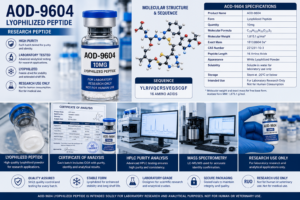
 AOD-9604 Lyophilized Peptide Overview
AOD-9604 lyophilized peptide refers to AOD-9604 supplied as a dry, lyophilized research material rather than as a prepared liquid solution.
Lyophilization, commonly called freeze-drying, is widely used for laboratory materials because it produces a dry preparation that can be packaged and maintained according to defined storage conditions. For research peptides, the lyophilized form is typically accompanied by product specifications and, where available, a lot-specific Certificate of Analysis (COA).
AOD-9604 is a synthetic peptide associated with the lipolytic domain of human growth hormone. PubChem identifies AOD-9604 by the sequence YLRIVQCRSVEGSCGF, with a molecular formula of C78H123N23O23S2 and a molecular weight of approximately 1,815.1 g/mol for the free compound.
For researchers evaluating AOD-9604, important documentation can include:
- Molecular identity
- Peptide sequence
- Molecular weight
- Chemical formula
- Product quantity
- Lot or batch number
- HPLC purity
- Mass-spectrometry identity testing
- Appearance
- Certificate of Analysis
- Storage information
The purpose of this page is to provide an educational overview of AOD-9604 as a lyophilized research peptide and explain how researchers can evaluate product documentation.
What Is AOD-9604?
AOD-9604 is a synthetic peptide that has been investigated in metabolic and obesity-related research.
PubChem describes AOD-9604 as a synthetic analogue of the lipolytic domain of human growth hormone. Its listed sequence is:
YLRIVQCRSVEGSCGF
The molecule contains 16 amino acids and a disulfide connection involving its cysteine residues.
AOD-9604 should not be confused with full-length human growth hormone. Although the compound is associated with a region of human growth hormone, it is a distinct synthetic peptide with its own molecular identity and analytical characteristics.
This distinction is particularly important when creating laboratory documentation, product specifications, and Certificates of Analysis.
What Does “Lyophilized Peptide” Mean?
Lyophilized peptide means the peptide has been processed into a dry preparation using lyophilization, or freeze-drying.
In general terms, lyophilization involves freezing a material and removing water under controlled conditions. The resulting dry preparation can then be packaged for laboratory use.
For research peptides, the lyophilized format can provide practical advantages for laboratory storage and transportation compared with a ready-made aqueous preparation.
However, lyophilization does not automatically establish purity, identity, sterility, or suitability for any particular research application.
Those characteristics must be evaluated through appropriate analytical testing and documentation.
AOD-9604 Lyophilized Peptide Specifications
The following table summarizes commonly referenced molecular information for AOD-9604.
| Specification | Information |
|---|---|
| Compound | AOD-9604 |
| Physical form | Lyophilized research peptide |
| Peptide sequence | YLRIVQCRSVEGSCGF |
| Peptide length | 16 amino acids |
| Molecular formula | C78H123N23O23S2 |
| Molecular weight | 1,815.1 g/mol* |
| CAS number | 221231-10-3 listed by PubChem |
| Research category | Synthetic peptide |
| Quality documentation | COA / analytical documentation where applicable |
*PubChem lists 1,815.1 g/mol for AOD-9604 free compound.
The exact chemical form should always be checked against the applicable product documentation.
AOD-9604 Molecular Weight
AOD-9604 molecular weight is an important specification for researchers working with peptide characterization and analytical methods.
PubChem currently lists the free compound at:
1,815.1 g/mol
The molecular formula is:
C78H123N23O23S2
The exact mass reported by PubChem is approximately 1813.8604 Da.
Researchers should distinguish between:
- Molecular weight
- Exact mass
- Monoisotopic mass
- Observed mass in mass spectrometry
These terms are related but are not interchangeable.
AOD-9604 Peptide Sequence
The AOD-9604 peptide sequence is:
YLRIVQCRSVEGSCGF
This sequence contains 16 amino acids.
PubChem identifies the compound with the systematic description corresponding to a cyclic disulfide between the cysteine residues.
Sequence information can be useful in:
- Peptide identification
- Molecular modeling
- Research database searches
- Analytical characterization
- Mass-spectrometry interpretation
- Laboratory documentation
When publishing a peptide sequence, it is good practice to cross-reference an authoritative chemical database and the supplier’s applicable specification sheet.
AOD-9604 Free Base vs. Acetate
One important consideration when evaluating AOD-9604 documentation is the chemical form.
AOD-9604 can be described as a free-base compound or as an acetate salt.
The FDA’s 2024 Pharmacy Compounding Advisory Committee materials distinguish between the two forms. FDA’s table lists AOD-9604 free base at approximately 1,815.09 g/mol with formula C78H123N23O23S2, while AOD-9604 acetate is listed at approximately 1,875.1 g/mol with formula C80H127N23O25S2.
This distinction matters when reviewing:
- COAs
- Molecular-weight calculations
- Mass-spectrometry data
- Product specifications
- Research databases
- Supplier documentation
A professional product page should therefore identify the chemical form rather than assuming that every AOD-9604 product has exactly the same reported molecular weight.
Why Chemical Form Matters for a COA
A Certificate of Analysis should correspond to the material actually tested.
FDA’s briefing materials specifically noted inconsistencies in public-domain information concerning AOD-9604 chemistry and COAs, including situations where a nominated material and the accompanying COA referred to different forms.
This highlights an important quality-control principle:
The product identity, chemical form, lot number, and analytical results should all agree.
A strong AOD-9604 COA should therefore clearly identify whether the tested material is:
- AOD-9604 free base
- AOD-9604 acetate
- Another defined formulation
AOD-9604 Purity
AOD-9604 purity is one of the most important analytical characteristics researchers may look for.
Purity is generally reported according to a defined analytical method. For peptide research materials, HPLC is commonly used for chromatographic characterization.
A purity percentage should always be associated with the actual tested lot.
For example:
Purity by HPLC: [actual laboratory result]
The value should come directly from the applicable laboratory report.
A website should not take a purity result from an unrelated batch and present it as the purity of every AOD-9604 vial.
This is particularly important for research products because manufacturing batches can have different analytical results.
AOD-9604 HPLC Analysis
High-performance liquid chromatography, or HPLC, is an analytical technique used to separate components within a sample.
For peptide research, HPLC can provide chromatographic information that helps characterize the sample and estimate purity according to the laboratory’s validated or specified method.
When reviewing an AOD-9604 HPLC result, researchers should look for:
- Product identification
- Lot number
- Testing date
- HPLC method
- Reported purity
- Chromatogram where provided
- Laboratory information
Different analytical methods can produce different results.
Therefore, comparing a single HPLC percentage without considering the analytical method can be misleading.
AOD-9604 Mass Spectrometry
Mass spectrometry can provide complementary information about peptide identity.
For AOD-9604, the expected molecular characteristics can be compared with the mass observed during analytical testing.
A mass-spectrometry report may contain:
- Expected molecular mass
- Observed molecular mass
- Sample identification
- Analytical method
- Testing date
- Laboratory information
When combined with HPLC analysis, mass spectrometry can provide a broader analytical picture of a research peptide.
HPLC primarily provides chromatographic separation information, while mass spectrometry can support molecular-mass identification.
AOD-9604 COA: Certificate of Analysis
An AOD-9604 COA should ideally be specific to the batch or lot being supplied.
A comprehensive certificate may include:
| COA Field | Recommended Information |
|---|---|
| Product name | AOD-9604 |
| Product form | Free base / acetate / applicable form |
| Lot number | Actual batch number |
| Quantity | Actual product quantity |
| Molecular weight | Applicable molecular specification |
| Sequence | YLRIVQCRSVEGSCGF |
| Appearance | Actual observation |
| HPLC purity | Actual laboratory result |
| Identity | Actual analytical result |
| Mass spectrometry | Actual result |
| Laboratory | Actual testing facility |
| Analysis date | Actual date |
| Certificate number | Actual number |
Do not publish placeholder values as laboratory results.
A COA is meaningful because it connects an analytical result to a particular material.
How to Evaluate an AOD-9604 COA
Researchers can use a simple quality-documentation checklist.
1. Confirm the Product
Check that the certificate identifies AOD-9604.
2. Confirm the Chemical Form
Determine whether the certificate describes free-base AOD-9604 or an acetate form.
3. Confirm the Lot
The lot number should match the product being evaluated.
4. Review the Molecular Information
Compare the reported molecular information with an authoritative database.
5. Review HPLC
Check the reported chromatographic purity and analytical method.
6. Review Mass Spectrometry
Look for identity or molecular-mass confirmation where available.
7. Review Laboratory Information
Confirm that the certificate identifies the testing facility.
8. Check the Date
Make sure the testing date corresponds to the applicable lot.
AOD-9604 Research Background
AOD-9604 has a history of investigation in metabolic research.
A 2000 study published in Hormone Research evaluated AOD9604 as a synthetic analogue of the lipolytic domain of human growth hormone in obese Zucker rats. Under the experimental conditions described, the researchers reported reduced body-weight gain and increased lipolytic activity in adipose tissue.
These findings are preclinical research findings.
They should not be presented as proof of a treatment effect in humans.
Later research investigated AOD-9604 in humans in the context of obesity-related development. Regulatory materials have raised characterization and safety questions concerning the substance, including peptide-related impurities and characterization challenges.
Consequently, an SEO product page should use scientific terminology such as:
- “research peptide”
- “laboratory research”
- “experimental compound”
- “analytical characterization”
rather than making unsupported therapeutic claims.
AOD-9604 and Weight-Loss Claims
AOD-9604 is frequently associated online with weight-loss discussions.
However, a research product page should not imply that AOD-9604 is an established weight-loss treatment.
The existence of preclinical findings does not establish clinical efficacy.
The FDA’s materials on AOD-9604 specifically discuss its investigation for obesity and raise concerns related to characterization and potential safety risks.
For SEO and compliance purposes, avoid claims such as:
- “guaranteed weight loss”
- “fat-burning treatment”
- “approved weight-loss peptide”
- “clinically proven fat loss”
- “safe for human use”
Instead, describe the compound’s research history accurately and keep the product positioned for laboratory research.
Lyophilized AOD-9604 Quality Considerations
The lyophilized form is only one part of product quality.
Researchers should consider several characteristics together:
Identity
Does the analytical documentation support the identity of the intended peptide?
Purity
What purity result was reported, and which method was used?
Chemical Form
Is the material free base or a salt such as acetate?
Lot Traceability
Can the COA be connected to the exact product lot?
Appearance
Does the physical material correspond to the documented appearance?
Storage
Are the storage requirements clearly documented?
Analytical Documentation
Are HPLC and mass-spectrometry results available where applicable?
A strong research product page should present these characteristics clearly without overstating what the documentation proves.
Lyophilized Peptide Storage
Storage requirements should be based on the specific product, formulation, packaging, and supplier documentation.
FDA’s 2024 briefing materials discussed storage recommendations for AOD-9604 acetate, including different temperature recommendations depending on storage duration.
Because storage requirements can depend on chemical form and intended duration, the safest product-page approach is:
Follow the storage conditions specified on the applicable product documentation and lot-specific documentation.
Researchers should also consider exposure to:
- Moisture
- Heat
- Light
- Repeated temperature changes
- Improper container closure
Prepared solutions may have different stability considerations from lyophilized material.
AOD-9604 10mg Lyophilized Peptide
For an AOD-9604 10mg research peptide, the “10mg” designation describes the quantity of material supplied.
It is separate from molecular weight.
For example:
Quantity: 10mg
Molecular weight: approximately 1,815.1 g/mol for the free compound
These values represent different physical properties.
Researchers performing quantitative calculations should rely on the exact product documentation and chemical form associated with their material.
Recommended Product-Page Quality Table
For an AOD-9604 lyophilized peptide product page, consider presenting the following:
| Product Information | Details |
|---|---|
| Product | AOD-9604 |
| Form | Lyophilized |
| Quantity | 10mg |
| Sequence | YLRIVQCRSVEGSCGF |
| Molecular weight | 1,815.1 g/mol* |
| Formula | C78H123N23O23S2* |
| Purity | Lot-specific |
| HPLC | Lot-specific |
| Identity/MS | Lot-specific |
| COA | Available where applicable |
| Intended use | Laboratory research only |
*Free-compound reference values from PubChem. Confirm the exact chemical form for the supplied material.
What Makes a High-Quality AOD-9604 Product Page?
A strong research product page should provide transparency rather than exaggerated marketing.
Use authoritative molecular information
Reference established chemical databases for sequence and molecular specifications.
Use lot-specific analytical information
Present actual COA data for the relevant batch.
Separate facts from research findings
A molecular specification is different from a biological claim.
Identify the chemical form
Free base and acetate should not be treated as identical analytical materials.
Avoid unsupported medical claims
Keep the product positioned for legitimate laboratory research.
Make documentation easy to understand
Use tables, headings, FAQs, and clear explanations.