

BPC-157 10mg: Research Peptide Quality and Documentation Guide
Introduction
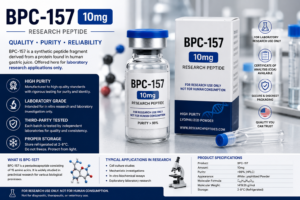
BPC-157 10mg is a highly specific product-search phrase used by researchers and buyers looking for information about a particular peptide presentation. A useful product page should go beyond promotional language and help visitors evaluate identity, analytical documentation, packaging, storage information, and the limits of the available scientific evidence.
BPC-157, also called Body Protection Compound-157, is commonly described in the scientific literature as a synthetic pentadecapeptide. Research interest has focused largely on preclinical and translational questions, while human clinical evidence remains limited. Current regulatory information also matters: BPC-157 is not an FDA-approved drug, and FDA materials identify unresolved issues involving safety information, immunogenicity, peptide-related impurities, and active-ingredient characterization for proposed human uses.
For that reason, this page is written for research and educational purposes. It does not provide dosing, injection, reconstitution, administration, or treatment instructions. No product claim should imply that BPC-157 10mg is approved to diagnose, treat, cure, or prevent disease.
What Is BPC-157 10mg?
The phrase BPC-157 10mg generally refers to a presentation containing a stated nominal amount of BPC-157 peptide per vial or unit. The amount shown on a product label is only one part of product identity. It does not, by itself, establish purity, sequence confirmation, stability, suitability for a particular experiment, or equivalence between suppliers.
For research procurement, complete identity should be evaluated using the product label and supporting technical documentation. Depending on the supplier and analytical method, useful records may include the peptide sequence, molecular mass information, batch or lot number, stated purity specification, analytical chromatogram, mass-spectrometry data, and certificate of analysis.
Researchers should also distinguish between a nominal quantity and a verified analytical result. A 10mg label describes a presentation; quality documentation is what helps establish whether the material supplied corresponds to the stated identity and specifications.
Understanding the Current Research Landscape
BPC-157 has been investigated in a range of experimental systems, with much of the published literature consisting of preclinical studies. Reviews and systematic assessments describe substantial biological research interest while also emphasizing important gaps in standardized formulations, human pharmacokinetics, controlled clinical evidence, and validated clinical dosing.
These gaps are important for scientific communication. Preclinical findings should not automatically be translated into claims about outcomes in humans. A responsible BPC-157 10mg page can describe the peptide as an investigational research subject while avoiding statements that present experimental observations as established medical benefits.
Recent literature has continued to examine formulation and translational barriers, including the limited clinical evidence base and the need for better characterized pharmaceutical development. For SEO and user trust, this uncertainty should be stated clearly rather than hidden behind broad claims such as “proven healing” or “guaranteed recovery.”
Why Product Identity Matters
Peptides are not interchangeable merely because they share a familiar product name. Product evaluation begins with identity.
Sequence and molecular information
Where appropriate for the product, researchers may review sequence information and the expected molecular characteristics supplied by the manufacturer. This information should be consistent across the label, certificate of analysis, and analytical records.
Lot or batch traceability
A lot or batch number provides a link between the physical material and its supporting documentation. For repeat research, traceability can be especially important when comparing experiments performed with different production lots.
Stated quantity
For a BPC-157 10mg presentation, confirm what the stated quantity represents and review any accompanying specification or analytical documentation. Avoid assuming that two 10mg products are analytically equivalent simply because their labels show the same nominal amount.
What to Look for in BPC-157 Quality Documentation
Quality evaluation should be based on evidence rather than marketing phrases such as “premium” or “highest purity.” Depending on the intended research application, a product record may include the following elements.
Certificate of Analysis
A Certificate of Analysis, often called a COA, can connect a specific lot with stated specifications and test results. Review whether the document identifies the product and lot clearly and whether the reported analytical methods are explained sufficiently for the intended research context.
Analytical purity information
Purity claims should identify the analytical basis used to generate them. Chromatographic data can provide useful information about sample composition, but a percentage alone does not answer every question about identity or impurity profile.
Identity confirmation
Appropriate analytical documentation may include mass information or another method used to support identity. The most relevant method depends on the product and the research requirements.
Handling and storage information
Storage guidance should come from the supplier’s current product documentation. Do not copy a storage rule from another peptide or another supplier and assume that it applies universally. Stability depends on the exact material, presentation, packaging, and documented conditions.
BPC-157 10mg Packaging and Product Presentation
Packaging is part of product quality communication. A clear product presentation should make it possible to identify the material and connect it to its documentation without creating a misleading impression that the product is an approved medicine.
A research-oriented label can clearly show:
- Product name: BPC-157
- Nominal presentation: 10mg, where accurate
- Lot or batch identification
- Supplier or manufacturer identification
- Storage information from current documentation
- Research-use or other applicable labeling limitations
Packaging should be inspected on receipt. Damaged vials, compromised seals, missing lot identifiers, mismatched documentation, or unexplained changes in product appearance should be addressed through the supplier’s documented quality process.
Responsible Research Use
The phrase BPC-157 research peptide should not be used as a substitute for a clear research policy. Before using a peptide in an experiment, researchers should review the relevant institutional procedures, study protocol, material specifications, and applicable legal or regulatory requirements.
The available evidence base does not justify presenting BPC-157 as an approved therapy. FDA has stated that it has limited safety information for proposed human routes and has identified concerns involving immunogenicity and peptide-related impurities. This is especially relevant to websites because phrases such as “medical grade,” “safe for injection,” or condition-specific treatment claims can create a misleading impression of regulatory status.
For human research, clinical development, or any regulated application, use the appropriate approvals, oversight, and product requirements. This page does not replace a protocol, ethics review, investigator guidance, manufacturer documentation, or regulatory advice.
How to Evaluate a BPC-157 Supplier
When comparing a BPC-157 supplier, transparency should carry more weight than aggressive promotional claims. A useful supplier evaluation may include:
- Clear product identity — The product name and nominal presentation are stated consistently.
- Lot traceability — Documentation can be connected to the specific material supplied.
- Accessible analytical information — Relevant COA and testing information is available for review where applicable.
- Consistent labeling — The vial, product page, and documentation do not contradict one another.
- Realistic claims — Marketing does not represent preclinical observations as proven human outcomes.
- Storage transparency — Current supplier guidance is available instead of generic, copied instructions.
- Documented limitations — Research-use restrictions and regulatory status are communicated clearly when applicable.
These checks do not guarantee suitability for every experiment, but they provide a more defensible starting point than choosing a product solely on price, search ranking, or broad purity claims.
BPC-157 10mg and Regulatory Considerations
Regulatory status is an important part of accurate product content. In the United States, BPC-157 is not an FDA-approved drug. FDA materials also describe safety and quality concerns associated with proposed human use of compounded BPC-157, including limited safety information and potential issues involving immunogenicity, peptide-related impurities, and active pharmaceutical ingredient characterization.
For athletes and organizations operating under anti-doping rules, the applicable rules should be checked directly. The World Anti-Doping Agency’s 2026 Prohibited List is in force, and BPC-157 appears in the list. Requirements can change, so athletes and support personnel should verify the current official rules rather than relying on a static product page.
Regulatory status can differ by country and by intended use. A website should therefore avoid implying that a research product has been approved, registered, or authorized unless that status can be verified for the exact jurisdiction and product.
Storage and Handling Considerations
There is no single storage instruction that should be applied to every BPC-157 product. Follow the conditions stated in the current documentation for the exact material and presentation.
Good documentation practice includes recording the lot, receipt date, storage conditions, and any handling steps required by the research protocol. If a product requires controlled conditions, those conditions should be maintained according to the supplier’s specifications and institutional procedures.
Avoid publishing universal “mixing,” reconstitution, injection, or dosing instructions on a research product page. Those activities involve application-specific decisions and, where human use is involved, potentially significant safety and regulatory issues.
BPC-157 10mg Product Specifications Checklist
Before selecting a product, review:
- Exact product identity
- Nominal quantity or presentation
- Lot or batch number
- Available certificate of analysis
- Analytical method and stated purity information
- Identity-supporting analytical data where available
- Packaging and closure integrity
- Current supplier storage guidance
- Research-use limitations and applicable regulatory information
This checklist helps keep the page focused on verifiable product information rather than unsupported outcome claims.