

PNC-27 30mg Overview
PNC-27
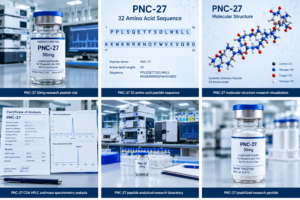
is a synthetic 32-amino-acid chimeric peptide that has been investigated in laboratory research involving the p53 protein region, HDM-2 interactions, peptide localization, and membrane-associated mechanisms. Published studies describe PNC-27 as a construct combining a p53-derived sequence with a membrane-residency or penetratin-derived sequence.
For researchers evaluating a PNC-27 30mg research peptide, molecular identity, sequence, analytical documentation, purity information, and batch traceability are important considerations.
The 30mg designation describes the quantity of material in the product format; it should not be interpreted as a recommended dose or administration amount. PNC-27 is presented here strictly as a laboratory research material and is not intended for human or veterinary use.
Published literature identifies the peptide sequence as:
PPLSQETFSDLWKLLKKWKMRRNQFWVKVQRG
The literature describes the first 15 residues as corresponding to residues 12–26 of human p53, while the remaining sequence forms the membrane-residency component used in the experimental construct.
What Is PNC-27?
PNC-27 is an experimentally studied synthetic peptide constructed from two functional sequence regions.
The first region corresponds to residues 12–26 of human p53. Research publications have characterized this region in relation to binding interactions involving HDM-2. The second region is a 17-residue membrane-residency sequence associated with the penetratin/Antennapedia-derived peptide system.
This architecture makes PNC-27 different from a simple short peptide representing only a portion of p53. Instead, it is a chimeric peptide construct, meaning that two sequence elements are connected into one synthetic peptide chain.
Researchers have studied PNC-27 in cellular and preclinical experimental systems. A 2022 peer-reviewed paper reported investigation of PNC-27 binding to HDM-2 and membrane-pore formation in experimental models.
These findings are useful for understanding why PNC-27 continues to appear in research literature, but they should not be interpreted as evidence of an approved medical application or established human therapeutic efficacy.
PNC-27 30mg Molecular Profile
For laboratory identification, researchers may compare the product documentation against established chemical identifiers.
| Property | PNC-27 Information |
|---|---|
| Product format | PNC-27 30mg |
| Peptide type | Synthetic chimeric peptide |
| Chain length | 32 amino acids |
| Sequence | PPLSQETFSDLWKLLKKWKMRRNQFWVKVQRG |
| Molecular formula | C₁₈₈H₂₉₃N₅₃O₄₄S |
| Molecular weight | Approximately 4,032 g/mol |
| CAS number | 1159861-00-3 |
| PubChem CID | 16201774 |
| Typical research format | Lyophilized peptide |
| Intended context | Laboratory research and analytical use |
Published and reference sources place the molecular mass at approximately 4,031–4,032 Da, depending on the reporting convention and molecular representation.
The molecular formula and CAS identifier are useful for distinguishing PNC-27 from related p53-derived experimental peptides.
PNC-27 Peptide Sequence
The complete published sequence for PNC-27 is:
PPLSQETFSDLWKLLKKWKMRRNQFWVKVQRG
It contains 32 amino-acid residues.
The construct can be viewed as two principal sequence regions:
p53-derived segment:
PPLSQETFSDLWKLL
Membrane-residency/penetratin-derived segment:
KKWKMRRNQFWVKVQRG
The first sequence segment corresponds to residues 12–26 of human p53, while the second sequence segment is the membrane-residency sequence described in the experimental literature.
Sequence verification is particularly important when evaluating peptide identity because closely related constructs can contain overlapping p53 regions while differing in their attached sequences.
For this reason, a laboratory buyer should evaluate the sequence listed on the applicable product documentation rather than relying only on a product name or abbreviated peptide label.
PNC-27 Molecular Weight
The reported molecular weight of PNC-27 is approximately 4,032 g/mol.
A published peptide table reports PNC-27 at approximately 4,031 Da, while current chemical-reference and commercial research sources report values around 4,031.72–4,032 g/mol.
Small differences in displayed molecular mass can occur because sources may use different conventions for average versus calculated molecular mass, terminal groups, or presentation of the molecular entity.
For analytical work, the most useful practice is to compare the supplier’s stated molecular mass with the batch-specific analytical documentation and the expected molecular identity.
PNC-27 Molecular Formula
The commonly reported molecular formula for PNC-27 is:
C₁₈₈H₂₉₃N₅₃O₄₄S
This formula corresponds to the published 32-residue construct and is reported by multiple current reference sources.
The molecular formula provides a useful chemical identifier, but it should not be considered a substitute for analytical verification.
For research procurement, formula, molecular weight, CAS number, sequence, purity testing, and lot information can be considered together when establishing material identity.
PNC-27 CAS Number
The commonly referenced CAS Registry Number for PNC-27 is:
1159861-00-3
Current research-reference sources associate this CAS number with PNC-27 and its published molecular identity.
When ordering or documenting a research compound, including the CAS number alongside the product name can reduce ambiguity, particularly when several related p53-derived peptides are discussed in scientific literature.
Researchers should nevertheless confirm the CAS identifier against the supplier’s current product documentation and the exact molecular form being supplied.
PNC-27 30mg Research Use
A PNC-27 30mg product should be understood as a research quantity rather than a therapeutic dosage.
The scientific literature has investigated PNC-27 in experimental systems involving peptide–protein interactions, cellular membranes, and membrane-associated activity. A 2022 study specifically examined the relationship between PNC-27, HDM-2, and selective membrane-pore formation.
Earlier peer-reviewed work also examined PNC-27 as a p53-derived peptide connected to an Antennapedia-derived leader sequence.
These studies provide scientific context for the compound, but laboratory findings should not be presented as established clinical outcomes.
Important evidence distinction
PNC-27 research remains experimental. Results reported in cellular or animal models do not establish safety, effectiveness, dosage, pharmacokinetics, or clinical benefit in humans.
Therefore, SEO and product content should use research-oriented language such as:
- “studied in laboratory models”
- “investigated in preclinical research”
- “research compound”
- “experimental peptide”
- “molecular and analytical research”
- “cellular research model”
Avoid claims that PNC-27 treats, cures, prevents, or diagnoses cancer or any other disease.
PNC-27 and p53 Research
One reason PNC-27 attracts scientific interest is its relationship to the p53 protein.
The construct contains a segment corresponding to residues 12–26 of human p53, a region associated with HDM-2 binding. The attached membrane-residency sequence forms the second component of the chimeric construct.
Researchers have therefore investigated PNC-27 in experimental systems designed to examine questions surrounding:
- p53-derived peptide structure
- HDM-2 interactions
- peptide localization
- membrane-associated peptide behavior
- membrane-pore formation
- cellular model responses
- peptide sequence–function relationships
The distinction between research mechanism and clinical application is important. A mechanism observed experimentally does not automatically translate into a safe or effective treatment in humans.
PNC-27 and HDM-2 Research
HDM-2 is an important part of the scientific context surrounding PNC-27.
Published research describes PNC-27 as containing a p53-derived segment involved in the p53/HDM-2 interaction. Experimental work has investigated whether this chimeric peptide can associate with HDM-2 in membrane-related environments and what effects may follow in cellular models.
This makes PNC-27 p53 peptide and PNC-27 HDM-2 research relevant informational keyword themes for scientific SEO.
However, product pages should avoid turning mechanistic research into medical promises. The correct framing is that these interactions have been studied experimentally.
PNC-27 COA and Analytical Quality
A Certificate of Analysis, or COA, can be an important part of research-peptide purchasing and documentation.
For a PNC-27 30mg product, researchers may want to review batch-specific documentation covering items such as:
- Product identification
- Lot or batch number
- Reported quantity
- Purity measurement
- Analytical method
- Molecular-mass confirmation
- Testing laboratory
- Test date
- Acceptance criteria
- Applicable analytical results
Published PNC-27 research has used analytical methods including HPLC and mass spectrometry. One published study reported PNC-27 as greater than 95% pure by HPLC and mass-spectrometric analysis.
That published result describes material used in a particular study and should not be presented as the purity specification of every commercially available PNC-27 30mg batch.
For commercial research material, the appropriate practice is to rely on the current, batch-specific COA rather than copying a historical purity number from scientific literature.
HPLC and Mass Spectrometry
HPLC and mass spectrometry are commonly relevant analytical techniques for peptide characterization.
HPLC
High-performance liquid chromatography can provide information about chromatographic purity and the presence of detectable components under the selected analytical conditions.
Mass spectrometry
Mass spectrometry can help evaluate whether the measured molecular mass is consistent with the expected peptide identity.
Together, these analytical approaches can provide stronger identity and quality information than a product label alone.
For a PNC-27 research peptide, researchers can compare the expected molecular mass and sequence information against the analytical documentation supplied for the specific lot.
PNC-27 30mg Lyophilized Peptide
PNC-27 is commonly presented by research suppliers as a lyophilized peptide. Current commercial reference pages describe PNC-27 in lyophilized powder form.
Lyophilization is widely used for peptide research materials because it allows the peptide to be supplied as a dry material before laboratory preparation.
The appropriate storage and handling conditions should always be determined from the current supplier documentation, product label, COA, and applicable laboratory procedures.
This page intentionally does not provide reconstitution instructions, administration directions, or dosing recommendations.
Why Researchers Review the 30mg Product Format
The phrase PNC-27 30mg combines the compound identity with a specific material quantity.
For SEO purposes, this distinction is useful because researchers searching for “PNC-27 30mg” may be looking for:
- Product availability
- Molecular information
- Sequence confirmation
- CAS identification
- COA documentation
- Purity information
- Research-use status
- Packaging information
- Analytical documentation
- Supplier information
The quantity itself should not be described as a therapeutic dose.
A clear product page should make this distinction visible so that both search engines and laboratory users understand what “30mg” means.
How to Evaluate a PNC-27 Research Supplier
When comparing PNC-27 research products, laboratory buyers can look beyond the product name.
1. Confirm identity
Check the peptide name, sequence, CAS number, molecular formula, and molecular weight.
2. Review the COA
Look for batch-specific analytical documentation rather than generic marketing claims.
3. Check analytical methods
Determine whether the supplier provides relevant HPLC, mass-spectrometry, or other identity/purity information.
4. Confirm quantity
Make sure the stated 30mg quantity corresponds to the actual product configuration.
5. Review research-use language
The product should be clearly represented as laboratory research material rather than a medication or consumer supplement.
6. Maintain lot traceability
For laboratory records, batch and lot information can be useful for connecting experimental results to the exact material evaluated.
PNC-27 Research Applications: Scientific Context
PNC-27 has appeared in research investigating several areas of experimental peptide science.
Published studies have examined its relationship to p53-derived sequences, HDM-2, membrane interactions, and cellular responses.
Potential informational research categories include:
Peptide biochemistry:
Studying sequence, structure, molecular identity, and peptide behavior.
Protein–peptide interactions:
Examining interactions involving p53-derived regions and HDM-2.
Membrane research:
Investigating peptide localization and membrane-associated behavior.
Analytical chemistry:
Evaluating peptide identity, purity, molecular mass, and batch consistency.
Cellular research:
Using appropriate experimental models to investigate published hypotheses involving PNC-27.
These are research categories rather than recommendations for a specific experimental protocol.
PNC-27 30mg Research-Use-Only Statement
Research Use Only.
PNC-27 30mg is intended strictly for laboratory research, analytical, educational, or experimental purposes where legally permitted. It is not intended for human or veterinary use.
PNC-27 is not presented as a drug, dietary supplement, medical treatment, or approved therapy. The information on this page describes published scientific literature and molecular/analytical characteristics and should not be interpreted as medical advice.
No therapeutic, diagnostic, or disease-prevention claims should be inferred from experimental findings.
PNC-27 Storage and Laboratory Documentation
Researchers should follow the storage requirements supplied with the specific product.
Storage information can vary according to peptide formulation, packaging, supplier specifications, and whether the material remains in its original dry state or has been otherwise prepared.
A laboratory inventory record can include:
- Product name
- CAS number
- Molecular weight
- Sequence
- Quantity
- Lot number
- Date received
- COA reference
- Supplier information
- Storage condition
- Relevant analytical documentation
Keeping these details together improves traceability and makes later experimental documentation easier.