

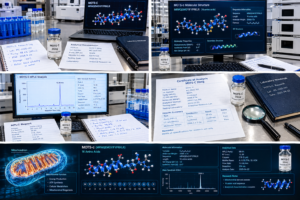
What Is MOTS-C 20mg?
MOTS-C 20mg refers to a nominal 20-milligram quantity of MOTS-c research material. MOTS-c is a short mitochondrial-derived peptide encoded by the mitochondrial 12S rRNA region. Scientific literature describes MOTS-c as a 16-amino-acid peptide that has been investigated in cellular and experimental research involving mitochondrial signaling and metabolic processes.
For researchers evaluating a MOTS-C 20mg product, the quantity alone is only one part of the analytical picture. Important documentation can include:
- Peptide identity
- Amino-acid sequence
- Molecular formula
- Molecular weight
- HPLC purity
- Mass spectrometry
- Certificate of Analysis (COA)
- Lot or batch number
- Testing date
- Analytical laboratory
- Physical appearance
- Additional quality-control information
A well-structured research-peptide product page should therefore combine technical identity information with batch-specific analytical documentation.
MOTS-c has attracted scientific interest because it is encoded within the mitochondrial genome rather than being a conventional nuclear-encoded peptide. Research published in Cell Metabolism identified MOTS-c as a 16-amino-acid mitochondrial-derived peptide and investigated its relationship with cellular metabolic homeostasis.
This research background makes MOTS-C a useful topic for laboratory-focused SEO content, but experimental findings should not be presented as established human therapeutic outcomes.
MOTS-C Peptide Sequence
The recognized human MOTS-c sequence is:
MRWQEMGYIFYPRKLR
The sequence contains 16 amino acids:
| Position | Amino Acid | One-Letter Code |
|---|---|---|
| 1 | Methionine | M |
| 2 | Arginine | R |
| 3 | Tryptophan | W |
| 4 | Glutamine | Q |
| 5 | Glutamic acid | E |
| 6 | Methionine | M |
| 7 | Glycine | G |
| 8 | Tyrosine | Y |
| 9 | Isoleucine | I |
| 10 | Phenylalanine | F |
| 11 | Tyrosine | Y |
| 12 | Proline | P |
| 13 | Arginine | R |
| 14 | Lysine | K |
| 15 | Leucine | L |
| 16 | Arginine | R |
PubChem lists the human MOTS-c sequence as MRWQEMGYIFYPRKLR.
Why the sequence matters
Sequence information is fundamental to peptide identification.
For laboratory researchers, sequence information can be compared with:
- Expected molecular mass
- Mass-spectrometry results
- Reference databases
- Synthesis specifications
- Certificate of Analysis documentation
- Analytical standards
This makes MOTS-C peptide sequence an important secondary keyword for a technically optimized product page.
MOTS-C Molecular Weight
PubChem lists MOTS-c with a molecular formula of:
C101H152N28O22S2
and a molecular weight of approximately:
2174.6 g/mol
The PubChem record also reports an exact mass of approximately 2174.1111 Da for the listed structure.
| MOTS-C Property | Information |
|---|---|
| Peptide | MOTS-c |
| Length | 16 amino acids |
| Sequence | MRWQEMGYIFYPRKLR |
| Molecular formula | C101H152N28O22S2 |
| Molecular weight | 2174.6 g/mol |
| CAS | 1627580-64-6 |
| Research classification | Laboratory research material |
Why molecular weight matters
Molecular-weight information can help researchers compare an expected peptide identity with analytical measurements.
Mass spectrometry is particularly useful because it can provide molecular-mass evidence alongside other analytical techniques.
However, molecular weight should not be used as the sole identity criterion. A comprehensive analytical evaluation can incorporate sequence information, chromatographic behavior, mass spectrometry, and batch documentation.
This is especially important for peptides because related compounds, salts, modifications, impurities, and different chemical forms can influence observed analytical values.
MOTS-C 20mg Research Peptide and Mitochondrial Biology
MOTS-c is categorized as a mitochondrial-derived peptide.
Research published in Cell Metabolism identified MOTS-c as a 16-amino-acid peptide encoded by a short open reading frame within mitochondrial 12S rRNA. The study investigated mechanisms involving metabolic signaling and reported experimental findings in cellular and animal models.
Subsequent reviews have examined MOTS-c as a mitochondrial-derived signaling peptide and discussed experimental research involving metabolic regulation, cellular stress responses, and mitochondrial biology.
For an SEO product page, however, these findings should remain clearly identified as research findings.
MOTS-C 20mg should not be presented as a treatment for diabetes, obesity, aging, cardiovascular disease, or another medical condition.
MOTS-C Laboratory Research
Laboratory research involving MOTS-c can be approached from several scientific perspectives.
Mitochondrial Research
Because MOTS-c originates from mitochondrial genetic information, it has become a subject of mitochondrial biology research.
Researchers can investigate questions involving:
- Mitochondrial signaling
- Cellular metabolic regulation
- Stress responses
- Peptide-mediated signaling
- Mitochondrial-derived peptides
- Cellular homeostasis
Metabolic Research
The original MOTS-c research reported effects involving metabolic pathways in experimental models. The researchers described connections involving skeletal muscle, folate metabolism, purine biosynthesis, and AMPK signaling.
These findings provide a scientific basis for continued laboratory investigation, but experimental animal or cellular findings should not automatically be extrapolated to humans.
Cellular Stress Research
Later literature has explored the relationship between MOTS-c and cellular stress signaling.
A research-focused product page can therefore position MOTS-C as a material relevant to investigations involving mitochondrial signaling and cellular biology, rather than making therapeutic promises.
MOTS-C Purity and Analytical Testing
For researchers evaluating MOTS-C 20mg material, purity is an important analytical consideration.
Common peptide-analysis approaches can include:
- RP-HPLC
- HPLC-UV
- LC-MS
- Mass spectrometry
- Peptide-content analysis
- Related-substance analysis
HPLC Analysis
High-performance liquid chromatography can separate components of a peptide sample and provide a chromatographic purity assessment.
A MOTS-C HPLC report may include:
- Main peak
- Retention time
- Area percentage
- Related peaks
- Chromatographic conditions
- Detection wavelength
- Sample identification
- Testing date
A reported HPLC percentage should always be interpreted according to the specific analytical method.
Mass Spectrometry
Mass spectrometry can complement chromatography by providing information about molecular mass.
For MOTS-C, researchers can compare observed mass information with the expected molecular characteristics of the peptide.
The strongest analytical documentation is therefore not simply a large purity percentage. Researchers should consider identity + purity + batch traceability together.
MOTS-C 20mg COA: Certificate of Analysis
A Certificate of Analysis (COA) is one of the most important documents associated with research peptide quality documentation.
For a MOTS-C 20mg product, a COA may include:
- Product name
- Lot number
- Batch number
- Test date
- Testing laboratory
- HPLC purity
- Identity testing
- Mass spectrometry
- Peptide content
- Appearance
- Analytical specification
- Test result
- Report number
Why batch-specific documentation matters
A COA should correspond to the specific batch being evaluated.
Researchers should compare the lot number appearing on the product documentation with the lot number on the COA.
A certificate from a different batch should not automatically be treated as evidence for the current batch.
What makes a COA useful?
A useful COA should allow a researcher to determine:
What was tested?
Which batch was tested?
When was it tested?
Who performed the analysis?
What analytical methods were used?
What were the measured results?
This makes COA transparency an important part of a research-peptide product page.
MOTS-C 20mg: Understanding Purity Results
Purity percentages can be useful, but they need context.
For example, an HPLC result may report a high percentage associated with the principal chromatographic peak.
That result does not automatically establish:
- Sterility
- Endotoxin status
- Absence of every possible impurity
- Clinical safety
- Therapeutic efficacy
- Human suitability
- Regulatory approval
Instead, HPLC purity should be understood as one component of analytical characterization.
For researchers, the most informative documentation combines:
HPLC → chromatographic profile
LC-MS/MS → identity and mass information
COA → batch-specific documentation
Sequence → molecular identity reference
Molecular formula → chemical reference
MOTS-C 20mg Research Material: What Researchers Should Check
Before evaluating a research peptide, researchers can review a documentation checklist.
1. Product Identity
Does the documentation clearly identify MOTS-c?
2. Sequence
Does the listed sequence correspond to the expected MOTS-c sequence?
3. Molecular Information
Does the molecular formula and molecular weight correspond to the stated chemical form?
4. Lot Number
Can the product be connected to a specific batch?
5. HPLC Result
Is a chromatographic purity result available?
6. Identity Testing
Is mass spectrometry or another identity method reported?
7. Testing Laboratory
Is the analytical laboratory identified?
8. Testing Date
Does the report identify when the sample was tested?
9. COA Availability
Can the relevant Certificate of Analysis be reviewed?
10. Research-Use Statement
Does the product documentation clearly distinguish research material from medical products?
This checklist can improve both transparency and commercial search relevance.
MOTS-C 20mg vs. MOTS-C Research Peptide
The phrases “MOTS-C 20mg” and “MOTS-C research peptide” can serve different search intents.
MOTS-C 20mg
This keyword is strongly product-oriented.
Users searching this phrase may be looking for:
- Product specifications
- Quantity
- Purity information
- COA
- Research documentation
- Analytical information
MOTS-C Research Peptide
This phrase has broader informational intent.
Users may be looking for:
- Scientific background
- Sequence
- Molecular weight
- Research applications
- Analytical testing
- Laboratory documentation
Using both keyword groups naturally allows a Peptides Grey House page to capture commercial and informational searches without excessive keyword repetition.
MOTS-C 20mg Quality Documentation
A transparent product page can organize technical documentation into several sections.
Product Information
- MOTS-c
- 20mg nominal quantity
- Research-use classification
Chemical Information
- Sequence
- Molecular formula
- Molecular weight
- CAS information
Analytical Information
- HPLC
- Mass spectrometry
- Purity
- Identity
Batch Documentation
- Lot number
- Testing date
- COA
- Laboratory report
Research Information
- Mitochondrial-derived peptide
- Cellular research
- Metabolic research
- Mitochondrial biology
This structure creates a comprehensive resource for users searching for MOTS-C 20mg research peptide information.
MOTS-C Scientific Background
MOTS-c was originally described as a mitochondrial-derived peptide encoded by a short open reading frame within mitochondrial DNA.
The 2015 Cell Metabolism study reported a 16-amino-acid peptide and investigated its role in metabolic homeostasis. The experimental work included cellular and mouse models.
Later reviews have described MOTS-c as a mitochondrial-derived peptide with experimental connections to metabolic signaling, cellular stress, and aging-related research.
Importantly, these publications represent scientific research, not an endorsement of MOTS-C 20mg as a medical treatment.
A responsible product page should preserve this distinction.
Why Researchers Search for MOTS-C Molecular Information
Technical searches such as:
- “MOTS-C molecular weight”
- “MOTS-C peptide sequence”
- “MOTS-C formula”
- “MOTS-C HPLC”
- “MOTS-C COA”
often indicate users who want to validate analytical or product information.
Including accurate molecular information can therefore strengthen topical relevance.
PubChem currently lists the sequence MRWQEMGYIFYPRKLR, molecular formula C101H152N28O22S2, and molecular weight 2174.6 g/mol for its MOTS-c record.
MOTS-C 20mg Research-Use Statement
MOTS-C 20mg is intended for laboratory research and scientific investigation only. This material is not represented as an FDA-approved medication, dietary supplement, or therapeutic product. It is not intended to diagnose, treat, cure, or prevent any disease or medical condition. This page does not provide human or veterinary dosing, administration, injection, or treatment instructions. Researchers should follow appropriate laboratory safety procedures, institutional protocols, supplier documentation, and all applicable laws and regulations.
Frequently Asked Questions About MOTS-C 20mg
What is MOTS-C 20mg?
MOTS-C 20mg refers to a nominal 20mg quantity of MOTS-c research material. MOTS-c is a 16-amino-acid mitochondrial-derived peptide encoded within the mitochondrial 12S rRNA region.
What is the MOTS-C peptide sequence?
The human MOTS-c sequence is MRWQEMGYIFYPRKLR. PubChem identifies it as a 16-amino-acid peptide.
What is the molecular weight of MOTS-C?
PubChem lists MOTS-c with a molecular weight of approximately 2174.6 g/mol for the listed molecular form.
What is the molecular formula of MOTS-C?
The molecular formula listed by PubChem is C101H152N28O22S2.
What is MOTS-C used for in research?
MOTS-c has been investigated in experimental research involving mitochondrial signaling, cellular metabolism, metabolic homeostasis, and cellular stress. These areas represent research contexts rather than established therapeutic uses.
What is MOTS-C HPLC testing?
HPLC testing separates components in a peptide sample and can provide a chromatographic purity assessment. Researchers should interpret the result according to the analytical method and report accompanying the test.
Why is a MOTS-C COA important?
A Certificate of Analysis can provide batch-specific information such as purity, identity testing, lot number, testing date, and analytical laboratory information.
Does a high HPLC purity percentage prove that MOTS-C is safe?
No. HPLC purity is an analytical measurement and does not establish human safety, therapeutic efficacy, or regulatory approval.
What should I look for on a MOTS-C 20mg COA?
Look for the product identity, lot number, testing laboratory, test date, analytical method, HPLC result, identity testing, and other applicable quality-control information.
Is MOTS-C the same as a conventional protein hormone?
MOTS-c is a short mitochondrial-derived peptide consisting of 16 amino acids. Scientific literature distinguishes it from conventional longer protein hormones.
Is MOTS-C 20mg FDA approved?
A research-material product should not be represented as an FDA-approved medicine simply because MOTS-c appears in scientific databases or research publications. A COA documents analytical results; it does not establish FDA approval.