

Ara-290 16mg Research Peptide
Ara-290, also known as cibinetide, is a synthetic peptide that has been investigated in scientific research involving the tissue-protective receptor system. For laboratory researchers evaluating Ara-290 16mg, product identity, chemical form, analytical documentation, purity, and lot traceability are important considerations when selecting research material.
PubChem identifies cibinetide as an 11-residue peptide with the sequence XEQLERALNSS, where X represents pyroglutamic acid at the N-terminus. PubChem lists the molecular formula of the free compound as C51H84N16O21 and a molecular weight of approximately 1257.3 g/mol.
Importantly, the chemical form should always be confirmed when comparing specifications. PubChem separately lists ARA290 cibinetide acetate, with a molecular formula of C53H88N16O23 and a molecular weight of approximately 1317.4 g/mol.
That distinction makes analytical documentation particularly important for researchers purchasing or comparing Ara-290 materials.
Research Use Only
Ara-290 16mg described on a research-material page should be presented exclusively for legitimate laboratory and analytical research. It should not be marketed as a product for diagnosis, treatment, prevention, or mitigation of disease, and product information should not provide instructions for human or veterinary administration.
Research Use Only. Not for human or veterinary use. Not intended to diagnose, treat, cure, mitigate, or prevent any disease or condition.
What Is Ara-290?
Ara-290 is a synthetic peptide also known as cibinetide. It has been studied as a peptide research compound associated with the tissue-protective receptor system.
From a chemical perspective, Ara-290 is an 11-amino-acid peptide. PubChem reports its sequence as:
XEQLERALNSS
The first residue is represented by X, corresponding to pyroglutamic acid.
Researchers evaluating a peptide such as Ara-290 generally need more than a product name. Identity, chemical form, lot information, analytical purity, and appropriate characterization data can all affect whether a material is suitable for a particular laboratory workflow.
This is why a high-quality Ara-290 16mg research peptide page should provide transparent information about analytical documentation rather than relying solely on marketing terminology such as “high purity.”
Ara-290 16mg: Understanding the Product Specification
The term 16mg describes the stated quantity of material in the product presentation. It does not by itself establish peptide purity, identity, chemical form, or analytical quality.
For research procurement, scientists may want to distinguish between several pieces of information:
- Stated quantity
- Peptide identity
- Chemical form or salt form
- Molecular weight
- Molecular formula
- Lot number
- Purity result
- Analytical method
- Identity testing
- Manufacturing or testing date
- Storage information
- Certificate of Analysis availability
A 16mg quantity can therefore be considered a packaging or quantity specification, while analytical specifications provide information about the material itself.
Researchers should review the documentation associated with the specific lot rather than assuming that every Ara-290 product has identical analytical characteristics.
Ara-290 Molecular Weight and Chemical Information
Chemical reference information is useful when designing analytical workflows, reviewing mass-spectrometry results, or comparing supplier documentation.
For cibinetide/Ara-290 free compound, PubChem reports:
| Property | Ara-290 / Cibinetide |
|---|---|
| Common name | Ara-290 / Cibinetide |
| Peptide length | 11 residues |
| Sequence | XEQLERALNSS |
| Molecular formula | C51H84N16O21 |
| Molecular weight | ~1257.3 g/mol |
| PubChem CID | 91810664 |
For Ara-290 acetate, PubChem reports:
| Property | Ara-290 Acetate |
|---|---|
| Molecular formula | C53H88N16O23 |
| Molecular weight | ~1317.4 g/mol |
| Sequence | XEQLERALNSS |
| Form | Acetate |
| PubChem CID | 163342019 |
Why Chemical Form Matters
A common mistake in peptide research content is treating a free compound and a salt form as though they necessarily have the same reported molecular weight.
They do not.
For that reason, an Ara-290 COA should ideally identify the material being tested and make the applicable chemical form clear. Researchers comparing theoretical mass with experimental mass-spectrometry results should use the molecular information corresponding to the actual material.
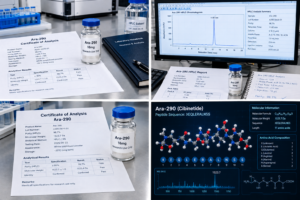
Ara-290 Peptide Sequence
The documented Ara-290/cibinetide sequence is:
XEQLERALNSS
PubChem describes the peptide as:
H-Pyr-Glu-Gln-Leu-Glu-Arg-Ala-Leu-Asn-Ser-Ser-OH.
This sequence information is relevant to laboratory researchers working with peptide identity, analytical characterization, database searches, or mass-spectrometry workflows.
Sequence information should not, however, be interpreted as proof of purity. A sample can have the expected nominal sequence while still containing related impurities, truncated sequences, residual reagents, salts, or other process-related components.
That is one reason multiple analytical approaches can be useful when characterizing research peptides.
Ara-290 HPLC Analysis
High-performance liquid chromatography (HPLC) is commonly used in peptide analytical workflows to evaluate chromatographic profiles and estimate purity.
For an Ara-290 research material, an HPLC report may provide information such as:
- Main chromatographic peak
- Retention time
- Relative peak area
- Reported purity
- Analytical method
- Column or method information
- Detection wavelength
- Test date
- Lot identification
An HPLC percentage should be interpreted in the context of the method used. A stated chromatographic purity value is not automatically equivalent to absolute chemical purity across every possible analytical method.
For researchers, the most useful documentation connects the analytical result to a specific lot number.
What to Look for in an Ara-290 HPLC Report
When reviewing an Ara-290 HPLC document, consider whether it includes:
- Product name
- Lot or batch number
- Sample identification
- Analytical method
- Chromatogram
- Reported purity
- Retention time
- Testing date
- Laboratory or testing organization
- Applicable specification
This type of documentation makes analytical records easier to evaluate and maintain.
Ara-290 COA: Certificate of Analysis
A Certificate of Analysis (COA) is an important document for research-material procurement because it connects a product or material to specific testing information.
An Ara-290 COA may include:
- Product identification
- Lot number
- Batch number
- Quantity
- Appearance
- Purity
- Identity testing
- HPLC results
- Mass-spectrometry results
- Molecular information
- Test date
- Specification limits
- Storage conditions
- Testing laboratory
The exact contents of a COA vary by supplier and analytical program.
Why Lot-Specific COA Documentation Matters
A general product page can describe an Ara-290 material, but a lot-specific COA provides information about the actual batch being referenced.
For research laboratories, this distinction is important for:
- Procurement records
- Experimental documentation
- Batch comparison
- Internal quality systems
- Analytical traceability
- Reproducibility
- Material qualification
A strong Ara-290 certificate of analysis should therefore be traceable to the corresponding lot.
Ara-290 Purity Testing
Purity is one of the most important quality considerations when evaluating synthetic peptides.
For Ara-290, researchers may encounter purity information expressed as a percentage based on an analytical method. HPLC is one common approach, while mass spectrometry can provide complementary information about molecular identity.
A robust peptide characterization strategy may consider multiple analytical dimensions rather than relying on a single number.
HPLC Purity
HPLC can provide a chromatographic profile and estimate the proportion of the principal detected component under the stated analytical conditions.
Mass Spectrometry
Mass spectrometry can help evaluate whether the observed molecular mass is consistent with the expected compound.
Identity Testing
Identity testing can provide additional evidence that the material corresponds to the intended peptide.
Documentation
The analytical result becomes more useful when it is linked to the exact lot, test date, method, and product identity.
Researchers should avoid interpreting a purity percentage without considering the analytical method and specification behind it.
Ara-290 Mass Spectrometry
Mass spectrometry is particularly useful for peptide characterization because molecular mass provides an additional analytical dimension beyond chromatographic separation.
For Ara-290/cibinetide, the expected molecular information depends on the chemical form.
PubChem lists the free compound at approximately 1257.3 g/mol, while the acetate form is listed at approximately 1317.4 g/mol.
Consequently, researchers reviewing mass-spectrometry data should verify whether their reference value corresponds to:
- Free compound
- Acetate form
- Another documented salt or formulation
- The expected ion/adduct state in the analytical method
This prevents a common analytical error: comparing an experimental signal against the wrong reference form.
Ara-290 Research Applications
Ara-290/cibinetide has appeared in scientific research examining biological mechanisms associated with tissue protection and receptor signaling.
For an SEO and research-material page, it is important to distinguish research history from claims about established clinical use.
Researchers may investigate Ara-290 in areas such as:
- Peptide-receptor interactions
- Molecular signaling
- Cell-based research
- Biochemical studies
- Protein and peptide characterization
- Analytical method development
- Experimental receptor biology
The existence of published research does not establish that a research peptide is an approved treatment or that experimental findings can be generalized to humans.
FDA guidance concerning peptide drug development also emphasizes the importance of issues such as pharmacokinetics, safety, drug interactions, and immunogenicity during development of peptide drug products.
Ara-290 16mg for Laboratory Research
For qualified researchers, selecting a research peptide involves more than comparing package size.
A useful procurement checklist includes:
1. Identity
Confirm that the material is identified as Ara-290/cibinetide and verify the stated sequence or chemical description.
2. Chemical Form
Determine whether the material is supplied as the free compound or a documented salt form.
3. Purity
Review the stated analytical purity and the method used to determine it.
4. COA
Request or review a lot-specific Certificate of Analysis.
5. HPLC
Check whether chromatographic data are available and associated with the applicable lot.
6. Mass Spectrometry
Look for identity or molecular-mass characterization where provided.
7. Traceability
Confirm that the product identifier, lot number, and analytical documents correspond.
8. Storage Information
Follow the supplier’s documented storage conditions and laboratory quality procedures.
How to Evaluate an Ara-290 Research Peptide Supplier
Researchers comparing Ara-290 materials in the United States can use a documentation-focused checklist rather than relying on marketing language.
Look for:
Clear identity:
The product should have a defined name and chemical description.
Lot traceability:
The COA should correspond to a specific lot or batch.
Analytical transparency:
HPLC, mass spectrometry, or other characterization information should be clearly identified.
Accessible documentation:
Researchers should be able to review applicable quality documents before or alongside procurement.
Research-use labeling:
The product and website should clearly communicate the intended research-only status.
No unsupported medical claims:
A research-material supplier should distinguish laboratory information from therapeutic claims.
The FDA has specifically warned that simply placing “research use only” language on a product does not determine regulatory status when surrounding marketing demonstrates an intended human-use purpose.
For that reason, responsible research-peptide content should keep product descriptions, analytical information, and research applications separate from human-use claims.
Ara-290 16mg Quality-Control Checklist
Before incorporating a new research peptide into a laboratory workflow, researchers can document:
-
Product identity
-
Chemical form
-
Lot number
-
Quantity
-
Molecular formula
-
Molecular weight
-
Peptide sequence
-
HPLC documentation
-
Purity result
-
Identity testing
-
Mass-spectrometry data, when available
-
COA
-
Test date
-
Storage information
-
Supplier documentation
This approach supports better laboratory traceability and helps researchers distinguish verified analytical information from generic product descriptions.
Ara-290 16mg in the U.S. Research Market
For U.S.-based researchers, product documentation should be considered alongside applicable institutional, laboratory, shipping, and regulatory requirements.
A “research use only” designation is not a substitute for regulatory compliance. FDA enforcement actions have emphasized that intended use can be evaluated based on the overall marketing and circumstances surrounding a product, not merely a disclaimer appearing on a label.
Accordingly, a U.S.-targeted Ara-290 research page should avoid:
- Human dosing instructions
- Injection instructions
- Treatment protocols
- Disease-treatment claims
- Therapeutic promises
- Claims that a product is FDA-approved
- Instructions for preparing a peptide for human administration
Instead, the page should focus on identity, analytical testing, documentation, and legitimate laboratory research.
Why HPLC and COA Documentation Work Together
HPLC and COA documentation answer related but different questions.
HPLC:
What does the chromatographic profile of the tested sample look like, and what purity result was obtained under the specified method?
COA:
What material was tested, which lot was tested, what specifications were applied, and what were the reported results?
When these records are properly linked, researchers can build a stronger chain of analytical traceability.
For Ara-290 16mg, this means a researcher should ideally be able to connect:
Product → Lot → COA → Analytical Test → Result
That chain is more meaningful than an isolated “high purity” claim.
Frequently Asked Questions About Ara-290 16mg
What is Ara-290?
Ara-290, also called cibinetide, is a synthetic 11-residue peptide. PubChem lists the sequence as XEQLERALNSS.
What is the molecular weight of Ara-290?
PubChem lists cibinetide/Ara-290 at approximately 1257.3 g/mol.
What is the Ara-290 peptide sequence?
The documented sequence is XEQLERALNSS, with X representing pyroglutamic acid.
Is Ara-290 the same as Ara-290 acetate?
They refer to related chemical forms, but they should not automatically be treated as having the same molecular weight. PubChem lists Ara-290/cibinetide at approximately 1257.3 g/mol and Ara-290 acetate at approximately 1317.4 g/mol.
What does an Ara-290 COA show?
A COA can document product identity, lot information, analytical results, purity, testing methods, and other quality specifications. The exact contents depend on the testing program.
Why is HPLC important for Ara-290?
HPLC can provide chromatographic information and a reported purity result under defined analytical conditions. It is useful as part of a broader peptide characterization strategy.
Does HPLC prove peptide identity?
Not by itself. HPLC primarily provides chromatographic information. Identity may require complementary analytical techniques, such as mass spectrometry or other validated testing.
Why should researchers check the lot number?
A lot number connects the material to its specific production and analytical documentation. This improves traceability and helps researchers maintain consistent laboratory records.
Is Ara-290 16mg intended for human use?
Research-material listings should not be presented as instructions or products for human or veterinary use. The intended purpose of this page is laboratory and analytical research only.
Where can researchers find Ara-290 analytical information?
Researchers should review the applicable product documentation and lot-specific COA, including available HPLC and identity-testing information.
Is Ara-290 FDA-approved?
A research peptide should not be represented as FDA-approved unless a specific approved drug product and indication can be verified through authoritative FDA sources. Research-material status should not be confused with drug approval.