

MOTS-C 40mg Purity: A Complete Guide to HPLC Testing, COA Reports, and Research Quality
Introduction to MOTS-C 40mg Purity
MOTS-C 40mg purity is an important consideration for laboratory researchers evaluating peptide identity, analytical quality, batch consistency, and documentation. When comparing research peptides, the product label alone does not establish purity. Reliable evaluation requires appropriate analytical methods, traceable batch information, and a Certificate of Analysis (COA) that corresponds to the material being examined.
MOTS-C, also written as MOTS-c, is a mitochondrial-derived peptide studied in scientific research involving cellular signaling and metabolic processes. Researchers evaluating MOTS-C research material should distinguish between published scientific interest in the peptide and the verified analytical properties of a particular laboratory sample.
For Peptides Grey House, a strong MOTS-C 40mg purity resource should explain what purity percentages mean, how high-performance liquid chromatography (HPLC) is used, why mass spectrometry matters, and how to interpret batch-specific quality documentation.
Important: A purity percentage should never be presented as verified for a particular product unless supporting analytical documentation is available. Any specification published on this page should be checked against the current lot-specific report.
What Does MOTS-C 40mg Purity Mean?
MOTS-C 40mg describes the nominal quantity indicated on a product label. Purity describes a separate analytical characteristic: the proportion of detected material attributed to the principal peptide under a specified testing method.
These measurements are related to quality assessment, but they are not interchangeable.
For example, a hypothetical laboratory report might show 99% chromatographic purity. That result does not automatically establish that the container holds exactly 40mg of peptide, that the material is sterile, or that it is suitable for any particular experimental application.
When assessing MOTS-C 40mg purity, researchers should examine several distinct questions:
- Identity: Does the analytical evidence support the claimed peptide identity?
- Chromatographic purity: What percentage of the measured detector signal is attributed to the principal peak?
- Peptide content: How much of the measured sample is attributable to the peptide itself?
- Net fill: What quantity of material is present in the container?
- Contaminant testing: Have relevant contaminants been assessed using suitable methods?
- Traceability: Does the report match the batch or lot under consideration?
A scientifically useful quality assessment considers these characteristics together rather than relying on one headline percentage.
Why MOTS-C Purity Testing Matters
Purity testing helps researchers characterize a material before incorporating it into a controlled laboratory workflow. Impurities, degradation products, related peptide sequences, residual synthesis materials, and differences in sample composition can affect analytical interpretation.
A transparent testing process can help researchers determine whether a sample meets predefined specifications for an intended laboratory investigation.
However, a high reported purity percentage is not a universal guarantee of quality. The result depends on the analytical method, detector response, sample preparation, reference standards, and reporting criteria.
For this reason, claims such as “high purity,” “research grade,” or “99% pure” should be supported by documentation rather than treated as self-verifying marketing descriptions.
HPLC Analysis of MOTS-C 40mg
High-performance liquid chromatography, commonly abbreviated as HPLC, is an analytical technique used to separate components within a sample. In peptide analysis, reverse-phase HPLC is frequently used to evaluate the principal peptide peak and other detectable components.
During a typical analysis, a prepared sample passes through a chromatographic column. Components separate according to their interactions with the stationary phase and mobile phase. A detector records signals as the components leave the column, producing a chromatogram.
How to Interpret an HPLC Chromatogram
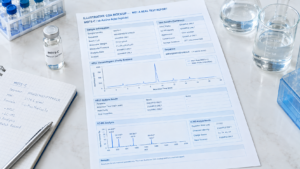
A chromatogram typically displays detector response against retention time. The principal peptide may appear as a prominent peak, while other detected components may appear as smaller peaks.
When a report provides area-based purity, the laboratory generally calculates the proportion of the integrated signal attributed to the principal peak relative to the integrated signals included in the calculation.
The exact calculation depends on the validated method and its reporting rules.
When reviewing an MOTS-C HPLC report, look for:
- The stated analytical method.
- The detector used and relevant detection wavelength.
- The principal peak and its retention time.
- Integrated peak areas and reported purity.
- The sample identification and batch number.
- The laboratory name and report date.
- Any stated limitations or acceptance criteria.
A chromatogram image without sample identification or a corresponding report is weaker evidence than a traceable analytical record.
Does 99% HPLC Purity Mean 99% Peptide Content?
No. This is one of the most important distinctions in peptide quality evaluation.
Chromatographic purity is often calculated from detector peak areas. Peptide content is a different measurement that estimates the quantity of peptide in the sample. Water, counterions, residual solvents, salts, and other materials may affect the measured content without necessarily appearing as equivalent signals in a conventional chromatographic purity calculation.
Consequently, a sample can have a high HPLC purity result while its actual peptide content is lower than the nominal vial quantity.
Researchers should check whether the COA reports chromatographic purity, peptide content, net fill, or more than one of these measurements.
Mass Spectrometry and MOTS-C Identity Confirmation
Mass spectrometry (MS) provides information about the mass-to-charge ratios of detected ions. When used appropriately, it can help assess whether the measured material is consistent with the expected molecular mass of MOTS-C.
Liquid chromatography–mass spectrometry (LC-MS) combines chromatographic separation with mass analysis. This can provide complementary information about the principal component and the identity of the material being evaluated.
HPLC and mass spectrometry answer different questions.
HPLC helps characterize the distribution of detected components under a defined chromatographic method. Mass spectrometry provides evidence about molecular mass and identity. Using both methods can provide a more informative analytical picture than relying on a purity percentage alone.
Nevertheless, mass agreement does not necessarily establish every aspect of molecular structure, and neither method by itself proves sterility, biological activity, or suitability for human use.
For a research peptide, the strongest documentation clearly identifies the methods used and links the results to the relevant batch.
How to Read an MOTS-C 40mg Certificate of Analysis
A Certificate of Analysis, or COA, summarizes analytical results for a defined sample or batch. It should allow a qualified reviewer to understand what was tested, which methods were used, and whether the results meet the laboratory’s stated criteria.
When reviewing a COA for MOTS-C 40mg, examine the following fields.
1. Product Name and Batch Number
The product name should identify MOTS-C, and the lot or batch number should correspond to the material being evaluated.
A report for a different lot should not be used as proof of the current batch’s purity. If a supplier changes batches, the corresponding documentation should change as well.
2. Testing Laboratory
The report should identify the laboratory responsible for the analysis. Where relevant, reviewers should verify laboratory credentials, the scope of accreditation, and whether the reported method falls within that scope.
A statement that testing was performed independently is not, by itself, proof of a laboratory’s accreditation or competence.
3. HPLC Purity Result
Look for the reported purity percentage and the method used to calculate it. Review the chromatogram when available and check whether the result meets the stated acceptance criteria.
Do not assume that two percentages produced by different methods are directly comparable.
4. Molecular Identity
Check whether the report includes mass spectrometry or another suitable identity test. The result should be consistent with the claimed peptide and should be traceable to the tested sample.
5. Peptide Content and Net Fill
These fields help distinguish the amount of peptide present from the total mass of material in a container.
If the product is labeled 40mg, a nominal label claim should not be treated as an independently measured content result unless the report supports that conclusion.
6. Additional Contaminant Tests
Depending on the intended research and quality requirements, further testing may include residual solvents, water content, elemental impurities, bacterial endotoxins, or microbial contamination.
Each test has a specific scope. A purity test does not automatically demonstrate that all other contaminants have been assessed.
7. Date, Signature, and Report Traceability
The report should include appropriate dates and identifiers. When available, confirm the certificate through the issuing laboratory’s verification system.
The goal is to establish a credible connection between the report, the tested sample, and the material being considered.
What Is a Good MOTS-C 40mg Purity Standard?
There is no single purity percentage that, on its own, guarantees suitability for every research application. Acceptance criteria should be established according to the analytical requirements of the experiment and the material specification.
Some suppliers advertise thresholds such as 98% or 99% HPLC purity. These figures are commercial specifications unless they are supported by the applicable test report. They should not be treated as universal scientific standards.
When comparing MOTS-C research materials, assess:
- Whether the analytical method is clearly identified.
- Whether the reported result meets the declared specification.
- Whether peptide identity is independently supported.
- Whether content and net fill are reported separately.
- Whether relevant contaminant testing is documented.
- Whether the report is traceable to the specific lot.
- Whether the documentation is sufficiently detailed to be reviewed.
A transparent, verifiable report is more informative than a bold purity claim without supporting evidence.
Factors That Can Affect Peptide Quality
Peptide quality can be influenced by synthesis, purification, packaging, transportation, storage, and handling. A product’s analytical profile at one point in time does not necessarily establish its condition after unsuitable storage or repeated handling.
Manufacturing and Purification
Synthesis and purification processes influence the types and levels of impurities that may remain in a sample. Appropriate analytical testing helps characterize the resulting material.
Moisture and Environmental Exposure
Peptide powders may be affected by moisture, temperature, and other environmental factors. Appropriate storage conditions should be determined from validated product-specific information rather than assumed from the product name.
Transportation and Packaging
Packaging integrity and transportation conditions can affect sample condition. Buyers and laboratory personnel should review available handling documentation and investigate any damage or evidence of compromised packaging.
Batch-to-Batch Variation
Different production batches may have different analytical results. Previous test results should not automatically be carried forward to a new lot.
A consistent quality process requires appropriate checks for each relevant batch and clear documentation of any changes.
Choosing MOTS-C 40mg for Laboratory Research
Researchers evaluating MOTS-C 40mg should prioritize documentation, material traceability, and suitability for the intended laboratory protocol.
Before selecting a research reagent, review the product specification, analytical methods, certificate availability, and handling documentation. Consider whether the supplier can explain the difference between purity, peptide content, net fill, and contaminant testing.
For Peptides Grey House, publishing clear specifications and accessible batch documentation can support informed evaluation and improve the credibility of product-related content.
A responsible product page should avoid guaranteeing experimental outcomes or presenting analytical purity as evidence of biological effectiveness.
MOTS-C is a research subject, not an established consumer wellness ingredient. Research interest in cellular signaling or metabolic pathways should not be interpreted as proof that a research peptide is effective or safe as a treatment.
Frequently Asked Questions About MOTS-C 40mg Purity
What does MOTS-C 40mg purity mean?
It refers to the analytical purity of MOTS-C supplied with a nominal 40mg label claim. The actual purity must be established using an appropriate test report for the specific batch.
How is MOTS-C purity tested?
HPLC is commonly used to separate and quantify detectable components under a specified method. Mass spectrometry can provide complementary evidence about molecular identity.
Is 99% HPLC purity the same as 99% peptide content?
No. HPLC purity is often based on detector peak areas, whereas peptide content estimates the amount of peptide in the sample. These values should be reported and interpreted separately.
What is a COA for MOTS-C 40mg?
A Certificate of Analysis documents results for a defined sample or batch. It may include identity, purity, peptide content, appearance, and additional tests relevant to the material specification.
Should the COA match the batch number?
Yes. The batch identifier on the report should match the lot being evaluated. A certificate for another batch does not establish the purity of the current material.
Does high purity mean MOTS-C is safe for humans?
No. Analytical purity does not establish human safety, clinical effectiveness, sterility, or regulatory approval. Research-use material should not be used for self-administration.
Does HPLC alone confirm peptide identity?
Not necessarily. HPLC can characterize separation and purity under a defined method, but a suitable identity method, such as mass spectrometry, provides additional evidence.
Why can peptide content be lower than the labeled quantity?
The nominal quantity on a label may differ from the measured peptide content. Water, counterions, residual materials, and differences in measurement methods can contribute to that distinction.
How often should MOTS-C purity be verified?
Verification should be appropriate to the quality system and research requirements. Each relevant batch should have traceable documentation, and results should not be assumed to apply to subsequent lots.
Is MOTS-C 40mg FDA-approved for treatment?
MOTS-C research material should not be represented as an FDA-approved treatment. Researchers and consumers should consult authoritative regulatory information before drawing conclusions about a product’s status.
Conclusion: Evaluate MOTS-C 40mg Purity With Verifiable Evidence
MOTS-C 40mg purity is best evaluated through a combination of HPLC analysis, suitable identity testing, peptide-content information, and batch-specific documentation.
For laboratory researchers, the most useful COA is one that identifies the sample, explains the methods used, reports the relevant results, and can be connected to the batch under review.
Peptides Grey House can strengthen this page by publishing accurate specifications, providing accessible lot-specific documentation where available, and clearly distinguishing verified analytical results from general descriptions.
Research-use notice: MOTS-C research material is intended for qualified laboratory research only, not for human or veterinary use, diagnosis, treatment, or self-administration. Analytical results apply only to the samples and methods documented in the relevant reports.