

Introduction to SNAP-8 Purity
When evaluating a research peptide, the word purity can describe several different analytical concepts. For SNAP-8, also known as Acetyl Octapeptide-3, a meaningful purity assessment should be connected to a defined analytical method, a specific batch, and supporting documentation.
SNAP-8 is a synthetic peptide that has been studied using chromatographic and mass-spectrometric techniques. A published analytical method specifically developed an LC-MS/MS procedure for Acetyl Octapeptide-3 and demonstrated quantitative analysis using liquid chromatography coupled with tandem mass spectrometry.
For research laboratories, therefore, SNAP-8 purity is not simply a number printed on a product page. A useful quality assessment can involve:
- Chromatographic purity
- Peptide identity
- Mass confirmation
- Batch-specific Certificate of Analysis
- Analytical method information
- Related-substance or impurity assessment
- Physical appearance and packaging documentation
- Storage and handling records where applicable
A responsible research supplier should distinguish between a general product specification and an analytical result generated for a particular batch.
What Does SNAP-8 Purity Mean?
SNAP-8 purity generally refers to the proportion of the desired peptide-related material detected under a defined analytical method.
This distinction is important because HPLC area percentage is not automatically equivalent to absolute peptide content.
For example, an HPLC chromatogram may show a dominant principal peak accompanied by smaller peaks. Those additional peaks can represent detectable related substances, degradation products, synthesis-related components, or other chromatographically distinguishable materials.
Modern peptide analysis therefore commonly uses complementary techniques rather than relying on a single measurement. Literature on synthetic peptide characterization describes chromatography as an important tool for examining impurities and related substances, while mass spectrometry provides valuable information for identity and molecular integrity.
For SNAP-8 research materials, the most useful question is not simply:
“What percentage purity is SNAP-8?”
Instead, researchers should ask:
“What analytical purity was reported for this specific SNAP-8 batch, using which method and under which conditions?”
SNAP-8 and Acetyl Octapeptide-3
SNAP-8 is commonly identified as Acetyl Octapeptide-3.
PubChem currently lists Acetyl Octapeptide-3 under CID 71587832 with the molecular formula C42H72N16O15S and a calculated molecular weight of approximately 1073.2 g/mol. PubChem also lists SNAP-8 as a synonym and gives CAS 868844-74-0 for the record.
Because chemical databases can contain multiple deposited structures or representations, a research page should ideally identify the exact material represented by the applicable supplier documentation rather than assuming every listing uses identical conventions.
For SEO and laboratory documentation, useful related terminology includes:
- SNAP-8
- Acetyl Octapeptide-3
- SNAP-8 peptide
- SNAP-8 research peptide
- SNAP-8 purity
- SNAP-8 HPLC
- SNAP-8 LC-MS
- SNAP-8 COA
- Acetyl Octapeptide-3 analytical testing
Why SNAP-8 Purity Testing Matters
Synthetic peptides can contain chemically related substances originating from synthesis, purification, handling, storage, or degradation.
A 2026 publication discussing synthetic peptide purification emphasizes the importance of robust purity control and notes that even minor impurities can affect analytical results and downstream applications.
For research laboratories, analytical characterization can help establish:
- Identity — Is the material consistent with the expected peptide?
- Chromatographic purity — How much of the detected chromatographic signal corresponds to the principal component?
- Molecular confirmation — Does mass spectrometry support the expected molecular identity?
- Batch consistency — Does the current batch meet the stated specification?
- Documentation traceability — Can the reported analytical result be connected to a specific lot?
This makes analytical documentation particularly useful when reproducibility matters.
SNAP-8 HPLC Purity Analysis
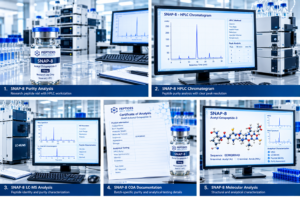
HPLC, or high-performance liquid chromatography, is one of the principal analytical technologies used for peptide separation.
In reversed-phase HPLC, peptide components interact with a stationary phase and mobile phase differently. These differences can allow the primary peptide to separate from detectable related components.
Published research specifically investigating SNAP-8 developed a liquid-chromatography method using a C18 column and demonstrated separation and detection of the peptide before mass-spectrometric analysis.
A typical SNAP-8 HPLC report may contain information such as:
- Column type
- Mobile-phase composition
- Gradient
- Detection wavelength
- Retention time
- Principal peak area
- Additional detected peaks
- Calculated chromatographic purity
- Injection information
- Sample identification
- Analytical date
However, the precise method conditions can vary between laboratories.
Why the HPLC method matters
Two laboratories can analyze the same peptide using different chromatographic conditions and potentially obtain different chromatographic profiles.
Variables can include:
- Column chemistry
- Column dimensions
- Mobile-phase composition
- Gradient profile
- Flow rate
- Temperature
- Detection wavelength
- Injection volume
- Sample preparation
- Integration parameters
For that reason, a statement such as “SNAP-8 is 99% pure” has limited analytical meaning unless the corresponding method and batch documentation are available.
HPLC Area Purity vs. Absolute Peptide Content
This is one of the most important concepts for anyone researching SNAP-8 purity.
Chromatographic purity generally describes the relative proportion of detected chromatographic signal assigned to the principal component.
It does not necessarily represent:
- Absolute peptide concentration
- Total vial mass
- Water content
- Counterion content
- Residual solvent
- Inorganic material
- Other substances that may not respond identically to the detector
Research into synthetic peptide analytical methods has highlighted the importance of understanding detector response and impurity behavior when interpreting chromatographic measurements.
Therefore, a high HPLC percentage should be interpreted alongside other available analytical information.
SNAP-8 LC-MS and LC-MS/MS Testing
Mass spectrometry provides a complementary approach to chromatographic analysis.
A published study specifically developed an LC-MS/MS method for SNAP-8, using liquid chromatography coupled to a triple-quadrupole mass spectrometer. The study reported successful detection and quantitative analysis of SNAP-8 using multiple-reaction monitoring.
The researchers observed SNAP-8 as a multiply charged ion in electrospray ionization, illustrating why peptide mass spectrometry can differ from simply looking for a single molecular-ion value.
LC-MS/MS can be useful for:
- Molecular identity confirmation
- Detection of peptide-related signals
- Quantitative analysis
- Supporting chromatographic characterization
- Investigating analytical samples
- Confirming that a chromatographic peak is consistent with the expected analyte
Mass spectrometry is particularly valuable because chromatographic retention alone does not establish molecular identity.
What Is a SNAP-8 COA?
A Certificate of Analysis (COA) is batch-specific documentation that reports analytical testing or specifications associated with a material.
For SNAP-8 research material, a useful COA may contain:
- Product name
- Compound identification
- Batch or lot number
- Test date
- Appearance
- Purity result
- Analytical method
- Molecular identity result
- Storage information
- Testing laboratory
- Specification
- Actual result
- Pass/fail status
- Authorized approval or verification
The exact format varies by supplier and laboratory.
Why batch numbers matter
A COA should be traceable to the actual batch being evaluated.
A generic document showing a product name without a matching lot number provides less useful evidence than a batch-specific report connected directly to the material under consideration.
For research purchasing and laboratory recordkeeping, batch traceability is therefore an important quality-control consideration.
How to Evaluate a SNAP-8 Purity COA
When reviewing a SNAP-8 COA, consider the following checklist.
1. Product identity
Check that the document identifies SNAP-8 or Acetyl Octapeptide-3 clearly.
2. Lot number
Confirm that the lot number corresponds to the material being documented.
3. Purity result
Look for an actual analytical result rather than only a general marketing specification.
4. Analytical method
Determine whether purity was assessed by HPLC, another chromatographic method, or a different analytical technique.
5. Identity testing
Look for supporting mass-spectrometry or other identity-confirmation information where available.
6. Testing date
A dated report provides better traceability than an undated generic certificate.
7. Laboratory identification
Determine whether the testing laboratory is identified and whether the documentation provides sufficient traceability.
8. Specification versus result
Do not confuse a specification such as “≥X%” with the actual measured result.
9. Sample relationship
Confirm that the analytical report relates to the same product and batch.
10. Supporting chromatogram
Where available, a chromatogram can provide additional context for chromatographic purity.
What Can Appear as SNAP-8-Related Impurities?
Synthetic peptides can contain chemically related substances resulting from synthesis and subsequent processing.
Potential categories can include:
- Truncated sequences
- Modified peptide species
- Oxidized forms
- Deamidated species
- Isomeric forms
- Process-related components
- Degradation products
- Other chromatographically distinguishable related substances
The exact impurity profile depends on the synthesis route, purification process, formulation, storage conditions, analytical method, and sample history.
Research literature on peptide characterization identifies several types of chemical changes that may require chromatographic investigation, including oxidation, deamidation, isomerization, and synthesis-related impurities.
This is why SNAP-8 purity should be treated as an analytical measurement rather than a permanent intrinsic label.
SNAP-8 Purity and Peptide Stability
Purity and stability are related but different concepts.
A peptide can initially meet a specified purity criterion and subsequently develop additional detectable components during storage or handling.
Factors that may affect peptide stability can include:
- Temperature
- Moisture
- Light exposure
- Oxygen exposure
- Container characteristics
- Sample preparation
- Storage duration
- Repeated handling
Published SNAP-8 analytical research evaluated stability under its own experimental conditions and reported stability during a defined refrigerated testing period. That result should not automatically be interpreted as a universal storage specification for every SNAP-8 material or formulation.
For research use, laboratories should follow the storage conditions supplied for the specific material and batch.
Why One Purity Number Is Not Enough
A strong research-quality assessment should avoid reducing an analytical material to one percentage.
Consider the difference between:
“SNAP-8 — 99%”
and:
“SNAP-8 — chromatographic purity reported for batch ABC123, with the analytical method and supporting identity data documented on the batch COA.”
The second statement provides considerably more analytical context.
This distinction is especially important for SEO content because unsupported numerical claims can create inaccurate expectations.
Peptides Grey House should publish only the purity percentage actually supported by the applicable batch documentation.
If a particular batch has no verified purity result available, the page should say so rather than inventing or implying a numerical result.
SNAP-8 Purity Quality-Control Checklist
Before selecting or documenting a SNAP-8 research material, researchers can review:
| Quality factor | What to look for |
|---|---|
| Product identity | SNAP-8 / Acetyl Octapeptide-3 |
| Batch number | Matches supplied material |
| Purity | Actual batch result |
| HPLC | Chromatographic evidence where available |
| LC-MS | Molecular identity support |
| COA | Batch-specific documentation |
| Testing date | Clearly documented |
| Laboratory | Testing source identified |
| Storage | Appropriate supplier documentation |
| Traceability | Product, batch and certificate connected |
This checklist can also be incorporated into an internal laboratory purchasing or sample-receipt workflow.
SNAP-8 Research Applications
SNAP-8 can be relevant to research involving synthetic peptide characterization, analytical chemistry, formulation studies, and related laboratory investigations.
Potential research-oriented applications include:
- Analytical method development
- Chromatographic characterization
- LC-MS/MS method development
- Synthetic peptide quality studies
- Reference-material investigations
- Stability research
- Formulation research
- Peptide impurity profiling
- Comparative analytical studies
The 2020 SNAP-8 LC-MS/MS publication demonstrates that analytical method development can be used to detect and quantify SNAP-8 in a defined experimental matrix.
These applications should not be interpreted as instructions for human use or as evidence of therapeutic effectiveness.
SNAP-8 Purity: Common SEO Questions
Is SNAP-8 purity always 99%?
No universal percentage should be assumed.
Purity is dependent on the specific batch and analytical method. A supplier should support any numerical purity claim with appropriate batch-specific analytical documentation.
How is SNAP-8 purity tested?
SNAP-8 can be characterized using chromatographic methods such as HPLC, while LC-MS/MS can provide complementary molecular identification and quantitative information. A published study specifically developed LC-MS/MS methodology for Acetyl Octapeptide-3.
What does SNAP-8 HPLC purity mean?
SNAP-8 HPLC purity generally refers to the proportion of chromatographic signal attributed to the principal component under the specified HPLC conditions.
It should not automatically be interpreted as absolute peptide content.
What should a SNAP-8 COA contain?
A useful batch-specific COA can include product identity, lot number, analytical result, method, test date, specifications and laboratory information.
Is HPLC enough to confirm SNAP-8 identity?
HPLC can provide important chromatographic information, but identity is better supported when complementary analytical techniques are available. Mass spectrometry is widely used for synthetic peptide identity and integrity assessment.
Why is batch-specific testing important?
Different production batches can have different analytical results. Batch-specific documentation connects the reported result to the actual material being evaluated.
What is Acetyl Octapeptide-3?
Acetyl Octapeptide-3 is a name used for SNAP-8. PubChem currently lists Acetyl Octapeptide-3 as the compound name and SNAP-8 among its synonyms.
Does high HPLC purity prove complete chemical purity?
Not necessarily. Chromatographic purity depends on the analytical method and detector response. Complementary techniques can provide additional information about molecular identity and related substances.
Research-Use-Only Statement
SNAP-8 materials discussed on this page are presented for laboratory research and analytical purposes only.
This information is intended to support research documentation, analytical characterization, quality evaluation, and scientific education. It is not intended to diagnose, treat, cure, mitigate, or prevent any disease or medical condition.
Nothing on this page should be interpreted as instructions for human administration, dosing, injection, reconstitution, or therapeutic use.
Researchers should follow applicable institutional procedures, laboratory safety requirements, supplier documentation, and relevant laws and regulations.