

Gonadorelin 2mg for Laboratory Research
Gonadorelin 2mg is a research peptide associated with the gonadotropin-releasing hormone (GnRH) family and is commonly examined in biochemical, analytical, and peptide-research settings.
For researchers evaluating a Gonadorelin research material, the important questions extend beyond the stated milligram quantity. Analytical identity, chromatographic purity, molecular characterization, lot traceability, and supporting documentation can all be important when evaluating a peptide for laboratory use.
Gonadorelin is a decapeptide. FDA’s substance-identification system identifies gonadorelin as the gonadotropin-releasing hormone/GnRH substance and lists the sequence as QHWSYGLRPG, with the structural modifications corresponding to the pyroglutamyl N-terminus and glycinamide C-terminus.
For Gonadorelin 2mg research material, researchers should therefore distinguish between:
- Material quantity
- Chemical identity
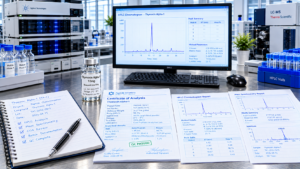
Gonadorelin 2mg - Peptide sequence
- Molecular form or salt form
- HPLC chromatographic purity
- Mass-spectrometric identity
- Lot or batch information
- Certificate of Analysis (COA)
- Storage and handling documentation
These characteristics provide a more useful framework for evaluating research material than the package size alone.
What Is Gonadorelin?
Gonadorelin is a synthetic decapeptide corresponding to gonadotropin-releasing hormone. It is also known by names including GnRH and luteinizing hormone-releasing hormone (LHRH). The FDA’s GSRS record identifies gonadorelin under UNII 9O7312W37G and lists several synonymous names and mappings.
The peptide sequence represented in the FDA record is:
QHWSYGLRPG
PubChem provides the corresponding condensed structural description as:
H-Pyr-His-Trp-Ser-Tyr-Gly-Leu-Arg-Pro-Gly-NH₂
This means the peptide contains ten amino-acid residues with characteristic terminal modifications.
For laboratory researchers, these structural details matter because analytical testing should be connected to the expected molecular identity rather than simply relying on the product name.
Gonadorelin 2mg Research Material
The term Gonadorelin 2mg generally describes a quantity of Gonadorelin research material rather than a unique chemical structure.
When evaluating a 2mg research-peptide presentation, researchers can examine several documentation points:
1. Product identity
The documentation should clearly identify the material as Gonadorelin or the applicable Gonadorelin salt/form.
2. Lot number
A lot or batch identifier allows analytical documentation to be connected to a particular material.
3. Purity information
HPLC or another validated analytical method may provide information about chromatographic purity.
4. Molecular identity
Mass spectrometry can provide complementary information about molecular mass and identity.
5. COA documentation
A Certificate of Analysis can consolidate product identification, testing information, specifications, and measured results.
6. Quantity
The 2mg designation describes the labeled amount of research material and should not be confused with analytical purity.
A useful research-material evaluation therefore considers quantity + identity + purity + documentation together.
Gonadorelin Molecular Weight
Molecular weight is an important reference value when interpreting analytical data for a peptide.
PubChem lists Gonadorelin acetate with the molecular formula C57H79N17O15 and a molecular weight of approximately 1242.3 g/mol. PubChem also lists an exact mass of approximately 1241.594 Da for this acetate form.
However, researchers should pay attention to the exact molecular form being evaluated.
For example, Gonadorelin acetate and Gonadorelin acetate hydrate have different molecular compositions and molecular weights. PubChem lists the hydrate at approximately 1260.4 g/mol.
This distinction is important when comparing:
- COA data
- Expected mass-spectrometry peaks
- Molecular formulas
- Reference databases
- Supplier documentation
- Analytical reports
A molecular-weight value should therefore always be interpreted in relation to the specific chemical form.
Gonadorelin Peptide Sequence
The Gonadorelin peptide sequence is a useful identity reference for laboratory research.
The FDA GSRS record identifies the peptide sequence as:
QHWSYGLRPG
PubChem describes the structure using the modified peptide notation:
H-Pyr-His-Trp-Ser-Tyr-Gly-Leu-Arg-Pro-Gly-NH₂.
The sequence can be useful when researchers are comparing a material with reference information or interpreting analytical characterization.
It is particularly important to recognize that a peptide sequence alone does not establish the purity or quality of a physical batch. Two materials can have the same nominal sequence while differing in purity, degradation products, residual materials, water content, counterions, or other analytical characteristics.
That is why sequence information is best considered alongside HPLC, MS, and COA documentation.
Gonadorelin HPLC Testing
Gonadorelin HPLC testing can be used to examine the chromatographic profile of a peptide research material.
High-performance liquid chromatography separates components based on their interactions with the chromatographic system. For peptide analysis, the resulting chromatogram can provide information about the primary peak and other detectable components under the specified analytical conditions.
A Gonadorelin HPLC report may include:
- Sample identification
- Lot number
- Analytical method
- Column information
- Mobile-phase information
- Detection wavelength
- Retention time
- Main peak area
- Secondary peaks
- Calculated chromatographic purity
- Test date
Why HPLC matters
A clearly documented chromatographic method provides researchers with information that is more useful than a simple statement such as “high purity.”
For example, a COA might report an HPLC purity percentage calculated from chromatographic peak areas. Researchers should examine the actual method and specification before interpreting the result.
HPLC does not answer every quality question
HPLC purity should not automatically be interpreted as:
- Complete molecular identification
- Absolute chemical purity
- Sterility
- Endotoxin status
- Biological activity
- Absence of every possible impurity
- Suitability for human or veterinary use
HPLC is one component of analytical characterization.
Gonadorelin COA: What Researchers Should Look For
A Gonadorelin COA, or Certificate of Analysis, can provide batch-specific analytical information.
A useful COA may contain:
| COA Element | Why It Matters |
|---|---|
| Product name | Identifies the material tested |
| Lot number | Connects testing to a specific batch |
| Manufacturing or test date | Establishes documentation timing |
| HPLC purity | Provides chromatographic purity information |
| Mass spectrometry | Supports molecular identity |
| Molecular weight | Helps interpret analytical results |
| Appearance | Documents physical characteristics |
| Quantity | Identifies labeled material amount |
| Specification | Defines the acceptance criterion |
| Result | Shows the observed analytical result |
Researchers should compare the specification with the actual result rather than looking only for a large percentage.
For example, “HPLC purity ≥ X%” is an acceptance criterion, while the reported numerical percentage is the measured result.
A good documentation workflow connects the COA to the exact lot being evaluated.
Gonadorelin Purity and Analytical Quality
The phrase Gonadorelin purity can refer to different analytical concepts depending on the test method.
Chromatographic purity generally describes the proportion of detected chromatographic signal attributed to the principal component under the stated analytical conditions.
This is different from:
- Assay
- Peptide content
- Water content
- Residual solvent testing
- Counterion content
- Microbiological testing
- Endotoxin testing
- Structural confirmation
Researchers should therefore avoid treating one percentage as a complete representation of material quality.
Practical purity checklist
When reviewing Gonadorelin research material, look for:
✓ Lot-specific HPLC results
✓ Clearly identified analytical method
✓ Molecular identity data
✓ COA documentation
✓ Consistent product naming
✓ Traceable batch information
✓ Appropriate storage information
✓ Clearly stated research-use status
This approach creates a more comprehensive quality-review process.
Gonadorelin Mass Spectrometry
Mass spectrometry can complement HPLC by providing information about molecular mass.
For peptide research, LC-MS or another appropriate mass-spectrometric method can help researchers compare an observed mass with the expected molecular form.
This is particularly useful when evaluating a material whose documentation includes:
- Expected molecular weight
- Molecular formula
- Peptide sequence
- Salt or counterion information
- Observed mass
- Analytical tolerance
Researchers should remember that the expected mass can differ depending on whether they are evaluating the free peptide, acetate, hydrate, or another molecular form.
For Gonadorelin acetate, PubChem lists approximately 1242.3 g/mol as the molecular weight of the acetate form.
Gonadorelin Acetate vs. Gonadorelin
One important SEO and laboratory-research distinction is the difference between Gonadorelin and Gonadorelin acetate.
Gonadorelin refers to the peptide active moiety, while Gonadorelin acetate represents a particular salt/form containing acetate.
PubChem lists Gonadorelin acetate as:
- Molecular formula: C57H79N17O15
- Molecular weight: approximately 1242.3 g/mol
- Sequence: XHWSYGLRPG
- CAS: 34973-08-5
The FDA GSRS database separately identifies Gonadorelin and related forms, reinforcing the importance of specifying the exact material being discussed.
For SEO content and product documentation, using the precise terminology helps prevent confusion between molecular forms.
Gonadorelin 2mg: Research Documentation
For a U.S.-focused research-peptide product page, documentation is an important part of the overall content strategy.
A strong Gonadorelin 2mg product page can provide access to information such as:
Product information
- Product name
- Research-use designation
- Labeled quantity
- Molecular form
- Lot identification
Analytical information
- HPLC purity
- Mass spectrometry
- Molecular weight
- Molecular formula
- Analytical method
Documentation
- COA
- Batch information
- Testing date
- Storage information
- Product specifications
This structure helps researchers locate technical information without mixing analytical documentation with therapeutic claims.
How to Evaluate a Gonadorelin Research Peptide
A practical evaluation can follow five stages.
Step 1: Confirm identity
Check the product name, peptide sequence, molecular form, and relevant identifiers.
Step 2: Review the COA
Verify that the COA corresponds to the same lot or batch.
Step 3: Examine HPLC information
Look at the chromatogram, stated method, main peak, secondary peaks, and reported purity.
Step 4: Review molecular identity
Compare mass-spectrometry information with the expected molecular form.
Step 5: Review research-use documentation
Confirm that the material is clearly designated for appropriate laboratory research and that its documentation matches the intended research application.
This process is more informative than evaluating a research peptide based only on a product title or advertised purity number.
Gonadorelin 2mg for U.S. Laboratory Research
For U.S. researchers, terminology and regulatory context should be kept separate from general laboratory product descriptions.
The FDA maintains a public substance-identification record for Gonadorelin, but FDA notes that the availability of a UNII does not itself mean that a substance has undergone regulatory review or approval.
Accordingly, research-product content should not imply that a research material is:
- FDA-approved for a particular use
- Clinically validated for a particular purpose
- Appropriate for self-administration
- A substitute for an approved medicine
- Intended for diagnosis or treatment
A research-oriented product page should instead emphasize analytical identity, laboratory documentation, quality information, and lawful scientific research.
Gonadorelin 2mg Storage and Handling Information
Research peptides should be handled according to the supplier’s documentation and the requirements of the research laboratory.
Important considerations may include:
- Manufacturer-specified storage temperature
- Protection from light where applicable
- Moisture control
- Container integrity
- Lot identification
- Avoidance of unnecessary environmental exposure
- Laboratory-specific handling procedures
Storage recommendations should be based on the documented characteristics of the specific product and formulation rather than generic assumptions about every peptide.
Researchers should consult the applicable product documentation and institutional laboratory procedures.
Why COA + HPLC + MS Create a Stronger Quality Picture
No single analytical test necessarily answers every question about a peptide research material.
HPLC can provide chromatographic information.
Mass spectrometry can support molecular identity.
COA documentation connects analytical results with a specific batch.
Molecular information provides a reference framework.
Together, these components create a more useful analytical picture.
For a Gonadorelin 2mg research product page, this combination also creates strong informational SEO coverage around:
- Gonadorelin HPLC
- Gonadorelin COA
- Gonadorelin purity
- Gonadorelin molecular weight
- Gonadorelin peptide sequence
- Gonadorelin mass spectrometry
- Gonadorelin research peptide
- Gonadorelin laboratory research
Frequently Asked Questions
What is Gonadorelin 2mg?
Gonadorelin 2mg refers to a research-material presentation containing a labeled 2mg quantity of Gonadorelin. The exact molecular form should be confirmed through the product documentation and COA.
What is the Gonadorelin peptide sequence?
The FDA identifies the Gonadorelin sequence as QHWSYGLRPG. The peptide has characteristic terminal modifications, represented in PubChem as H-Pyr-His-Trp-Ser-Tyr-Gly-Leu-Arg-Pro-Gly-NH₂.
What is the molecular weight of Gonadorelin?
Molecular weight depends on the molecular form. PubChem lists Gonadorelin acetate at approximately 1242.3 g/mol and Gonadorelin acetate hydrate at approximately 1260.4 g/mol.
What is Gonadorelin HPLC testing?
Gonadorelin HPLC testing uses high-performance liquid chromatography to evaluate the chromatographic profile of a sample under specified analytical conditions. It can provide information about chromatographic purity and related peaks.
What should a Gonadorelin COA contain?
A useful COA may include the product name, lot number, specifications, analytical results, HPLC data, molecular identity information, testing date, and other applicable quality information.
Is HPLC purity the same as total peptide content?
No. HPLC chromatographic purity and total peptide content are different analytical concepts and should not automatically be treated as interchangeable.
Is Gonadorelin the same as Gonadorelin acetate?
Not exactly. Gonadorelin acetate is a specific acetate form of the Gonadorelin peptide. The molecular formula and molecular weight therefore differ from those of other forms.
Is Gonadorelin 2mg intended for human use?
A research-material product page should clearly distinguish laboratory research from human or veterinary use. Research-use material should not be represented as a product for self-administration, diagnosis, treatment, or prevention of disease.
Why is the lot number important?
A lot number connects a physical research material with its corresponding analytical documentation, such as a COA and batch-specific testing.
Can Gonadorelin research material be evaluated by mass spectrometry?
Yes. Mass spectrometry can be used as a complementary analytical technique for investigating molecular identity and observed molecular mass.
Research-Use-Only Statement
Research Use Only. The information presented on this page is intended for lawful laboratory, analytical, educational, and scientific research purposes. Gonadorelin research material is not presented for human or veterinary consumption, self-administration, diagnosis, treatment, cure, or prevention of disease.
Analytical values such as HPLC purity, molecular weight, mass-spectrometric results, and other COA data should be interpreted according to the stated analytical method and the specific lot tested. HPLC purity alone does not establish complete chemical characterization, sterility, endotoxin status, biological activity, or therapeutic suitability.
Researchers are responsible for evaluating research materials according to their intended laboratory application and for following applicable laws, institutional requirements, laboratory procedures, and appropriate safety practices.