

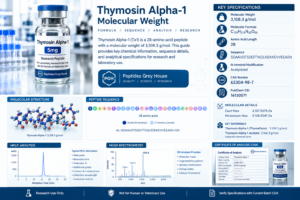
Thymosin Alpha-1 molecular weight is an important specification for researchers working with peptide identification, analytical characterization, mass spectrometry, formulation research, and quality-control workflows.
Thymosin Alpha-1, also known as Thymalfasin or Tα1, is a 28-amino-acid peptide. PubChem lists Thymalfasin with the molecular formula C129H215N33O55 and a molecular weight of 3108.3 g/mol. The database also identifies the peptide sequence as SDAAVDTSSEITTKDLKEKKEVVEEAEN and notes its N-terminal acetylation.
For laboratory researchers, molecular weight is more than a number. It can serve as an important reference point when interpreting analytical results, reviewing mass-spectrometry data, comparing theoretical and observed masses, and verifying the identity of a peptide material.
This page provides a research-oriented overview of Thymosin Alpha-1 molecular weight, molecular formula, sequence, structural characteristics, purity considerations, HPLC analysis, COA documentation, and related analytical terminology.
What Is the Molecular Weight of Thymosin Alpha-1?
The reported molecular weight of Thymosin Alpha-1 is 3108.3 g/mol for Thymalfasin, the acetylated 28-amino-acid peptide. PubChem identifies the compound under CID 16130571 and lists the molecular formula as C129H215N33O55.
Thymosin Alpha-1 molecular weight specifications
| Property | Specification |
|---|---|
| Common name | Thymosin Alpha-1 |
| Alternative name | Thymalfasin |
| Abbreviation | Tα1 |
| Molecular weight | 3108.3 g/mol |
| Molecular formula | C129H215N33O55 |
| Amino acids | 28 |
| Sequence | SDAAVDTSSEITTKDLKEKKEVVEEAEN |
| CAS Number | 62304-98-7 |
| N-terminal modification | Acetylated |
| Research classification | Laboratory/research use |
The molecular weight should always be interpreted together with the chemical form being analyzed. Peptide salts, solvates, counterions, or other material specifications can produce a different reported mass.
Thymosin Alpha-1 Molecular Formula
The molecular formula associated with Thymalfasin is:
C129H215N33O55
This formula describes the elemental composition of the acetylated peptide. PubChem lists the molecular formula alongside a molecular weight of 3108.3 g/mol.
Understanding the molecular formula can be useful in analytical chemistry because the theoretical mass derived from elemental composition provides a reference for techniques such as:
- Mass spectrometry
- LC-MS
- High-performance liquid chromatography
- Peptide identity testing
- Analytical method development
- Batch characterization
- Research documentation
For peptide researchers, the molecular formula and sequence together provide a more complete chemical identity than molecular weight alone.
Thymosin Alpha-1 Sequence
Thymosin Alpha-1 is a 28-amino-acid peptide. PubChem gives the sequence as:
SDAAVDTSSEITTKDLKEKKEVVEEAEN
The database identifies the peptide as N-terminally acetylated.
A more complete representation is:
Ac-Ser-Asp-Ala-Ala-Val-Asp-Thr-Ser-Ser-Glu-Ile-Thr-Thr-Lys-Asp-Leu-Lys-Glu-Lys-Lys-Glu-Val-Val-Glu-Glu-Ala-Glu-Asn-OH
The sequence is particularly relevant when researchers are evaluating peptide identity. A molecular-weight match alone is generally not sufficient to establish identity because different compounds can sometimes produce similar analytical masses.
Sequence information can therefore complement:
- Molecular-weight calculations
- LC-MS analysis
- HPLC retention behavior
- Reference-standard comparisons
- Peptide mapping
- Batch documentation
Why Thymosin Alpha-1 Molecular Weight Matters in Research
Molecular weight is one of the fundamental characteristics used to describe a peptide.
For Thymosin Alpha-1, the 3108.3 g/mol value can be used as a theoretical reference when evaluating analytical data.
Researchers may use molecular-weight information for:
1. Mass spectrometry interpretation
Mass spectrometry can provide highly useful information about peptide identity and molecular mass. Researchers can compare experimentally observed signals against theoretical expectations.
2. Identity confirmation
Molecular mass can be considered alongside sequence information, chromatographic behavior, and other analytical measurements.
3. HPLC method development
Molecular characteristics can help researchers establish analytical workflows for peptide materials.
4. Batch documentation
A COA may include analytical information related to identity, purity, molecular mass, or other quality attributes.
5. Research material comparison
Researchers may compare peptide materials from different batches or suppliers using documented analytical specifications.
Thymosin Alpha-1 5mg: Research Material Overview
A Thymosin Alpha-1 5mg research product generally refers to a vial containing a nominal 5 mg quantity of the peptide material.
The quantity of material in a vial and the molecular weight of the peptide are separate specifications.
For example:
- 5mg describes the nominal amount of material.
- 3108.3 g/mol describes molecular weight.
- C129H215N33O55 describes molecular composition.
- SDAAVDTSSEITTKDLKEKKEVVEEAEN describes the peptide sequence.
Keeping these specifications separate helps prevent confusion when creating product pages, laboratory records, or analytical documentation.
Any actual product specification should be verified against its batch-specific documentation rather than inferred solely from the nominal product name.
Thymosin Alpha-1 Molecular Weight vs. Thymosin Alpha-1 Acetate
One important SEO and scientific distinction is the difference between Thymalfasin/Thymosin Alpha-1 and a material explicitly identified as Thymosin Alpha-1 acetate.
PubChem lists Thymalfasin at:
3108.3 g/mol
However, PubChem also has a separate record for Thymosin a1 Acetate, listed at:
3168.3 g/mol
The acetate record contains Thymalfasin together with acetic acid as a component.
Therefore, researchers should avoid treating 3108.3 g/mol and 3168.3 g/mol as interchangeable specifications.
Important analytical consideration
When reviewing a COA or mass-spectrometry result, confirm whether the material is described as:
- Thymosin Alpha-1 / Thymalfasin
- Thymosin Alpha-1 acetate
- Another salt or formulation
- A peptide preparation containing additional components
This distinction can be particularly important when comparing theoretical and observed mass values.
Thymosin Alpha-1 Structural Characteristics
Scientific literature describes Thymosin Alpha-1 as a 28-residue peptide. Reviews have discussed its biochemical properties, structure, production, and biological research history.
A 2023 review describes Tα1 as a 28-amino-acid peptide with an approximate relative molecular weight of 3108 Da and notes the N-terminal acetylation.
These structural characteristics make Thymosin Alpha-1 a useful subject for peptide analytical research.
Researchers studying its physical and chemical characteristics may be interested in:
- Molecular mass
- Amino-acid sequence
- N-terminal acetylation
- Elemental composition
- Chromatographic profile
- Mass-spectrometry profile
- Purity
- Identity
- Batch consistency
Thymosin Alpha-1 Purity
Thymosin Alpha-1 purity should be evaluated using appropriate analytical documentation rather than relying on a generic website statement.
For a research peptide, purity may be reported using chromatographic analysis such as HPLC.
A product page should ideally distinguish between:
Theoretical identity:
The expected chemical identity and molecular characteristics.
Batch-specific purity:
The measured purity associated with a particular production batch.
Analytical identity:
Evidence from techniques such as HPLC-MS or other validated laboratory methods.
This distinction is important because purity specifications can vary between products and batches.
If a batch-specific COA is available, the reported analytical values should take precedence over generalized marketing language.
Thymosin Alpha-1 HPLC Analysis
High-performance liquid chromatography, or HPLC, is commonly used in peptide analytical workflows.
For Thymosin Alpha-1, an HPLC chromatogram can provide information about the chromatographic profile of the tested material.
A typical research documentation workflow may consider:
- Main peptide peak
- Retention time
- Relative peak area
- Additional peaks
- Chromatographic resolution
- Analytical method
- Detection wavelength
- Batch identification
HPLC results should be interpreted according to the analytical method used. Retention times are not universal values because they can change depending on the column, mobile phase, gradient, flow rate, temperature, detector, and other method parameters.
Therefore, a scientifically responsible product page should not publish a single HPLC retention time as though it were universal.
Thymosin Alpha-1 COA
A Certificate of Analysis (COA) can provide batch-specific information about a research material.
For Thymosin Alpha-1, a useful COA may include information such as:
- Product name
- Batch or lot number
- Test date
- Appearance
- Identity
- Purity
- HPLC result
- Mass-spectrometry result
- Quantity
- Storage information
- Laboratory or testing provider
Researchers should compare the COA information with the product label and maintain batch records where appropriate.
Why COA documentation matters
A COA can help connect a specific research material to a specific analytical result. This is more informative than relying only on a generic product description.
For SEO purposes, a dedicated Thymosin Alpha-1 COA page can also create a useful internal link from the molecular-weight page.
Thymosin Alpha-1 Research Background
Thymosin Alpha-1 was first described as a 28-amino-acid peptide in research on thymic peptides. A PubMed-indexed review describes its characterization beginning in 1977 and summarizes subsequent research into its biological activities and production.
Later literature has investigated the peptide’s interactions with immune-related pathways and cellular systems. A 2020 comprehensive review summarizes a broad body of literature concerning Thymosin Alpha-1.
A 2023 review discusses biochemical characteristics and research concerning Tα1, including studies of molecular mechanisms and immune-related signaling.
For a research-product website, these publications can be used as scientific background rather than as evidence that a particular commercial research material produces a particular biological outcome.
Potential Research Applications
Thymosin Alpha-1 has been investigated in a variety of scientific contexts. The literature includes research involving immune-cell signaling, molecular mechanisms, peptide characterization, and analytical or biochemical studies.
For laboratory research, relevant areas can include:
Peptide characterization
Researchers can study molecular identity, sequence, purity, and analytical behavior.
Analytical chemistry
Thymosin Alpha-1 can serve as a subject for chromatographic and mass-spectrometric investigations.
Peptide quality control
Researchers may evaluate batch consistency using appropriate analytical methods.
Molecular research
The peptide has been investigated in studies involving molecular and cellular signaling pathways.
Reference-material research
Well-characterized peptide material can support method development and comparative laboratory work.
These applications should not be interpreted as recommendations for human use.
Molecular Weight and Mass Spectrometry
One of the most useful applications of a theoretical molecular weight is comparison with experimentally measured mass.
For Thymosin Alpha-1, the PubChem molecular weight is:
3108.3 g/mol
The database also provides an exact mass value of approximately 3107.5075 Da and a monoisotopic mass of approximately 3106.5041 Da.
These values are not interchangeable.
Average molecular weight
3108.3 g/mol
This is the commonly displayed molecular-weight value and is particularly appropriate for general product and SEO information.
Exact mass
Approximately:
3107.5075 Da
Monoisotopic mass
Approximately:
3106.5041 Da
When discussing mass-spectrometry results, researchers should specify which mass convention is being used.
Quality Considerations for Thymosin Alpha-1 Research Peptides
Researchers evaluating a Thymosin Alpha-1 product may consider several quality attributes.
Identity
The product should correspond to the specified peptide identity and sequence.
Molecular weight
The expected molecular-weight value should match the chemical form being evaluated.
Purity
Purity should be supported by appropriate batch-specific analytical testing.
HPLC
Chromatographic analysis can provide a useful purity and profile assessment.
Mass spectrometry
MS can help evaluate molecular identity and experimentally observed mass.
COA
A batch-specific COA can provide traceability between the material and reported test results.
Documentation
Clear product labeling, lot identification, and analytical documentation support better research traceability.
How to Read a Thymosin Alpha-1 COA
When reviewing a COA, researchers can look for several key fields.
1. Product identity
Confirm that the document identifies the intended peptide.
2. Lot number
Verify that the COA corresponds to the material being evaluated.
3. Purity result
Check the analytical purity reported for the specific batch.
4. HPLC documentation
Review chromatographic results and the analytical method where provided.
5. Mass confirmation
Look for MS or another identity test when available.
6. Test date
Confirm when the analytical testing was performed.
7. Testing laboratory
Determine whether the testing organization is identified.
A COA should be interpreted as batch-specific documentation rather than a universal statement about every product carrying the same name.
Thymosin Alpha-1 Molecular Weight for SEO
The keyword “Thymosin Alpha-1 molecular weight” has strong informational intent.
A well-optimized page should answer the primary question quickly while providing deeper supporting information.
Recommended keyword placement includes:
- SEO title
- H1
- First paragraph
- Molecular-weight section
- Image alt text
- FAQ
- Internal links
- Meta description
- Relevant H2 headings
However, repeating the exact keyword excessively can make the content less natural.
A stronger SEO strategy combines the main keyword with closely related semantic terms such as:
- Thymosin Alpha-1 molecular formula
- Thymosin Alpha-1 sequence
- Thymalfasin molecular weight
- Thymosin Alpha-1 5mg
- Thymosin Alpha-1 purity
- Thymosin Alpha-1 HPLC
- Thymosin Alpha-1 COA
- Thymosin Alpha-1 peptide
- Thymosin Alpha-1 research peptide
Research-Use-Only Statement
Thymosin Alpha-1 5mg supplied by Peptides Grey House is intended for laboratory and research purposes only. It is not intended for human or veterinary administration and is not offered as a drug, medicine, dietary supplement, or therapeutic product.
Research materials should be handled only by appropriately qualified personnel using suitable laboratory procedures and applicable institutional requirements.
No information on this page should be interpreted as a recommendation for diagnosis, treatment, cure, prevention, dosing, or self-administration.
Frequently Asked Questions
What is the molecular weight of Thymosin Alpha-1?
The molecular weight of Thymosin Alpha-1, identified as Thymalfasin, is 3108.3 g/mol according to PubChem.
What is the molecular formula of Thymosin Alpha-1?
The molecular formula of Thymalfasin is C129H215N33O55.
How many amino acids are in Thymosin Alpha-1?
Thymosin Alpha-1 contains 28 amino-acid residues.
What is the Thymosin Alpha-1 sequence?
The sequence is SDAAVDTSSEITTKDLKEKKEVVEEAEN. PubChem identifies the N-terminus as acetylated.
What is Thymalfasin?
Thymalfasin is the name used for the synthetic form of Thymosin Alpha-1. PubChem lists Thymalfasin as a synonym for Thymosin Alpha-1.
Is Thymosin Alpha-1 the same as Thymosin Alpha-1 acetate?
Not exactly. PubChem separately lists Thymosin Alpha-1 acetate at 3168.3 g/mol, while Thymalfasin is listed at 3108.3 g/mol.
What is the CAS number for Thymosin Alpha-1?
The CAS number listed for Thymalfasin/Thymosin Alpha-1 is 62304-98-7.
Why is molecular weight important for peptide research?
Molecular weight provides a theoretical reference for peptide characterization, analytical method development, mass-spectrometry interpretation, and identity assessment.
What is Thymosin Alpha-1 HPLC?
Thymosin Alpha-1 HPLC refers to chromatographic analysis used to examine the peptide’s chromatographic profile and, depending on the method, assess purity or related analytical characteristics.
What should a Thymosin Alpha-1 COA contain?
A useful COA may include product identity, lot number, purity, analytical testing, HPLC information, mass confirmation, testing date, and other batch-specific specifications.