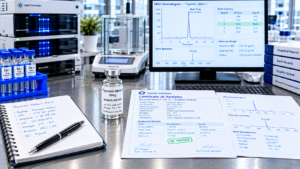
What Is Thymosin Alpha-1 10mg?
Thymosin Alpha-1 10mg refers to a 10-milligram quantity of the peptide commonly known as Thymosin Alpha-1 (Tα1) or thymalfasin.
For research-focused SEO, the important distinction is between the name of the peptide and the purpose for which a particular product is marketed. A research material should be described according to its documented identity, analytical specifications, batch information, and research-use designation rather than being presented as a treatment.
Thymosin Alpha-1 is a 28-amino-acid peptide with an N-terminal acetyl group. FDA technical materials identify the free-base molecular formula as C129H215N33O55 and molecular weight as approximately 3108.3 g/mol.
The peptide has a substantial scientific literature covering its biochemical characteristics and immunological research. Historical research established its relationship to thymic peptide biology, while subsequent studies have investigated its molecular and biological properties.
For laboratory researchers, however, the central quality questions remain:
- Is the material correctly identified?
- What is the reported purity?
- Is HPLC data available?
- Is molecular identity supported by mass spectrometry?
- Is a batch-specific COA available?
- Is the product clearly designated for research use?
- Can the material be traced to a specific lot?
These questions provide a more useful framework than relying on marketing terminology alone.
Thymosin Alpha-1 10mg Research Material
A research-grade Thymosin Alpha-1 product should be evaluated as an analytical and laboratory material.
Relevant documentation may include:
- Product name
- Peptide sequence
- Molecular formula
- Molecular weight
- Purity specification
- HPLC chromatogram
- Mass-spectrometry data
- Batch or lot number
- Certificate of Analysis
- Manufacturing or testing information
- Storage information
- Research-use designation
The 10mg designation describes the stated quantity of material. It does not, by itself, establish purity, identity, sterility, stability, or suitability for a particular experimental protocol.
This is an important distinction for both researchers and search engines.
A product page should avoid treating the quantity as evidence of quality. Instead, quantity and analytical quality should be presented as separate product attributes.
Thymosin Alpha-1 Peptide Identity
Thymosin Alpha-1 is also abbreviated Tα1 or Ta1.
FDA documentation describes Ta1 as an N-terminal acetylated 28-amino-acid peptide. The same FDA material notes that chemically synthesized thymalfasin has the same amino-acid sequence as naturally occurring Thymosin Alpha-1.
The peptide was originally isolated from thymosin fraction-5 derived from calf thymus. Research subsequently established that Thymosin Alpha-1 can arise through natural processing of a precursor protein.
For SEO and laboratory documentation, useful identity terms include:
- Thymosin Alpha-1
- Thymosin α1
- Tα1
- Ta1
- Thymalfasin
- Thymosin Alpha-1 peptide
- 28-amino-acid peptide
Researchers should confirm the exact chemical form listed on a product’s documentation because free-base and salt forms can have different molecular characteristics.
Thymosin Alpha-1 10mg Molecular Weight
The reported molecular weight is an important analytical reference point.
For Thymosin Alpha-1 free base, FDA documentation gives:
Molecular formula: C129H215N33O55
Molecular weight: approximately 3108.3 g/mol
Peptide length: 28 amino acids
The FDA document distinguishes the free-base form from the acetate salt form, which is important when comparing analytical specifications or mass-spectrometry results.
Why molecular weight matters
Mass spectrometry can provide molecular-mass evidence supporting peptide identity.
A laboratory researcher reviewing an analytical report can compare the expected molecular mass with the reported experimental value while considering:
- Chemical form
- Salt/adduct formation
- Instrument conditions
- Ionization
- Expected mass-to-charge ratio
- Analytical tolerance
Therefore, molecular weight should not be evaluated independently from the analytical method.
Thymosin Alpha-1 Peptide Sequence
The identity of a peptide depends substantially on its amino-acid sequence and chemical modifications.
Thymosin Alpha-1 is a 28-amino-acid peptide and contains an N-terminal acetyl modification. FDA documentation specifically describes Ta1 as an N-terminal acetylated 28-amino-acid peptide.
For a research product page, sequence information can help researchers distinguish Thymosin Alpha-1 from other thymosin-related compounds.
This is particularly important because names such as Thymosin Alpha-1, Thymosin Beta-4, and other thymosin-related materials refer to different peptides.
A well-structured product page should therefore identify the exact compound rather than using “thymosin” as a generic description.
Thymosin Alpha-1 HPLC Testing
High-performance liquid chromatography (HPLC) is one of the most useful analytical methods for evaluating peptide purity.
For a Thymosin Alpha-1 research material, HPLC analysis may provide information about:
- Main chromatographic peak
- Retention time
- Relative peak area
- Secondary peaks
- Chromatographic purity
- Potential detectable related substances
A typical HPLC report should be interpreted according to the analytical method used.
What HPLC can show
HPLC can help characterize the chromatographic profile of a peptide sample.
What HPLC does not automatically prove
An HPLC percentage alone does not establish every aspect of material quality.
For example, chromatographic purity does not automatically prove:
- Complete sequence identity
- Sterility
- Endotoxin status
- Long-term stability
- Absence of every possible contaminant
- Suitability for human use
For this reason, HPLC is most useful when combined with complementary analytical information.
Thymosin Alpha-1 Mass Spectrometry
Mass spectrometry is commonly used to support peptide identity by measuring molecular mass.
For Thymosin Alpha-1, an analytical mass spectrum can help researchers compare the observed molecular-mass information with the expected molecular characteristics of the specified form.
A quality-control workflow may therefore combine:
HPLC → chromatographic purity
LC-MS/MS or MS → molecular identity
COA → documented analytical results
Lot number → batch traceability
This multi-layered approach provides more context than a single headline purity percentage.
Thymosin Alpha-1 COA
A Certificate of Analysis (COA) is one of the most important documents to look for when evaluating a research peptide.
A useful Thymosin Alpha-1 COA may identify:
- Product name
- Lot number
- Batch number
- Test date
- Purity specification
- HPLC result
- Molecular-mass result
- Testing laboratory
- Analytical method
- Product quantity or specification
- Additional quality-control information
Researchers should check that the COA corresponds to the exact material being evaluated.
COA verification checklist
Before relying on a COA, check:
- Product identity — Does the name match the product?
- Lot number — Does the lot match the vial or product record?
- Testing date — When was the material analyzed?
- HPLC information — Is a purity result reported?
- Mass spectrometry — Is identity supported?
- Laboratory information — Is the testing source identified?
- Analytical method — Is the method described?
- Documentation consistency — Do all identifiers match?
A COA is most useful when it is batch-specific and traceable.
Thymosin Alpha-1 Purity
Searches for Thymosin Alpha-1 purity often reflect commercial investigation by researchers comparing available research materials.
Purity should be treated as an analytical measurement rather than a universal quality score.
For example, a supplier may report a high HPLC purity percentage. Researchers should still determine:
- Which HPLC method was used?
- Was the result generated for the specific lot?
- Is the chromatogram available?
- Was molecular identity independently evaluated?
- Are additional analytical tests available?
- Is the reported purity based on peak-area normalization or another calculation?
This approach creates more useful SEO content while avoiding unsupported claims.
Purity versus identity
These are different analytical questions.
Purity: How many detectable chromatographic components are represented by the target peak under the stated method?
Identity: Does the analytical evidence support the expected peptide?
A material can therefore require both purity and identity testing.
Why Batch Testing Matters
Batch testing is particularly relevant to research materials because analytical results should ideally be connected to the actual lot being studied.
Researchers may maintain a record containing:
| Research Material Record | Example Information |
|---|---|
| Compound | Thymosin Alpha-1 |
| Quantity | 10mg |
| Lot | Batch-specific identifier |
| Purity | Reported analytical result |
| Identity | Mass-spectrometry evidence |
| HPLC | Chromatogram/report |
| COA | Batch documentation |
| Test date | Date of analysis |
This information improves traceability and makes laboratory records more reproducible.
Thymosin Alpha-1 Laboratory Research
Thymosin Alpha-1 has been studied extensively in biomedical research, particularly in connection with immune-system biology.
Historical literature describes effects involving immune responses, while modern research continues to investigate its biological mechanisms and potential applications.
For a research-use website, however, it is important to distinguish scientific investigation from clinical claims.
Appropriate research topics can include:
- Peptide structure
- Molecular characterization
- Analytical chemistry
- Peptide stability
- Cellular research
- Immunology research
- Protein-peptide interactions
- Structure-function studies
- Molecular signaling research
- Analytical method development
These topics can be discussed without presenting a research material as a treatment or recommending human use.
Thymosin Alpha-1 and Immunology Research
Thymosin Alpha-1 has attracted scientific interest because of its relationship to immune-system biology.
Peer-reviewed literature has investigated its immunomodulatory properties and potential mechanisms. A PubMed-indexed review describes research into its effects on immune responses and its biological activity.
More recent literature continues to examine Thymosin Alpha-1 in areas including immune modulation and cancer-related research. These publications represent scientific investigation and should not be interpreted as establishing that a particular commercial research product is clinically effective or appropriate for human use.
This distinction is especially important when building commercial SEO pages.
Thymosin Alpha-1 Research vs Clinical Material
A major SEO and compliance consideration is the distinction between research peptide material and pharmaceutical products used in clinical settings.
The scientific literature contains clinical research involving thymalfasin, but a commercial research product should not automatically be represented as equivalent to a regulated pharmaceutical product.
Researchers should evaluate:
- Exact chemical identity
- Manufacturing specifications
- Analytical testing
- Batch documentation
- Purity
- Molecular identity
- Regulatory status
- Intended use
The FDA has specifically discussed Thymosin Alpha-1 in the context of compounded drug safety and stated that available safety information is inadequate to understand certain risks, including concerns involving immunogenicity and peptide-related impurities/API characterization.
This makes accurate product positioning particularly important.
Thymosin Alpha-1 and U.S. Research Considerations
For U.S.-focused content, avoid describing a research peptide as an FDA-approved drug simply because the compound has appeared in clinical research.
Regulatory status applies to specific products, formulations, uses, and regulatory pathways.
The FDA’s 2024 technical materials distinguish Thymosin Alpha-1 free base and acetate and discuss their chemical characteristics.
The FDA also identifies safety concerns surrounding compounded Thymosin Alpha-1, including potential immunogenicity and peptide-related impurities.
Therefore, a U.S. research page should use precise terminology such as:
- Research material
- Laboratory research
- Analytical research
- Research-use-only
- Experimental material
It should avoid implying that a product is approved for human administration.
How to Evaluate Thymosin Alpha-1 10mg Research Material
A practical evaluation framework can be organized into six categories.
1. Identity
Confirm the exact peptide and chemical form.
2. Quantity
Confirm that the product is labeled as 10mg if that is the advertised quantity.
3. Purity
Review the stated analytical purity and methodology.
4. Identity Testing
Look for LC-MS or mass-spectrometry evidence.
5. Documentation
Look for a lot-specific COA and supporting analytical data.
6. Research-Use Positioning
Confirm that the material is clearly designated for laboratory research.
This framework is useful for researchers comparing different research-material listings without turning the page into an unsupported supplier ranking.
Frequently Asked Questions
What is Thymosin Alpha-1 10mg?
Thymosin Alpha-1 10mg refers to a stated 10-milligram quantity of Thymosin Alpha-1 research material. The quantity does not itself establish purity, identity, sterility, or suitability for a particular experiment.
What is Thymosin Alpha-1?
Thymosin Alpha-1, also known as Tα1 or Ta1, is a 28-amino-acid peptide with an N-terminal acetyl group. FDA technical documentation identifies its free-base molecular formula as C129H215N33O55.
What is the molecular weight of Thymosin Alpha-1?
FDA documentation lists the molecular weight of Thymosin Alpha-1 free base as approximately 3108.3 g/mol.
Is Thymosin Alpha-1 the same as thymalfasin?
Thymalfasin is the name used for chemically synthesized Thymosin Alpha-1. FDA materials describe chemically synthesized thymalfasin as having the same amino-acid sequence as natural Thymosin Alpha-1.
What does HPLC testing show?
HPLC can provide information about the chromatographic purity profile of a peptide, including the main peak and detectable secondary peaks under the stated analytical method.
Why is mass spectrometry useful?
Mass spectrometry can provide molecular-mass information that supports peptide identity.
What should a Thymosin Alpha-1 COA contain?
A useful COA may include product identity, lot number, purity results, HPLC information, mass-spectrometry data, testing date, analytical methodology, and laboratory information.
Does 10mg indicate purity?
No. The 10mg designation refers to the stated quantity of material and does not establish analytical purity.
Is Thymosin Alpha-1 used in scientific research?
Yes. Thymosin Alpha-1 has been investigated in biomedical and immunological research, including studies of its biological and immunomodulatory properties.
Is a research Thymosin Alpha-1 product the same as a pharmaceutical product?
Not necessarily. Researchers should distinguish commercial research materials from specific regulated pharmaceutical products based on identity, formulation, manufacturing, analytical documentation, and regulatory status.
What should researchers check before evaluating a Thymosin Alpha-1 material?
Review the exact identity, chemical form, quantity, purity specification, HPLC data, mass-spectrometry evidence, COA, lot number, and research-use designation.
Research-Use Wording
Research Use Only
Thymosin Alpha-1 10mg materials discussed on this page are presented for lawful laboratory, analytical, educational, and scientific research purposes only. Research materials are not intended for human or veterinary use, consumption, diagnosis, treatment, cure, or prevention of disease.
Information concerning Thymosin Alpha-1, including scientific literature, molecular characteristics, HPLC analysis, mass spectrometry, purity, and Certificates of Analysis, is provided for research and educational purposes.
Researchers are responsible for determining the suitability of any research material for their own laboratory work and for following applicable laws, institutional requirements, laboratory procedures, and safety practices.