

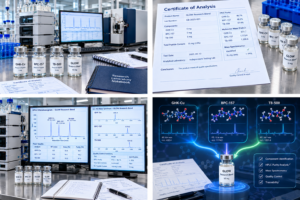
What Are Glow Peptides?
The term Glow peptides generally refers to a research-oriented peptide blend rather than a single peptide molecule.
The formulation most frequently associated with the term contains:
- GHK-Cu
- BPC-157
- TB-500
Each component is chemically distinct and has its own research literature.
GHK-Cu is a copper-associated peptide investigated in areas involving extracellular-matrix biology and cellular signaling. BPC-157 is a synthetic peptide studied primarily in preclinical research. TB-500 refers to the thymosin-beta-4 fragment commonly identified as LKKTETQ and is also investigated in laboratory research.
A key distinction is therefore:
GLOW ≠ one peptide
Instead:
GLOW = a market designation for a multi-component peptide preparation.
Current research sources emphasize that the precise formulation can differ among suppliers. Some current listings use a 70 mg total formulation consisting of 50 mg GHK-Cu, 10 mg BPC-157, and 10 mg TB-500, while other listings use different descriptions or quantities.
For that reason, the product label and lot-specific COA should take precedence over assumptions based on the name “GLOW.”
What Is in a GLOW Peptide Blend?
A commonly encountered GLOW research formulation contains three separate peptides.
| Component | Common research description | Important consideration |
|---|---|---|
| GHK-Cu | Copper-associated tripeptide | Verify chemical form and amount |
| BPC-157 | Synthetic pentadecapeptide | Primarily preclinical research |
| TB-500 | Thymosin-beta-4 fragment | Verify identity and specification |
| GLOW | Multi-component blend | Not a single chemical entity |
A frequently encountered formulation is:
- GHK-Cu — 50 mg
- BPC-157 — 10 mg
- TB-500 — 10 mg
- Total — 70 mg
However, this should be treated as a formulation example rather than a universal GLOW specification. Current sources explicitly note that supplier formulations and ratios can vary.
The best practice for laboratory research is to confirm:
- Component identity
- Amount of each component
- Chemical form
- Lot number
- HPLC results
- Mass-spectrometry results
- COA
- Storage information
GHK-Cu in Glow Peptides
GHK-Cu is a copper-associated tripeptide widely studied in biochemical and skin-related research.
The GHK portion refers to the amino-acid sequence:
Gly-His-Lys
Copper association creates the GHK-Cu complex.
Research involving GHK-Cu has examined areas such as:
- Extracellular-matrix signaling
- Fibroblast biology
- Collagen-related pathways
- Cellular signaling
- Skin research
- Tissue-remodeling biology
However, evidence involving topical or experimental GHK-Cu should not automatically be extrapolated to a GLOW combination or to a particular route of exposure.
The U.S. FDA currently identifies injectable GHK-Cu among substances for which there are limited human safety data and potential concerns involving immunogenicity, aggregation, and peptide-related impurities.
For research purposes, GHK-Cu should therefore be evaluated as one component of the formulation rather than as proof of an established clinical effect for GLOW.
BPC-157 in Glow Peptides
BPC-157 is a synthetic peptide that has received substantial attention in preclinical research.
Laboratory and animal research has examined BPC-157 in several biological contexts, including:
- Cellular signaling
- Vascular-related research
- Gastrointestinal models
- Connective-tissue models
- Experimental tissue-repair pathways
The important SEO and scientific distinction is between preclinical findings and demonstrated clinical outcomes.
FDA currently states that it has identified limited safety-related information for proposed routes involving BPC-157 and notes potential concerns involving immunogenicity, peptide-related impurities, and API characterization.
Therefore, a research article should describe BPC-157 as an investigational research peptide, not as an established human therapy.
TB-500 in Glow Peptides
TB-500 is commonly used in peptide research markets to refer to the thymosin-beta-4 fragment LKKTETQ.
It is important to distinguish TB-500 from the full thymosin-beta-4 protein.
Research involving thymosin-beta-4 and related fragments has examined biological processes involving:
- Actin-associated cellular mechanisms
- Cell migration
- Tissue biology
- Experimental wound models
- Cellular signaling
However, evidence concerning the parent protein should not automatically be treated as evidence for every TB-500 preparation.
The FDA currently identifies thymosin-beta-4 fragment, also known as TB-500, as having potential concerns involving aggregation and peptide-related impurities and states that it has not identified human exposure data sufficient to understand whether drug products containing the substance could cause harm.
This makes accurate identity and analytical documentation particularly important when evaluating TB-500 as a research material.
Is GLOW Peptide One Peptide?
No.
GLOW is generally used as a blend or market designation, not as the name of one molecularly defined peptide.
That distinction matters for:
- Analytical testing
- COA interpretation
- Molecular-weight calculations
- Purity reporting
- Product comparisons
- Research documentation
A single peptide has a defined molecular identity, while a blend contains multiple molecular species.
Therefore, a GLOW COA may need to document the individual components rather than reporting only one generic “GLOW purity” value.
Current research-oriented sources specifically recommend verifying the exact composition against the product specification and lot-specific COA.
GLOW Peptide Purity Testing
Peptide purity testing is one of the most important quality considerations when evaluating a GLOW research material.
Because GLOW contains multiple peptides, researchers should ideally understand how each component was characterized.
Relevant analytical methods can include:
HPLC
High-performance liquid chromatography can provide chromatographic separation and a relative purity assessment under specified analytical conditions.
LC-MS
Liquid chromatography combined with mass spectrometry can provide both separation and molecular-mass information.
Mass Spectrometry
MS can support molecular identity by comparing observed mass characteristics with expected values.
Complementary testing
Depending on the research requirements, additional analytical techniques may be relevant.
A purity percentage alone does not establish complete chemical identity.
For example:
HPLC purity ≠ molecular identity
and:
Molecular-mass confirmation ≠ complete purity characterization
A stronger analytical profile uses complementary information.
How to Read a GLOW Peptide COA
A Certificate of Analysis should be one of the first documents a researcher reviews when evaluating a research peptide blend.
Look for the following:
1. Product name
Confirm that the COA corresponds to the specific GLOW product.
2. Lot number
The lot number should match the physical material being evaluated.
3. Component composition
The COA should identify the individual components where applicable.
4. HPLC results
Review the reported chromatographic purity and testing methodology.
5. Mass spectrometry
Look for molecular-mass or identity confirmation.
6. Testing laboratory
An analytical laboratory should be identified where applicable.
7. Test date
Confirm when the analytical testing occurred.
8. Specification
Check whether the document identifies the applicable acceptance criteria.
9. Actual results
Actual analytical values are more informative than generic claims such as “high purity.”
10. Batch traceability
The COA should clearly connect the test results with the product lot.
Why GLOW Peptide HPLC Testing Matters
HPLC is widely used for peptide purity analysis because peptides can contain closely related chemical species.
A chromatogram may show:
- Main peptide peaks
- Related impurity peaks
- Retention times
- Peak areas
- Relative area percentages
For a multi-component blend, the analytical interpretation can be more complicated than for a single peptide.
Researchers should ask:
- Was each component tested separately?
- Was the blend analyzed as a mixture?
- What column was used?
- What detection method was used?
- How were peaks identified?
- Were molecular identities independently confirmed?
The exact analytical method matters because different methods can produce different separation characteristics.
GLOW Peptide and Mass Spectrometry
Mass spectrometry can add another layer of analytical information.
For a research blend, MS may help answer:
Does the observed molecular mass correspond with the expected component?
For example, a laboratory can compare an observed mass with the theoretical mass of the expected peptide.
This is especially useful when a product contains multiple peptides because a generic label alone does not establish molecular identity.
An analytical package combining HPLC + MS can therefore provide complementary information:
HPLC → chromatographic separation
MS → molecular-mass information
Together, these methods can provide a more informative analytical profile than either result considered alone.
Glow Peptides and Research Applications
GLOW is generally discussed in the research marketplace in connection with studies involving the biological areas associated with its individual components.
These include laboratory investigation of:
- Peptide signaling
- Extracellular-matrix biology
- Fibroblast research
- Cellular migration
- Connective-tissue models
- Experimental tissue biology
- Peptide analytical chemistry
- Molecular characterization
The appropriate interpretation is research-oriented, not therapeutic.
Research findings involving one component cannot automatically establish that the complete GLOW formulation produces the same effect.
This is especially important because current sources report that the exact three-component combination has not been established through controlled human clinical trials.
Does GLOW Have Proven Synergy?
The idea behind combining GHK-Cu, BPC-157, and TB-500 is sometimes described in terms of complementary biological pathways.
However, mechanistic complementarity is not the same as demonstrated synergy.
To establish synergy scientifically, researchers would generally need comparative experiments involving:
- Component A alone
- Component B alone
- Component C alone
- The combination
- Appropriate controls
The combined formulation would then need to demonstrate an outcome greater than what could reasonably be attributed to the individual components.
Current research-oriented sources emphasize that evidence for the individual peptides should not be mistaken for evidence that the GLOW combination itself has demonstrated synergy.
This distinction is valuable for both scientific accuracy and SEO credibility.
Glow Peptides vs. Individual Research Peptides
Researchers may encounter both a GLOW blend and individual peptides.
| Research Material | Analytical Question |
|---|---|
| GHK-Cu | What is the identity and purity of GHK-Cu? |
| BPC-157 | What is the identity and purity of BPC-157? |
| TB-500 | What is the identity and purity of TB-500? |
| GLOW blend | What components are present and how are they individually characterized? |
A blend may be convenient from a research-material perspective, but it can also make analytical interpretation more complicated.
Researchers should therefore determine whether the experimental design requires:
- Individual peptide characterization
- A multi-component preparation
- Separate controls
- Component-specific analytical testing
How to Evaluate High-Purity Glow Peptides
The phrase “high purity” should always be supported by analytical documentation.
A useful evaluation checklist includes:
Composition
Does the supplier disclose the exact components and quantities?
HPLC
Is chromatographic purity documented?
MS
Is molecular identity supported?
COA
Is a batch-specific Certificate of Analysis available?
Lot number
Does the COA match the actual lot?
Testing laboratory
Is the testing source identified?
Documentation
Are actual analytical results available?
Storage
Are storage requirements clearly communicated?
Research-use status
Is the product clearly designated for laboratory research?
These factors provide a more meaningful basis for evaluating a research material than the product name alone.
Glow Peptides USA: What U.S. Researchers Should Check
For researchers searching for Glow peptides USA, geographic location should not be the only purchasing criterion.
Researchers should also evaluate:
- Product identity
- Exact blend composition
- Lot-specific COA
- HPLC results
- Mass-spectrometry data
- Testing laboratory
- Shipping documentation
- Storage instructions
- Research-use designation
- Applicable U.S. regulatory considerations
The FDA currently identifies BPC-157, injectable GHK-Cu, and TB-500 among substances for which it has raised safety or characterization concerns in the context of compounded drugs.
That regulatory information should not be interpreted as approval or disapproval of a specific research supplier. Instead, it reinforces the importance of distinguishing laboratory research materials from approved pharmaceutical products.
Glow Peptides and Peptides Grey House
For a Peptides Grey House content strategy, “Glow peptides” can function as a commercial-investigation pillar that connects users to individual peptide research pages.
Potential internal links include:
- GHK-Cu research peptide
- BPC-157 research peptide
- TB-500 research peptide
- Peptide purity testing
- Peptide testing
- Peptide COA
- HPLC peptide analysis
- High purity research peptide
- Research peptides USA
- Biochemistry grade peptide
- Laboratory reconstitution solution
- Biochemical research solution
This creates a topical cluster around research peptide identification, testing, quality documentation, and laboratory use.
Avoid presenting the individual research pages as proof that the complete GLOW combination has been clinically established.
Common Glow Peptides SEO Questions
What are Glow peptides?
Glow peptides generally refers to a multi-peptide research blend commonly associated with GHK-Cu, BPC-157, and TB-500. It is not a single peptide molecule.
What is in Glow peptide?
A commonly encountered formulation contains GHK-Cu, BPC-157, and TB-500. Exact amounts can vary by supplier, so the product specification and COA should be checked.
Is GLOW a single peptide?
No. GLOW is generally a market name for a combination of multiple peptides.
What is the common GLOW peptide ratio?
A frequently encountered research formulation is 50 mg GHK-Cu, 10 mg BPC-157, and 10 mg TB-500, totaling 70 mg. This is not a universal or clinically validated formulation, and supplier specifications can differ.
What is GLOW peptide used for?
GLOW is marketed and discussed as a research blend involving biological pathways associated with its individual components. Research on the components should not be confused with evidence establishing the combined formulation for human use.
Is GLOW peptide FDA-approved?
The GLOW combination is not an FDA-approved drug. FDA separately identifies BPC-157, injectable GHK-Cu, and TB-500 among substances with identified safety or characterization concerns in the context of compounded drugs.
Does GLOW peptide have human clinical trials?
Current research-oriented sources report that controlled human clinical evidence for the exact GHK-Cu + BPC-157 + TB-500 combination has not been established.
What should a GLOW peptide COA show?
A useful COA should identify the product and lot and, where applicable, document the individual components, HPLC purity, mass-spectrometry identity, testing date, analytical laboratory, and other applicable specifications.
Why is HPLC important for GLOW peptides?
HPLC can provide chromatographic information about the components and related impurities under defined analytical conditions. For a multi-peptide blend, component-specific characterization can be particularly useful.
Is GHK-Cu the same as GLOW?
No. GHK-Cu is one component commonly found in GLOW formulations. GLOW refers to the overall multi-component blend.
Is TB-500 the same as thymosin beta-4?
TB-500 is commonly used to describe the thymosin-beta-4 fragment LKKTETQ. It should not automatically be treated as identical to the full thymosin-beta-4 protein.