

Introduction
A SNAP-8 research peptide is a synthetic peptide material commonly identified as Acetyl Octapeptide-3. It is relevant to peptide chemistry, analytical science, formulation research, and laboratory characterization.
For researchers evaluating a synthetic peptide, the name alone is only one part of the identification process. A complete research record can include the peptide sequence, chemical structure, molecular formula, molecular weight, batch number, chromatographic data, mass-spectrometric information, and Certificate of Analysis (COA).
SNAP-8 is particularly interesting from an analytical perspective because published research has established LC-MS/MS methods for its detection and quantification. A 2020 study developed a liquid chromatography-triple-quadrupole mass-spectrometry method for Acetyl Octapeptide-3 and demonstrated its application to a SNAP-8-containing research formulation.
Public chemical databases should also be checked carefully. PubChem currently has records identifying SNAP-8 as Acetyl Octapeptide-3, including a record listing C42H72N16O15S and a molecular weight of 1,073.2 g/mol. Another PubChem record contains a different deposited structure with C41H70N16O16S and a molecular weight of 1,075.2 g/mol.
That difference illustrates why laboratory users should verify the exact chemical form and batch documentation rather than relying on a name or single database value.
Research-use statement: SNAP-8 research peptide is described for laboratory research, analytical characterization, method development, and scientific investigation only. It is not presented as a medicine, treatment, dietary supplement, or product for human or veterinary administration.
What Is a SNAP-8 Research Peptide?
SNAP-8 is a synthetic octapeptide commonly identified as Acetyl Octapeptide-3.
PubChem lists SNAP-8 as a synonym for Acetyl Octapeptide-3 and provides the sequence EMQRRAD in one current record. Another PubChem structure record provides the modified peptide notation:
Ac-Glu-Glu-Met-Gln-Arg-Arg-Ala-Asp-NH₂
and represents the underlying sequence as EEMQRRAD.
The distinction between the abbreviated sequence and the complete modified structure matters in analytical chemistry. N-terminal acetylation and C-terminal amidation contribute to the chemical identity and calculated mass.
For laboratory documentation, useful identifiers may include:
- Chemical name
- Synonyms
- CAS number
- Molecular formula
- Molecular weight
- Exact mass
- Peptide sequence
- Structural modifications
- Batch number
- HPLC results
- LC-MS or MS/MS data
- Certificate of Analysis
This information helps researchers distinguish the target peptide from related materials.
SNAP-8 Research Peptide vs. Related Peptides
Peptide names can sometimes be confusing because several cosmetic-science peptides have similar names.
SNAP-8 should not be treated as interchangeable with Acetyl Hexapeptide-8.
PubChem identifies Acetyl Hexapeptide-8 as a separate chemical record with the shorter sequence EMQRR and a molecular weight of approximately 887.0 g/mol.
By contrast, SNAP-8 is an eight-residue peptide containing the extended sequence associated with EEMQRRAD in the relevant PubChem record.
For SEO and laboratory documentation, this distinction is valuable because searches for:
- SNAP-8
- Acetyl Octapeptide-3
- Acetyl Hexapeptide-8
- Argireline
- SNAP-8 peptide
do not necessarily represent the same chemical material.
A product page should therefore identify the exact compound rather than relying exclusively on broad peptide terminology.
SNAP-8 Molecular Information
Molecular information provides a foundation for analytical identification.
One current PubChem record for Acetyl Octapeptide-3 lists:
| Property | Reported value |
|---|---|
| Compound | Acetyl Octapeptide-3 |
| Synonym | SNAP-8 |
| CAS | 868844-74-0 |
| Molecular formula | C42H72N16O15S |
| Molecular weight | 1,073.2 g/mol |
| Exact/monoisotopic mass | 1,072.50837683 Da |
| PubChem CID | 71587832 |
| Sequence | EMQRRAD |
These values are from the current PubChem record for that deposited structure.
A separate PubChem record for Acetyl Octapeptide-3 lists:
- Formula: C41H70N16O16S
- Molecular weight: 1,075.2 g/mol
- Sequence: EEMQRRAD
- CAS: 868844-74-0
Why does the molecular information differ?
Database discrepancies can arise from differences in deposited structures, naming conventions, terminal representation, or chemical-form assignments.
For a research organization, the practical approach is to compare:
Product identity → chemical structure → COA → analytical results
rather than assuming that every public database record necessarily represents the same structural form.
This is particularly important when calculating expected mass-spectrometric signals.
SNAP-8 Peptide Sequence
The complete modified sequence associated with the PubChem record is:
Ac-Glu-Glu-Met-Gln-Arg-Arg-Ala-Asp-NH₂
The residue sequence is represented as:
EEMQRRAD
Sequence information can support:
- Peptide identification
- Molecular-mass calculations
- Reference-standard comparison
- LC-MS interpretation
- Synthetic-peptide documentation
- Database searches
- Analytical-method development
The terminal modifications should be included when calculating the expected molecular mass.
SNAP-8 HPLC Analysis
High-performance liquid chromatography (HPLC) is widely used for the chromatographic characterization of synthetic peptides.
For SNAP-8 research, HPLC can provide information about:
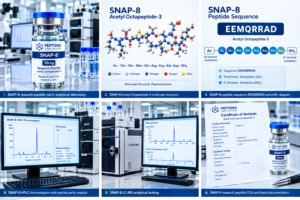
- Retention time
- Main chromatographic component
- Related peaks
- Relative chromatographic purity
- Potential degradation products
- Batch-to-batch chromatographic differences
A typical chromatogram plots detector response against retention time.
A dominant peak may correspond to the principal chromatographic component, while additional peaks can indicate other detectable components.
However, HPLC results should be interpreted within the context of the analytical method.
HPLC does not equal complete identity confirmation
HPLC is primarily a separation technique.
It can demonstrate that a sample produces a particular chromatographic profile, but retention time alone does not establish complete molecular identity.
For stronger characterization, researchers may use orthogonal techniques such as:
- LC-MS
- LC-MS/MS
- High-resolution mass spectrometry
- Reference-standard comparison
The published SNAP-8 analytical method demonstrates the value of combining liquid chromatography with tandem mass spectrometry.
SNAP-8 LC-MS and LC-MS/MS
Mass spectrometry provides complementary information to chromatography.
A 2020 peer-reviewed study developed an LC-MS/MS method specifically for Acetyl Octapeptide-3. The researchers used a triple-quadrupole mass spectrometer with electrospray ionization and multiple-reaction-monitoring detection.
The researchers observed multiply charged SNAP-8 ions. In their experimental method, a doubly charged precursor around m/z 538 was selected for analysis.
This illustrates an important analytical principle:
Molecular weight is not the same thing as m/z.
A peptide with a molecular mass around 1,073–1,075 Da can produce an ion with a substantially lower m/z value when it carries multiple charges.
Consequently, researchers interpreting LC-MS results should consider:
- Molecular formula
- Expected mass
- Ion charge
- Precursor m/z
- Product ions
- Retention time
- Reference standards
Together, these parameters can provide substantially more information than any single measurement.
Published SNAP-8 Analytical Research
The peer-reviewed literature provides useful context for SNAP-8 analytical testing.
Ji and colleagues published a 2020 study titled “Method development for acetyl octapeptide-3 analysis by liquid chromatography-tandem mass spectrometry.” The study developed and validated an LC-MS/MS method using multiple-reaction monitoring.
Under the researchers’ specific experimental conditions, the method demonstrated:
- Correlation coefficient of at least 0.9971
- Defined detection and quantification limits
- Repeatability measurements
- Accuracy measurements
- Application to a SNAP-8-containing microneedle patch
These figures should be understood as results from that particular validated method, not universal specifications for every SNAP-8 sample, laboratory, instrument, or formulation.
Analytical performance can change with:
- Column selection
- Mobile phase
- Gradient
- Sample matrix
- Instrument platform
- Ionization conditions
- Reference material
- Sample preparation
- Detector settings
That distinction is important when creating scientifically responsible SEO content.
SNAP-8 Purity Testing
The phrase SNAP-8 purity can refer to different analytical concepts.
For example, HPLC purity may be calculated using the relative area of chromatographic peaks detected under a specified method.
A reported chromatographic percentage should therefore always be considered alongside the:
- Detector
- Column
- Mobile phase
- Detection wavelength
- Integration method
- Sample preparation
- Analytical specification
Chromatographic purity vs. total content
These concepts are not necessarily identical.
Chromatographic area percentage describes the distribution of detected chromatographic components under a particular method. It does not automatically describe the total mass percentage of the target peptide in a vial.
For a research-grade product page, it is therefore better to state the analytical method and batch-specific result than to make an unsupported generalized purity statement.
SNAP-8 COA and Batch Documentation
A Certificate of Analysis (COA) provides batch-level documentation.
A useful SNAP-8 COA can include:
- Product name
- Batch or lot number
- Chemical identity
- Test date
- Purity
- Analytical method
- Identity testing
- Appearance
- Quantity or net content where applicable
- Storage information
- Laboratory information
How to review a SNAP-8 COA
Researchers can check whether:
- The product name matches the material.
- The lot number matches the physical label.
- The chemical identity is clearly defined.
- The analytical method is stated.
- Purity is associated with a defined test method.
- Identity testing is documented.
- The testing date is provided.
- Results are specific to the batch.
A batch-specific document is substantially more useful for traceability than a generic laboratory report unrelated to the supplied material.
SNAP-8 Analytical Quality
Analytical quality is best understood as a combination of complementary measurements.
For example:
Identity
Does the analytical evidence support the expected chemical structure?
Purity
What proportion of detectable chromatographic material corresponds to the principal component?
Mass
Does the observed mass or m/z behavior correspond with the expected molecular structure?
Documentation
Can the analytical results be connected to a specific batch?
Reproducibility
Can another qualified laboratory understand the method and reproduce the analytical workflow?
This multi-factor approach is useful for both research laboratories and SEO content because it moves the discussion beyond generic “high-quality peptide” terminology.
SNAP-8 Research Applications
SNAP-8 research can involve several laboratory and scientific contexts.
Peptide characterization
Researchers can investigate chemical identity, chromatographic properties, molecular mass, and related analytical characteristics.
Analytical method development
SNAP-8 can be used as an analyte for developing chromatographic and mass-spectrometric methods.
Formulation research
Published work has examined SNAP-8 in formulated systems, including a biodegradable microneedle patch.
Stability research
Laboratories can evaluate changes in chromatographic or mass-spectrometric profiles under controlled experimental conditions.
Batch comparison
Different research batches can be compared using consistent analytical procedures.
Cosmetic-science research
SNAP-8 has been investigated in cosmetic-science contexts, and published research has developed analytical methods for measuring the peptide in relevant formulations.
These are research categories and should not be converted into unsupported claims about human outcomes.
SNAP-8 Research Peptide Quality-Control Workflow
A structured laboratory workflow can include the following stages.
Step 1: Confirm the identity
Record the chemical name, sequence, CAS number where applicable, and structural representation.
Step 2: Review the COA
Check the batch number and analytical methods.
Step 3: Review HPLC data
Examine the chromatographic profile and reported purity methodology.
Step 4: Review mass-spectrometric data
Where available, compare observed mass-related data with the expected molecular structure.
Step 5: Record the batch
Maintain a traceable laboratory record linking the physical material to the analytical documentation.
Step 6: Maintain storage records
Follow the product-specific storage documentation and laboratory procedures.
This process helps support reproducibility and analytical traceability.
SNAP-8 Storage Considerations
Storage requirements should be based on the specific material’s documentation rather than a generic internet recommendation.
Relevant environmental factors can include:
- Temperature
- Moisture
- Light
- Container integrity
- Storage duration
- Repeated environmental exposure
Researchers should follow the supplier’s documented storage conditions and their own institutional laboratory procedures.
A research product page should not invent stability periods or storage specifications when batch-specific evidence is unavailable.
Evaluating a SNAP-8 Research Peptide Supplier
When comparing research materials, researchers can evaluate documentation and analytical transparency.
Batch traceability
The product should have a clear batch or lot identifier.
COA availability
The supplier should provide appropriate batch documentation where applicable.
Analytical evidence
Look for defined methods such as HPLC or LC-MS rather than unsupported purity statements.
Chemical identity
The product description should identify the compound and relevant structural information.
Clear research-use language
The intended laboratory context should be stated clearly.
Transparent product information
Technical claims should distinguish documented results from general descriptions.
This framework helps researchers evaluate the information quality of a product page without relying solely on marketing language.
SNAP-8 Research Peptide: Important Technical Distinctions
Several terms are frequently confused in peptide research.
Molecular weight
The calculated or reported mass of the molecule.
Exact mass
The calculated mass based on specific isotopic masses.
m/z
The mass-to-charge ratio measured by a mass spectrometer.
HPLC purity
A chromatographic measurement under defined analytical conditions.
Identity
Evidence that the measured material corresponds to the expected chemical structure.
Total peptide content
The amount of target peptide present in the material, which may require an analytical approach different from simple HPLC area percentage.
Understanding these distinctions makes technical content more accurate and useful.