

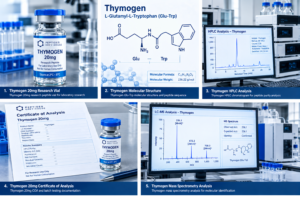
Thymogen 20mg Research Peptide
Thymogen 20mg is a research-use peptide material associated with the synthetic dipeptide L-glutamyl-L-tryptophan, commonly represented as Glu-Trp or EW. The compound is also known by names including Thymogen, Oglufanide, Glutamyltryptophan, and L-alpha-glutamyl-L-tryptophan. PubChem identifies Thymogen with the molecular formula C16H19N3O5, molecular weight 333.34 g/mol, and CAS Registry Number 38101-59-6.
For laboratory researchers, the value of a Thymogen 20mg product page is not simply the stated quantity. Research workflows generally require clear compound identification, documented purity, batch traceability, analytical characterization, and appropriate handling of the supplied material.
This page provides an informational overview of Thymogen 20mg for qualified laboratory and analytical research environments. It focuses on chemical identity, molecular properties, HPLC analysis, COA documentation, purity terminology, and research considerations.
Research-use statement: Thymogen 20mg described on this page is intended for research and analytical purposes only. It is not presented as a dietary supplement, therapeutic product, or recommendation for human or veterinary use.
What Is Thymogen?
Thymogen is associated with the synthetic dipeptide L-Glu-L-Trp, consisting of L-glutamic acid and L-tryptophan joined through a peptide linkage. PubChem lists its sequence as EW and its condensed representation as H-Glu-Trp-OH.
The compound has attracted scientific interest because of research into synthetic thymic peptides and their biological effects. A PubMed-indexed review describes L-Glu-L-Trp as one of the immunomodulatory molecules isolated from the thymic peptide preparation Thymalin and notes that a synthetic dipeptide was subsequently developed as Thymogen.
Historical research has examined the compound in different experimental systems, including studies involving immune-cell differentiation, cytokine-related processes, and hematopoietic models. These studies provide scientific context but should not be interpreted as evidence that a commercially supplied research material produces a particular clinical outcome.
For modern analytical research, the central considerations are more fundamental: What compound is present? How pure is the material? Is the batch consistent with its stated identity? What analytical documentation supports the result?
Thymogen 20mg: Key Chemical Information
| Property | Thymogen information |
|---|---|
| Compound | Thymogen / Oglufanide |
| Peptide identity | L-Glu-L-Trp |
| Sequence | EW |
| Molecular formula | C16H19N3O5 |
| Molecular weight | 333.34 g/mol |
| Exact mass | 333.13247072 Da |
| CAS Registry Number | 38101-59-6 |
| PubChem CID | 100094 |
| IUPAC condensed | H-Glu-Trp-OH |
The molecular information above is based on PubChem’s current chemical record. PubChem also lists a monoisotopic mass of 333.13247072 Da.
Researchers should distinguish between molecular weight, exact mass, and an experimentally observed mass-spectrometry ion. These values serve different analytical purposes and should not be used interchangeably.
Thymogen Molecular Weight
The molecular weight of Thymogen is 333.34 g/mol according to PubChem.
This figure is useful when preparing analytical calculations, comparing chemical databases, evaluating mass-spectrometry data, or checking whether a material’s documented identity corresponds to the intended compound.
The exact mass reported by PubChem is 333.13247072 Da, while the molecular weight is conventionally expressed as approximately 333.34 g/mol.
Why Molecular Weight Matters in Research
Molecular-weight information can support several laboratory workflows:
- Compound identification
- Analytical-method development
- Mass-spectrometry interpretation
- Reference-standard comparison
- Chemical database verification
- Documentation and inventory control
- Batch characterization
Mass spectrometry can provide additional evidence of molecular identity. PubChem’s record includes experimental MS/MS data for Thymogen, including a positive-mode precursor at approximately m/z 334.14 for the protonated molecular ion.
An analytical laboratory should interpret observed MS signals in the context of ionization mode, adduct formation, instrument parameters, and the complete spectrum rather than relying on one numerical peak.
Thymogen Purity
Purity is one of the most important specifications to evaluate when comparing research-grade peptide materials.
For a Thymogen 20mg research product, a stated purity percentage should ideally be supported by batch-specific analytical documentation rather than treated as a universal property of every vial or batch.
A product description may state a target purity specification, but researchers should examine the corresponding Certificate of Analysis for the actual batch.
What Can Influence Reported Purity?
Analytical purity can be affected by:
- Synthetic process conditions
- Starting-material quality
- Purification efficiency
- Residual synthesis-related compounds
- Related peptide or degradation products
- Water or solvent content
- Counterions or salts
- Analytical methodology
- Sample preparation
- Instrument conditions
For this reason, the term “purity” should always be interpreted alongside the analytical method used to determine it.
HPLC Purity
High-performance liquid chromatography, or HPLC, is widely used for peptide characterization.
In a reverse-phase HPLC method, Thymogen may be separated from other detectable components according to differences in chromatographic retention. The resulting chromatogram can provide information about the principal peak and additional detectable peaks.
However, HPLC purity is method-dependent. A reported percentage should therefore be understood as an analytical result under specified conditions, rather than an absolute guarantee that no other material exists.
Thymogen HPLC Analysis
An HPLC chromatogram can be an important component of the analytical documentation accompanying a Thymogen 20mg research material.
A typical peptide HPLC report may contain:
- Sample identification
- Batch or lot number
- Analytical method
- Column information
- Mobile-phase conditions
- Detection wavelength
- Retention time
- Principal peak area
- Related peak information
- Calculated purity
- Analyst or laboratory information
How to Read a Thymogen HPLC Chromatogram
When reviewing an HPLC report, researchers can examine whether the sample identification and batch number correspond to the material being evaluated.
The chromatogram should then be reviewed for the primary analytical peak and any additional peaks.
A high percentage associated with the principal peak can indicate strong chromatographic purity under that particular method. Nevertheless, the chromatographic result should be considered together with identity testing and other available analytical information.
HPLC Is Not the Same as Identity Confirmation
One important distinction is that purity and identity are different analytical questions.
HPLC primarily helps assess chromatographic composition. Additional techniques may be needed to establish molecular identity.
For peptide research, complementary methods may include:
- Mass spectrometry
- LC-MS
- Amino-acid analysis
- Spectroscopic characterization
- Reference-standard comparison
The most useful documentation therefore combines appropriate analytical methods rather than relying on a single number.
Thymogen COA: Certificate of Analysis
A Certificate of Analysis (COA) provides batch-specific information about a research material.
For Thymogen 20mg, a useful COA should clearly connect the analytical results to the specific lot supplied.
Information to Look for on a Thymogen COA
A comprehensive COA may include:
- Product name
- Chemical identity
- Batch or lot number
- Manufacturing or test date
- Appearance
- Purity result
- HPLC result
- Identity testing
- Molecular-weight or mass-spectrometry data
- Storage information
- Testing laboratory
- Specification limits
- Actual results
- Authorized approval or laboratory sign-off
Why Batch Traceability Matters
Two batches carrying the same product name should not automatically be assumed to have identical analytical results.
Batch-level documentation allows researchers to connect a physical sample with its corresponding analytical record.
This is particularly important when research results need to be reproduced, compared, or documented in a laboratory notebook or quality-management system.
A strong product page should therefore avoid presenting a generic COA as if it were automatically representative of every future batch.
Thymogen Identity and Sequence
Thymogen is identified in PubChem as L-alpha-glutamyl-L-tryptophan, with the sequence EW.
The two-letter sequence is useful as a compact representation of the dipeptide:
E = Glutamic acid
W = Tryptophan
The complete chemical identity is more specific than simply referring to “a peptide.” It includes the amino-acid composition and stereochemical configuration.
PubChem provides the IUPAC name, InChI, InChIKey, SMILES representation, formula, and additional identifiers for database-level chemical identification.
These identifiers can be useful when researchers need to distinguish Thymogen from related compounds or structurally different peptide analogues.
Thymogen Research Background
Scientific literature has investigated Glu-Trp in the context of synthetic thymic peptides.
A PubMed-indexed review from 1997 describes the isolation of L-Glu-L-Trp from a natural thymic peptide preparation using reversed-phase HPLC and discusses the development of a pharmaceutical based on the synthesized dipeptide.
Another experimental study investigated L-Glu-L-Trp in a rat model and reported effects involving immune-related and hematopoietic endpoints. Such findings are experimental and should not be translated directly into claims about human outcomes or the intended use of a laboratory research material.
This distinction is particularly important for SEO product content. Research literature can describe biological activity under defined experimental conditions, while a research supplier’s product page should remain focused on identity, analytical quality, documentation, and laboratory research use.
Thymogen 20mg Research Applications
A research-use description can appropriately focus on analytical and scientific applications without making therapeutic claims.
Potential research contexts include:
1. Peptide Characterization
Researchers can investigate the chemical characteristics of Glu-Trp using appropriate analytical instrumentation.
2. Chromatographic Method Development
Thymogen may be relevant to studies involving peptide separation and chromatographic characterization.
3. Mass-Spectrometry Research
The compound’s known molecular formula and mass characteristics provide reference information for MS-based analytical workflows.
4. Peptide Chemistry
Because Thymogen is a defined dipeptide, it can serve as a subject for investigations involving peptide structure, synthesis, stability, and analytical chemistry.
5. Comparative Research
Researchers may compare Glu-Trp with structurally related peptides or other synthetic peptide materials under controlled laboratory conditions.
Quality Considerations for Thymogen 20mg
When evaluating a research peptide, quality should be assessed from multiple perspectives.
Identity
The material should have a clearly defined chemical identity and preferably supporting analytical evidence.
Purity
The reported purity should be associated with a defined analytical method and specific batch.
Documentation
A batch-specific COA can provide important traceability information.
Analytical Consistency
HPLC, MS, or other appropriate analytical results can provide complementary evidence.
Packaging and Labeling
The product label should allow the physical material to be connected with its lot-specific documentation.
Storage Information
Researchers should follow the supplier’s documented storage requirements and applicable laboratory quality procedures.
Thymogen 20mg: Research-Use-Only Statement
Thymogen 20mg is offered for research and analytical use only. It is not intended for human consumption, self-administration, diagnosis, treatment, cure, or prevention of any disease or medical condition.
Information on this page is provided for scientific and educational purposes. Historical or experimental literature concerning Glu-Trp should not be interpreted as a recommendation for human or veterinary use.
Researchers are responsible for following applicable institutional procedures, laboratory safety requirements, chemical-handling practices, and relevant regulations.
Frequently Asked Questions About Thymogen 20mg
What is Thymogen 20mg?
Thymogen 20mg refers to a product containing 20mg of material identified as Thymogen, commonly associated with the synthetic dipeptide L-Glu-L-Trp. PubChem identifies Thymogen as L-alpha-glutamyl-L-tryptophan.
What is the molecular weight of Thymogen?
Thymogen has a molecular weight of 333.34 g/mol, according to PubChem. Its reported exact mass is 333.13247072 Da.
What is the molecular formula of Thymogen?
The molecular formula is C16H19N3O5.
What is the sequence of Thymogen?
Thymogen is represented by the dipeptide sequence EW, corresponding to glutamic acid followed by tryptophan. PubChem lists the compound as H-Glu-Trp-OH.
What is the CAS number for Thymogen?
PubChem lists 38101-59-6 as a CAS Registry Number associated with Thymogen. It also lists 122933-59-9 among additional identifiers.
What does Thymogen HPLC purity mean?
HPLC purity is an analytical measurement based on chromatographic separation and detection. It describes the proportion represented by the relevant chromatographic peak under the specified method and should not automatically be interpreted as an absolute measure of every possible impurity.
What is a Thymogen COA?
A Certificate of Analysis is a batch-specific quality document that can provide information such as identity, purity, analytical results, batch number, and testing details.
Why is a batch-specific COA important?
A batch-specific COA connects analytical results to a particular lot. This improves traceability and allows researchers to document which material was used in a particular experiment.
Is Thymogen the same as Thymalin?
No. The names refer to different materials. Research literature describes L-Glu-L-Trp as one molecule isolated from the thymic peptide preparation Thymalin, while Thymogen refers to the synthetic dipeptide product based on Glu-Trp.
Is Thymogen the same as Thymosin Alpha-1?
No. Thymogen/Glu-Trp is a small dipeptide, whereas thymosin alpha-1 is a substantially larger peptide with a different sequence and chemical identity.
Is Thymogen suitable for human use?
This product page positions Thymogen 20mg as a research-use-only material, not as a product for human use. Research literature should not be interpreted as a recommendation for self-administration.