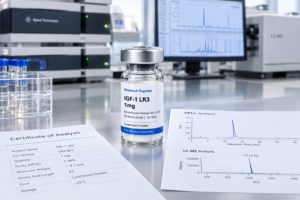
IGF-1 LR3 1mg is a laboratory research material based on Long R3 insulin-like growth factor-1, an engineered analog of human insulin-like growth factor-1 (IGF-1). It is primarily discussed in laboratory literature and research catalogs in connection with growth-factor signaling, receptor biology, cell-culture research, and analytical characterization.
The designation “LR3” describes two structural modifications compared with mature human IGF-1: a 13-amino-acid N-terminal extension and an arginine substitution at position 3 of the mature IGF-1 sequence. These modifications produce an 83-amino-acid analog rather than the 70-amino-acid mature IGF-1 molecule.
For research organizations, the important considerations when evaluating an IGF-1 LR3 1mg material include identity, molecular characteristics, purity, analytical documentation, batch traceability, storage documentation, and suitability for the intended laboratory workflow.
This page provides an educational overview of IGF-1 LR3 1mg, including molecular weight, sequence, analytical testing, Certificate of Analysis (COA) considerations, research applications, supplier-quality evaluation, and frequently asked questions.
Research-use statement: Information on this page is intended for laboratory research, analytical evaluation, educational purposes, and scientific documentation. IGF-1 LR3 products marketed as research materials should not be represented as medicines, supplements, or products intended for human or veterinary administration.
What Is IGF-1 LR3?
IGF-1 LR3, also called Long R3 IGF-1 or Long R3 IGF-I, is a modified analog of insulin-like growth factor-1.
Native mature human IGF-1 contains 70 amino acids. IGF-1 LR3 contains an additional 13-residue N-terminal extension, producing an 83-residue protein analog. The mature IGF-1 portion also incorporates a Glu-to-Arg substitution at position 3.
The two defining modifications are therefore:
- Long: a 13-amino-acid N-terminal extension
- R3: an arginine substitution for glutamic acid at position 3 of mature IGF-1
- Total length: 83 amino acids
These structural differences are important when distinguishing IGF-1 LR3 from native IGF-1 and from other IGF-1-related research materials.
IGF-1 LR3 is also distinct from mecasermin, the recombinant human IGF-1 pharmaceutical product. A research listing should therefore identify the material accurately and avoid implying that IGF-1 LR3 is interchangeable with an approved pharmaceutical IGF-1 product.
IGF-1 LR3 1mg Research Material
A 1mg presentation refers to the nominal quantity of material supplied in a research vial or package.
The “1mg” designation describes the amount of product supplied; it does not establish purity, biological activity, sterility, or suitability for any particular experimental system.
For laboratory purchasing, researchers should distinguish between:
Labeled quantity:
The amount stated on the product label.
Measured content:
The quantity determined through an analytical assay where such testing is available.
Purity:
The proportion of the analyzed material represented by the target compound under the supplier’s stated analytical method.
Identity:
Evidence that the material corresponds to the intended IGF-1 LR3 target.
These are separate quality attributes and should not be treated as interchangeable.
IGF-1 LR3 Molecular Weight
One of the most frequently searched technical specifications for this material is IGF-1 LR3 molecular weight.
Published and commercial research references generally place the molecular weight of IGF-1 LR3 at approximately 9.1 kDa. Depending on whether a source reports the reduced chain, folded/disulfide-linked form, or a particular calculation convention, values around 9,111–9,118 Da can appear.
For example, one current research reference reports an average molecular weight of approximately 9,111.5 Da for the folded form containing three disulfide bonds, while the reduced-chain calculation is approximately 9,117.6 Da.
IGF-1 LR3 Molecular Specifications
| Property | Research reference |
|---|---|
| Compound | IGF-1 LR3 |
| Common name | Long R3 IGF-1 |
| Molecular class | IGF-1 analog/protein |
| Sequence length | 83 amino acids |
| Approx. molecular weight | ~9.1 kDa |
| N-terminal extension | 13 amino acids |
| R3 modification | Glu → Arg at mature position 3 |
| Physical form commonly listed | Lyophilized research material |
| Research context | Growth-factor and cell-signaling research |
Because different databases and suppliers may use different mass conventions, the batch-specific analytical documentation should take precedence for a particular commercial material.
IGF-1 LR3 Sequence
The structural identity of IGF-1 LR3 is defined by its modified sequence.
A commonly reported sequence is:
MFPAMPLSSLFVNGPRTLCGAELVDALQFVCGDRGFYFNKPTGYGSSSRRAPQTGIVDECCFRSCDLRRLEMYCAPLKPAKSA
The first 13 residues represent the characteristic N-terminal extension:
MFPAMPLSSLFVN
The remainder corresponds to the mature IGF-1-derived portion containing the R3 substitution. Current structural references identify the complete molecule as an 83-residue analog.
Sequence information is particularly useful for:
- Identity confirmation
- Reference-standard comparison
- Mass-spectrometry interpretation
- Protein characterization
- Bioinformatics
- Structure-function research
- Analytical method development
Researchers should verify sequence information against a trusted scientific reference and the supplier’s batch documentation rather than relying on an isolated marketplace listing.
IGF-1 LR3 Structure and Research Significance
The “Long” component of IGF-1 LR3 refers to the additional N-terminal peptide segment.
The “R3” component identifies the substitution at position 3 of mature IGF-1.
These changes were designed to alter the interaction of the analog with IGF-binding proteins and its availability within experimental systems. Research references describe IGF-1 LR3 as an analog used to investigate IGF-related receptor and signaling biology.
This makes IGF-1 LR3 useful as a research subject when investigating questions involving:
- IGF-1 receptor signaling
- Growth-factor biology
- Cell signaling
- Protein-receptor interactions
- Cell proliferation models
- Molecular characterization
- Comparative IGF research
The presence of an altered sequence also makes analytical identity particularly important.
IGF-1 LR3 Research Applications
IGF-1 LR3 appears in research contexts involving IGF-1 receptor biology and growth-factor signaling.
Laboratory researchers may investigate the molecule in controlled experimental systems designed to understand how modified IGF-1 analogs interact with biological pathways.
Areas of scientific investigation can include:
Cell Signaling Research
IGF-1-related molecules are studied in models examining receptor-mediated signaling pathways.
Protein Characterization
Researchers can use analytical techniques to investigate molecular identity, molecular mass, purity, and structural characteristics.
Cell-Culture Research
IGF-1 analogs can be investigated in controlled cell-based research systems where growth-factor signaling is being examined.
Comparative Research
IGF-1 LR3 can be compared with other IGF-related materials to investigate how structural modifications influence analytical or biological behavior.
Analytical Method Development
The compound can serve as a reference material when developing or evaluating analytical methods appropriate to the research objective.
Research applications should always be interpreted in the context of the specific experimental model and published evidence. Laboratory observations should not automatically be translated into claims about human outcomes.
IGF-1 LR3 COA: Certificate of Analysis
A Certificate of Analysis (COA) is one of the most important documents to review when purchasing IGF-1 LR3 1mg for laboratory research.
A strong COA should connect the analytical results to the specific lot or batch being supplied.
Important fields can include:
- Product name
- Lot or batch number
- Manufacturing or production date
- Analysis date
- Release date
- Labeled quantity
- Analytical method
- Purity result
- Identity result
- Molecular-weight confirmation
- Appearance
- Testing laboratory
- Specification limits
- Storage information
- Authorized approval or release information
Some current research-market COAs report HPLC purity and identity testing, while individual documents differ substantially in the tests and specifications they include.
HPLC Purity
High-performance liquid chromatography (HPLC) can be used to evaluate chromatographic purity.
A reported value such as “≥99% HPLC” should always be interpreted alongside:
- The HPLC method
- Reference standard
- Detection conditions
- Acceptance criteria
- Batch number
- Date of analysis
A purity percentage by itself does not establish every other quality attribute of a research material.
Mass Spectrometry
Mass spectrometry can provide useful evidence for molecular identity and expected mass.
For a protein analog such as IGF-1 LR3, mass-spectrometric characterization can help determine whether the observed molecular mass is consistent with the intended molecular species.
Identity Testing
Identity testing should demonstrate that the tested material corresponds to IGF-1 LR3.
Depending on the laboratory and analytical package, identity may be supported through chromatography, mass spectrometry, sequencing-related analysis, or other validated techniques.
COA Batch Matching
The lot number printed on the product packaging should match the lot number appearing on the COA.
This is a simple but important quality-control step.
Do not rely on a generic COA if the document cannot be connected to the actual batch being purchased.
IGF-1 LR3 Purity
Purity is another important SEO and purchasing term associated with IGF-1 LR3 1mg.
Some current research-market documents report purity values above 99% by HPLC. For example, recently published vendor COAs show batch-specific results of 99% or higher.
However, purity claims should always be treated as supplier- and batch-specific.
A product description stating “99% purity” is not equivalent to independently verifying that result.
When evaluating a supplier, look for:
- Batch-specific documentation
- Analytical method
- Testing date
- Laboratory identification
- Identity confirmation
- Purity specification
- Actual test result
- Matching lot number
This approach provides substantially more useful information than relying solely on a marketing statement.
IGF-1 LR3 Analytical Testing
Several analytical approaches may be relevant to protein research materials.
HPLC
HPLC can be used to evaluate chromatographic purity and identify major peaks associated with the target material.
Mass Spectrometry
Mass spectrometry can help confirm molecular mass and support identity characterization.
Electrophoretic Analysis
Appropriate electrophoretic techniques can provide additional information about protein characteristics.
Protein Quantification
Laboratories may use appropriate quantitative methods to characterize protein concentration or content.
Structural Analysis
Depending on the research question, structural techniques may be used to investigate folding, molecular interactions, or related characteristics.
No single analytical test necessarily answers every quality question. A comprehensive research specification should therefore consider identity, purity, quantity, and relevant quality attributes together.
IGF-1 LR3 Storage and Handling Documentation
Storage requirements for research proteins can vary depending on the supplier, formulation, container, and intended storage period.
For that reason, buyers should follow the specific manufacturer’s current storage instructions and batch documentation rather than copying storage conditions from an unrelated supplier.
Important considerations can include:
- Protecting the material from inappropriate environmental exposure
- Maintaining the sealed container according to supplier instructions
- Avoiding unnecessary temperature fluctuations
- Maintaining batch traceability
- Recording storage conditions
- Reviewing the product-specific documentation before laboratory use
The exact storage conditions should therefore be treated as a product-specific specification, not a universal IGF-1 LR3 rule.
IGF-1 LR3 vs. Native IGF-1
IGF-1 LR3 should not be confused with native mature human IGF-1.
| Feature | Native mature IGF-1 | IGF-1 LR3 |
|---|---|---|
| Approx. sequence length | 70 aa | 83 aa |
| N-terminal extension | No | Yes |
| R3 substitution | No | Yes |
| Molecular class | IGF-1 | Modified IGF-1 analog |
| Research use | Growth-factor biology | Modified IGF research |
| Identity | Native mature IGF-1 | Long R3 analog |
The additional 13 residues and the Arg3 substitution are the defining molecular differences.
IGF-1 LR3 vs. Mecasermin
Another important distinction for SEO and scientific accuracy is the difference between IGF-1 LR3 and mecasermin.
Mecasermin is recombinant human IGF-1 used as a pharmaceutical product, whereas IGF-1 LR3 is a modified research analog with structural differences from mature human IGF-1.
Therefore, a research page should not use the names interchangeably.
For laboratory documentation, product identity should be based on the actual material, sequence, batch information, and analytical documentation.
How to Evaluate an IGF-1 LR3 1mg Supplier
Before purchasing a research material, consider the following supplier-quality checklist.
1. Product Identity
Does the supplier clearly identify the compound as IGF-1 LR3 or Long R3 IGF-1?
2. Batch Documentation
Is a lot-specific COA available?
3. Analytical Testing
Does the COA identify the methods used for purity and identity testing?
4. Traceability
Can the COA be connected to the exact product lot?
5. Product Quantity
Is the labeled amount clearly stated?
6. Physical Description
Does the supplier provide an appropriate description of the supplied material?
7. Research-Use Statement
Does the supplier clearly define the material’s intended research status?
8. Documentation Consistency
Do the product page, label and COA use consistent identity information?
9. Storage Documentation
Are product-specific storage instructions provided?
10. Regulatory Transparency
Does the supplier avoid presenting research material as an approved therapeutic product?
Why Batch-Specific COAs Matter
A Certificate of Analysis is most useful when it relates directly to the material being purchased.
For example, if a website displays a COA for one batch but ships another batch, the displayed analytical result should not automatically be assumed to apply to the second lot.
A useful quality workflow is:
Product label → Lot number → COA → Analytical results → Purchase records
Maintaining this chain helps laboratories preserve traceability and documentation quality.
Research-Use Wording for IGF-1 LR3 1mg
The following wording can be used on a product page:
IGF-1 LR3 1mg is supplied as a research-use laboratory material for qualified scientific and analytical applications. The material is intended for research, characterization, and controlled laboratory investigation only. It is not marketed as a medicine, dietary supplement, cosmetic ingredient, or veterinary product and is not intended for human or animal administration. Product specifications, analytical results, purity, identity, and storage information should be verified against the applicable batch-specific documentation.
This wording keeps the page focused on laboratory research rather than making therapeutic or performance claims.
Frequently Asked Questions About IGF-1 LR3 1mg
What is IGF-1 LR3 1mg?
IGF-1 LR3 1mg refers to a research-material presentation containing a nominal 1mg quantity of IGF-1 LR3, also known as Long R3 IGF-1.
What does LR3 mean?
“Long” refers to the 13-amino-acid N-terminal extension, while “R3” refers to the arginine substitution at position 3 of the mature IGF-1 sequence.
How many amino acids are in IGF-1 LR3?
IGF-1 LR3 is commonly described as an 83-amino-acid analog.
What is the molecular weight of IGF-1 LR3?
IGF-1 LR3 has a molecular weight of approximately 9.1 kDa. Depending on the molecular-state and calculation convention, reported values can differ slightly.
What is the IGF-1 LR3 sequence?
A commonly reported 83-residue sequence begins with MFPAMPLSSLFVN and incorporates the characteristic R3 modification. The complete sequence should be verified against an authoritative scientific reference or the supplier’s documentation.
Is IGF-1 LR3 the same as IGF-1?
No. IGF-1 LR3 is a modified analog of mature IGF-1 containing an N-terminal extension and an Arg3 substitution.
Is IGF-1 LR3 the same as mecasermin?
No. Mecasermin is recombinant human IGF-1, whereas IGF-1 LR3 is a structurally modified analog.
What should an IGF-1 LR3 COA contain?
A useful COA should identify the product and lot and provide relevant analytical information such as purity, identity testing, analytical methods, dates, and applicable specifications.
Is 99% HPLC purity sufficient to establish overall quality?
Not by itself. HPLC purity is one analytical attribute. Identity, quantity, batch traceability, and other relevant quality characteristics should also be considered.
Why do IGF-1 LR3 molecular-weight values differ between sources?
Different references can report calculated mass for different molecular states, such as reduced versus disulfide-linked forms. This can produce small differences in reported molecular weight.
Is IGF-1 LR3 intended for human use?
Research-market IGF-1 LR3 should be described strictly according to its documented research status and should not be presented as an approved human therapeutic product.