

IGF-DES 2mg: Des(1–3)IGF-1 Research Peptide, Purity, HPLC & Molecular Analysis
Introduction to IGF-DES 2mg
IGF-DES 2mg is a research-material designation associated with Des(1–3)IGF-1, a truncated form of insulin-like growth factor 1 (IGF-1). It is also described in scientific and technical literature using names such as IGF-1 DES, Des 1–3 IGF-1, and Des(1–3)IGF-I.
Des(1–3)IGF-1 differs from mature human IGF-1 because the first three amino acids of the mature chain—Gly-Pro-Glu—are absent. Technical specifications for recombinant human Des(1–3)IGF-1 describe a 67-amino-acid, non-glycosylated polypeptide with a reported molecular weight of approximately 7.4 kDa.
For laboratories researching IGF-related molecular systems, the product name and nominal 2mg quantity are only part of the information required for proper characterization. Researchers may also need the exact sequence, molecular form, molecular weight, purity, HPLC profile, mass-spectrometry data, and batch-specific Certificate of Analysis (COA).
This guide provides an informational overview of IGF-DES 2mg, including its molecular identity, analytical considerations, HPLC and purity terminology, COA documentation, and research-use positioning.
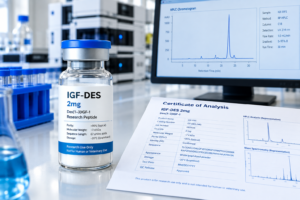
Research-use statement: IGF-DES 2mg is presented as a laboratory research material for scientific investigation and analytical characterization only. It is not intended for human or veterinary use.
What Is IGF-DES?
IGF-DES generally refers to Des(1–3)IGF-1, a truncated IGF-1 variant.
The “Des(1–3)” designation indicates that residues 1 through 3 of mature IGF-1 are absent. Technical documentation describes the missing N-terminal tripeptide as Gly-Pro-Glu (GPE).
This structural difference is significant because the N-terminal region of IGF-1 contributes to interactions with IGF-binding proteins. Research has examined how removal of these residues changes binding characteristics and other molecular properties.
Common names and terminology
| Term | Description |
|---|---|
| IGF-DES | Common shorthand for Des(1–3)IGF-1 |
| IGF-1 DES | Alternative product/research name |
| Des(1–3)IGF-1 | Scientific designation |
| Des(1–3)IGF-I | Alternative spelling |
| Des 1–3 IGF-1 | Search and literature variation |
| IGF-DES 2mg | Nominal product quantity |
Because terminology can vary, researchers should use the exact sequence and molecular specification when documenting a material.
IGF-DES 2mg Research Background
IGF-1 belongs to the insulin-like growth factor family and has been widely investigated in molecular biology, receptor signaling, protein chemistry, and cellular research.
Des(1–3)IGF-1 has been studied as a truncated IGF-1 analogue. Research examining IGF-binding proteins has shown that residues in the N-terminal portion of IGF-1 are important for binding to several IGF-binding proteins. Studies specifically examining Des(1–3)IGF-1 found substantially altered interactions with IGF-binding proteins while retaining relevant receptor interactions.
These observations make Des(1–3)IGF-1 useful as a research model for investigating relationships between:
- Protein sequence
- Molecular structure
- Binding-protein interactions
- Receptor interactions
- Protein characterization
- IGF-related molecular pathways
Importantly, experimental findings depend on the particular material and model system used. Results from cell or animal research should not automatically be interpreted as evidence of human clinical effects.
IGF-DES Peptide Sequence
The IGF-DES peptide sequence is one of the most important pieces of information for analytical identification.
Technical specifications for recombinant human Des(1–3)IGF-1 describe a 67-amino-acid sequence. One published supplier specification provides the sequence:
TLCGAELVDALQFVCGDRGFYFNKPTGYGSSSRRAPQTGIVDECCFRSCDLRRLEMYCAPLKPAKSA
The exact sequence should always be checked against the relevant product specification before using it for analytical work.
Why sequence matters
Two materials can have similar names but different molecular characteristics.
Researchers comparing IGF-related products should verify:
- Amino-acid sequence
- Sequence length
- Molecular form
- Molecular weight
- Terminal structure
- Purity
- Analytical identity
- Batch documentation
Sequence verification is particularly important when comparing IGF-DES, full-length IGF-1, and modified IGF-1 analogues.
IGF-DES Molecular Weight
IGF-DES molecular weight is an important informational and SEO topic for laboratories evaluating Des(1–3)IGF-1.
Technical specifications for recombinant human Des(1–3)IGF-1 commonly report a molecular weight of approximately 7.4 kDa. Another technical listing reports approximately 7,370 daltons.
The exact reported value can depend on whether a source gives a calculated mass, average molecular weight, or experimentally measured mass.
Molecular-weight summary
| Property | IGF-DES |
|---|---|
| Scientific name | Des(1–3)IGF-1 |
| Approximate length | 67 amino acids |
| Approximate molecular weight | 7.4 kDa |
| Molecular form | Truncated IGF-1 |
| Missing N-terminal residues | Gly-Pro-Glu |
| Analytical confirmation | Mass spectrometry, where available |
For a commercial research page, the molecular-weight figure should be tied to the specific product specification rather than presented as a universal value for every material sold under the IGF-DES name.
IGF-DES 2mg Product Specifications
The 2mg designation describes the nominal quantity of research material.
Quantity should not be confused with purity, molecular identity, or biological activity.
A professional product page can present the following specifications:
| Specification | Recommended product information |
|---|---|
| Product | IGF-DES 2mg |
| Scientific name | Des(1–3)IGF-1 |
| Quantity | 2mg |
| Molecular form | Truncated IGF-1 |
| Sequence | Product-specific |
| Molecular weight | Approximately 7.4 kDa where applicable |
| Purity | Batch-specific |
| HPLC | Batch-specific where available |
| Mass spectrometry | Where available |
| COA | Lot-specific where available |
| Intended use | Laboratory research only |
If the Peptides Grey House product has a different analytical specification, the product-specific documentation should take precedence over generic literature values.
IGF-DES HPLC Analysis
IGF-DES HPLC is a useful analytical keyword for researchers interested in peptide and protein characterization.
High-performance liquid chromatography (HPLC) separates components according to their interaction with a chromatographic system. In peptide and protein research, chromatographic data can provide information about the principal component and related chromatographic species.
Technical documentation for recombinant Des(1–3)IGF-1 has reported purity assessment using HPLC alongside other analytical methods.
Information commonly associated with an HPLC report
An IGF-DES HPLC record may include:
- Sample identification
- Retention time
- Main peak
- Relative peak area
- Related peaks
- Column information
- Detection conditions
- Analytical method
- Testing date
- Lot number
Representative vs. batch-specific HPLC
This distinction is important for product SEO and laboratory transparency.
A representative chromatogram illustrates the type of analytical profile expected from a material or method.
A batch-specific chromatogram is associated with a particular lot and provides more direct documentation of the supplied material.
A product page should not imply that a representative chromatogram proves the purity of every batch.
IGF-DES Purity
IGF-DES purity is another important quality-related search term.
Purity should be reported with its analytical method and, whenever possible, its corresponding batch number.
Published technical specifications for recombinant Des(1–3)IGF-1 have reported purity measurements using HPLC and SDS-PAGE. One supplier specification reports greater than 97% purity by SDS-PAGE and HPLC, while another lists greater than 95% by HPLC. These are supplier-specific specifications and should not be generalized to every IGF-DES product.
Why analytical method matters
Different analytical techniques provide different information.
HPLC can provide chromatographic purity information.
SDS-PAGE can provide information about protein size and electrophoretic composition.
Mass spectrometry can help confirm molecular mass and identity.
Using several complementary methods can provide a more complete analytical picture.
Recommended product-page wording
Instead of making an unsupported blanket statement such as “IGF-DES is 99% pure,” use wording such as:
“Purity is reported according to the applicable batch-specific analytical documentation.”
This keeps the page accurate while allowing the actual COA to establish the relevant result.
IGF-DES COA
A Certificate of Analysis (COA) provides batch-level documentation for a research material.
An IGF-DES COA may include:
- Product name
- Catalog number
- Lot number
- Quantity
- Analytical method
- Purity result
- HPLC result
- Identity testing
- Molecular characterization
- Testing date
- Quality-control information
The precise contents depend on the testing laboratory and supplier.
COA verification checklist
Researchers reviewing an IGF-DES COA can check:
- Does the product name match the material?
- Does the lot number correspond to the supplied product?
- Is the molecular form specified?
- Is the analytical method identified?
- Is the purity result clearly reported?
- Is identity testing documented?
- Is the testing date provided?
- Is the document associated with the current batch?
A batch-specific COA is more useful than a generic quality statement because it connects analytical results to a defined lot.
IGF-DES and Molecular Characterization
Molecular characterization is especially important for IGF-DES because it is a truncated protein rather than simply another name for full-length IGF-1.
Useful characterization data may include:
Sequence confirmation
Confirms the intended amino-acid composition.
Molecular-mass confirmation
Helps compare expected and measured molecular mass.
Chromatographic analysis
Provides information about the sample’s chromatographic profile.
Electrophoretic analysis
Can provide additional information about protein size and composition.
Batch documentation
Connects analytical findings to a particular research material.
This layered approach provides a stronger scientific record than relying on the product name alone.
IGF-DES vs. Full-Length IGF-1
IGF-DES should not be treated as interchangeable with full-length IGF-1.
The key structural difference is the absence of the N-terminal Gly-Pro-Glu sequence in Des(1–3)IGF-1. This alteration affects interactions with IGF-binding proteins.
| Feature | Full-length IGF-1 | IGF-DES |
|---|---|---|
| Molecular family | IGF-1 | IGF-1 analogue |
| N-terminal GPE | Present | Absent |
| Mature-chain length | 70 amino acids | 67 amino acids |
| Molecular mass | Approximately 7.6 kDa | Approximately 7.4 kDa |
| Research focus | IGF-1 biology | Truncated IGF-1 characterization |
| Analytical comparison | Sequence and mass | Sequence and mass |
The values above are approximate reference information; product-specific specifications should be used for analytical work.
IGF-DES vs. IGF-1 LR3
IGF-DES and IGF-1 LR3 are both associated with IGF-1 research but represent different molecular modifications.
IGF-DES is characterized by deletion of the first three residues of mature IGF-1.
IGF-1 LR3 is a different engineered analogue with additional sequence modifications.
Consequently, researchers should not substitute one for the other when interpreting experimental literature.
For SEO, this distinction also creates a useful internal-link opportunity:
IGF-DES 2mg → IGF-1 LR3 1mg → IGF-1 molecular analysis → Peptide Purity Analysis
IGF-DES Research Applications
IGF-DES can be discussed in connection with laboratory research areas such as:
- Protein characterization
- IGF receptor research
- IGF-binding protein research
- Molecular biology
- Analytical chemistry
- Protein purification
- HPLC analysis
- Mass spectrometry
- Structure-function research
- Comparative protein studies
Published studies have examined Des(1–3)IGF-1 in relation to IGF-binding proteins and receptor interactions.
These research categories should not be converted into claims that the material provides a particular health, therapeutic, or performance outcome.
Research-Use-Only Positioning
For a U.S.-focused research product page, use clear and consistent language.
Recommended research-use wording
IGF-DES 2mg is supplied as a laboratory research material for scientific investigation, analytical characterization, and controlled biochemical research. It is intended for research use only and is not intended for human or veterinary use.
Quality-documentation wording
Product identity, molecular weight, purity, HPLC results, and other analytical specifications should be verified against the documentation applicable to the specific batch or lot.
Compliance-oriented wording
Avoid language suggesting:
- Human administration
- Veterinary administration
- Disease treatment
- Disease prevention
- Clinical approval
- Guaranteed biological effects
- Performance enhancement
The page should remain focused on laboratory research and analytical information.
IGF-DES 2mg Storage and Documentation
Storage information should be based on the actual supplier specification rather than copied generically from another IGF-DES product.
Published supplier documentation differs in formulation and storage recommendations. For example, one recombinant Des(1–3)IGF-1 specification describes lyophilized material and provides its own storage guidance.
Therefore, the product page should direct researchers to the current product documentation for:
- Storage temperature
- Container requirements
- Stability information
- Reconstitution information, if supplied
- Handling instructions
- Freeze/thaw limitations
The product page should not imply that storage conditions for one supplier’s formulation apply universally to every IGF-DES material.
Frequently Asked Questions About IGF-DES 2mg
What is IGF-DES 2mg?
IGF-DES 2mg is a research-material designation referring to a 2mg quantity of material identified as IGF-DES, commonly associated with Des(1–3)IGF-1.
What is Des(1–3)IGF-1?
Des(1–3)IGF-1 is a truncated IGF-1 analogue lacking the N-terminal Gly-Pro-Glu tripeptide. Technical specifications describe it as a 67-amino-acid protein.
What is the molecular weight of IGF-DES?
A commonly reported molecular weight for recombinant human Des(1–3)IGF-1 is approximately 7.4 kDa, with one technical specification reporting 7,370 ± 2 daltons.
What is the IGF-DES peptide sequence?
Technical documentation lists a 67-amino-acid sequence beginning with TLCGAELV… and ending with …LKPAKSA. The exact sequence should be verified against the applicable product documentation.
What is IGF-DES HPLC?
IGF-DES HPLC refers to high-performance liquid chromatography used to analyze an IGF-DES research material. It can provide chromatographic information relevant to purity and characterization.
How is IGF-DES purity measured?
Purity can be evaluated using analytical techniques such as HPLC. Some technical specifications also use SDS-PAGE as a complementary characterization method.
What is an IGF-DES COA?
An IGF-DES COA is a Certificate of Analysis associated with a particular product lot. It may document identity, purity, HPLC, mass information, and other quality-control parameters.
Is IGF-DES the same as IGF-1?
No. IGF-DES is a truncated IGF-1 analogue in which the first three residues of the mature IGF-1 chain are absent.
Is IGF-DES the same as IGF-1 LR3?
No. IGF-1 LR3 is a separately modified IGF-1 analogue. Their sequences and molecular characteristics differ.
What research areas involve IGF-DES?
Research has investigated Des(1–3)IGF-1 in areas including IGF-binding proteins, receptor interactions, molecular characterization, and cellular research.
Is IGF-DES 2mg for human use?
A research-grade IGF-DES product should be explicitly designated for laboratory research use only and not for human or veterinary use.
Why is batch-specific documentation important?
Batch-specific documentation connects analytical results to the actual material supplied. This can help researchers distinguish product specifications from generic information about the molecular class.