

What Is a Thymosin Alpha-1 COA?
A Thymosin Alpha-1 COA, or Certificate of Analysis, is an analytical document used to report testing information associated with a specific sample or batch of Thymosin Alpha-1.
For research materials, a COA can help document:
- Compound identity
- Lot or batch number
- HPLC purity
- Mass-spectrometry results
- Molecular identity
- Test date
- Testing laboratory
- Analytical methodology
- Additional quality-control results
The most important concept is traceability.
A COA should not simply be treated as a marketing certificate. Researchers should determine whether the document actually corresponds to the material being evaluated.
Current examples of publicly available Thymosin Alpha-1 COAs demonstrate why this matters: published certificates can identify a particular lot, testing laboratory, analytical method, and test date rather than merely displaying a generic purity statement.
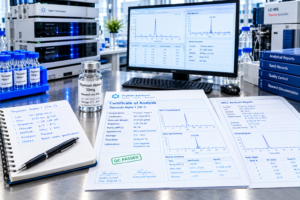
Why a Thymosin Alpha-1 COA Matters
A research peptide can be described using many specifications, but those specifications are more useful when supported by analytical documentation.
For example, a product page might state:
Thymosin Alpha-1 — 10mg — high purity
That information describes the product but does not independently answer:
- Which lot was tested?
- What analytical method was used?
- What was the measured purity?
- Was identity confirmed?
- When was the sample tested?
- Which laboratory performed the analysis?
- Does the COA correspond to the material received?
A batch-specific COA can provide additional information to answer those questions.
For this reason, Thymosin Alpha-1 COA is an important commercial-investigation keyword as well as an informational keyword.
What Should a Thymosin Alpha-1 COA Include?
The exact contents vary between laboratories and suppliers.
A detailed COA may contain:
Product Identification
The document should clearly identify the compound being tested.
Lot or Batch Number
The lot number connects the analytical report to a particular production batch.
Testing Laboratory
The document may identify the laboratory that performed the analysis.
Test Date
The analysis date establishes when the sample was examined.
HPLC Purity
HPLC can provide chromatographic purity information.
Mass Spectrometry
Mass spectrometry can provide molecular-mass evidence supporting identity.
Quantity or Content
Some certificates report measured content separately from chromatographic purity.
Additional Testing
Depending on the laboratory and test scope, additional tests may include water content, residual solvents, elemental impurities, microbial testing, or endotoxin testing.
The critical point is that not every COA includes every test.
A researcher should therefore examine the actual test panel rather than assuming that a COA represents comprehensive characterization.
Thymosin Alpha-1 COA and Lot Numbers
The lot number is one of the most important fields on a Certificate of Analysis.
Suppose a product is labeled:
Thymosin Alpha-1 10mg
Lot: TA1-XXXX
The associated COA should identify the same lot or provide a documented traceability relationship.
This helps answer:
Does this certificate actually apply to the material being evaluated?
Publicly posted Thymosin Alpha-1 COAs illustrate this principle. Some current certificates explicitly connect a certificate number, product, lot number, testing laboratory, and analysis date.
COA traceability checklist
Check:
- Product name
- Lot number
- Certificate number
- Testing laboratory
- Analysis date
- Report date
- Analytical methods
- Reported results
A mismatch between product and lot documentation should be investigated rather than ignored.
Thymosin Alpha-1 COA HPLC Testing
HPLC, or high-performance liquid chromatography, is one of the most frequently reported analytical methods on peptide COAs.
HPLC separates components within a sample and produces a chromatographic profile.
For a Thymosin Alpha-1 COA, researchers may see information such as:
- HPLC purity
- Main peak
- Retention time
- Secondary peaks
- Detection wavelength
- Chromatographic method
- Column information
Some publicly available Thymosin Alpha-1 certificates report reverse-phase HPLC or HPLC-UV results.
What does an HPLC purity percentage mean?
A reported HPLC percentage generally describes the proportion of chromatographic signal attributed to the target peak under the specified method.
It should therefore be interpreted as an analytical measurement, not as a universal statement that every component of the material has been characterized.
For example:
99% HPLC purity
does not automatically mean:
- 99% total vial content
- 99% peptide mass
- sterile material
- endotoxin-free material
- complete sequence verification
- absence of every impurity
Those are different analytical questions.
Thymosin Alpha-1 COA Mass Spectrometry
Mass spectrometry provides complementary information to HPLC.
While HPLC is commonly used to evaluate chromatographic purity, mass spectrometry can help evaluate molecular identity.
A Thymosin Alpha-1 COA may therefore report:
HPLC → purity
MS / LC-MS → identity
This distinction is fundamental when evaluating research peptide documentation.
Some current Thymosin Alpha-1 COAs report HPLC purity together with mass-spectrometry identity testing.
A researcher can compare the observed molecular-mass information with the expected value for the specified chemical form.
Thymosin Alpha-1 Molecular Weight on a COA
Molecular weight is another useful field to evaluate.
FDA technical documentation identifies Thymosin Alpha-1 free base as a 28-amino-acid peptide with molecular formula C129H215N33O55 and molecular weight around 3108.3 g/mol.
Some current research COAs similarly list approximately 3108.3 g/mol as the molecular weight.
However, researchers should consider the exact chemical form when interpreting mass-spectrometry data.
Relevant factors can include:
- Free-base form
- Salt form
- Ionization state
- Adducts
- Instrument conditions
- Mass-to-charge ratio
- Analytical tolerance
Therefore, a COA should be interpreted according to its stated analytical method.
Thymosin Alpha-1 COA Purity
Thymosin Alpha-1 purity is one of the strongest supporting keywords for this page.
A COA may provide a numerical purity result generated through HPLC.
Examples of publicly posted current certificates show different reported values, demonstrating why researchers should evaluate the specific lot rather than assume one purity percentage applies to every batch.
This distinction is important for SEO content.
Instead of saying:
Thymosin Alpha-1 is always 99% pure.
A more accurate research-oriented formulation is:
The COA should provide the analytical purity result for the specific Thymosin Alpha-1 lot being evaluated.
This keeps the page factual and avoids unsupported universal claims.
Purity Is Not the Same as Peptide Content
One of the most important concepts in interpreting a peptide COA is the difference between purity and content.
Purity
Purity may refer to the proportion of chromatographic signal associated with the target compound.
Content
Content refers to how much peptide is actually present in the tested material.
These are not necessarily interchangeable measurements.
A material can have a high chromatographic purity result while its total measured content is a separate analytical value.
Some current Thymosin Alpha-1 COAs report both purity and net peptide content as separate fields.
Therefore, researchers should not interpret a high HPLC percentage as automatically confirming the labeled quantity.
What Other Tests Can Appear on a Thymosin Alpha-1 COA?
Depending on the laboratory and scope of testing, a COA may include additional analytical panels.
Potential examples include:
- Water content
- Residual solvents
- Elemental impurities
- Microbial testing
- Endotoxin testing
- Appearance
- Net peptide content
- Counterion analysis
- Related substances
- Stability observations
Current publicly available Thymosin Alpha-1 certificates demonstrate that test scope can vary considerably between laboratories. One published report, for example, lists HPLC purity, identity, endotoxin, elemental-impurity and other analytical panels, while other COAs focus primarily on identity and purity.
Therefore:
COA ≠ automatically comprehensive testing.
The researcher should review the actual report.
FDA Information on Thymosin Alpha-1 COAs
FDA technical materials concerning Thymosin Alpha-1 include an example COA and discuss concerns surrounding characterization of impurities and peptide-related aggregates.
The FDA document notes that a reviewed COA included fields such as molecular formula, molecular weight, batch information, sequence, HPLC purity, peptide content, and identity testing. It also states that available information did not adequately characterize potential impurities and aggregation for the material under discussion.
This is an important lesson for SEO content:
A COA can provide useful analytical information, but the presence of a COA alone does not establish that every possible quality attribute has been tested.
Researchers should examine the actual analytical scope.
How to Read a Thymosin Alpha-1 COA
Use the following step-by-step approach.
Step 1: Confirm the Compound
Verify that the document specifically identifies Thymosin Alpha-1.
Do not assume that documentation for another thymosin-related peptide applies to Thymosin Alpha-1.
Step 2: Check the Lot Number
Compare the COA lot number with the product or vial documentation.
Step 3: Identify the Laboratory
Determine who performed the analysis.
Step 4: Review the Methods
Look for HPLC, LC-MS, mass spectrometry, or other stated analytical methods.
Step 5: Review Purity
Read the actual reported purity and understand the method used to generate it.
Step 6: Review Identity
Determine whether molecular identity was independently assessed.
Step 7: Check Additional Tests
Look for content, water, residual solvents, endotoxin, microbial, or other tests where applicable.
Step 8: Check the Dates
Review manufacturing, testing, and report dates when provided.
Step 9: Verify Consistency
Product name, lot number, certificate number, and analytical results should be internally consistent.
Thymosin Alpha-1 10mg COA
For searches specifically targeting Thymosin Alpha-1 10mg COA, the quantity should be treated separately from analytical quality.
A 10mg label identifies the stated product quantity.
The COA should provide the analytical information associated with the applicable batch.
A useful documentation record may look conceptually like:
| Field | What to Review |
|---|---|
| Product | Thymosin Alpha-1 |
| Stated quantity | 10mg |
| Lot | Batch-specific identifier |
| HPLC | Reported purity |
| MS | Identity evidence |
| COA | Certificate number |
| Laboratory | Testing source |
| Test date | Analytical date |
| Additional tests | Actual documented scope |
Current online COAs for 10mg Thymosin Alpha-1 demonstrate this lot-specific approach.
Thymosin Alpha-1 COA Verification
A strong research-material documentation system should make verification straightforward.
Possible verification methods include:
Lot-number matching
Match the lot printed on the product documentation to the COA.
Certificate-number matching
Check that the certificate number corresponds to the analytical record.
Laboratory verification
Where available, use the testing laboratory’s own verification system.
Original-document review
Prefer the original laboratory report or an unaltered certificate over a marketing summary.
Some current research suppliers publish laboratory report identifiers or direct verification references alongside their Thymosin Alpha-1 certificates.
Red Flags When Reviewing a Thymosin Alpha-1 COA
A COA deserves additional scrutiny when it:
- Does not identify a lot number
- Does not identify the testing laboratory
- Provides only a headline purity percentage
- Does not state the analytical method
- Uses inconsistent product names
- Has conflicting dates
- Does not identify the sample
- Cannot be connected to the material received
- Makes broad claims beyond the tests actually performed
None of these automatically proves that a material is unsuitable, but they are reasons to seek additional documentation.
Thymosin Alpha-1 COA and Research Quality
A good analytical framework separates several different questions.
Identity
Is the material consistent with Thymosin Alpha-1?
Purity
What does the chromatographic method report?
Content
How much target peptide is actually measured?
Impurities
What additional components were tested or characterized?
Traceability
Can the results be connected to a specific lot?
Documentation
Is the analytical report complete enough to review?
This framework is more useful than simply asking whether a peptide has a “COA.”
Thymosin Alpha-1 Research-Use Documentation
For a U.S.-focused research website, documentation should clearly distinguish laboratory research materials from regulated pharmaceutical products.
Suitable terminology includes:
- Research peptide
- Laboratory material
- Analytical reference material
- Research-use-only
- In-vitro research
- Analytical testing
- Batch documentation
Avoid presenting a research-material COA as evidence of therapeutic efficacy.
A Certificate of Analysis describes analytical findings. It does not independently establish that a compound is approved for human use or that a commercial research product is equivalent to a regulated pharmaceutical product.
Frequently Asked Questions
What is a Thymosin Alpha-1 COA?
A Thymosin Alpha-1 COA is a Certificate of Analysis documenting analytical results associated with a specific sample or batch of Thymosin Alpha-1.
What does a Thymosin Alpha-1 COA show?
Depending on the laboratory, it may show product identity, lot number, HPLC purity, mass-spectrometry results, testing dates, laboratory information, content measurements, and additional quality-control tests.
Does every Thymosin Alpha-1 COA contain the same tests?
No. Testing scope varies. One COA may report HPLC and mass spectrometry, while another may include additional testing such as endotoxin, elemental impurities, water content, or residual solvents.
What does HPLC purity mean on a Thymosin Alpha-1 COA?
HPLC purity generally represents the chromatographic proportion attributed to the target compound under the stated analytical method. It is not automatically equivalent to total peptide content.
Why is the lot number important?
The lot number connects the COA to a particular batch and helps researchers determine whether the certificate applies to the material being evaluated.
Does a COA prove a peptide is safe for human use?
No. A COA reports analytical findings and does not by itself establish human-use approval, therapeutic efficacy, or suitability for clinical administration.
What is the molecular weight of Thymosin Alpha-1?
FDA technical documentation identifies Thymosin Alpha-1 free base as approximately 3108.3 g/mol.
Why is mass spectrometry included on a peptide COA?
Mass spectrometry can provide molecular-mass information supporting the identity of the peptide.
Does 99% HPLC purity mean there are no impurities?
No. HPLC purity is method-dependent and does not necessarily characterize every possible impurity, aggregate, contaminant, or quality attribute.
What should I check before accepting a Thymosin Alpha-1 COA?
Check the product name, lot number, certificate number, laboratory, test date, analytical methods, HPLC result, identity testing, and any additional tests reported.
Is a Thymosin Alpha-1 10mg COA different from a regular Thymosin Alpha-1 COA?
The important question is whether the certificate applies to the specific 10mg product or its source lot. Quantity and analytical documentation should be evaluated separately.
Can a COA be used to compare research peptide suppliers?
It can provide useful documentation for comparison, but researchers should compare the actual analytical scope, lot traceability, methods, laboratory information, and documentation quality rather than relying only on a reported purity percentage.
Research-Use Wording
Research Use Only
The information on this page is provided for lawful laboratory, analytical, educational, and scientific research purposes. Thymosin Alpha-1 research materials and Certificates of Analysis discussed here are not intended for human or veterinary use, consumption, diagnosis, treatment, cure, or prevention of disease.
A Certificate of Analysis reports analytical findings for the sample or lot identified in the document. HPLC purity, mass-spectrometry identity, peptide content, endotoxin results, and other analytical measurements represent different quality attributes and should not be treated as interchangeable.
Researchers are responsible for evaluating the suitability of research materials for their own laboratory applications and for complying with applicable laws, institutional requirements, laboratory procedures, and safety practices.