

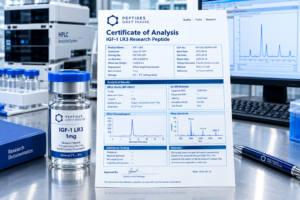
IGF-1 LR3 COA: Certificate of Analysis, HPLC Purity & LC-MS Identity Testing
An IGF-1 LR3 COA (Certificate of Analysis) is an important laboratory document used to document the analytical characteristics of a specific IGF-1 LR3 research-material batch. Depending on the laboratory and testing panel, a COA may include HPLC purity, mass-spectrometry identity testing, lot or batch information, analytical dates, appearance, net content, and additional quality-control measurements.
For researchers evaluating laboratory materials, the most important feature of a Certificate of Analysis is that the results are traceable to the specific lot being documented. A COA should therefore be reviewed alongside the batch or lot number printed on the corresponding research-material label.
Publicly available IGF-1 LR3 certificates demonstrate why batch-specific documentation matters. Different laboratories and suppliers have published different HPLC results for different lots, rather than one universal purity value.
What Is an IGF-1 LR3 COA?
An IGF-1 LR3 Certificate of Analysis is a laboratory document that records analytical findings for a particular sample or batch.
The purpose of a COA is to provide documented evidence of what was tested, which analytical methods were used, when the testing occurred, and what results were obtained.
A professionally prepared IGF-1 LR3 COA may contain:
- Product or compound name
- Lot or batch number
- COA or report number
- Testing laboratory
- Sample identification
- Date received
- Date analyzed
- Date reported
- HPLC purity result
- LC-MS or mass-spectrometry identity result
- Molecular-mass information
- Appearance
- Net peptide content, where tested
- Additional quality-control tests
- Laboratory authorization or analyst information
- Research-use limitations
The exact fields vary between laboratories. Some laboratories publish only purity and identity results, while others provide broader analytical panels. For example, publicly available peptide-testing services describe combinations of HPLC, LC-MS, net content, endotoxin, sterility, elemental impurities, and other analyses depending on the testing scope.
Why an IGF-1 LR3 COA Matters
A Certificate of Analysis gives researchers a documented analytical reference rather than requiring them to rely solely on a product description.
A product page might state that a material is high purity, but a batch-specific COA can provide the underlying laboratory result associated with a particular lot.
This distinction is important.
Product specification describes what a material is expected to meet.
COA documentation records what a tested sample or lot actually produced under the stated analytical method.
For example, an IGF-1 LR3 product page might describe an intended purity specification, while the corresponding COA reports the measured HPLC result for the specific batch.
This makes the COA an important part of research-material documentation and quality-control review.
Batch Traceability
One of the most important details on an IGF-1 LR3 COA is the lot or batch number.
The lot number should correspond to the material being documented.
A useful verification process is:
- Locate the lot number on the research-material label.
- Locate the lot number on the COA.
- Confirm that the identifiers match.
- Check the testing date and laboratory information.
- Review the analytical methods.
- Review the reported results.
- Preserve the COA with the associated laboratory records.
Publicly documented IGF-1 LR3 COA systems emphasize this lot-to-certificate matching process.
IGF-1 LR3 HPLC Purity Testing
HPLC, or high-performance liquid chromatography, is one of the analytical techniques commonly used to evaluate peptide purity.
For peptide research materials, reverse-phase HPLC can separate components of a sample based on their interactions with the chromatographic system.
The resulting chromatogram contains peaks representing detected components.
A laboratory can use the chromatographic data to calculate a reported purity value according to its stated analytical method.
What Does HPLC Purity Mean?
When a COA reports an HPLC purity percentage, that number should be interpreted according to the method and reporting convention used by the laboratory.
It is not automatically equivalent to:
- total vial content,
- biological activity,
- potency in a biological system,
- sterility,
- identity confirmation,
- or absolute chemical purity under every possible analytical definition.
This distinction is particularly important when comparing certificates from different laboratories.
A strong IGF-1 LR3 COA page should therefore show the analytical method, not just a large purity percentage.
For example:
Purity Method: RP-HPLC / HPLC-UV
Reported Result: [ACTUAL BATCH-SPECIFIC RESULT]
Specification: [LABORATORY-SPECIFIED SPECIFICATION]
Never replace the actual laboratory result with a generic marketing claim.
IGF-1 LR3 LC-MS Identity Testing
HPLC purity and molecular identity are related but different analytical questions.
LC-MS, or liquid chromatography–mass spectrometry, can be used to support molecular identity by comparing measured mass information with the expected characteristics of the analyzed material.
A COA may therefore contain both:
- HPLC: chromatographic purity assessment
- LC-MS/MS: molecular identity assessment
Some publicly available IGF-1 LR3 certificates specifically describe HPLC for purity and LC-MS for identity confirmation.
This is why a COA that reports only a purity percentage provides less analytical context than a certificate documenting both purity and identity.
Why HPLC and LC-MS Should Not Be Treated as the Same Test
HPLC primarily addresses chromatographic separation and purity reporting.
Mass spectrometry provides mass-based information that can support identity assessment.
Therefore:
HPLC answers:
“How does the sample separate chromatographically, and what purity result is calculated under this method?”
LC-MS answers:
“Does the measured mass support the expected molecular identity?”
A comprehensive COA can bring these analytical perspectives together.
What Should an IGF-1 LR3 COA Include?
A professional IGF-1 LR3 COA should be easy to read and trace back to the laboratory report.
1. Product Name
The certificate should clearly identify the material being analyzed.
Example:
Product: IGF-1 LR3
If a supplier uses a catalog number or product code, that identifier may also be included.
2. Lot or Batch Number
The lot number connects the certificate to the tested material.
Example:
Lot: [ACTUAL LOT NUMBER]
This field should correspond exactly with the material label.
3. COA Number
A unique certificate or report number helps establish document traceability.
Example:
COA No.: [ACTUAL COA NUMBER]
4. Testing Laboratory
The certificate should identify the laboratory responsible for the reported analytical work.
5. Analysis Date
The testing date indicates when the analytical work was performed.
The issue date may be different from the actual testing date, so both should be distinguished when available.
6. HPLC Purity
This section reports the chromatographic purity result.
Example:
HPLC Purity: [ACTUAL RESULT]
Do not insert an invented value.
7. Identity Result
The COA may report an identity determination using LC-MS or another stated analytical method.
Example:
Identity: [ACTUAL LABORATORY RESULT]
8. Additional Testing
Depending on the laboratory, additional tests may include net content, endotoxin, residual solvents, elemental impurities, microbial testing, or other analytical parameters.
Not every COA contains every test.
The website should reproduce only tests actually performed and documented.
How to Read an IGF-1 LR3 COA
A COA can initially look complicated because it may contain laboratory terminology, chromatograms, analytical tables, and instrument information.
A simple review can be divided into several steps.
Step 1: Verify the Product
Check that the product listed on the certificate corresponds to the material being evaluated.
Step 2: Verify the Lot Number
The lot number is one of the most important fields.
The COA should correspond to the exact lot or batch.
Step 3: Identify the Testing Laboratory
Determine which laboratory performed the analysis.
Step 4: Review the Methods
Look for the stated analytical methods.
Examples include:
- HPLC
- RP-HPLC
- HPLC-UV
- LC-MS
- ESI-MS
- Other laboratory-specific analytical methods
Step 5: Review the Results
Look at the reported purity and identity findings.
Do not interpret a result outside the context of the laboratory’s method and specification.
Step 6: Check the Dates
Confirm when the sample was received, tested, and reported when those fields are available.
Step 7: Preserve the Documentation
The COA should remain associated with the relevant laboratory-material records.
IGF-1 LR3 Purity: Why the Batch Matters
One of the most important SEO and scientific-quality principles for an IGF-1 LR3 COA page is batch specificity.
There is no reason to assume that one purity percentage applies to every IGF-1 LR3 batch.
Current publicly available certificates show different reported results. Examples include certificates reporting results around 95.7%, 99.05%, 99.35%, and 99.56%, depending on the documented lot and laboratory.
These examples should not be presented as the purity of your own material.
Instead, they demonstrate why a website should publish the actual result from the applicable certificate.
Recommended Website Format
IGF-1 LR3 COA
- Product: IGF-1 LR3
- Lot: [ACTUAL LOT]
- COA Number: [ACTUAL COA]
- Testing Laboratory: [ACTUAL LAB]
- HPLC Purity: [ACTUAL RESULT]
- Identity: [ACTUAL RESULT]
- Analysis Date: [ACTUAL DATE]
- Additional Testing: [ACTUAL TESTS]
This approach is more transparent and gives search visitors useful information without turning a generic purity claim into a false batch-specific statement.
IGF-1 LR3 COA vs Product Specification
A product specification and a Certificate of Analysis should not be confused.
A specification may establish a target or acceptance criterion.
A COA records analytical findings associated with a tested sample or lot.
For example:
Specification:
HPLC purity ≥ [documented specification]
Actual result:
HPLC purity = [documented laboratory result]
This distinction allows researchers to see both the expected standard and the measured result.
It also creates better technical content for search engines because the page answers several related questions rather than repeating the same keyword.
Why a Public COA Builds Documentation Transparency
Publishing a COA can make laboratory-material documentation easier to inspect.
A useful COA page can provide:
- Lot identification
- Testing laboratory
- Analytical method
- HPLC result
- Identity result
- Testing date
- Original certificate
- Additional analytical information
Where applicable, a QR code or certificate verification reference can also connect the website visitor to an external laboratory record.
The most useful approach is to provide documentation that can be independently checked rather than relying only on promotional statements.
Independent laboratories that provide peptide testing describe this model as combining analytical results with traceable certificate documentation.
IGF-1 LR3 COA and Quality Control
Quality control involves more than one number.
A robust research-material evaluation can consider several characteristics:
Identity
Does the analytical result support the expected compound identity?
Purity
What does the stated chromatographic method report?
Batch Traceability
Can the result be connected to the exact lot?
Net Content
Where measured, does the analytical documentation provide information about actual material content?
Additional Quality Tests
Depending on the material and laboratory, additional analyses may include endotoxin, microbial testing, residual solvents, elemental impurities, or other parameters.
The exact testing requirements depend on the laboratory’s validated methods and the intended research application.
IGF-1 LR3 COA Documentation for Laboratory Research
For laboratory researchers, documentation can be useful when maintaining internal records.
A laboratory documentation package may include:
- Product identification
- Supplier information
- Lot number
- COA
- Analytical report
- Date received
- Storage records
- Internal sample identification
- Relevant laboratory SOP references
The COA should be treated as analytical documentation rather than as a guarantee of performance in every experimental system.
Laboratory results are specific to the sample and methods described in the report.
What Makes a Professional IGF-1 LR3 COA Page?
For SEO and user trust, your IGF-1 LR3 COA page should contain more than an image of a certificate.
A strong page should include:
- A clear H1 containing the primary keyword.
- A short explanation of what the COA documents.
- The applicable batch number.
- The testing laboratory.
- Analytical methods.
- HPLC purity information.
- Identity-testing information.
- A readable COA image or PDF.
- A batch-specific verification statement.
- Research-use-only wording.
- FAQ content.
- Relevant internal links.
This creates a useful resource instead of a thin product page.
Research-Use-Only Statement
IGF-1 LR3 research material is intended solely for laboratory research and analytical purposes. It is not intended for human or veterinary consumption, self-administration, diagnosis, treatment, cure, or prevention of disease. Researchers are responsible for following applicable laboratory procedures, institutional requirements, safety practices, and laws or regulations governing the handling and use of research materials.
Analytical results reported on a Certificate of Analysis apply only to the specific sample, lot, or batch identified on that document and should not be generalized to other batches unless supported by applicable testing.