

TB-500 5mg Research Peptide: Laboratory Research, Purity, HPLC & COA Guide
TB-500 5mg is a peptide research material commonly encountered in biochemical and analytical research discussions. For laboratories evaluating TB-500 as a research material, the most important considerations include chemical identity, sequence, molecular characterization, purity, analytical testing, lot traceability, and appropriate research-use documentation.
This comprehensive guide explains what researchers should know when evaluating TB-500 5mg research peptide material, including its documented molecular characteristics, analytical quality considerations, HPLC and COA documentation, storage considerations, and responsible research-use positioning in the United States.
Research-use notice: TB-500 research material discussed on this page is intended for legitimate laboratory and scientific research only. It is not presented as a drug, dietary supplement, medical treatment, or product for human or veterinary administration. This article does not provide dosing, injection, reconstitution-for-administration, or treatment instructions.
What Is TB-500?
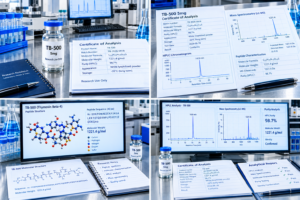
TB-500 is commonly associated with the N-acetylated heptapeptide Ac-LKKTETQ, also described as an N-acetylated peptide containing the sequence LKKTETQ. PubChem lists TB-500 under the synonym TB500 and reports the molecular formula C38H68N10O14 and molecular weight of approximately 889.0 g/mol for the listed compound.
The distinction between TB-500 and full-length thymosin beta-4 is particularly important.
Full-length thymosin beta-4 is a substantially larger peptide/protein sequence. PubChem lists thymosin beta-4 with a molecular weight of approximately 4,963 g/mol, while the PubChem TB-500 record lists approximately 889.0 g/mol.
Therefore, researchers should not automatically use information about full-length thymosin beta-4 as though it were analytical information for TB-500.
TB-500 5mg: What Does 5mg Mean?
The 5mg designation refers to the nominal quantity of material in the product presentation.
It does not by itself establish:
- Purity
- Identity
- Molecular integrity
- Analytical quality
- Stability
- Biological activity
- Suitability for a particular experiment
For research procurement, the quantity should therefore be considered together with the analytical documentation associated with the specific lot.
A professionally documented TB-500 5mg research material should ideally provide researchers with access to product specifications and lot-specific quality information.
TB-500 Molecular Characteristics
According to PubChem, the listed TB-500 structure is:
Sequence: LKKTETQ
N-terminal modification: Acetylated
Molecular formula: C38H68N10O14
Molecular weight: 889.0 g/mol
Exact mass: 888.49164688 Da
Monoisotopic mass: 888.49164688 Da
The molecular information above is useful when developing analytical workflows, interpreting mass-spectrometry results, or comparing supplier documentation.
However, researchers should always verify the identity and specification of the actual material supplied because peptide naming and salt/formulation conventions can vary.
TB-500 vs. Thymosin Beta-4
One of the most important concepts for researchers is understanding that TB-500 is not simply another name for full-length thymosin beta-4.
The PubChem TB-500 record identifies the seven-amino-acid sequence LKKTETQ with N-terminal acetylation.
By comparison, full-length thymosin beta-4 is a much larger peptide containing 43 amino acids and has a reported molecular weight of approximately 4,963 g/mol in PubChem.
This difference has practical analytical implications.
A laboratory performing mass spectrometry, chromatography, identity testing, or reference-material comparison should make sure that the expected molecular characteristics correspond to the exact compound being evaluated.
Why this distinction matters for SEO and laboratory research
Online peptide terminology sometimes uses TB-500, thymosin beta-4, and thymosin beta-4 fragments interchangeably. This can create confusion for researchers searching for analytical information.
For accurate laboratory documentation, the safest approach is to identify the precise material by:
- Chemical name
- Sequence
- Modification
- Molecular formula
- Molecular mass
- Lot number
- Analytical documentation
TB-500 5mg Research Applications
TB-500 has been discussed in scientific literature and regulatory materials in connection with peptide research. However, laboratory research findings should not be presented as proof of clinical efficacy or safety.
Potential laboratory research contexts can include:
Peptide characterization
Researchers may investigate molecular characteristics, purity profiles, chromatographic behavior, and mass-spectrometric properties.
Analytical method development
TB-500 can be relevant to laboratories developing or evaluating analytical workflows for peptide materials.
Chromatographic research
Researchers may study chromatographic retention and peak profiles using validated laboratory methods.
Mass-spectrometry research
Mass spectrometry can be used to examine whether observed molecular characteristics are consistent with an expected peptide material.
Comparative material analysis
Laboratories may compare different lots or reference materials using controlled analytical procedures.
The specific suitability of a research material depends on the laboratory’s protocol, analytical instrumentation, and research objectives.
TB-500 Purity Testing
TB-500 purity is an important consideration when evaluating a research material.
A purity percentage should ideally be supported by an analytical method and associated documentation rather than presented as an unsupported marketing claim.
Researchers reviewing TB-500 5mg material can look for:
- Reported purity
- Analytical technique
- Chromatographic data
- Lot number
- Test date
- Sample identification
- Acceptance criteria
- Testing laboratory information where available
Purity results should be interpreted in the context of the analytical method used.
A reported percentage alone cannot answer every question about identity, impurities, degradation products, residual solvents, counterions, or other characteristics.
TB-500 HPLC Analysis
High-performance liquid chromatography, or HPLC, is one of the analytical techniques commonly used for peptide characterization.
An HPLC chromatogram can provide information about chromatographic separation under the specified experimental conditions.
For a TB-500 research material, researchers may review:
- Main chromatographic peak
- Retention time
- Additional detected peaks
- Reported purity
- Column information
- Mobile-phase information
- Detection wavelength
- Sample identification
The interpretation of an HPLC chromatogram should be performed by appropriately qualified personnel and should take the complete analytical method into account.
Why lot-specific HPLC matters
A generic HPLC example does not necessarily demonstrate the quality of every production lot.
For this reason, a lot-specific TB-500 HPLC report can be more informative for procurement and laboratory documentation than a generic chromatogram.
TB-500 Mass Spectrometry
Mass spectrometry provides another useful analytical approach for peptide characterization.
For TB-500, the expected molecular characteristics can be compared against analytical observations. PubChem lists a calculated monoisotopic mass of approximately 888.4916 Da for the TB-500 record.
Actual observed mass-spectrometry results can vary depending on:
- Instrumentation
- Ionization technique
- Sample preparation
- Charge state
- Adduct formation
- Calibration
- Matrix effects
Consequently, researchers should evaluate mass-spectrometry data in conjunction with the laboratory method and supporting documentation.
TB-500 COA: What Should Researchers Look For?
A Certificate of Analysis (COA) provides documentation about a specific research-material lot.
When reviewing a TB-500 5mg COA, researchers can check whether it contains:
Product identification
The product name should clearly identify the material being tested.
Lot number
The lot number should correspond to the actual product supplied.
Purity
A numerical purity result should be accompanied by information about the analytical method.
Identity testing
Where applicable, the documentation should identify how the material’s identity was evaluated.
Testing date
A date provides useful context for laboratory traceability.
Analytical information
The COA should identify relevant testing methods or reference analytical reports where appropriate.
Specifications
Acceptance criteria can help researchers understand how the material was evaluated.
Storage information
Storage specifications can support appropriate laboratory inventory management.
What Makes a High-Quality TB-500 Research Material?
There is no single laboratory test that establishes every aspect of research-material quality.
A more complete assessment can consider:
Identity: Does the material correspond to the expected compound?
Purity: Is the reported purity supported by analytical testing?
Consistency: Is the documentation associated with the actual lot?
Traceability: Can the material be tracked through laboratory records?
Analytical characterization: Are appropriate HPLC, MS, or other data available?
Documentation: Is the product accompanied by a meaningful COA?
Research-use positioning: Is the material clearly presented for laboratory research rather than human consumption?
These factors can help professional laboratories establish a more consistent procurement process.
TB-500 5mg Storage Considerations
Research-material storage should follow the supplier’s current specification and the laboratory’s validated procedures.
Researchers should review the supplied documentation for information concerning:
- Temperature
- Light exposure
- Moisture
- Container integrity
- Lot identification
- Retest or expiration information when provided
- Laboratory inventory conditions
FDA’s 2026 review materials note reported stability information for TB-500 free base under certain conditions, while also emphasizing gaps in characterization and safety information. Researchers should therefore rely on the specification accompanying the actual material rather than applying a generic storage assumption to every TB-500 product.
TB-500 Research Use Only: What Does It Mean?
A research-use-only designation indicates that a material is intended for legitimate laboratory research rather than human therapeutic use.
However, the phrase should not be treated as a blanket exemption from applicable regulatory requirements.
FDA’s recent materials concerning TB-500 state that the agency identified significant gaps in safety information, including a lack of human exposure data for drug products containing TB-500-related substances. FDA also discussed potential immunogenicity concerns associated with injectable routes and peptide-related impurities.
For this reason, responsible research content should focus on analytical characterization and laboratory use rather than providing human-use claims.
Current U.S. Regulatory Considerations
TB-500 has received recent regulatory attention in the United States.
At a July 2026 Pharmacy Compounding Advisory Committee meeting, FDA considered TB-500 free base and TB-500 acetate among substances nominated for consideration for the 503A Bulks List. The uses evaluated for TB-500-related substances included wound healing.
FDA’s review materials stated that there was a lack of clinical and nonclinical safety information for TB-500 free base and TB-500 acetate and highlighted uncertainty concerning potential safety risks in humans.
These regulatory facts are relevant to U.S.-targeted SEO because a research-material website should clearly distinguish laboratory research from human therapeutic marketing.
TB-500 5mg Laboratory Procurement Checklist
Before purchasing a research material, a qualified laboratory can review the following checklist:
- Confirm the exact compound identity.
- Verify the sequence and modification.
- Check the stated molecular formula.
- Review the reported molecular weight.
- Request or review the lot-specific COA.
- Check available HPLC data.
- Review mass-spectrometry information where available.
- Confirm the lot number.
- Review storage specifications.
- Maintain appropriate laboratory records.
- Confirm that the material is intended solely for legitimate research.
- Review applicable institutional and regulatory requirements.
This approach can reduce confusion between TB-500 and other thymosin-related research materials.
TB-500 5mg and Analytical Documentation
For a professional research website, analytical documentation should be central to the product page.
A useful documentation package may include:
- Product specification
- Certificate of Analysis
- HPLC chromatogram
- Mass-spectrometry report
- Lot number
- Purity result
- Molecular information
- Storage specification
- Research-use statement
Providing this information gives researchers a clearer basis for evaluating the material.
Why Lot Traceability Matters
Laboratory reproducibility depends partly on knowing exactly which material was used.
If two experiments produce different results, researchers may need to determine whether the difference relates to:
- Experimental conditions
- Analytical method
- Sample handling
- Material lot
- Purity profile
- Storage history
- Instrumentation
A traceable lot number can therefore become an important part of the laboratory record.
TB-500 5mg: Research Material Quality Summary
When evaluating TB-500 5mg, researchers should distinguish quantity from quality.
The 5mg designation communicates the nominal amount of material. It does not independently establish purity or identity.
A stronger research-material evaluation combines:
TB-500 5mg quantity + verified identity + analytical testing + lot-specific COA + appropriate documentation.
That combination provides substantially more useful information for laboratory procurement than quantity alone.
Frequently Asked Questions
What is TB-500 5mg?
TB-500 5mg refers to a research-material presentation containing a nominal 5mg quantity of TB-500. The quantity itself does not establish purity, identity, or suitability for a particular laboratory experiment.
What is the molecular weight of TB-500?
PubChem lists TB-500 with a molecular weight of approximately 889.0 g/mol and molecular formula C38H68N10O14.
What is the TB-500 sequence?
PubChem identifies the TB-500 sequence as LKKTETQ, with an N-terminal acetyl modification in the listed structure.
Is TB-500 the same as thymosin beta-4?
No. TB-500 and full-length thymosin beta-4 have substantially different molecular characteristics. PubChem lists TB-500 at approximately 889.0 g/mol and full-length thymosin beta-4 at approximately 4,963 g/mol.
What is TB-500 purity?
TB-500 purity is an analytical measurement describing the proportion of the target material detected under a specified analytical method. Researchers should review the actual testing method and lot-specific documentation rather than relying solely on a headline percentage.
What is a TB-500 COA?
A TB-500 Certificate of Analysis is a quality document associated with a particular material lot. It may contain information about identity, purity, testing methods, lot number, and other specifications.
Why is HPLC used for TB-500?
HPLC can help characterize peptide samples by separating components under controlled chromatographic conditions. It can provide useful information about the primary component and detectable secondary peaks.
Does TB-500 have FDA approval for human use?
This page does not present TB-500 as an FDA-approved human-use drug. FDA’s 2026 review materials state that important safety information for TB-500-related substances is lacking and that potential human safety risks are unknown.
Is TB-500 research material intended for human use?
Research-use material should not be presented or marketed for human consumption. This article does not provide human-use instructions, dosing, or administration guidance.
What should I check before buying TB-500 5mg?
Researchers can review identity, sequence, molecular information, purity testing, HPLC data, mass-spectrometry data, lot-specific COA documentation, storage requirements, and supplier traceability.
Why is lot-specific testing important?
Lot-specific testing connects analytical results to a particular batch. This improves traceability and gives researchers more relevant information than a generic product specification.
What is the difference between TB-500 and TB-500 acetate?
These terms can refer to different material forms or salt states. Researchers should verify the exact chemical form, molecular specification, and analytical documentation for the material being evaluated.
Conclusion
TB-500 5mg is a specialized peptide research material for laboratory and analytical research contexts. PubChem identifies TB-500 as an N-acetylated heptapeptide with the sequence LKKTETQ and reports a molecular weight of approximately 889.0 g/mol.
For research procurement, the most important considerations extend beyond the 5mg quantity. Researchers should evaluate identity, purity, HPLC characterization, mass spectrometry, COA documentation, lot traceability, storage specifications, and research-use positioning.
TB-500 should also be distinguished analytically from full-length thymosin beta-4, which has substantially different molecular characteristics.
U.S. researchers should additionally be aware that FDA has recently reviewed TB-500-related substances and identified substantial gaps in human safety information.
For a professional research-focused website, the strongest approach is therefore to emphasize transparent analytical documentation and legitimate laboratory research rather than unsupported therapeutic claims.
Research Use Only. Not for human or veterinary use. Not intended to diagnose, treat, cure, mitigate, or prevent any disease or condition.