

What Is Oxytocin?
Oxytocin is a naturally occurring cyclic nonapeptide hormone consisting of nine amino acids. PubChem lists its molecular formula as C43H66N12O12S2 and its molecular weight as approximately 1007.2 g/mol. Its sequence is commonly represented as CYIQNCPLG, with a disulfide bond between the two cysteine residues.
Oxytocin has been extensively studied in molecular biology, endocrinology, neuroscience, reproductive biology and receptor pharmacology.
Unlike many synthetic research peptides, oxytocin is also an established pharmaceutical substance. The FDA’s labeling for synthetic oxytocin injection identifies it as a prescription product and describes its pharmacological activity on uterine smooth muscle.
For this reason, an SEO page for Oxytocin 10mg should clearly separate:
- Oxytocin’s scientific identity
- Published biological research
- Pharmaceutical oxytocin
- Laboratory research materials
- Product quantity or packaging
The term 10mg describes the quantity of material in a particular product format. It should not be presented as a recommended clinical dose.
Oxytocin 10mg at a Glance
| Property | Oxytocin |
|---|---|
| Primary keyword | Oxytocin 10mg |
| Peptide type | Cyclic nonapeptide |
| Amino-acid length | 9 residues |
| Sequence | CYIQNCPLG |
| Molecular formula | C43H66N12O12S2 |
| Molecular weight | 1007.2 g/mol |
| CAS number | 50-56-6 |
| PubChem CID | 439302 |
| Structural feature | Intramolecular disulfide bond |
| Research areas | Receptor biology, endocrinology, neuroscience, peptide research |
| Common research terminology | Oxytocin peptide, oxytocin research peptide |
The molecular information above is supported by PubChem’s current chemical record.
Oxytocin Peptide Sequence
The canonical oxytocin peptide sequence is:
CYIQNCPLG
The nine amino acids are:
- Cysteine
- Tyrosine
- Isoleucine
- Glutamine
- Asparagine
- Cysteine
- Proline
- Leucine
- Glycine
Oxytocin is structurally distinctive because cysteine residues at positions 1 and 6 form a disulfide bridge, creating the characteristic cyclic portion of the peptide. PubChem identifies oxytocin as a heterodetic cyclic peptide and lists the sequence CYIQNCPLG.
This structural feature is important when researchers evaluate oxytocin by analytical methods because the peptide’s three-dimensional structure and disulfide connectivity are part of its molecular identity.
Oxytocin Molecular Weight
The molecular weight of oxytocin is approximately:
1007.2 g/mol
PubChem reports a molecular weight of 1007.2 g/mol for the oxytocin structure represented by molecular formula C43H66N12O12S2.
A molecular-weight value is useful when researchers are:
- Reviewing analytical data
- Evaluating mass-spectrometry results
- Comparing peptide reference materials
- Building chemical databases
- Studying peptide structure
- Confirming compound identity
Researchers should distinguish the molecular weight of the oxytocin molecule from the quantity of product supplied.
For example:
Oxytocin molecular weight: approximately 1007.2 g/mol
Oxytocin 10mg: a product quantity
These are fundamentally different measurements.
Oxytocin Molecular Formula
The molecular formula of oxytocin is:
C43H66N12O12S2
This formula indicates the elemental composition of the molecular form recorded by PubChem.
Molecular-formula information is particularly useful for:
- Chemical identification
- Mass calculations
- Analytical chemistry
- Database searches
- Research documentation
- Mass-spectrometry interpretation
When publishing scientific SEO content, the molecular formula should be kept consistent with the specific oxytocin molecular form being described.
Oxytocin CAS Number
The commonly listed CAS Registry Number for oxytocin is:
50-56-6
PubChem lists 50-56-6 among the synonyms and identifiers for oxytocin.
The CAS number can be useful when searching scientific databases, chemical catalogs and research documentation.
However, a CAS number should not be the only method used to verify peptide identity. Researchers should also consider:
- Molecular formula
- Molecular weight
- Peptide sequence
- Structural information
- Analytical documentation
- Batch identification
Oxytocin Structure and Disulfide Bond
Oxytocin belongs to the family of cyclic peptide hormones.
Its two cysteine residues form an intramolecular disulfide bridge. This creates a ring-like portion of the peptide while the remaining residues form the peptide’s tail region.
The structural representation can be simplified as:
Cys¹ — Tyr² — Ile³ — Gln⁴ — Asn⁵ — Cys⁶ — Pro⁷ — Leu⁸ — Gly⁹
with a disulfide connection between:
Cys¹ ↔ Cys⁶
The FDA’s pharmaceutical labeling similarly depicts synthetic oxytocin as the nine-residue peptide Cys-Tyr-Ile-Gln-Asn-Cys-Pro-Leu-Gly-NH₂.
This structural distinction is important because oxytocin is not simply a linear nine-amino-acid peptide.
Oxytocin Research and Receptor Biology
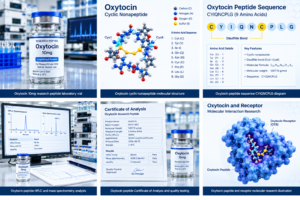
spans several scientific disciplines.
Researchers have investigated oxytocin in relation to the oxytocin receptor, a G-protein-coupled receptor involved in cellular signaling.
Research areas include:
- Receptor binding
- Signal transduction
- Peptide-receptor interactions
- Neuroendocrinology
- Reproductive biology
- Smooth-muscle physiology
- Social and behavioral neuroscience
- Peptide structure and pharmacology
The scientific literature surrounding oxytocin is extensive because the peptide has both physiological and pharmaceutical significance.
For an SEO research page, it is useful to describe these areas without turning laboratory findings into generalized therapeutic promises.
Oxytocin in Laboratory Research
Oxytocin can be studied as a molecular reference compound in several types of laboratory research.
Peptide chemistry
Researchers can examine oxytocin’s sequence, cyclic structure, disulfide linkage and chemical properties.
Receptor research
Oxytocin is widely studied in receptor-binding and signaling experiments involving the oxytocin receptor.
Molecular biology
Research may examine oxytocin-related signaling pathways and receptor expression in cellular systems.
Neuroscience
Oxytocin has been investigated extensively in neuroendocrine and behavioral research.
Analytical chemistry
The defined molecular structure makes oxytocin relevant to analytical workflows involving peptide identification and characterization.
Oxytocin 10mg Research Material
The phrase Oxytocin 10mg generally indicates a product containing 10 milligrams of oxytocin or an oxytocin-containing preparation.
However, the physical presentation and intended use of a specific product must be established from its product documentation.
This distinction is particularly important because FDA-approved synthetic oxytocin exists as a prescription pharmaceutical formulation. The FDA labeling describes Oxytocin Injection, USP as a sterile synthetic oxytocin solution intended for intravenous infusion or intramuscular use.
Therefore, a research-oriented website should not automatically equate a 10mg research product with the FDA-approved injectable pharmaceutical.
The page should instead clearly identify the product’s:
- Quantity
- Molecular identity
- Physical form
- Analytical documentation
- Intended research context
- Applicable labeling
Oxytocin COA and Analytical Testing
A Certificate of Analysis (COA) can be an important quality-control document for research materials.
When evaluating an oxytocin research product, researchers may review documentation containing:
Identity
The COA should identify the compound and corresponding batch or lot.
Purity
HPLC or another validated analytical technique may be used to characterize purity.
Mass confirmation
Mass spectrometry can provide information supporting molecular identity.
Batch information
The lot number should connect the COA to the specific material supplied.
Testing date
The document should indicate when analytical testing occurred.
Quantity
The labeled amount should correspond to the product documentation.
A strong research product page should avoid claiming that every batch has the same purity unless that specification is supported by current batch documentation.
Oxytocin Lyophilized Peptide
Oxytocin research materials may be supplied in different physical forms depending on the manufacturer and intended application.
For a lyophilized oxytocin peptide, the material is supplied in a freeze-dried form rather than as a ready-to-use aqueous solution.
Product documentation should be consulted for:
- Storage requirements
- Packaging
- Stability information
- Handling requirements
- Analytical specifications
Do not assume that a lyophilized research material is equivalent to an FDA-approved pharmaceutical formulation.
Oxytocin Research: Pharmaceutical vs Research Context
This distinction deserves particular attention.
Pharmaceutical oxytocin is a regulated medicinal product with established labeling. The FDA-approved labeling describes synthetic oxytocin injection and its clinical uses, administration routes and safety information.
Research oxytocin refers to material used for laboratory or analytical research according to the product’s specific labeling and documentation.
These categories should not be mixed in SEO copy.
Recommended wording:
“Oxytocin is a well-characterized cyclic nonapeptide that has been extensively investigated in receptor biology, neuroendocrinology and peptide research.”
Avoid wording that implies an unapproved 10mg research product is interchangeable with a prescription pharmaceutical.
How to Evaluate an Oxytocin Research Product
Researchers comparing suppliers can review several factors.
1. Molecular identity
Check the listed sequence, formula, molecular weight and CAS number.
2. Batch-specific documentation
Look for a COA associated with the exact lot.
3. Analytical testing
Review available HPLC, mass-spectrometry or other analytical information.
4. Physical form
Confirm whether the material is supplied as lyophilized powder, solution or another formulation.
5. Product quantity
Verify whether the listed 10mg represents the actual labeled quantity.
6. Research-use labeling
Research materials should have clear intended-use information.
7. Regulatory distinction
Do not assume that research material has the same regulatory status, formulation or quality requirements as a prescription drug.