

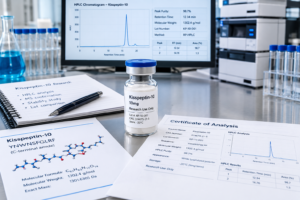
Kisspeptin 10mg for Laboratory Research
Kisspeptin 10mg is a research-material search term associated with Kisspeptin-10, a decapeptide extensively investigated in molecular, reproductive-biology, endocrinology, receptor-signaling, and biochemical research.
For researchers evaluating Kisspeptin 10mg research material, the labeled quantity is only one part of the overall quality picture. Chemical identity, peptide sequence, molecular weight, chromatographic purity, molecular characterization, batch traceability, and Certificate of Analysis documentation can all be relevant.
PubChem identifies human Kisspeptin-10 as a 10-amino-acid peptide with the molecular formula C63H83N17O14 and molecular weight 1302.4 g/mol. Its listed sequence is YNWNSFGLRF, with a C-terminal amide.
An FDA Pharmacy Compounding Advisory Committee document similarly describes Kisspeptin-10 as a synthetic, non-glycosylated oligopeptide containing 10 amino acids and gives a molecular weight of approximately 1302 g/mol.
For a research-focused product page, the most useful quality framework is:
- Product identity
- Peptide sequence
- Molecular form
- Molecular weight
- HPLC purity
- Mass-spectrometry identity
- COA documentation
- Lot traceability
- Storage information
- Research-use status
What Is Kisspeptin-10?
Kisspeptin-10, commonly abbreviated KP-10, is one of the naturally occurring kisspeptin isoforms derived from the KISS1 gene.
Research literature describes kisspeptins as a family of related peptides produced through processing of a common precursor. The naturally occurring forms include Kisspeptin-54, Kisspeptin-14, Kisspeptin-13, and Kisspeptin-10.
Kisspeptin-10 is the shortest commonly discussed naturally occurring kisspeptin isoform and contains the core C-terminal sequence shared by the longer forms.
PubMed literature identifies kisspeptins as ligands of KISS1R, also known as the kisspeptin receptor, and describes the KISS1/KISS1R system as an important research area in neuroendocrine signaling.
For laboratory research, Kisspeptin-10 is therefore relevant to studies involving:
- Peptide-receptor interactions
- KISS1R signaling
- Molecular biology
- Neuroendocrine research
- Reproductive-biology research
- Cell-based assays
- Structure-activity studies
- Analytical peptide characterization
Kisspeptin 10mg Research Material
The term Kisspeptin 10mg describes a labeled quantity of research material. It does not by itself establish purity, molecular identity, potency, or suitability for a particular laboratory experiment.
Researchers evaluating Kisspeptin research material can examine several documentation categories.
Product identity
The material should clearly identify the peptide as Kisspeptin-10 or the applicable molecular form.
Quantity
A 10mg designation identifies the labeled quantity. It should not be interpreted as an analytical purity value.
Sequence
The expected sequence provides an important molecular identity reference.
Molecular weight
The expected molecular mass can be compared with analytical characterization.
HPLC
Chromatographic testing can provide information about purity and related peaks.
Mass spectrometry
MS can provide complementary molecular-identity information.
COA
A batch-specific Certificate of Analysis connects the analytical results with a particular lot.
Together, these factors provide a more useful framework than the package size alone.
Kisspeptin-10 Peptide Sequence
The Kisspeptin-10 peptide sequence is:
YNWNSFGLRF
PubChem gives the condensed structure as:
H-Tyr-Asn-Trp-Asn-Ser-Phe-Gly-Leu-Arg-Phe-NH₂.
The C-terminal amide is an important structural feature.
This sequence is also represented in FDA documentation describing Kisspeptin-10 as:
H-Tyr-Asn-Trp-Asn-Ser-Phe-Gly-Leu-Arg-Phe-NH₂.
Sequence information can be useful when researchers compare:
- Product specifications
- Reference databases
- Analytical reports
- Mass-spectrometry data
- Peptide synthesis documentation
- COA information
However, sequence information alone does not demonstrate the purity of a particular physical batch.
A research material can have the expected sequence while still requiring additional testing for impurities, degradation products, residual solvents, water content, or other quality attributes.
Kisspeptin Molecular Weight
Kisspeptin molecular weight is an important search term for analytical research.
PubChem currently lists human Kisspeptin-10 with:
- Molecular formula: C63H83N17O14
- Molecular weight: 1302.4 g/mol
- Exact mass: 1301.6305 Da
- Monoisotopic mass: 1301.6305 Da
- CAS: 374675-21-5
- Sequence: YNWNSFGLRF
The FDA’s 2024 committee document gives the molecular weight as approximately 1302 g/mol and describes the same molecular formula.
Why molecular form matters
Researchers should verify the exact material being analyzed.
For example, PubChem separately lists a Kisspeptin-10 human TFA form with a molecular weight of approximately 1416.5 g/mol.
This illustrates why a molecular-weight value should always be interpreted together with the molecular form.
A COA, MS report, or product specification should identify whether the reported value applies to the peptide itself or a salt/counterion form.
Kisspeptin HPLC Testing
Kisspeptin HPLC is an important analytical quality keyword for this product.
High-performance liquid chromatography can separate peptide components according to their interactions with a chromatographic system.
A Kisspeptin HPLC report may include:
- Analytical column
- Mobile phase
- Detection wavelength
- Retention time
- Main peak
- Secondary peaks
- Peak areas
- Calculated purity
- Sample identification
- Lot number
- Analytical method
A useful HPLC result should be interpreted in the context of its method and acceptance criteria.
What does HPLC purity tell researchers?
HPLC purity generally describes chromatographic purity under the stated method.
It does not automatically establish:
- Complete molecular identity
- Absolute chemical purity
- Biological activity
- Sterility
- Endotoxin status
- Absence of all degradation products
- Suitability for human use
This distinction is especially important when comparing research materials from different suppliers.
Kisspeptin-10 COA
A Kisspeptin COA, or Certificate of Analysis, can provide batch-specific information about a research material.
An FDA committee document published in connection with its review of Kisspeptin-10 includes an example COA. That document reports a Kisspeptin-10 lot with an MS molecular-weight result of 1302.5 Da, HPLC purity of 98.9%, and HPLC retention-time identification that conformed to the specified standard.
The example is useful as an illustration of the types of analytical information that can appear in a COA; it should not be treated as the specification or result for another supplier’s batch.
A Kisspeptin COA may contain:
| COA Field | Purpose |
|---|---|
| Product name | Identifies the material |
| CAS number | Provides chemical identification |
| Lot number | Enables traceability |
| Sequence | Provides structural reference |
| Molecular weight | Supports identity testing |
| HPLC purity | Provides chromatographic purity |
| Retention time | Supports chromatographic identity |
| Water content | Documents moisture |
| Residual solvents | Documents applicable process residues |
| Peptide content | Provides additional quantitative information |
| Endotoxin testing | Documents a specific microbiological quality attribute where tested |
| Storage | Provides handling information |
The FDA example demonstrates why researchers should review the full COA instead of relying on a single headline purity number.
Kisspeptin Purity
Kisspeptin purity can describe different analytical concepts depending on the test method.
For research material, it is useful to distinguish:
HPLC purity
A chromatographic measurement based on the analytical method used.
Peptide content
A quantitative measurement that can differ from chromatographic purity.
Molecular identity
Evidence supporting the expected molecular structure.
Water content
The amount of water detected by the specified analytical method.
Residual solvents
Potential process-related solvent residues.
Related substances
Other detectable molecular species or impurities.
The FDA-published example COA illustrates this distinction by reporting HPLC purity separately from peptide content, water content, residual solvents, and other testing.
This is an important SEO and educational point because researchers should not interpret one purity percentage as a complete description of peptide quality.
Kisspeptin Mass Spectrometry
Mass spectrometry can complement HPLC by providing information about molecular mass.
For Kisspeptin-10, researchers can compare an observed molecular mass against the expected value for the particular molecular form.
PubChem lists the molecular weight of human Kisspeptin-10 as approximately 1302.4 g/mol, with an exact mass of approximately 1301.6305 Da.
An FDA-published Kisspeptin-10 COA example reported an MS result of 1302.5 Da against a specification of 1302.5 ± 1.0 Da.
MS can therefore provide complementary evidence alongside chromatographic testing.
Researchers should nevertheless interpret the spectrum according to:
- Molecular form
- Expected mass
- Ionization conditions
- Instrument method
- Adducts
- Sample preparation
- Analytical tolerance
Kisspeptin-10 vs. Longer Kisspeptin Isoforms
Kisspeptin-10 is part of a broader family of kisspeptin peptides.
Research literature describes four naturally occurring isoforms:
- Kisspeptin-54
- Kisspeptin-14
- Kisspeptin-13
- Kisspeptin-10
These forms share the same C-terminal decapeptide sequence.
This is important for SEO because searches for “Kisspeptin” do not always refer specifically to Kisspeptin-10.
A product page should clearly identify the exact peptide being offered or studied.
For Kisspeptin 10mg, the target molecule should be identified as Kisspeptin-10, rather than using “Kisspeptin” as an ambiguous generic label.
Kisspeptin-10 and KISS1R Research
Kisspeptin research is closely associated with the KISS1/KISS1R signaling system.
PubMed literature describes kisspeptins as endogenous ligands of KISS1R and discusses the system in relation to neuroendocrine signaling.
This creates several legitimate laboratory-research topics for a Kisspeptin 10mg content cluster:
- Kisspeptin receptor research
- KISS1R signaling
- Peptide-receptor binding studies
- Structure-activity relationships
- Cell-based research
- Neuroendocrine signaling
- Peptide analytical characterization
Research should be described in scientific terms rather than converting experimental findings into claims about personal health outcomes.
Kisspeptin 10mg Research Quality Checklist
Researchers evaluating Kisspeptin-10 research material can use a structured quality checklist.
1. Confirm the identity
Check the product name, sequence, molecular formula, and molecular form.
2. Verify the molecular weight
Compare the stated molecular weight with the expected value for the exact chemical form.
3. Review HPLC information
Examine the chromatographic purity and analytical method.
4. Review MS information
Where available, compare observed mass with the expected molecular mass.
5. Examine the COA
Confirm that the COA corresponds to the actual lot.
6. Review related testing
Look for water content, residual solvent, peptide content, or other applicable tests.
7. Confirm storage information
Follow documentation applicable to the specific material.
8. Confirm research-use status
Ensure that the product is represented appropriately as laboratory research material.
This provides a more complete quality assessment than relying on a single percentage or marketing phrase.
Kisspeptin 10mg Storage Information
Storage requirements should be based on the exact research material and supplier documentation.
An FDA-published Kisspeptin-10 COA example stated storage at 2–8°C for less than six months and −20°C for longer-term storage, but these conditions belong to that specific documented material and should not automatically be applied to every Kisspeptin-10 product.
For a research product page, appropriate language is:
Follow the storage conditions specified in the applicable product documentation and lot-specific COA.
Researchers should consider:
- Temperature
- Moisture
- Container integrity
- Light exposure where applicable
- Lot identification
- Retest or expiration information
- Laboratory handling requirements
Kisspeptin 10mg and U.S. Research Context
For U.S.-targeted SEO, it is important to distinguish scientific research from clinical or prescription claims.
FDA materials have specifically discussed Kisspeptin-10 in the context of compounding-related evaluation, including concerns about peptide-related impurities, API characterization, and potential immunogenicity for certain routes of administration.
That regulatory discussion should not be interpreted as establishing a blanket status for every Kisspeptin-10 research material.
For Peptides Grey House, U.S.-focused content should therefore emphasize:
- Laboratory research
- Analytical characterization
- HPLC documentation
- COA availability
- Molecular identity
- Lot traceability
- Research-use-only positioning
Avoid implying that a research product is FDA-approved, clinically validated, or interchangeable with a prescription or compounded product.
Kisspeptin 10mg: Frequently Asked Questions
What is Kisspeptin 10mg?
Kisspeptin 10mg refers to a research-material presentation containing a labeled 10mg quantity of Kisspeptin-10. The quantity does not itself establish purity or molecular identity.
What is Kisspeptin-10?
Kisspeptin-10 is a 10-amino-acid kisspeptin isoform derived from the KISS1 precursor. It is also known as KP-10.
What is the Kisspeptin-10 sequence?
The human Kisspeptin-10 sequence is YNWNSFGLRF, with a C-terminal amide.
What is the molecular weight of Kisspeptin-10?
PubChem lists human Kisspeptin-10 at approximately 1302.4 g/mol, with an exact mass of approximately 1301.6305 Da.
Does Kisspeptin-10 have a different molecular weight in salt forms?
Yes. Molecular weight can change depending on the chemical form. For example, PubChem lists human Kisspeptin-10 TFA at approximately 1416.5 g/mol.
What is Kisspeptin HPLC testing?
Kisspeptin HPLC testing uses high-performance liquid chromatography to characterize the peptide’s chromatographic profile and purity under a specified analytical method.
What is a Kisspeptin COA?
A Kisspeptin COA is a Certificate of Analysis containing batch-specific information such as identity, molecular weight, HPLC results, purity, lot number, and other applicable analytical results.
Does HPLC purity prove complete peptide quality?
No. HPLC purity describes the result of a particular chromatographic method. It does not independently establish every quality attribute.
What does mass spectrometry tell researchers?
Mass spectrometry can provide complementary information about molecular mass and identity. The result should be interpreted according to the specific molecular form and analytical method.
Is Kisspeptin-10 the same as Kisspeptin-54?
No. They are different naturally occurring kisspeptin isoforms, although they share the same C-terminal decapeptide sequence.
What is KISS1R?
KISS1R is the receptor through which kisspeptin signaling is studied. Kisspeptins are described in the scientific literature as ligands of KISS1R.
Is Kisspeptin 10mg intended for human use?
This page is written for laboratory research. Research-use material should not be represented as intended for human or veterinary administration, diagnosis, treatment, cure, or prevention of disease.
Research-Use-Only Statement
Research Use Only. The information presented on this page is intended for lawful laboratory, analytical, educational, and scientific research purposes. Kisspeptin 10mg research material is not presented for human or veterinary consumption, administration, diagnosis, treatment, cure, or prevention of disease.
Analytical values including HPLC purity, molecular weight, mass-spectrometric results, peptide content, water content, and other COA data should be interpreted according to the specific analytical method, molecular form, reference standard, and lot tested.
HPLC purity should not automatically be interpreted as complete chemical characterization, sterility, endotoxin status, biological activity, or therapeutic suitability.
Researchers are responsible for evaluating research materials according to their intended laboratory application and for complying with applicable laws, institutional requirements, laboratory procedures, and appropriate safety practices.