

Introduction to TB-500 Research Peptide
TB-500 research peptide is a synthetic peptide commonly identified as the N-terminally acetylated 17–23 fragment of thymosin beta-4, with the sequence LKKTETQ. Its chemically modified form is represented as Ac-LKKTETQ-OH.
FDA documentation identifies TB-500 as a synthetic N-acetylated heptapeptide corresponding to amino acids 17 through 23 of the full-length 43-amino-acid peptide thymosin beta-4.
PubChem lists TB-500 with the molecular formula C₃₈H₆₈N₁₀O₁₄ and a molecular weight of approximately 889.0 g/mol. It also records the sequence LKKTETQ and the condensed structure Ac-Leu-Lys-Lys-Thr-Glu-Thr-Gln-OH.
For laboratories researching peptide chemistry, analytical characterization, or peptide-protein interactions, the distinction between TB-500 and full-length thymosin beta-4 is particularly important.
Full-length thymosin beta-4 is a 43-amino-acid peptide, whereas TB-500 represents the shorter N-acetylated fragment. Consequently, findings involving full-length thymosin beta-4 should not automatically be presented as evidence for the shorter TB-500 molecule.
This page provides a research-focused overview of TB-500 structure, peptide sequence, molecular weight, purity, HPLC analysis, COA documentation, mass spectrometry, laboratory research considerations, and related scientific terminology.
What Is TB-500 Research Peptide?
TB-500 is commonly described as an N-terminally acetylated heptapeptide derived from the 17–23 region of thymosin beta-4.
The core sequence is:
LKKTETQ
The modified peptide can be represented as:
Ac-LKKTETQ-OH
The seven amino acids are:
- Leucine (L)
- Lysine (K)
- Lysine (K)
- Threonine (T)
- Glutamic acid (E)
- Threonine (T)
- Glutamine (Q)
FDA’s scientific assessment specifically identifies TB-500 as the N-acetylated 17–23 fragment of thymosin beta-4.
The FDA Substance Registration System also lists TB-500 under the chemical identity N-acetyl-L-leucyl-L-lysyl-L-lysyl-L-threonyl-L-α-glutamyl-L-threonyl-L-glutamine. The FDA notes that availability of a UNII does not imply regulatory review or approval.
This chemical identity is important when evaluating research materials because a commercial product name alone does not provide enough information to establish molecular identity, purity, or batch quality.
TB-500 vs. Thymosin Beta-4
One of the most important topics for anyone researching TB-500 is the difference between TB-500 and full-length thymosin beta-4.
| Characteristic | TB-500 | Full-Length Thymosin Beta-4 |
|---|---|---|
| Molecular type | Synthetic peptide fragment | Full-length peptide |
| Sequence | LKKTETQ | 43 amino acids |
| Relevant region | Residues 17–23 | Complete peptide |
| N-terminal modification | Acetylated | Full-length native sequence |
| Approximate molecular mass | 889 g/mol | Approximately 5 kDa |
| Research terminology | TB-500 / thymosin beta-4 fragment | Thymosin beta-4 / Tβ4 |
FDA specifically describes TB-500 as the N-acetylated 17–23 fragment of thymosin beta-4.
This distinction matters for SEO as well as scientific accuracy.
A page targeting searches for:
- TB-500 research peptide
- TB-500 peptide
- TB-500 sequence
- TB-500 molecular weight
- thymosin beta-4 fragment
- LKKTETQ peptide
should clearly explain that these terms do not necessarily refer to the full-length thymosin beta-4 molecule.
TB-500 Peptide Sequence
The commonly documented TB-500 sequence is:
LKKTETQ
The chemically modified structure is:
Ac-Leu-Lys-Lys-Thr-Glu-Thr-Gln-OH
PubChem records LKKTETQ as the sequence and Ac-Leu-Lys-Lys-Thr-Glu-Thr-Gln-OH as the condensed structure.
Why the TB-500 Sequence Matters
A clearly defined peptide sequence is useful for:
- Peptide identification
- Analytical chemistry
- Mass-spectrometry interpretation
- Synthetic peptide characterization
- Reference-material comparison
- Structure-function research
- Laboratory documentation
The sequence also helps researchers distinguish TB-500 from other peptides and from full-length thymosin beta-4.
For research documentation, the peptide’s sequence should ideally be considered together with its modification state and chemical form.
TB-500 Molecular Weight
The reported molecular weight of TB-500 free base is approximately:
889.0 g/mol
PubChem lists:
- Molecular formula: C₃₈H₆₈N₁₀O₁₄
- Molecular weight: 889.0 g/mol
- Exact mass: 888.49164688 Da
- Monoisotopic mass: 888.49164688 Da
- Sequence: LKKTETQ
The exact molecular mass is particularly useful when interpreting high-resolution mass-spectrometry data.
Why Molecular Form Matters
Researchers should not assume that every material marketed as TB-500 has identical mass characteristics.
Salt or formulation forms can alter the overall molecular mass. For example, PubChem separately catalogs a TB-500 trifluoroacetic-acid salt, demonstrating why the precise chemical form should be established before interpreting analytical data.
For a laboratory record, it is therefore useful to document:
Product identity → chemical form → expected molecular mass → observed analytical mass
TB-500 Structure and Chemistry
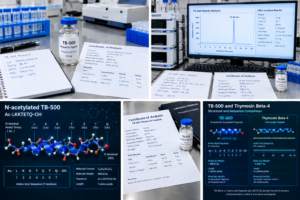
TB-500 contains seven amino-acid residues and an N-terminal acetyl modification.
The structure can be represented as:
Ac-LKKTETQ-OH
The N-terminal acetyl group is not simply a marketing descriptor. It is part of the chemical identity of the material described as TB-500 in regulatory and analytical literature.
The structure contains:
- One N-terminal acetyl modification
- Seven amino-acid residues
- Multiple charged and polar functional groups
- A C-terminal carboxyl group
These characteristics influence chromatographic and mass-spectrometric behavior.
PubChem provides the molecular formula, condensed structure, exact mass, and additional computed chemical descriptors for TB-500.
TB-500 and Thymosin Beta-4 Research
TB-500 research is closely connected to scientific interest in thymosin beta-4.
Thymosin beta-4 is a 43-amino-acid peptide, and the LKKTETQ region corresponds to residues 17–23 of that molecule. FDA documentation identifies this relationship directly.
Scientific research has examined the LKKTETQ region in connection with thymosin beta-4 biology and actin-related mechanisms.
However, it is important to distinguish:
Full-length thymosin beta-4 research
from
Research specifically performed with N-acetylated TB-500.
These compounds are chemically different.
A strong scientific SEO page should therefore avoid statements implying that every biological observation reported for thymosin beta-4 automatically applies to TB-500.
TB-500 Laboratory Research
TB-500 may be relevant to laboratory research involving peptide chemistry and analytical characterization.
Potential research categories include:
Peptide Chemistry
Researchers may study:
- Synthetic peptide structure
- Chemical modifications
- Purification
- Stability
- Molecular characterization
Analytical Chemistry
TB-500 can be investigated using analytical techniques such as:
- HPLC
- LC-MS
- UHPLC-MS/MS
- High-resolution mass spectrometry
Structure-Function Research
The defined sequence provides a model for investigating relationships between peptide structure and molecular behavior.
Peptide-Protein Interaction Research
Researchers can investigate interactions involving defined peptide sequences under controlled experimental conditions.
Analytical Reference Work
TB-500 can also be relevant to research involving identification and detection of peptide compounds.
Published analytical research has specifically demonstrated identification of Ac-LKKTETQ using HPLC and high-resolution mass spectrometry.
TB-500 HPLC Analysis
TB-500 HPLC is an important technical search term because high-performance liquid chromatography can provide useful chromatographic information about peptide research material.
An HPLC report may provide information such as:
- Retention time
- Main chromatographic peak
- Secondary peaks
- Relative peak area
- Reported chromatographic purity
HPLC is especially useful when paired with another identity-confirmation technique.
HPLC + Mass Spectrometry
HPLC primarily separates components based on chromatographic behavior.
Mass spectrometry provides information about molecular mass and fragmentation.
Using both methods can provide complementary information.
A published study identified the N-terminally acetylated TB-500 fragment Ac-LKKTETQ using high-performance liquid chromatography/high-resolution mass spectrometry.
This makes TB-500 HPLC, TB-500 mass spectrometry, and TB-500 analytical testing valuable technical keyword clusters for an authoritative research page.
TB-500 Purity
TB-500 purity is one of the most commercially important research-material quality considerations.
A reported purity percentage should always be understood in context.
Researchers should consider:
- Which analytical method was used?
- Was HPLC used?
- Is mass-spectrometry data available?
- Does the result correspond to the specific lot?
- Is the chemical form identified?
- Is the COA batch-specific?
- Are analytical limitations documented?
Why Batch-Specific Documentation Matters
A product name does not guarantee that every production lot has identical analytical characteristics.
For reproducible research, laboratories can record:
- Product name
- Lot number
- Batch number
- Purity result
- HPLC documentation
- Mass data
- COA
- Testing date
This creates a stronger connection between the material used and the experimental record.
TB-500 COA: Certificate of Analysis
A TB-500 COA should provide batch-specific analytical information about the research material.
Depending on the testing laboratory and product specification, a COA may contain:
- Product name
- Chemical identity
- Lot number
- Batch number
- Purity
- HPLC result
- Molecular mass
- Analytical method
- Testing date
- Specification
- Result
TB-500 COA Checklist
Before relying on a certificate, researchers can verify:
1. Product identity
Does the document identify TB-500 or the intended chemical substance?
2. Sequence
Is the expected LKKTETQ sequence documented?
3. Modification
Is N-terminal acetylation identified where appropriate?
4. Lot number
Does the COA match the material received?
5. Purity
Is the purity measurement linked to a stated method?
6. Mass data
Does the reported mass correspond to the documented molecular form?
7. Testing date
Is the analytical result traceable to a particular testing event?
A well-documented COA is one component of research-material quality evaluation rather than a substitute for independent laboratory validation.
TB-500 Mass Spectrometry
Mass spectrometry is particularly useful for peptide identity research.
For TB-500 free base, PubChem reports an exact mass of:
888.49164688 Da
and a molecular weight of:
889.0 g/mol.
Published research has used high-resolution mass spectrometry to identify Ac-LKKTETQ in TB-500.
Researchers interpreting mass spectra should consider:
- Ionization state
- Adduct formation
- Salt form
- Instrument calibration
- Sample preparation
- Peptide modifications
- Fragmentation behavior
A mass result should therefore be evaluated within the context of the analytical method rather than treated as an isolated number.
TB-500 Analytical Testing
A comprehensive TB-500 analytical testing strategy may combine multiple measurements.
Identity Testing
Establish whether the material corresponds to the intended chemical structure.
Sequence Confirmation
Confirm the expected amino-acid sequence.
Chromatographic Analysis
Use HPLC or related methods to characterize the sample’s chromatographic profile.
Mass Analysis
Use MS or high-resolution MS to support molecular identification.
Documentation
Connect analytical results to a specific lot or batch.
Purity Assessment
Review the reported purity using the analytical method stated on the documentation.
A multi-method approach can provide more useful information than relying exclusively on a single purity percentage.
TB-500 Research Material: Quality Checklist
When evaluating TB-500 research material, consider the following:
Chemical Identity
Look for a clearly defined identity rather than relying solely on the product name.
Peptide Sequence
The expected sequence is LKKTETQ.
N-Terminal Modification
TB-500 is described as N-terminally acetylated.
Molecular Weight
The free-base molecular weight is approximately 889.0 g/mol.
HPLC Documentation
Review the chromatographic purity information when available.
Mass-Spectrometry Data
MS can provide complementary molecular-identity information.
COA
Use a lot-specific certificate when evaluating batch documentation.
Traceability
Maintain the lot number and relevant analytical records with laboratory documentation.
TB-500 and Scientific Evidence
Scientific evidence involving TB-500 should be interpreted carefully.
A 2012 analytical study characterized the N-terminal acetylated 17–23 fragment of thymosin beta-4 in TB-500 using HPLC and high-resolution mass spectrometry.
Another study developed LC-MS methods for detecting N-acetylated LKKTETQ and related metabolites in equine plasma and urine.
More recent analytical research investigated TB-500 and its metabolites using UHPLC-Q-Exactive Orbitrap MS/MS. The researchers reported that a metabolite, rather than the parent TB-500 molecule, accounted for a wound-healing signal observed in their experimental system.
This illustrates why research content should distinguish among:
- Parent peptide
- Metabolites
- Full-length thymosin beta-4
- Peptide fragments
- In-vitro findings
- Animal studies
- Human evidence
Scientific observations from one category should not automatically be generalized to another.
TB-500 Research Peptide in the United States
For a U.S.-targeted research page, TB-500 should be presented around laboratory research and analytical characterization, rather than as a therapeutic product.
The FDA currently identifies thymosin beta-4 fragment (LKKTETQ), also known as TB-500, among substances for which the agency has identified important safety information gaps concerning human exposure. FDA notes concerns including potential immunogenicity associated with aggregation and peptide-related impurities.
The FDA Substance Registration System lists a TB-500 identifier but explicitly states that a UNII does not imply regulatory review or approval.
Accordingly, research-focused content should avoid presenting TB-500 as:
- An FDA-approved medication
- A dietary supplement
- A disease treatment
- A human therapeutic
- A veterinary treatment
- A product with established clinical efficacy
Instead, appropriate content themes include:
- TB-500 research peptide
- TB-500 research material
- TB-500 HPLC
- TB-500 COA
- TB-500 molecular weight
- TB-500 peptide sequence
- TB-500 analytical testing
- TB-500 laboratory research
Research-Use-Only Statement
TB-500 research peptide is intended for laboratory research and scientific investigation only.
This material is not represented as an FDA-approved medication, dietary supplement, or therapeutic product.
It is not intended to diagnose, treat, cure, or prevent any disease or medical condition.
This content does not provide human or veterinary dosing, administration, injection, or treatment instructions.
Researchers should follow appropriate laboratory safety practices, institutional protocols, supplier documentation, and all applicable laws and regulations.
Frequently Asked Questions About TB-500 Research Peptide
What is TB-500 research peptide?
TB-500 is commonly identified as an N-terminally acetylated seven-amino-acid fragment of thymosin beta-4 with the sequence LKKTETQ.
What is the TB-500 peptide sequence?
The sequence is LKKTETQ. The modified chemical structure is commonly represented as Ac-LKKTETQ-OH.
What is the molecular weight of TB-500?
PubChem reports a molecular weight of approximately 889.0 g/mol and an exact mass of 888.49164688 Da for the documented TB-500 structure.
Is TB-500 the same as thymosin beta-4?
No. TB-500 is the N-acetylated 17–23 fragment, while full-length thymosin beta-4 contains 43 amino acids.
What does TB-500 HPLC testing show?
HPLC can provide chromatographic information about a peptide sample, including its principal peak and relative chromatographic purity.
What is a TB-500 COA?
A Certificate of Analysis provides batch-specific analytical information such as identity, purity, lot number, analytical method, and potentially molecular-mass data.
Why is TB-500 purity important?
Purity information helps researchers evaluate the analytical quality of a particular research-material batch and maintain experimental traceability.
Can mass spectrometry identify TB-500?
Mass spectrometry can provide molecular-mass and fragmentation information that supports peptide identity. Published research has specifically used high-resolution MS to identify Ac-LKKTETQ in TB-500.
What research techniques are associated with TB-500?
Published work has used techniques including HPLC, LC-MS, and high-resolution mass spectrometry for TB-500 detection and characterization.
Does research on thymosin beta-4 automatically apply to TB-500?
No. Although TB-500 corresponds to a region of thymosin beta-4, the compounds are chemically distinct. Results should be attributed to the specific molecule actually studied.
Is TB-500 FDA approved?
TB-500 should not be described as an FDA-approved therapeutic. FDA’s substance-registration information explicitly states that a UNII does not imply regulatory review or approval.
Is this TB-500 page intended for human use?
No. The page is structured for laboratory research, scientific education, and analytical characterization and does not provide human or veterinary administration instructions.