

What Is Kisspeptin?
Kisspeptins are peptide products derived from the KISS1 gene. Research literature identifies several endogenous kisspeptin forms, including Kisspeptin-54, Kisspeptin-14, Kisspeptin-13, and Kisspeptin-10.
These peptides share a conserved C-terminal decapeptide region that allows them to interact with KISS1R, the endogenous kisspeptin receptor. Research has therefore focused extensively on the Kisspeptin/KISS1R signaling system and its relationship to neuroendocrine signaling.
Kisspeptin research extends across several scientific areas, including:
- Peptide-receptor interaction studies
- GPCR signaling research
- Neuroendocrine signaling
- Hypothalamic signaling pathways
- Reproductive biology research
- Hormonal signaling research
- Cellular and molecular biology
- Ligand-response experiments
- Analytical peptide characterization
Kisspeptin should therefore be viewed as a research molecule with a specific biological signaling role rather than simply as a generic laboratory peptide.
What Is Kisspeptin-10?
Kisspeptin-10, also abbreviated KP-10, is the shortest naturally occurring human kisspeptin fragment capable of activating KISS1R.
The human sequence is:
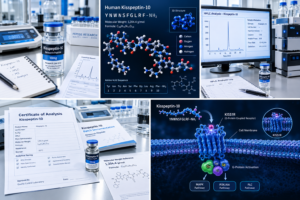
YNWNSFGLRF-NH₂
PubChem identifies human Kisspeptin-10 as human metastin 45-54 and lists CAS number 374675-21-5. Its reported molecular formula is C₆₃H₈₃N₁₇O₁₄, with a calculated molecular weight of approximately 1302.4 g/mol.
The C-terminal amidated phenylalanine and conserved RFamide motif are important structural characteristics of the human peptide.
Researchers should pay close attention to species designation when ordering Kisspeptin-10 because peptide sequences can differ between organisms. For example, PubChem lists human KP-10 as YNWNSFGLRF, while certain non-human Kisspeptin-10 compounds have different terminal residues and molecular weights.
This distinction is particularly important for analytical studies in which sequence identity must match the experimental model.
Kisspeptin 10mg Research Peptide Specifications
When evaluating a Kisspeptin 10mg research peptide, researchers may want to document the following characteristics:
| Specification | Human Kisspeptin-10 |
|---|---|
| Common name | Kisspeptin-10 |
| Abbreviation | KP-10 |
| Alternative name | Human metastin 45-54 |
| Sequence | YNWNSFGLRF-NH₂ |
| Molecular formula | C₆₃H₈₃N₁₇O₁₄ |
| Molecular weight | ~1302.4 g/mol |
| CAS | 374675-21-5 |
| Receptor of interest | KISS1R |
| Material quantity | 10mg |
| Research classification | Laboratory/research use |
The molecular information above is based on the human Kisspeptin-10 compound listed by PubChem.
A supplier’s certificate of analysis should be reviewed separately because the theoretical molecular characteristics of a peptide do not by themselves establish the identity or purity of a particular production lot.
Kisspeptin Peptide Sequence
The sequence is one of the most important identifiers when evaluating a research peptide.
Human Kisspeptin-10 is:
Tyr-Asn-Trp-Asn-Ser-Phe-Gly-Leu-Arg-Phe-NH₂
One-letter notation:
YNWNSFGLRF-NH₂
PubChem records the sequence as YNWNSFGLRF with a C-terminal amide designation.
The conserved C-terminal region is biologically significant because native kisspeptin peptides share this region and use it to interact with KISS1R. Research literature describes KP-10 as the shortest kisspeptin fragment capable of activating this receptor.
For laboratory documentation, the sequence should be recorded exactly as specified by the supplier and analytical documentation. Researchers should also verify whether the material is supplied as the free peptide or a salt/TFA-associated form because this can affect the reported molecular mass.
Kisspeptin and KISS1R Research
One of the central areas of Kisspeptin research is the relationship between Kisspeptin ligands and KISS1R, a G-protein-coupled receptor.
Scientific literature describes KISS1R as the endogenous receptor for kisspeptins and reports its expression in tissues including the hypothalamus, pituitary, gonads, placenta, pancreas, and kidney.
This signaling system has made Kisspeptin valuable for laboratory studies examining:
- Ligand-receptor interactions
- GPCR activation
- Intracellular signaling
- Neuroendocrine communication
- Hypothalamic pathways
- Reproductive signaling mechanisms
- Peptide structure-function relationships
The use of KP-10 as a research ligand allows investigators to study specific aspects of this signaling system under controlled experimental conditions.
Importantly, findings from an in-vitro or animal model should not automatically be interpreted as evidence of an equivalent effect in humans.
Kisspeptin-10 vs. Kisspeptin-54
Kisspeptin-10 and Kisspeptin-54 are related endogenous peptides but differ substantially in length and pharmacokinetic characteristics.
Both contain the conserved C-terminal sequence associated with KISS1R activity. However, research literature notes differences in peptide half-life and experimental behavior. Reviews have reported that Kisspeptin-54 generally has a longer terminal half-life than Kisspeptin-10 in humans.
For laboratory research, the choice between KP-10 and KP-54 should therefore depend on the scientific question, experimental system, peptide specification, and study design.
A research supplier should clearly identify which peptide is being supplied rather than using “Kisspeptin” as an ambiguous product name.
Kisspeptin 10mg Research Applications
Kisspeptin-10 can be relevant to research programs investigating peptide signaling and KISS1R biology.
Potential research categories include:
1. Receptor Signaling Research
KP-10 can serve as a peptide ligand in experimental systems designed to examine KISS1R signaling and receptor response.
2. Neuroendocrine Research
Kisspeptin signaling is closely associated with neuroendocrine pathways, making it relevant to laboratory investigations of hypothalamic signaling.
3. Reproductive Biology Research
Researchers have extensively investigated Kisspeptin signaling in relation to reproductive neuroendocrinology and reproductive-axis regulation.
4. Peptide Structure-Function Studies
The relatively short KP-10 sequence makes it useful for studying how peptide structure relates to receptor recognition and biological activity.
5. Analytical Research
Kisspeptin-10 can also be characterized using analytical methods such as chromatography and mass spectrometry.
Kisspeptin Purity and Quality Control
Purity is an important consideration when purchasing any research peptide.
A reported purity percentage should be interpreted alongside the analytical method used to generate the result. For example, chromatographic purity and mass-spectrometric identity answer different analytical questions.
A useful Kisspeptin research peptide documentation package may include:
- Certificate of Analysis (COA)
- Lot or batch number
- Peptide identity
- Reported purity
- HPLC or RP-HPLC data
- Mass spectrometry data
- Molecular weight information
- Quantity supplied
- Manufacturing or testing date
- Storage information
HPLC Analysis
Reverse-phase HPLC can be used to assess chromatographic purity and identify the primary peptide peak.
For a research-grade product page, an HPLC chromatogram should be presented as lot-specific analytical documentation rather than as a generic illustration of purity.
Mass Spectrometry
Mass spectrometry can provide information about molecular mass and support peptide identity.
Researchers comparing a theoretical molecular weight with an experimental mass should consider factors such as peptide modification, counterions, ionization state, and instrument conditions.
Kisspeptin COA: What Researchers Should Check
A Kisspeptin COA can provide valuable lot-level information.
Before using a research peptide, researchers should review whether the certificate clearly identifies:
- Product name
- Batch or lot number
- Quantity
- Sequence or molecular identity
- Purity result
- Analytical method
- Molecular mass or mass confirmation
- Testing date
- Laboratory or analytical provider
- Storage or handling information where applicable
A COA should correspond to the actual lot being supplied.
This is particularly important for peptides because seemingly similar product names can refer to different species, sequences, modifications, or salt forms.
Kisspeptin Molecular Weight
The molecular weight of human Kisspeptin-10 is approximately 1302.4 g/mol, according to PubChem. Its molecular formula is C₆₃H₈₃N₁₇O₁₄.
Researchers should distinguish between:
- Molecular weight of the parent peptide
- Molecular weight of a salt or TFA-associated form
- Exact mass
- Monoisotopic mass
- Experimentally observed MS mass
For example, PubChem lists a human Kisspeptin-10 TFA compound at approximately 1416.5 g/mol, demonstrating why the material’s chemical form matters when comparing theoretical and experimental analytical data.
Therefore, product specifications should identify the chemical form rather than relying only on the generic peptide name.
Lyophilized Kisspeptin Research Material
Research peptides are commonly supplied as lyophilized material.
Lyophilization, or freeze-drying, produces a dry peptide preparation that can be more practical for controlled laboratory storage and handling than a prepared liquid.
Researchers should follow the supplier’s lot-specific storage and handling instructions. Factors that may influence peptide stability include:
- Temperature
- Moisture
- Light exposure
- Repeated temperature cycling
- Container integrity
- Peptide concentration after preparation
- Experimental handling conditions
Researchers should avoid assuming that storage requirements for one peptide automatically apply to another peptide.
Kisspeptin 10mg: Understanding the “10mg” Quantity
The term 10mg describes the quantity of peptide material contained in the research product.
It does not constitute a human dosage recommendation.
For laboratory purchasing and inventory management, the quantity can be useful for calculating how much research material is available for a planned experimental program. Actual experimental concentrations should be determined by qualified researchers according to validated protocols, institutional requirements, and the scientific objective of the study.
This distinction is important for responsible SEO and product communication because a research peptide page should not present laboratory material as an approved therapeutic product.
How to Evaluate a Kisspeptin Research Peptide
When comparing Kisspeptin research materials, consider several documentation factors rather than relying on the product name alone.
Identity
Confirm the exact peptide sequence and species.
Purity
Review the reported purity and analytical method.
Analytical Data
Look for appropriate HPLC and mass-spectrometry documentation where available.
Lot Traceability
A lot number helps connect the physical material with its analytical documentation.
Chemical Form
Check whether the material is supplied as the parent peptide or an associated salt/counterion form.
Quantity
Confirm that the supplied amount matches the product specification.
Research-Use Labeling
The product should be clearly designated for laboratory research and not represented as a human-use medication.
Why Researchers Search for Kisspeptin 10mg Research Peptide
The phrase “Kisspeptin 10mg research peptide” combines several high-intent search concepts.
Researchers may be looking for information about:
- Kisspeptin-10 identity
- KP-10 sequence
- Kisspeptin molecular weight
- Kisspeptin purity
- Kisspeptin COA
- KISS1R research
- Research-grade Kisspeptin
- 10mg peptide quantity
- HPLC characterization
- Mass spectrometry
- Laboratory peptide specifications
A strong research-product page should answer these questions directly instead of relying on vague descriptions or unsupported biological claims.
Research-Use Statement
For laboratory research use only.
Kisspeptin 10mg research peptide is intended solely for qualified scientific research and laboratory applications. It is not intended for human consumption, self-administration, diagnosis, treatment, prevention, or cure of any disease or medical condition.
Research materials should be handled by appropriately trained personnel in accordance with applicable laboratory procedures, institutional requirements, and relevant regulations.
Information on this page is provided for scientific and educational purposes and should not be interpreted as medical advice or a recommendation for human use.
Kisspeptin Research Peptide FAQ
What is Kisspeptin-10?
Kisspeptin-10, or KP-10, is a naturally occurring kisspeptin fragment containing 10 amino acids. Human KP-10 has the sequence YNWNSFGLRF-NH₂ and interacts with the KISS1R receptor.
What is the molecular weight of human Kisspeptin-10?
PubChem reports a molecular weight of approximately 1302.4 g/mol for human Kisspeptin-10.
What is the Kisspeptin-10 sequence?
The human Kisspeptin-10 sequence is YNWNSFGLRF-NH₂.
What does Kisspeptin 10mg mean?
It refers to the quantity of research peptide material supplied. The 10mg quantity should not be interpreted as a recommended human dose.
What is KISS1R?
KISS1R is the endogenous receptor associated with kisspeptin signaling. It is a G-protein-coupled receptor that has been extensively investigated in neuroendocrine and reproductive biology research.
Is Kisspeptin-10 the same as Kisspeptin-54?
No. They are related kisspeptin peptides with different lengths and pharmacokinetic characteristics. Both contain the conserved C-terminal region involved in KISS1R interaction.
What should a Kisspeptin COA contain?
A COA may include product identity, lot number, purity, analytical testing, molecular mass information, and other lot-specific quality data.
Why is HPLC relevant to Kisspeptin research?
HPLC can provide chromatographic information used to evaluate peptide purity and composition. Researchers should review the actual lot-specific chromatogram when available.
Why can the molecular weight differ between Kisspeptin products?
Different species sequences, chemical forms, modifications, or counterions can produce different molecular weights. Human KP-10 and its TFA-associated form, for example, have different listed molecular weights.
Is Kisspeptin 10mg intended for human use?
A research-use Kisspeptin product should be marketed and handled strictly as laboratory research material, not as a product for human administration.
Conclusion
Kisspeptin-10 is an important research peptide for studying the molecular biology of kisspeptin signaling and the KISS1R receptor. Human KP-10 is characterized by the sequence YNWNSFGLRF-NH₂, with a reported molecular weight of approximately 1302.4 g/mol.
For researchers evaluating a Kisspeptin 10mg research peptide, product identity, sequence, species, chemical form, purity, HPLC results, mass-spectrometry data, COA documentation, lot traceability, and storage information are key quality considerations.
A well-documented research peptide product page should provide scientific specifications clearly while maintaining an explicit research-use-only position. This approach gives researchers useful information without confusing laboratory material with an approved therapeutic product.