

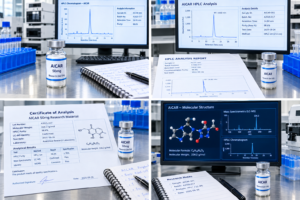
AICAR 50mg: Research Compound, Purity, HPLC & COA Guide
AICAR 50mg is a laboratory research compound used in experimental studies involving cellular energy signaling and AMP-activated protein kinase (AMPK) pathways. Also known as acadesine or AICA riboside, AICAR is a small-molecule nucleoside analog rather than a conventional peptide.
For researchers evaluating AICAR 50mg research material, important quality considerations include compound identity, molecular formula, molecular weight, HPLC purity, mass spectrometry, Certificate of Analysis (COA), batch traceability, physical form, and applicable storage documentation.
This guide provides an SEO-focused technical overview of AICAR 50mg for laboratory and analytical research.
Research Use Only: AICAR 50mg discussed on this page is presented solely as laboratory research material. It is not intended for human consumption, human administration, veterinary use, diagnosis, treatment, cure, mitigation, or prevention of disease.
AICAR 50mg at a Glance
| Specification | Research Information |
|---|---|
| Product | AICAR 50mg |
| Common name | AICAR |
| Alternative name | Acadesine / AICA riboside |
| Compound type | Nucleoside analog |
| CAS number | 2627-69-2 |
| Molecular formula | C₉H₁₄N₄O₅ |
| Molecular weight | Approximately 258.23 g/mol |
| Physical form | Commonly supplied as powder or lyophilized research material |
| Analytical methods | HPLC, LC-MS/MS and related methods |
| Research area | Cellular energy and AMPK pathway research |
| Intended application | Laboratory research only |
Commercial and laboratory reference sources identify AICAR as a nucleoside analog and report a molecular weight of approximately 258.23 g/mol. Sigma-Aldrich, for example, lists AICAR at ≥98% HPLC purity in powder form.
What Is AICAR 50mg?
AICAR, short for 5-aminoimidazole-4-carboxamide ribonucleoside, is a synthetic nucleoside analog used as a research reagent in studies of cellular energy signaling.
It is sometimes described in online markets as an “AICAR peptide,” but that terminology is chemically imprecise. AICAR does not have an amino-acid peptide sequence like compounds such as BPC-157 or TB-500.
Instead, AICAR belongs to the nucleoside-analog class.
This distinction matters when creating technically accurate SEO content.
The 50mg designation refers to the nominal quantity associated with a particular product configuration. It should not be interpreted as a human dosage recommendation or experimental dosing instruction.
AICAR 50mg Research Compound
The keyword AICAR 50mg has both commercial and informational search intent.
Researchers searching for AICAR 50mg may be looking for:
- Laboratory-grade research material
- Batch-specific COA documentation
- HPLC purity information
- Molecular-weight information
- LC-MS identity confirmation
- Research specifications
- Analytical testing
- Laboratory reference material
- U.S.-based research suppliers
- Product quantity information
A strong research-product page should therefore provide technical information instead of relying only on a product description.
Important documentation can include the exact lot number, testing date, analytical method, reported purity, identity result, and laboratory information.
AICAR Molecular Weight
The molecular weight of AICAR is approximately 258.23 g/mol.
Current laboratory and chemical-reference sources list:
- Molecular formula: C₉H₁₄N₄O₅
- Molecular weight: 258.23 g/mol
- CAS: 2627-69-2
Sigma-Aldrich lists AICAR with a molecular weight of 258.23 and a specification of ≥98% HPLC.
Another current research-material record lists AICAR at 258.24 g/mol, illustrating that small differences in displayed molecular weight can result from rounding conventions.
Why molecular weight matters
Molecular-weight information is useful when researchers evaluate:
- Compound identity
- Mass-spectrometry results
- Analytical standards
- Chemical calculations
- Chromatographic methods
- Research documentation
The theoretical molecular weight should always be distinguished from an experimentally observed mass reported by an analytical instrument.
AICAR Purity
AICAR purity is one of the most important quality-related search terms for this product.
Purity measurements are normally reported alongside an analytical method.
For example, current published records show different batch-specific HPLC results:
- One AICAR 50mg COA reports 99.875% chromatographic purity for its identified lot.
- Another current research-material record reports 99.61% HPLC purity for a specific 50mg lot.
- A separate batch report lists 99.1% HPLC purity.
These values demonstrate an important principle:
A purity result belongs to the tested sample or batch.
It should not automatically be presented as the purity of every AICAR 50mg product.
Researchers should therefore review the current COA associated with the exact lot under consideration.
AICAR HPLC Testing
High-performance liquid chromatography (HPLC) is widely used for analytical characterization of research compounds.
For AICAR, HPLC can provide chromatographic information about the target compound and potentially related impurities.
A useful HPLC report may include:
- Product name
- Sample identification
- Batch number
- Analytical method
- Detector information
- Retention time
- Main peak
- Purity percentage
- Chromatogram
- Acceptance specification
- Testing date
Current published AICAR records demonstrate that HPLC results can be reported using different analytical specifications and methodologies. One current COA reports 99.875% integrated detector-area purity using an RP-UPLC-DAD method.
Therefore, an SEO page should avoid presenting a generic purity percentage as though it were universal.
AICAR COA: Certificate of Analysis
An AICAR COA provides batch-specific analytical information.
For researchers, the COA can be one of the most useful documents for evaluating research material.
A comprehensive COA may include:
- Product name
- Lot number
- Certificate number
- Quantity
- Molecular formula
- Molecular weight
- Appearance
- HPLC purity
- Mass-spectrometry identity
- Assay or active-content information
- Water content
- Endotoxin testing, when applicable
- Sterility testing, when applicable
- Testing laboratory
- Test date
- Acceptance criteria
One current AICAR batch record reports HPLC purity, active content, endotoxin information, sterility testing, and identity/structure results separately.
This separation is important because purity, active content, sterility, and endotoxin status are different analytical attributes.
How to Read an AICAR COA
When reviewing an AICAR 50mg COA, start with the product and batch identifiers.
1. Product identity
Confirm that the document identifies the material as AICAR.
2. Lot number
The lot number should correspond to the material being evaluated.
3. Testing date
Check when the sample was analyzed.
4. Analytical method
Determine whether the reported result comes from HPLC, LC-MS, another method, or multiple methods.
5. Purity
Review the reported purity together with the analytical method.
6. Identity
Look for mass-spectrometry or another identity-confirmation result where applicable.
7. Additional tests
Review water, residual solvents, endotoxins, sterility, or other tests only when actually reported.
An absent test should not be interpreted as a passing result.
AICAR Mass Spectrometry and LC-MS
Mass spectrometry can provide supporting information for compound identity.
For AICAR, the expected molecular weight is approximately 258.23 Da. Analytical instruments may report an observed mass-to-charge ratio rather than simply displaying the neutral molecular weight.
Current AICAR documentation includes LC-MS and mass-spectrometry testing as identity-related analytical approaches. For example, one current 50mg product record identifies AICAR through LC-MS, while another batch report records an MS result alongside HPLC purity.
Researchers should therefore interpret an MS result according to:
- Instrument methodology
- Ionization technique
- Charge state
- Expected molecular mass
- Reference standard
- Acceptance criteria
Mass spectrometry should be viewed as part of an analytical identification framework rather than as a replacement for every other quality test.
AICAR Research Applications
AICAR is widely discussed in laboratory research involving AMP-activated protein kinase (AMPK) and cellular energy signaling.
Research literature and current laboratory references describe AICAR as a compound used to investigate AMPK-related cellular processes.
Research areas may include:
- Cellular energy signaling
- AMPK pathway research
- Metabolic signaling
- Glucose-transport studies
- Fatty-acid metabolism research
- Mitochondrial biology
- Cell-culture experiments
- Biochemical pathway analysis
These descriptions concern experimental research contexts and should not be interpreted as claims that AICAR is an approved treatment or consumer health product.
AICAR and AMPK Research
AMPK is an important cellular energy-sensing pathway.
AICAR is frequently used as a pharmacological research tool in experimental systems investigating AMPK-related signaling.
Researchers may use AICAR to examine questions involving:
- Cellular energy balance
- AMP-associated signaling
- Metabolic pathway regulation
- Cellular responses to energetic stress
- AMPK-dependent signaling
- AMPK-independent experimental effects
The exact biological response depends on the experimental model, concentration, exposure conditions, cell type, and study design.
This is why product documentation should not substitute for the experimental protocol or scientific literature.
AICAR 50mg Laboratory Research Material
For laboratory use, researchers should evaluate AICAR according to the requirements of the particular experiment.
Relevant quality attributes can include:
Identity
Does the analytical documentation support the identity of AICAR?
Purity
What HPLC or other chromatographic result is reported?
Molecular characteristics
Does the molecular formula and expected mass correspond to the intended compound?
Batch traceability
Can the material be connected to a specific lot and COA?
Quantity
Does the documented quantity correspond to the product configuration?
Physical form
Is the material described consistently as powder or lyophilized material?
Additional analytical tests
Are other quality attributes documented where relevant to the laboratory’s requirements?
This approach is more informative than evaluating a product based solely on a marketing purity percentage.
AICAR 50mg Storage Information
Storage requirements should follow the current supplier documentation and the laboratory’s own handling procedures.
Current AICAR research-product records commonly identify temperature-controlled storage for the material, including long-term storage around −20°C in some product documentation.
Researchers should not assume that every AICAR product has identical stability requirements.
Storage documentation should be reviewed for:
- Temperature
- Light protection
- Moisture protection
- Container requirements
- Shelf-life information
- Stability after opening
- Laboratory handling requirements
The supplier’s current technical documentation should take precedence over generalized online recommendations.
AICAR 50mg Research Compound Quality Checklist
Before selecting AICAR research material, researchers can review the following checklist.
Product information
- Is the product clearly identified as AICAR?
- Is the quantity clearly stated as 50mg?
- Is the chemical identity provided?
- Is the CAS number provided?
Analytical documentation
- Is a COA available?
- Does the COA match the lot?
- Is HPLC testing reported?
- Is identity testing reported?
- Is mass spectrometry or LC-MS available?
Technical specifications
- Is the molecular formula listed?
- Is molecular weight listed?
- Is the physical form identified?
- Are additional analytical tests documented?
Traceability
- Is there a batch number?
- Is there a testing date?
- Is the testing laboratory identified?
Research-use status
- Is the material clearly labeled for laboratory research?
- Are human and veterinary applications excluded?
AICAR 50mg USA Research Material
For U.S.-targeted SEO, AICAR 50mg USA and related phrases can capture researchers looking for laboratory material and analytical documentation in the United States.
However, geographic wording should not be used to imply regulatory approval.
A U.S.-focused research product page should emphasize:
- Research-use-only status
- Batch-specific documentation
- Analytical transparency
- Product identification
- COA availability
- Laboratory quality controls
- Applicable shipping information
- Regulatory and institutional compliance
Researchers should independently confirm applicable federal, state, local, and institutional requirements before acquiring or using research materials.
Why AICAR Should Not Be Called a Peptide
This distinction can improve both scientific accuracy and SEO quality.
AICAR is a nucleoside analog, not a conventional peptide.
Its chemical formula is C₉H₁₄N₄O₅, and its molecular weight is approximately 258.23 g/mol.
A peptide, by contrast, is generally composed of amino-acid residues linked through peptide bonds.
Therefore, terms such as:
- AICAR research compound
- AICAR research material
- AICAR 50mg
- AICAR laboratory reagent
- AICAR analytical standard
are more chemically precise.
If the target audience searches for “AICAR peptide,” the phrase can be addressed naturally for search relevance, but the article should clarify the underlying chemistry rather than reinforce an inaccurate classification.
AICAR 50mg: Research-Use Positioning
A strong commercial research page can position AICAR around measurable analytical attributes rather than unsupported claims.
Useful terminology includes:
- AICAR 50mg
- AICAR research compound
- AICAR research material
- AICAR purity
- AICAR HPLC
- AICAR COA
- AICAR molecular weight
- AICAR mass spectrometry
- AICAR LC-MS
- AICAR analytical testing
- AICAR laboratory research
- AICAR 50mg USA
Avoid describing AICAR as:
- A weight-loss product
- A supplement
- A performance-enhancement product
- A human medication
- A treatment
- A disease cure
- A product intended for self-administration
This keeps the page aligned with laboratory research intent.
Frequently Asked Questions
What is AICAR 50mg?
AICAR 50mg is a research-material configuration containing a nominal 50mg quantity of AICAR. AICAR is a small-molecule nucleoside analog used in laboratory research involving cellular energy and AMPK-related pathways.
Is AICAR a peptide?
No. AICAR is more accurately classified as a nucleoside analog. Calling it an “AICAR peptide” is common in some commercial search contexts but is chemically imprecise.
What is the molecular weight of AICAR?
AICAR has a molecular weight of approximately 258.23 g/mol. Its molecular formula is C₉H₁₄N₄O₅.
What is AICAR purity?
AICAR purity is batch- and method-specific. Current published records show HPLC results such as 99.1%, 99.61%, and 99.875% for different tested batches. These results should not be treated as universal specifications.
What is an AICAR COA?
An AICAR Certificate of Analysis is a quality-control document associated with a specific batch. It may report identity, HPLC purity, molecular characteristics, quantity, and additional analytical tests.
Why is HPLC used for AICAR?
HPLC can be used to evaluate chromatographic purity and characterize the analytical profile of AICAR research material.
What does LC-MS tell researchers?
LC-MS can provide supporting information about compound identity by combining chromatographic separation with mass-spectrometric analysis.
Is AICAR 50mg intended for human use?
No. This page presents AICAR 50mg strictly as laboratory research material and does not provide human-use instructions or dosing recommendations.
What should I check before purchasing AICAR research material?
Review the product identity, lot number, COA, analytical method, HPLC result, identity testing, molecular information, testing laboratory, and any additional specifications relevant to your research.
Does 50mg mean a recommended dose?
No. The 50mg designation identifies the nominal quantity of material in the product configuration. It is not a dosing recommendation.