

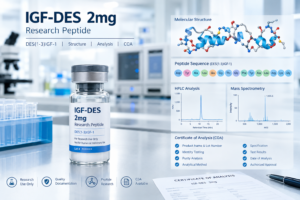
What Is IGF-DES 2mg?
IGF-DES 2mg refers to a 2mg quantity of research material identified as IGF-DES, commonly associated with DES(1-3)IGF-1, a truncated derivative of insulin-like growth factor-1.
For a scientific product page, it is important to distinguish IGF-DES from other IGF-related compounds. IGF-1, IGF-1 LR3, IGF-DES, and individual IGF-1 fragments are not interchangeable molecular identities.
This distinction matters because molecular formula, molecular weight, sequence, analytical characteristics, and biological properties depend on the exact molecular form being described.
PubChem, for example, separately catalogs IGF-1 fragments such as IGF-I (57-70), which has a molecular weight of 1546.9 g/mol and sequence LEMYKAPLKPAKSA. That record is not IGF-DES and should not be used as the molecular profile for an IGF-DES product.
For Peptides Grey House, the strongest approach is therefore to build the IGF-DES 2mg page around:
- Exact product identity
- DES(1-3)IGF-1 terminology
- Peptide structure
- Sequence verification
- Molecular characterization
- Analytical testing
- COA documentation
- Research applications
- Research-use-only positioning
IGF-DES 2mg at a Glance
| Property | IGF-DES 2mg |
|---|---|
| Product quantity | 2mg |
| Common research name | IGF-DES |
| Related designation | DES(1-3)IGF-1 |
| Peptide family | IGF-related peptide |
| Research context | Peptide chemistry, molecular biology and receptor-related research |
| Documentation | COA, identity and analytical testing should be reviewed |
| Product status | Research material |
| Clinical use | Not represented as a therapeutic product |
The 2mg designation describes the stated quantity of material. It does not by itself establish molecular identity, purity, biological activity, pharmaceutical grade, or clinical suitability.
Understanding DES(1-3)IGF-1
The term DES(1-3)IGF-1 refers to an IGF-1-related peptide designation in which the nomenclature indicates a modified or truncated form of the IGF-1 sequence.
This makes exact naming particularly important.
Researchers searching for IGF-DES may encounter several related terms:
- IGF-DES
- DES IGF-1
- DES(1-3)IGF-1
- DES(1-3)IGF-I
- Des-IGF-1
These terms should be used carefully and verified against the actual product specification.
A product page should not automatically substitute information from:
- Full-length IGF-1
- IGF-1 LR3
- IGF-1 fragments
- Long R3 IGF-1
- Other IGF analogues
PubChem, for example, contains a separate record for IGF-1 LR3 associated with CAS 946870-92-4, demonstrating that LR3 is a distinct IGF-related designation.
IGF-DES vs. IGF-1
One of the most important educational sections on an IGF-DES 2mg page should explain the difference between IGF-DES and conventional IGF-1.
IGF-1 refers to insulin-like growth factor-1, a naturally occurring peptide involved in biological signaling.
IGF-DES refers to a specific modified/truncated IGF-related research peptide designation.
IGF-1 LR3 is another distinct analogue with its own structural modification.
These names should not be treated as synonyms.
For SEO, this creates an opportunity to capture related searches while maintaining scientific accuracy.
A useful content cluster could include separate pages for:
- IGF-DES 2mg
- IGF-DES research peptide
- DES(1-3)IGF-1
- IGF-1 molecular weight
- IGF-1 peptide sequence
- IGF-1 LR3
- IGF peptide research
Each page can link to the others where the scientific relationship is genuinely relevant.
Why Exact Molecular Identity Matters
Peptide names can sometimes be abbreviated in commercial listings. That makes molecular identity especially important.
Before publishing molecular specifications for IGF-DES 2mg, the product documentation should be checked for:
- Full peptide name
- Sequence
- Molecular formula
- Molecular weight
- CAS number, if assigned
- Terminal modifications
- Purity specification
- Analytical method
- Lot number
- Certificate of Analysis
This is especially important for IGF-related peptides because databases contain multiple fragments and analogues.
For example, PubChem lists IGF-I (57-70) as a 14-residue peptide with a molecular weight of 1546.9 g/mol and CAS 123618-03-1. That compound should not be confused with IGF-DES.
IGF-DES 2mg Molecular Weight
2mg product page should correspond to the exact molecular form being supplied.
This is preferable to copying a molecular-weight value from a different IGF analogue or fragment.
For a commercial research page, the recommended wording is:
“Molecular weight should be verified against the product-specific specification and Certificate of Analysis for the exact IGF-DES molecular form.”
This approach is better than publishing an unsupported number.
Molecular weight can be relevant to:
- Mass spectrometry
- Analytical characterization
- Molecular modeling
- Peptide identification
- Research database comparisons
- Literature searches
However, molecular weight alone does not establish sample purity or product quality.
IGF-DES Peptide Sequence
Sequence information is one of the most important identifiers for peptide research.
For IGF-DES, researchers should verify the exact sequence against the manufacturer’s technical documentation or analytical reference.
The sequence can help distinguish IGF-DES from:
- Full-length IGF-1
- IGF-1 LR3
- IGF fragments
- Modified IGF analogues
- Degradation products
When sequence information is included on a product page, it should be reproduced exactly as specified by the product documentation.
This is particularly important for SEO pages because search engines may associate similar names with different molecular entities.
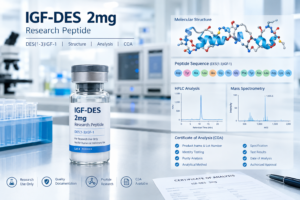
IGF-DES Molecular Structure
IGF-related peptides are structurally complex compared with very short peptide sequences.
A high-quality IGF-DES research page should therefore include a molecular-structure section explaining that the structure should be evaluated according to the exact sequence and any terminal or structural modifications.
Recommended visual information includes:
- Peptide backbone
- Amino-acid sequence
- Disulfide connectivity where applicable
- Modified or truncated regions
- Molecular model
- Analytical identification
A scientific diagram can provide substantially more value than a generic peptide-vial photograph because it directly addresses research intent.
IGF-DES 2mg Research Applications
IGF-related peptides are relevant to several areas of laboratory and biomedical research.
A research-use product page can discuss these areas without making therapeutic claims.
Peptide chemistry
Researchers can investigate synthesis, purification, characterization, sequence relationships, and structural properties of IGF-related peptides.
Molecular biology
IGF-related molecules can be examined in research models investigating cellular signaling and molecular interactions.
Receptor research
IGF-related signaling systems provide a research context for studying ligand-receptor interactions.
Analytical chemistry
Researchers can use analytical methods to evaluate peptide identity, purity, and molecular characteristics.
Protein and peptide science
IGF-DES can be studied as an example of how sequence modifications can affect molecular characteristics and research behavior.
IGF-DES and Analytical Testing
Analytical testing is a key component of research-material evaluation.
Depending on the supplier and product specification, relevant testing may include:
- HPLC
- Mass spectrometry
- Peptide identity testing
- Purity assessment
- Appearance
- Water or moisture analysis
- Lot-specific documentation
HPLC can provide chromatographic information about sample composition, while mass spectrometry can provide molecular-mass information useful for identity assessment.
The two techniques answer different analytical questions.
A chromatographic purity result should not automatically be interpreted as proof of molecular identity, while a mass-spectrometry result should not automatically be interpreted as proof of complete purity.
A stronger research-material evaluation considers multiple pieces of evidence together.
IGF-DES 2mg Certificate of Analysis
A Certificate of Analysis (COA) can provide lot-specific information about research material.
An effective COA may contain:
- Product name
- Lot number
- Test date
- Specification
- Test method
- Analytical result
- Purity information
- Identity information
- Authorized approval
Researchers should confirm that the COA corresponds to the actual lot being evaluated.
For SEO purposes, “IGF-DES COA” and “IGF-DES Certificate of Analysis” are valuable secondary terms because they align with research-material evaluation intent.
A professional product page can provide a clear explanation of what a COA is without publishing fabricated laboratory results.
IGF-DES 2mg Quantity vs. Purity
The term 2mg represents quantity.
It should not be interpreted as:
- 2mg of pure active compound automatically
- A clinical dose
- A potency rating
- A pharmaceutical strength
- Evidence of biological activity
Purity and identity require separate documentation.
This distinction is particularly important for research peptides because product quantity and analytical quality are different characteristics.
A clear product page can state:
“The 2mg designation describes the stated amount of research material. Product identity and purity should be evaluated using the applicable technical specification and lot-specific analytical documentation.”
Research Quality Considerations
Researchers evaluating IGF-DES 2mg may consider several factors.
Product identity
Is the exact peptide designation clearly stated?
Sequence
Is the sequence documented and consistent with the intended molecular form?
Analytical testing
Are appropriate identity and purity tests available?
Lot traceability
Can the documentation be connected to the specific batch?
Storage information
Are manufacturer-specified storage conditions clearly provided?
Labeling
Does the product label accurately describe the research material?
Documentation
Are relevant specifications and analytical records available?
These factors create more useful content than simply presenting a product name and quantity.
IGF-DES 2mg and Research-Use Positioning
IGF-DES is biologically active research material, so the page should use clear research-only language.
The product should not be presented as:
- A medicine
- A dietary supplement
- A bodybuilding product
- A treatment
- A disease-prevention product
- A clinically approved therapy
The page should instead emphasize scientific investigation and laboratory research.
This distinction is particularly important for SEO because search traffic around IGF-related peptides may include commercial, fitness, and therapeutic queries. A research supplier should maintain a consistent scientific positioning.