

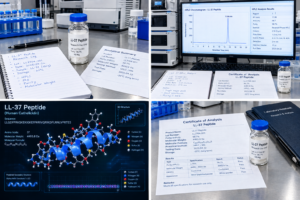
LL-37 5mg (CAP-18) Research Peptide
LL-37 5mg (CAP-18) is a research-material topic with strong interest around peptide identity, analytical characterization, purity, and laboratory documentation.
LL-37 is commonly referred to as cathelicidin LL-37, CAP-18, CAP18, and hCAP-18-related peptide. PubChem identifies LL-37 as a 37-residue peptide and lists the sequence:
LLGDFFRKSKEKIGKEFKRIVQRIKDFLRNLVPRTES
PubChem lists the molecular formula as C205H340N60O53 and molecular weight at approximately 4,493 g/mol.
For researchers evaluating an LL-37 5mg research material, the quantity alone does not establish identity or analytical quality. A more useful evaluation considers the peptide sequence, molecular information, purity data, HPLC results, identity testing, lot number, and Certificate of Analysis (COA).
Research Use Only
LL-37 5mg (CAP-18) is presented for laboratory research and analytical purposes only. It is not for human or veterinary use and is not intended to diagnose, treat, cure, mitigate, or prevent any disease or condition.
What Is LL-37?
LL-37 is a 37-amino-acid cathelicidin peptide associated with research into innate immune biology and host-defense mechanisms.
The peptide is derived from the larger human cathelicidin precursor system. The terms CAP-18 and hCAP-18 are associated with this precursor, while LL-37 refers specifically to the mature 37-residue peptide.
For research and SEO purposes, LL-37 may therefore appear under several related names:
- LL-37
- LL 37
- LL-37 peptide
- Cathelicidin LL-37
- CAP-18
- CAP18
- hCAP-18
- Ropocamptide
- Human cathelicidin
These terms should be used naturally throughout the page rather than repeated mechanically.
LL-37 5mg: Understanding the Product Quantity
The 5mg designation refers to the stated quantity of research material.
Quantity should be kept separate from analytical quality.
A 5mg specification does not, by itself, establish:
- Peptide purity
- Molecular identity
- Sequence confirmation
- Chemical form
- Residual solvents
- Water content
- Aggregation profile
- Biological activity
- Suitability for a particular assay
Researchers should therefore evaluate the stated quantity alongside the analytical documentation associated with the specific material.
A well-documented product page can make this process easier by providing clear information about identity, lot traceability, purity, analytical testing, and COA availability.
LL-37 Molecular Weight
PubChem lists LL-37 at approximately 4,493 g/mol. The database also reports a molecular formula of C205H340N60O53.
| Property | LL-37 |
|---|---|
| Common name | LL-37 |
| Alternative names | CAP-18, CAP18, cathelicidin LL-37 |
| Peptide length | 37 residues |
| Sequence | LLGDFFRKSKEKIGKEFKRIVQRIKDFLRNLVPRTES |
| Molecular formula | C205H340N60O53 |
| Molecular weight | ~4,493 g/mol |
| Exact mass | ~4492.58 Da |
| PubChem CID | 16198951 |
Why LL-37 Molecular Weight Matters
Molecular-weight information can support:
- Mass-spectrometry interpretation
- Peptide identity checks
- Analytical-method development
- Database comparison
- Supplier-document review
- Laboratory record keeping
Researchers should distinguish between molecular weight, exact mass, and monoisotopic mass when interpreting high-resolution analytical data.
Chemical form can also affect the relevant reported mass. For example, commercially available LL-37 may be supplied in a salt form, so the specification for the actual material should be checked rather than assuming that every product has identical formula-weight characteristics.
LL-37 Peptide Sequence
The documented LL-37 sequence is:
LLGDFFRKSKEKIGKEFKRIVQRIKDFLRNLVPRTES
This sequence contains 37 amino-acid residues.
Sequence information is an important part of peptide identity, but it is not equivalent to a purity measurement.
A physical research sample can contain related peptide species or process-related impurities even when the intended sequence is correctly specified.
For that reason, researchers may use sequence information together with chromatographic and molecular characterization.
LL-37 and CAP-18: Understanding the Terminology
The terms LL-37 and CAP-18 are closely related but should not automatically be treated as interchangeable chemical descriptions.
CAP-18/hCAP-18 refers to the larger cathelicidin precursor protein, while LL-37 identifies the mature 37-residue peptide associated with that precursor.
This distinction is important for SEO content because users may search for:
“LL-37 5mg CAP-18”
while the technical documentation may refer specifically to the mature LL-37 peptide.
A clear product page should explain the relationship without suggesting that the precursor protein and mature peptide are the same molecule.
LL-37 HPLC Analysis
High-performance liquid chromatography (HPLC) is widely used in peptide analytical workflows.
For LL-37 research material, HPLC documentation may include:
- Chromatographic profile
- Main peak
- Retention time
- Relative peak area
- Reported purity
- Analytical method
- Test date
- Lot number
- Specification
The exact HPLC method can differ between laboratories, so a reported purity percentage should always be interpreted in the context of its analytical method.
What Should an LL-37 HPLC Report Include?
Researchers reviewing an LL-37 HPLC report can look for:
- Product name
- Lot or batch number
- Sample identification
- Chromatogram
- Retention time
- Reported purity
- Analytical method
- Test date
- Testing laboratory
- Applicable specification
A chromatogram connected to a specific lot provides considerably more useful traceability than an isolated image with no identifying information.
LL-37 Purity Testing
LL-37 purity is an important research-material quality consideration.
However, purity should not be presented as a universal number independent of the analytical method.
A chromatographic purity result is influenced by the test conditions, detection method, integration approach, and specification applied.
Researchers may therefore want to review several analytical dimensions:
HPLC Purity
Provides chromatographic information about the principal detected component under specified conditions.
Identity Testing
Provides additional evidence that the material corresponds to the intended peptide.
Mass Spectrometry
Can provide molecular-mass information that complements chromatographic testing.
Lot Traceability
Connects the test result to the actual research-material batch.
The strongest documentation connects these elements instead of relying solely on a “high purity” statement.
LL-37 Certificate of Analysis
A Certificate of Analysis (COA) is a quality document associated with a specific research-material lot.
An LL-37 COA may include:
- Product name
- Lot number
- Batch number
- Test date
- Appearance
- Purity
- HPLC results
- Identity testing
- Molecular characterization
- Analytical method
- Specification
- Storage information
The precise contents depend on the supplier’s analytical program.
Why a Lot-Specific COA Matters
A product page describes the material generally.
A lot-specific COA provides testing information associated with a particular batch.
This distinction is useful for:
- Procurement records
- Laboratory notebooks
- Batch comparisons
- Quality-control documentation
- Research reproducibility
- Material traceability
A useful analytical chain can be represented as:
LL-37 5mg → Lot Number → COA → HPLC → Purity → Identity
LL-37 Mass Spectrometry
Mass spectrometry provides another analytical dimension for peptide characterization.
Because LL-37 has a molecular weight of approximately 4.5 kDa, mass-spectrometry data can contain multiple charge states depending on the analytical technique.
When interpreting LL-37 MS data, researchers should consider:
- Molecular form
- Charge state
- Ionization method
- Adducts
- Instrument resolution
- Sample preparation
- Expected molecular mass
- Analytical method
The neutral molecular weight reported in a chemical database should not automatically be equated with every peak in an MS spectrum.
This makes method-specific analytical documentation especially valuable.
LL-37 Laboratory Research
LL-37 is represented extensively in scientific literature concerning innate immune biology, host-defense peptides, membrane interactions, and cellular signaling.
Research areas involving LL-37 can include:
- Antimicrobial peptide biology
- Innate immune research
- Peptide-membrane interactions
- Cellular signaling
- Host-defense mechanisms
- Peptide structure
- Biochemical research
- Analytical peptide chemistry
- Molecular characterization
These research areas should be described carefully.
Experimental findings from a particular cell, animal, biochemical, or other research model should not automatically be converted into claims about clinical effectiveness.
LL-37 Research Peptide USA: How to Evaluate Research Material
For researchers evaluating LL-37 research material in the United States, a documentation-focused process can be useful.
1. Confirm Identity
Verify that the material is identified as LL-37 and review its chemical description.
2. Verify Sequence
Compare the stated sequence with an authoritative reference.
3. Review Molecular Information
Check molecular formula, molecular weight, and relevant chemical form.
4. Review Purity Data
Determine how the stated purity was measured.
5. Review HPLC
Look for a lot-associated chromatogram where available.
6. Review Identity Testing
Check whether complementary identity characterization is available.
7. Review the COA
Confirm that the COA corresponds to the specific lot.
8. Maintain Traceability
Record the lot and relevant analytical information in laboratory documentation.
This approach provides a stronger basis for comparing research materials than package quantity or marketing terminology alone.
U.S. Regulatory Context for LL-37 Research Material
For U.S.-targeted content, research-use language should be precise.
Current FDA materials identify cathelicidin LL-37 among bulk drug substances that have been associated with significant safety concerns in the agency’s compounding framework. FDA describes concerns including possible immunogenicity, peptide-related impurities, and difficulties in API characterization, and states that it lacks sufficient safety information to determine whether compounded LL-37 would cause harm to humans.
FDA’s April 2026 update also states that the LL-37 nomination was withdrawn from Category 2, while noting that FDA intends to consult its Pharmacy Compounding Advisory Committee regarding potential inclusion on the 503A bulks list before the end of February 2027. This regulatory status should not be confused with approval of LL-37 as a drug.
FDA also explains that compounded drugs are not FDA-approved and that its compounding framework places specific restrictions on bulk substances used in compounding.
For an SEO product page, these distinctions are important. The page should focus on laboratory research and analytical characterization, not human-use positioning.