

MOTS-C 40mg COA: A Complete Guide to Peptide Purity, HPLC Testing, and Laboratory Documentation
Introduction to MOTS-C 40mg COA
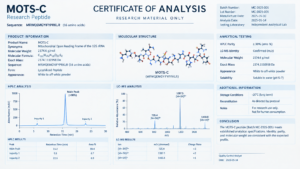
A MOTS-C 40mg Certificate of Analysis (COA) is a laboratory quality document intended to report analytical findings for a specific sample or production batch. For researchers evaluating MOTS-C research material, a COA can help clarify peptide identity, chromatographic purity, reported content, and the methods used to characterize the sample.
However, not all certificates provide the same information. A document displaying a purity percentage does not necessarily establish the actual amount of peptide in a vial, prove that the material is free from every contaminant, or demonstrate suitability for human use.
For Peptides Grey House, the MOTS-C 40mg COA page should explain how to read laboratory reports, identify important documentation fields, distinguish analytical methods, and verify whether a report corresponds to the batch being evaluated.
This guide focuses on laboratory documentation and research quality. Any specific purity percentage, test result, or claim about a particular MOTS-C 40mg batch should be published only when supported by authentic, traceable analytical records.
What Is a MOTS-C 40mg C
ertificate of Analysis?
A Certificate of Analysis, commonly abbreviated as COA or CoA, is a document that records analytical results for an identified material. Depending on the laboratory and product specification, it may include identity testing, purity analysis, content measurements, appearance, and additional quality checks.
For MOTS-C 40mg, the COA should help a qualified reviewer determine what material was tested, which analytical methods were used, and what results were obtained.
A useful certificate typically identifies:
- Product or compound name.
- Sample identification and batch or lot number.
- Testing laboratory and report date.
- Analytical methods used.
- Acceptance criteria or specifications, where applicable.
- Actual results and their units.
- Relevant chromatograms or supporting analytical data.
- Authorized review or approval, where applicable.
The value of a COA depends on the quality and traceability of its evidence. A generic certificate that lacks a matching batch number is not equivalent to a report tied to the material under evaluation.
For additional regulatory context, the U.S. Food and Drug Administration provides guidance on research-use-only labeling for certain in vitro diagnostic products. The meaning of that labeling depends on the product category and applicable regulations; a research-use statement alone does not establish regulatory approval or authorize every intended use.
Why Is a MOTS-C 40mg COA Important?
Laboratory research depends on knowing which materials are being studied and understanding their relevant characteristics. Without suitable documentation, researchers may have difficulty evaluating sample identity, impurity profiles, batch consistency, or whether the material meets predefined analytical specifications.
A well-documented COA supports a more transparent quality review by presenting test results alongside the methods used to obtain them.
For a MOTS-C 40mg research material, a COA can help answer several questions:
Identity: Is the analytical evidence consistent with the claimed peptide?
Purity: What proportion of the detected chromatographic signal is attributed to the principal component under the stated method?
Content: Is the amount of peptide in the sample measured separately from chromatographic purity?
Traceability: Does the certificate refer to the same batch or lot as the material being evaluated?
Testing scope: Which additional contaminants or quality characteristics were actually assessed?
These questions should be considered separately. A positive result in one category cannot automatically substitute for missing evidence in another.
Understanding HPLC Results on a MOTS-C COA
High-performance liquid chromatography (HPLC) is a widely used analytical technique for separating components within a sample. In peptide analysis, reverse-phase HPLC may be used to characterize a principal peptide peak and other detectable components.
A chromatogram plots detector response against retention time. The resulting pattern helps an analyst evaluate how the sample separates under the specified conditions.
What Does HPLC Purity Mean?
HPLC purity is commonly reported as a percentage derived from integrated chromatographic peak areas. The exact calculation depends on the analytical method, detector response, integration rules, and components included in the calculation.
For example, a hypothetical report might show 98.5% area-based purity. This is an illustrative value, not a verified result for any MOTS-C 40mg product.
When interpreting the result, check:
- The reported purity percentage.
- The analytical method and detector conditions.
- The principal peak and other integrated peaks.
- The sample identifier and lot number.
- The report date and laboratory identity.
- The stated acceptance criteria and actual measured result.
A headline percentage without an identified method provides limited information. Likewise, a chromatogram should not be treated as proof of peptide identity unless supported by an appropriate identity assessment.
Does HPLC Confirm the Exact Amount in a 40mg Vial?
No. Chromatographic purity and total peptide content are different measurements.
A label stating 40mg represents a nominal quantity. It does not, by itself, prove that an analytical assay measured exactly 40mg of peptide in the container.
Water, counterions, residual solvents, salts, and other components may influence the total sample mass. Some may not be represented proportionally in a conventional chromatographic purity calculation.
Researchers should therefore look for separate content or assay information when the quantity of peptide is relevant to their laboratory requirements.
Mass Spectrometry and MOTS-C Identity Testing
Mass spectrometry (MS) measures ions according to their mass-to-charge ratios. In suitable analytical workflows, it can provide evidence about whether a sample’s measured molecular mass is consistent with the expected identity of the target peptide.
LC-MS combines liquid chromatography with mass spectrometry, allowing components to be separated and then examined using mass analysis.
HPLC and mass spectrometry serve complementary purposes. HPLC can characterize the distribution of detectable components under a defined method, while MS can provide supporting molecular identity information.
When reviewing the identity section of a MOTS-C COA, look for the stated method, the reported result, the sample identifier, and any comparison with the expected molecular mass.
It is important to understand the limits of these techniques. A matching mass does not necessarily establish every aspect of molecular structure, and an identity result does not prove sterility, biological activity, or safety for human use.
A useful COA explains what was measured rather than merely displaying the name of an analytical instrument.
How to Verify a MOTS-C 40mg COA
Verification involves more than checking whether a PDF exists on a website. The objective is to establish a credible connection between the report and the material being evaluated.
Step 1: Match the Product Name
Confirm that the document identifies the relevant material as MOTS-C. Similar-looking product names or certificates for unrelated peptides should not be treated as interchangeable.
Step 2: Match the Batch or Lot Number
Compare the identifier printed on the certificate with the identifier on the product packaging or associated documentation.
If the numbers differ, ask for clarification before assuming that the results apply to the material in question.
Step 3: Identify the Testing Laboratory
Review the laboratory’s name and available contact or verification information. Where relevant, check the laboratory’s accreditation status and the scope of its accredited methods.
An independent laboratory report may provide useful additional evidence, but independence should be verified rather than assumed from a logo or statement.
Step 4: Check the Test Date
The report date helps establish when the sample was evaluated. An old report may not describe a newer production batch or establish the current condition of a stored sample.
Step 5: Read the Actual Results
Distinguish between an acceptance specification and the measured result. For example, a statement that a sample must meet a minimum purity threshold is not the same as a report showing the result obtained.
Step 6: Review Supporting Data
When available, inspect the chromatogram, identity results, and other supporting records. These can provide more information than a summary table alone.
Step 7: Verify the Document
If the laboratory offers a certificate verification service, use it. Where authenticity is uncertain, request clarification from the issuing laboratory or supplier.
A certificate should not be described as independently verified unless the verification process has actually been completed.
What Additional Tests May Appear on a MOTS-C COA?
The testing included in a COA depends on the product specification, analytical requirements, and laboratory capabilities. Some certificates focus narrowly on identity and chromatographic purity, while others report additional measurements.
Potentially relevant categories include:
Peptide content or assay: Estimates the quantity of the target material using a suitable method.
Water content: Measures moisture when relevant to the material specification.
Residual solvents: Evaluates specified solvents that may remain from manufacturing or processing.
Elemental impurities: Assesses selected elemental contaminants using an appropriate method.
Microbial testing: Evaluates specified microbiological characteristics.
Bacterial endotoxins: Measures endotoxin levels using an appropriate test.
These tests are not interchangeable. A high HPLC purity result does not establish that endotoxins, residual solvents, or microbial contamination have been tested or meet any particular limit.
The absence of a test result should not be interpreted as a passing result. If a particular quality attribute is important, confirm that the applicable method and result are documented.
Common MOTS-C COA Red Flags
A certificate may require further investigation when important details are missing or inconsistent.
Missing Batch Identification
A certificate that does not identify the tested batch may be difficult to connect to the material being evaluated.
Unsupported Purity Claims
A product description may advertise a purity percentage without providing an identifiable analytical report. Treat the claim as unverified until supporting evidence is available.
No Explanation of the Method
A percentage without a named method, relevant result details, or sufficient context is difficult to evaluate scientifically.
Confusing Purity With Quantity
A report may show chromatographic purity without reporting the actual amount of peptide. These are distinct characteristics and should not be presented as the same measurement.
Unverifiable Laboratory Details
Missing laboratory information or a certificate that cannot be authenticated may weaken confidence in the document’s provenance.
Unclear Specifications
A report should distinguish acceptance limits from observed results. If the two cannot be separated, request clarification.
Inconsistent Dates or Identifiers
Mismatched batch numbers, unexplained dates, or conflicting product names should be resolved before the document is relied upon.
These observations do not automatically prove misconduct or poor product quality. They identify documentation gaps that warrant further review.
Choosing a MOTS-C 40mg Research Supplier
Researchers assessing research materials should prioritize clear specifications, traceable documentation, and appropriate analytical evidence.
For Peptides Grey House, a credible quality-information page can explain which tests are available, identify the relevant batch documentation, and make the limitations of each test clear.
Before publishing a product-specific COA, confirm that the certificate is genuine, that its identifiers match the material, and that the displayed results have not been altered or misrepresented.
Where independent testing is available, describe the laboratory and scope of testing accurately. Do not claim that every batch has undergone third-party testing unless the records support that statement.
Likewise, avoid unsubstantiated claims such as “guaranteed purity,” “contaminant-free,” or “clinically proven.” Such statements require evidence appropriate to the exact claim being made.
Research-Use-Only Wording for MOTS-C 40mg
MOTS-C research content should clearly distinguish laboratory investigation from consumer health claims.
The FDA warns that unapproved drugs may lack the agency’s review for safety, effectiveness, and quality. The agency has also cautioned that products sold for purported research purposes may present risks when marketed or used as unapproved drugs.
For relevant regulatory context, see the FDA’s overview of unapproved drugs.
A suitable informational notice for a legitimate research-material page is:
Research-use notice: This page discusses laboratory analytical documentation and research material characterization. MOTS-C research material is not presented here as a treatment, diagnostic product, or consumer wellness product. Analytical purity and identity results do not establish safety or effectiveness in humans. Verify applicable regulatory requirements before acquiring, handling, or using any research material.
Research-use wording should accurately reflect the actual product, intended use, and applicable laws. A disclaimer alone does not make an otherwise unlawful product or marketing practice compliant.
Frequently Asked Questions About MOTS-C 40mg COA
What is a MOTS-C 40mg COA?
It is a certificate documenting analytical findings for an identified MOTS-C sample or batch. Depending on the report, it may include identity testing, HPLC purity, content measurements, and other specified quality results.
How can I verify a MOTS-C 40mg COA?
Match the product and lot identifiers, review the laboratory and test date, inspect the stated methods and actual results, and use the issuing laboratory’s verification process when available.
Does every MOTS-C COA include HPLC testing?
No. The tests included depend on the specific report. Check the actual analytical methods listed rather than assuming that HPLC was performed.
What does HPLC purity mean on a MOTS-C certificate?
It commonly refers to a percentage calculated from integrated chromatographic peak areas under a defined method. It is not automatically equivalent to the percentage of total sample mass that is peptide.
Does a high HPLC result prove the peptide’s identity?
No. Chromatographic purity and molecular identity answer different questions. An appropriate identity test, such as mass spectrometry, can provide additional evidence.
Does a 40mg label prove the actual peptide content?
No. A label claim is not a substitute for a suitable content measurement. Review the documentation to determine whether actual peptide content was measured.
Should a COA match the batch number on the vial?
Yes. Matching identifiers are important for connecting analytical findings to the material being evaluated. If they do not match, seek clarification.
Does a COA prove that MOTS-C is sterile?
Not unless appropriate sterility testing was performed and the report supports that conclusion. HPLC purity alone does not establish sterility.
Is MOTS-C 40mg COA documentation proof of human safety?
No. A COA describes the reported analytical characteristics of a tested sample. It does not establish clinical safety, effectiveness, or regulatory approval.
Where should a MOTS-C COA be published?
When authentic and available, the applicable batch-specific report can be presented alongside the product’s quality documentation. Ensure the report is readable, traceable, and accurately described.
Conclusion: Evaluate MOTS-C 40mg COA With Transparent Documentation
A reliable MOTS-C 40mg COA should connect a clearly identified sample to specific analytical methods and actual results. Batch traceability, HPLC purity, identity confirmation, and peptide-content information help researchers understand what has—and has not—been established.
For Peptides Grey House, the strongest quality-content strategy is to prioritize accurate documentation over unsupported numerical claims. Clear explanations of testing methods and limitations can make the page more useful to readers while supporting responsible, research-focused communication.
Final reminder: Do not publish a particular MOTS-C 40mg purity percentage, test date, laboratory name, or batch result without authentic documentation supporting the claim.