

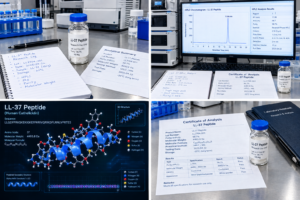
Introduction to LL-37 Peptide
LL-37 peptide is a well-studied human antimicrobial peptide belonging to the cathelicidin family. It is the C-terminal active peptide derived from the human cathelicidin precursor commonly referred to as hCAP18/CAP-18. Unlike many peptide research compounds that are investigated primarily for one molecular target, LL-37 has attracted substantial scientific interest because researchers have described antimicrobial, membrane-interacting, chemotactic, and immunomodulatory activities.
LL-37 is particularly important in research involving innate immunity, host defense, peptide-membrane interactions, microbiology, inflammation signaling, epithelial biology, and antimicrobial peptide design. Published literature describes LL-37 as the only identified human cathelicidin and characterizes it as a 37-residue peptide with an amphipathic alpha-helical tendency under appropriate environmental conditions.
For laboratory researchers, the importance of LL-37 extends beyond its antimicrobial properties. Its structure, positive charge, membrane interactions, aggregation behavior, and interactions with biological molecules make it a useful model for studying how naturally occurring peptides interact with cellular and microbial membranes.
Important research-use statement: LL-37 research material should be handled as a laboratory research compound. Products marketed for research should not be represented as approved medicines, dietary supplements, or products intended to diagnose, treat, cure, or prevent disease. Research material is not intended for human or veterinary administration.
What Is LL-37 Peptide?
LL-37 is a 37-amino-acid antimicrobial peptide generated from the C-terminal portion of human hCAP18. The precursor contains an N-terminal cathelin domain and a C-terminal region that gives rise to LL-37 after proteolytic processing.
The name “LL-37” reflects the peptide’s sequence characteristics and its 37-residue length. It is frequently discussed in scientific literature under several related names, including:
- LL-37
- Human LL-37
- Human cathelicidin LL-37
- hCAP18/LL-37
- CAP-18
- Cathelicidin antimicrobial peptide
- Human cationic antimicrobial protein-derived peptide
Researchers commonly investigate LL-37 because it provides a useful experimental model for studying cationic antimicrobial peptides and the relationship between peptide structure and biological activity.
Its positively charged character and amphipathic structure are especially relevant to membrane-interaction studies. Research has shown that LL-37 can associate with biological membranes and can influence membrane organization, making it an important molecule for biophysical and biochemical research.
LL-37 and the Cathelicidin Family
Cathelicidins are a family of antimicrobial peptides found across multiple animal species. In humans, LL-37 is the best-characterized and only identified member of the cathelicidin family.
Cathelicidins are produced as precursor proteins containing a conserved cathelin-like region and a variable C-terminal antimicrobial peptide region. Proteolytic processing releases the mature peptide.
This biological organization is important when interpreting research involving LL-37 because full-length hCAP18 and mature LL-37 are not interchangeable experimental materials.
Published research describes LL-37 as the mature C-terminal peptide released from hCAP18.
Why Researchers Study Cathelicidins
Cathelicidin research can provide insight into:
- Innate immune defense
- Microbial membrane interactions
- Peptide aggregation
- Host-microbe interactions
- Cellular signaling
- Chemotaxis
- Epithelial biology
- Antimicrobial peptide design
- Structure-activity relationships
- Peptide engineering
The broad research interest in LL-37 has also contributed to studies examining modified LL-37 fragments and engineered peptide analogues.
LL-37 Peptide Structure and Biochemical Characteristics
Understanding the structure of LL-37 is central to laboratory research.
LL-37 contains 37 amino-acid residues and is generally characterized as a cationic, amphipathic peptide. Studies have reported that it can adopt an alpha-helical conformation in membrane-like or hydrophobic environments, while its conformation can differ in aqueous environments.
Its amphipathic character means that different regions of the peptide can interact differently with surrounding molecular environments. This property is one reason LL-37 is frequently examined in membrane and biophysical research.
Structural Properties Relevant to Research
Researchers may investigate:
- Amino-acid sequence
- Charge distribution
- Hydrophobicity
- Helical structure
- Peptide aggregation
- Membrane association
- Lipid interactions
- Peptide concentration effects
- Environmental pH
- Ionic strength
- Temperature-dependent behavior
Because peptide structure can change according to experimental conditions, laboratory results should always be interpreted within the specific buffer, concentration, temperature, and assay system used.
LL-37 Peptide Research Applications
LL-37 has been investigated across several areas of experimental biology.
1. Antimicrobial Peptide Research
One of the most established areas of LL-37 research concerns antimicrobial activity.
Researchers have examined interactions between LL-37 and different microorganisms, including Gram-positive and Gram-negative bacteria. The peptide’s cationic and amphipathic properties can contribute to interactions with negatively charged microbial membranes.
Laboratory research may therefore use LL-37 to investigate:
- Membrane disruption
- Microbial susceptibility
- Peptide-membrane interactions
- Antimicrobial mechanisms
- Structure-activity relationships
- Peptide concentration-response relationships
These experiments are generally performed using controlled in-vitro systems rather than assuming that laboratory antimicrobial activity automatically translates into clinical efficacy.
2. Innate Immunity Research
LL-37 is an important research molecule in the study of innate immune responses.
Unlike adaptive immune responses, innate defense mechanisms provide rapid responses to environmental and microbial challenges. LL-37 has been investigated as part of this biological defense network.
Published reviews describe LL-37 as having functions extending beyond direct microbial activity, including interactions with immune and epithelial cells.
Research questions may include:
- How antimicrobial peptides interact with immune cells
- How peptide concentration influences cellular responses
- How LL-37 interacts with inflammatory signaling pathways
- How LL-37 behaves at epithelial surfaces
- How environmental conditions modify peptide activity
LL-37 and Cell Signaling Research
LL-37 has been studied for its interactions with several cellular systems.
Research literature describes effects involving chemotaxis, cytokine signaling, epithelial-cell activation, angiogenesis-related processes, and wound-associated cellular responses. These findings demonstrate why LL-37 is often considered a multifunctional host-defense peptide rather than simply an antimicrobial molecule.
However, these published biological observations should not be interpreted as evidence that an LL-37 research product is a treatment.
For SEO and responsible product communication, it is preferable to use terms such as:
- “studied in”
- “investigated for”
- “research model”
- “experimental system”
- “in-vitro research”
- “biochemical investigation”
rather than therapeutic claims.
LL-37 Peptide in Membrane Research
Membrane interaction is one of the most interesting aspects of LL-37 research.
Researchers have investigated how LL-37 associates with lipid membranes and how peptide structure influences those interactions. Its amphipathic alpha-helical characteristics are particularly relevant to membrane studies.
Potential laboratory research areas include:
Lipid-Peptide Interactions
Researchers can investigate how LL-37 behaves in model membrane systems containing different lipid compositions.
Peptide Aggregation
LL-37 has been reported to exhibit oligomerization and aggregation behavior under certain physiological solution conditions, making concentration and experimental environment important variables.
Membrane Permeability
Researchers can use controlled experimental models to investigate whether peptide exposure changes membrane permeability or integrity.
These experiments can help scientists better understand the relationship between peptide sequence, structure, membrane binding, and biological activity.
LL-37 Peptide Sequence and Molecular Research
The mature LL-37 peptide contains 37 amino acids. Its sequence and physicochemical characteristics are important when designing laboratory experiments or comparing LL-37 with engineered analogues.
Researchers studying LL-37 may compare:
- Native LL-37
- Truncated fragments
- Sequence-modified analogues
- Synthetic peptide variants
- Peptide conjugates
- Membrane-binding variants
Published research has specifically examined fragments and engineered derivatives to understand which regions contribute to different biological activities.
This makes LL-37 useful in structure-function research, where researchers ask how changing one or more residues affects peptide behavior.
LL-37 Purity, HPLC and COA Considerations
For research applications, peptide quality documentation can be as important as the peptide name itself.
A laboratory purchaser evaluating an LL-37 research peptide may review:
HPLC Purity
High-performance liquid chromatography, or HPLC, can be used to assess chromatographic purity and identify major components within a peptide sample.
A reported purity percentage should always be interpreted in the context of the analytical method and documentation supplied with the specific batch.
Certificate of Analysis
A Certificate of Analysis (COA) can provide batch-specific information such as:
- Product identification
- Lot or batch number
- Analytical method
- Reported purity
- Molecular-mass testing
- Testing date
- Analytical results
- Manufacturer or laboratory information
Mass Spectrometry
Mass spectrometry can help confirm whether the measured molecular mass corresponds to the expected peptide material.
For research laboratories, reviewing both chromatographic and mass-spectrometric information can provide a more complete picture of product identity and analytical quality.
What to Look for When Selecting an LL-37 Research Peptide
Researchers comparing LL-37 peptide products may consider several quality-related factors.
1. Clear Product Identity
The product should clearly identify the peptide being supplied rather than relying on ambiguous terminology.
2. Batch Documentation
Batch-specific documentation is useful when reproducibility matters.
3. Analytical Testing
Look for documentation describing analytical methods such as HPLC and mass spectrometry when applicable.
4. Research-Use Labeling
The intended use should be clearly stated as laboratory or research use.
5. Storage Information
Peptides can be sensitive to environmental conditions. Researchers should follow the supplier’s storage documentation and laboratory protocols.
6. Consistent Product Specifications
Consistent labeling, lot identification, and analytical documentation can simplify experimental recordkeeping.
LL-37 Peptide for Laboratory Research
LL-37 can serve as an experimental material for researchers working in peptide science, microbiology, molecular biology, biochemistry, immunology, and membrane biophysics.
Possible research contexts include:
- Antimicrobial peptide screening
- Membrane-interaction studies
- Peptide structure research
- Host-defense peptide studies
- Innate immunity models
- Cellular signaling experiments
- Protein-peptide interaction studies
- Peptide engineering
- Structure-activity relationship studies
- Comparative antimicrobial peptide research
LL-37 is particularly valuable as a reference molecule because its biology and biophysical properties have been investigated extensively in the scientific literature.
LL-37 Peptide: Research Advantages
Several characteristics make LL-37 an attractive experimental peptide.
Well-characterized research background
LL-37 has been the subject of numerous scientific reviews and experimental studies spanning antimicrobial activity, innate immunity, membrane interactions, and cellular biology.
Multifunctional biological profile
The scientific literature describes multiple biological activities rather than a single molecular function.
Useful structure-function model
Its relatively short sequence and well-studied helical behavior make it suitable for investigations involving peptide structure and activity.
Relevance to peptide engineering
LL-37 has served as a template for research into fragments and engineered antimicrobial peptides.
Research Limitations and Experimental Considerations
LL-37 research should be interpreted carefully.
Results can vary depending on:
- Peptide purity
- Peptide preparation
- Concentration
- Buffer composition
- Ionic strength
- pH
- Temperature
- Lipid composition
- Cell type
- Microbial strain
- Assay methodology
- Incubation time
An effect observed in an in-vitro assay does not necessarily demonstrate the same effect in an organism.
Similarly, findings involving native LL-37 should not automatically be applied to truncated fragments, modified analogues, or unrelated antimicrobial peptides.
For reproducible research, investigators should document the exact peptide material, lot, preparation conditions, assay conditions, and analytical controls.
LL-37 Peptide: Research Use Only
LL-37 research peptide products should be designated for laboratory research use only.
They are not presented as medications, dietary supplements, or products intended for human or veterinary administration.
This page is intended to provide scientific and product-information context for researchers evaluating LL-37 as an experimental peptide. It does not provide medical treatment recommendations, dosing instructions, injection protocols, or instructions for administering LL-37 to people or animals.
Researchers should use appropriate laboratory safety procedures, institutional protocols, applicable regulations, and supplier documentation when handling research peptides.
Frequently Asked Questions About LL-37 Peptide
What is LL-37 peptide?
LL-37 is a 37-amino-acid human cathelicidin-derived peptide and the mature C-terminal antimicrobial peptide generated from the hCAP18 precursor. It is extensively studied in antimicrobial peptide, innate immunity, membrane biology, and molecular research.
Is LL-37 the same as CAP-18?
The terms are closely related but should not automatically be treated as identical. hCAP18/CAP-18 generally refers to the human cathelicidin precursor protein, while LL-37 refers to its mature C-terminal peptide.
Why is LL-37 studied?
Researchers study LL-37 because of its antimicrobial activity, membrane interactions, immune-related signaling, and multifunctional biological behavior.
Is LL-37 an antimicrobial peptide?
Yes. LL-37 is classified as a human antimicrobial peptide and is the best-characterized human cathelicidin.
What research areas use LL-37?
LL-37 is investigated in microbiology, biochemistry, immunology, membrane biophysics, epithelial biology, antimicrobial peptide development, and structure-function research.
What is LL-37 purity?
LL-37 purity is a batch-specific analytical characteristic. Researchers should review the supplier’s COA and analytical testing rather than assuming a universal purity value for every product.
What is LL-37 HPLC testing?
HPLC testing can be used to characterize chromatographic purity and identify major components in a peptide sample. The specific result should be evaluated using the analytical documentation for the relevant batch.
Does LL-37 have a known molecular structure?
LL-37 is a 37-residue peptide with amphipathic and alpha-helical characteristics that have been extensively investigated in biophysical studies.
Can LL-37 research material be used in humans?
Research-use peptide products should not be represented or used as human or veterinary medicines. They are intended for controlled laboratory research.
Why is a COA important for LL-37 research?
A COA can provide batch-specific information about identity and analytical testing, helping researchers document the material used in an experiment.