

What Is the Molecular Weight of Oxytocin?
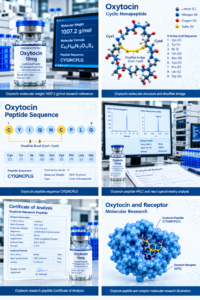
The molecular weight of oxytocin is 1007.2 g/mol for the standard oxytocin molecular form represented in PubChem.
PubChem identifies oxytocin as a cyclic nonapeptide with the molecular formula C43H66N12O12S2 and the amino-acid sequence CYIQNCPLG. The molecule contains a disulfide bridge between cysteine residues 1 and 6, which creates its characteristic cyclic structure.
Quick answer
Oxytocin molecular weight: 1007.2 g/mol
Molecular formula: C43H66N12O12S2
Peptide sequence: CYIQNCPLG
CAS number: 50-56-6
Peptide length: 9 amino acids
Structure: Cyclic nonapeptide with a Cys1–Cys6 disulfide bridge.
This information is particularly useful for researchers investigating peptide chemistry, molecular identification, analytical characterization, receptor biology and related laboratory applications.
Oxytocin Molecular Weight at a Glance
| Molecular Property | Oxytocin |
|---|---|
| Molecular weight | 1007.2 g/mol |
| Exact mass | Approximately 1006.4365 Da |
| Molecular formula | C43H66N12O12S2 |
| Peptide sequence | CYIQNCPLG |
| Peptide length | 9 amino acids |
| CAS number | 50-56-6 |
| PubChem CID | 439302 |
| Peptide type | Cyclic nonapeptide |
| Key structural feature | Cys1–Cys6 disulfide bridge |
| Research applications | Peptide chemistry, receptor biology, analytical research |
PubChem’s current oxytocin record reports the 1007.2 g/mol molecular weight and the molecular information shown above.
Why Oxytocin Molecular Weight Matters in Research
Molecular weight is one of the fundamental identifiers researchers use when characterizing a peptide.
For oxytocin, the value of 1007.2 g/mol can be useful when interpreting analytical information, comparing reference materials, searching chemical databases and evaluating mass-spectrometry data.
Molecular-weight information may support several areas of laboratory research.
1. Peptide identification
Researchers can compare the expected molecular weight with analytical measurements to support compound identification.
2. Mass spectrometry
Mass spectrometry can provide molecular-mass information that researchers compare with the expected molecular characteristics of oxytocin.
3. Chemical databases
The molecular weight can be used alongside the molecular formula, CAS number and sequence to locate oxytocin records across scientific databases.
4. Research documentation
A research record may include molecular weight as part of the compound’s basic identity profile.
5. Reference-material evaluation
Researchers can compare the molecular identity stated by a supplier with independent chemical references and analytical documentation.
Molecular weight is therefore one part of a larger identification process rather than a standalone proof of product quality.
Oxytocin Molecular Formula
The molecular formula associated with standard oxytocin in PubChem is:
C43H66N12O12S2
This formula describes the elemental composition of the molecular form represented in the PubChem record.
The formula contains:
- 43 carbon atoms
- 66 hydrogen atoms
- 12 nitrogen atoms
- 12 oxygen atoms
- 2 sulfur atoms
The two sulfur atoms are associated with the peptide’s two cysteine residues and its disulfide bridge.
The molecular formula is useful when researchers perform chemical searches, compare molecular records or investigate analytical data.
Oxytocin Peptide Sequence
The oxytocin sequence is:
CYIQNCPLG
This represents a nine-residue peptide:
- Cysteine
- Tyrosine
- Isoleucine
- Glutamine
- Asparagine
- Cysteine
- Proline
- Leucine
- Glycine
PubChem describes oxytocin as a cyclic nonapeptide and identifies the sequence as CYIQNCPLG.
The two cysteine residues are connected through a disulfide bond.
This produces a molecular structure that differs from a simple linear nine-amino-acid peptide.
Oxytocin Molecular Structure
Oxytocin has a distinctive cyclic structure.
The simplified peptide sequence is:
Cys¹–Tyr²–Ile³–Gln⁴–Asn⁵–Cys⁶–Pro⁷–Leu⁸–Gly⁹
The sulfur-containing cysteine residues form a disulfide connection:
Cys¹ ↔ Cys⁶
This structural feature produces the cyclic portion of the molecule. PubChem identifies oxytocin as a heterodetic cyclic peptide and provides its structural representation accordingly.
Understanding this structure is important for researchers because peptide sequence alone does not completely describe oxytocin’s molecular architecture.
Exact Mass vs Molecular Weight
Researchers may encounter two related but different terms:
Molecular weight
1007.2 g/mol
Exact mass
Approximately 1006.4365 Da
These values are not contradictory.
Molecular weight is generally presented as a conventional molecular-weight value, while exact mass refers to a calculated mass based on the isotopic masses of the atoms in the molecular composition.
This distinction becomes especially relevant in high-resolution mass spectrometry and analytical peptide characterization.
For general SEO and product information, 1007.2 g/mol is the most useful molecular-weight value to present.
Oxytocin Molecular Weight and 10mg Products
A common source of confusion is the difference between molecular weight and product quantity.
Oxytocin molecular weight
1007.2 g/mol
Oxytocin 10mg
10mg = product quantity
These values describe completely different characteristics.
The molecular weight tells researchers how much one mole of the molecular substance weighs.
The 10mg designation indicates the quantity associated with a particular product presentation.
Therefore, an SEO page should never treat “10mg” as another way of expressing molecular weight.
For a research product page, the two terms should remain clearly separated:
Oxytocin molecular weight: 1007.2 g/mol
Oxytocin 10mg: stated product quantity
Oxytocin CAS Number
The commonly listed CAS Registry Number for oxytocin is:
50-56-6
PubChem lists 50-56-6 among the identifiers associated with oxytocin.
Researchers can use the CAS number in combination with other identifiers when searching chemical and scientific databases.
For reliable compound identification, it is preferable to consider several identifiers together:
- Molecular weight
- Molecular formula
- Peptide sequence
- CAS number
- Structural representation
- Analytical data
A single identifier should not be treated as sufficient evidence of the identity or quality of a particular research product.
Oxytocin and the Disulfide Bond
The two sulfur atoms in oxytocin are associated with its two cysteine residues.
The peptide contains cysteine at positions 1 and 6:
Cys¹ — … — Cys⁶
These residues form a disulfide bridge.
This linkage contributes to the cyclic structure that distinguishes oxytocin from a simple linear peptide.
From a research perspective, disulfide connectivity can be important when evaluating peptide structure and analytical characterization.
It is therefore useful for an oxytocin research page to include both:
Sequence: CYIQNCPLG
and
Structural feature: Cys1–Cys6 disulfide bridge.
Oxytocin Research Applications
Oxytocin has a long history of scientific investigation.
Research involving oxytocin spans multiple fields, including:
Peptide chemistry
Researchers investigate peptide sequence, structure, molecular characteristics and chemical behavior.
Receptor biology
Oxytocin is studied in relation to the oxytocin receptor and associated cellular signaling.
Neuroendocrinology
The peptide has been widely investigated as a neuroendocrine signaling molecule.
Neuroscience
Oxytocin research includes investigations into nervous-system signaling and biological processes.
Reproductive biology
Oxytocin has an extensive research history in reproductive physiology.
Analytical chemistry
Researchers can use molecular-weight, sequence and structural information when characterizing oxytocin.
The broad scientific literature makes oxytocin an important research subject beyond simply its molecular weight.
Oxytocin Molecular Weight and Analytical Testing
When a research material is evaluated analytically, molecular weight can be considered alongside other measurements.
Common analytical approaches may include:
HPLC
High-performance liquid chromatography can provide information about chromatographic purity and related components.
Mass spectrometry
Mass spectrometry can provide molecular-mass information that can be compared with expected peptide characteristics.
Peptide identity testing
A supplier may provide analytical documentation supporting compound identity.
Certificate of Analysis
A COA may summarize batch-specific analytical results.
Researchers should always review the actual analytical documentation for the specific product or batch rather than assuming that generic specifications apply universally.
Oxytocin COA Considerations
A Certificate of Analysis can be an important component of research-material documentation.
For an oxytocin product, researchers may look for information such as:
- Product name
- Lot or batch number
- Molecular identity
- Purity result
- Analytical method
- Mass confirmation
- Testing date
- Quantity
- Manufacturer information
A batch-specific COA is particularly useful because analytical results can relate directly to the material supplied.
A website should avoid making unsupported statements such as “every batch is 99% pure” unless current documentation supports that exact claim.
Oxytocin Research Peptide Quality
For researchers evaluating an oxytocin research peptide, molecular weight is only one consideration.
A more complete evaluation may include:
Identity
Does the product documentation correspond to the expected oxytocin sequence and molecular formula?
Analytical characterization
Is analytical information available?
Batch documentation
Is a COA associated with the specific lot?
Physical form
Is the material supplied as lyophilized material or another formulation?
Labeling
Does the product clearly identify its intended research use?
Documentation consistency
Do the product page, COA and technical information agree with one another?
This broader approach provides more useful information than relying on molecular weight alone.
Important Distinction: Oxytocin vs Oxytocin Free Acid
Researchers should be aware that different molecular forms can have different reported molecular weights.
PubChem lists standard oxytocin at:
1007.2 g/mol
It separately lists oxytocin free acid with molecular formula C43H65N11O13S2 and molecular weight 1008.2 g/mol.
This one-unit difference illustrates why researchers should identify the precise molecular form being discussed.
For a page targeting the standard keyword “Oxytocin Molecular Weight,” the appropriate primary value is:
1007.2 g/mol
If a product uses a different molecular form, salt, formulation or chemical representation, its documentation should be checked before publishing molecular-weight information.
Oxytocin Molecular Weight vs Pharmaceutical Formulation
Oxytocin is also an established prescription pharmaceutical.
The FDA labeling for Oxytocin Injection, USP identifies it as a synthetic prescription product and describes its formulation and pharmaceutical use.
This creates an important distinction for research-focused SEO content.
The molecular weight describes the molecular substance.
It does not establish:
- Product approval
- Pharmaceutical formulation
- Clinical indication
- Product quality
- Manufacturing standards
- Intended use
Consequently, a research product page should not imply that a product is an FDA-approved pharmaceutical simply because it contains oxytocin.
Oxytocin Molecular Weight: Key Facts
For quick reference:
Compound: Oxytocin
Molecular weight: 1007.2 g/mol
Exact mass: Approximately 1006.4365 Da
Formula: C43H66N12O12S2
Sequence: CYIQNCPLG
Length: 9 amino acids
CAS: 50-56-6
PubChem CID: 439302
Structural classification: Cyclic nonapeptide
Disulfide bridge: Cys1–Cys6
These identifiers are supported by the current PubChem record.