

Thymogen Analytical Testing: HPLC, LC-MS, Purity & COA
Introduction
Thymogen analytical testing is an important part of documenting the identity, chromatographic purity, and quality characteristics of research-grade Thymogen material. For laboratories working with peptide research materials, analytical documentation can provide valuable information about what was tested, which methods were used, and how the reported results relate to a specific batch.
Thymogen is a synthetic dipeptide commonly identified as Glu-Trp, or L-alpha-glutamyl-L-tryptophan. Public chemical databases identify Thymogen with the molecular formula C₁₆H₁₉N₃O₅, molecular weight 333.34 g/mol, and CAS number 38101-59-6.
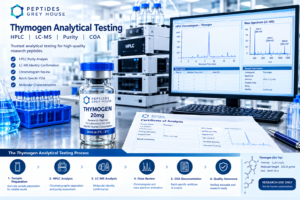
Analytical testing can involve several complementary techniques. HPLC is commonly used to evaluate chromatographic purity, while LC-MS or mass spectrometry can provide evidence supporting molecular identity. A Certificate of Analysis (COA) can bring these results together with batch information, analytical methods, specifications, and reported results.
For research organizations, universities, biotechnology laboratories, analytical laboratories, and other qualified research environments, understanding these analytical parameters can make it easier to evaluate peptide documentation objectively.
What Is Thymogen Analytical Testing?
Thymogen analytical testing refers to laboratory procedures used to characterize a Thymogen sample and document specific quality attributes.
Depending on the laboratory and testing package, analytical characterization may include:
- HPLC purity analysis
- LC-MS or mass spectrometry
- Molecular identity confirmation
- Chromatogram review
- Retention-time documentation
- Related-substance evaluation
- Appearance documentation
- Net-content measurement
- Batch or lot identification
- Certificate of Analysis documentation
The exact analytical panel varies between laboratories. Therefore, a statement such as “analytically tested” should always be accompanied by information explaining what was tested and by which method.
This distinction is particularly important for research materials. A purity result obtained through HPLC does not automatically establish sterility, endotoxin status, biological activity, or suitability for a particular experimental system.
Thymogen Chemical Identity
Before interpreting an analytical report, researchers should understand the reference identity of the material being tested.
Public chemical records identify Thymogen as:
| Property | Reference |
|---|---|
| Common name | Thymogen |
| Chemical identity | L-alpha-glutamyl-L-tryptophan |
| Sequence | Glu-Trp / EW |
| CAS | 38101-59-6 |
| Molecular formula | C₁₆H₁₉N₃O₅ |
| Molecular weight | 333.34 g/mol |
| PubChem CID | 100094 |
These identifiers can be useful when comparing a supplier’s documentation with an independent analytical report.
Analytical testing should use an appropriate reference identity so that the observed chromatographic and mass-spectrometric characteristics can be evaluated against the expected compound.
Why Thymogen Analytical Testing Matters
A product label alone does not provide the same information as an analytical report.
For example, a vial labeled “Thymogen 20mg” identifies the material and stated quantity, but it does not independently demonstrate the chromatographic profile or molecular identity of that particular lot.
Analytical testing can provide additional documentation.
A laboratory may use testing to investigate questions such as:
- Does the sample produce the expected chromatographic profile?
- Is the principal component consistent with the expected compound?
- What percentage of the detected chromatographic area is attributed to the principal peak?
- Does the measured mass support the proposed molecular identity?
- Are additional peaks visible?
- Is the result linked to a specific batch or lot?
- Does the analytical report identify the laboratory and testing date?
These questions are especially relevant when research projects require traceable analytical records.
Thymogen HPLC Testing
What Is HPLC?
High-performance liquid chromatography (HPLC) is an analytical separation technique used to separate components within a sample.
For peptide analysis, HPLC can be used to separate the target peptide from other detectable components based on differences in interactions with the chromatographic system.
A typical chromatographic analysis produces a chromatogram containing peaks.
Each peak represents a detected component under the specific analytical conditions used.
For Thymogen analytical testing, the chromatogram can provide information about:
- Main peak position
- Retention time
- Peak area
- Additional detectable peaks
- Chromatographic profile
- Reported purity calculation
The analytical method itself matters. Column chemistry, mobile phase, gradient, flow rate, temperature, detection wavelength, injection conditions, and sample preparation can all influence the chromatographic result.
Therefore, two laboratories can potentially produce somewhat different chromatograms while analyzing the same material if their methods differ.
Thymogen HPLC Purity
One of the most commonly discussed measurements in peptide analytical testing is HPLC purity.
HPLC purity is generally reported as an area percentage based on the chromatographic method used.
For example, a laboratory report may identify a principal peak and calculate its chromatographic area relative to the detected peaks included in the calculation.
However, the reported percentage should always be interpreted within the context of the analytical method.
A value reported on one laboratory’s COA should not automatically be treated as a universal purity value for every Thymogen batch.
Important distinction
HPLC purity is not the same thing as overall product quality.
A high chromatographic purity result does not by itself establish:
- Sterility
- Endotoxin status
- Heavy-metal status
- Residual-solvent compliance
- Biological activity
- Stability
- Clinical suitability
- Suitability for human or veterinary use
This is why a comprehensive analytical documentation system should identify exactly which tests were performed.
Understanding a Thymogen Chromatogram
A chromatogram is one of the most useful visual components of an HPLC report.
The horizontal axis commonly represents retention time, while the vertical axis represents the detector response.
A dominant peak may represent the principal component under the method conditions.
Additional peaks may represent other detectable components, impurities, degradation products, or analytical artifacts. Their interpretation requires appropriate analytical expertise and cannot be determined solely from the appearance of a graph.
When reviewing a Thymogen chromatogram, researchers should look for:
1. Sample identification
The report should identify the sample or compound analyzed.
2. Batch or lot number
The analytical result should be traceable to the specific material tested.
3. Analytical method
The report should provide enough information to understand what analytical technique was used.
4. Retention time
The reported retention time can help compare the sample’s chromatographic behavior under the stated conditions.
5. Peak information
Where available, the report may provide peak area, percentage area, or related-substance information.
6. Laboratory information
A professional analytical report should identify the testing organization and relevant report information.
Thymogen LC-MS Testing
What Is LC-MS?
Liquid chromatography-mass spectrometry (LC-MS) combines chromatographic separation with mass spectrometric detection.
This makes LC-MS particularly useful when researchers need information about molecular identity in addition to chromatographic separation.
During analysis, liquid chromatography separates components, while the mass spectrometer measures ions according to their mass-to-charge ratio.
For Thymogen, the expected molecular identity can be compared with the appropriate theoretical mass characteristics.
Public chemical data identify the molecular weight of Thymogen as 333.34 g/mol.
A laboratory’s LC-MS report may therefore provide an observed mass or mass-to-charge signal that is evaluated against the expected identity.
HPLC vs LC-MS for Thymogen
HPLC and LC-MS should not be treated as interchangeable techniques.
HPLC
HPLC is particularly useful for:
- Chromatographic separation
- Purity assessment
- Peak-area analysis
- Retention-time documentation
- Related-peak evaluation
LC-MS
LC-MS can provide:
- Molecular-mass information
- Identity-supporting evidence
- Mass-to-charge measurements
- Additional characterization of detected components
Why use both?
Using complementary analytical techniques can provide a broader picture.
HPLC can help answer:
“What does the chromatographic purity profile look like?”
LC-MS can help answer:
“Does the detected material have mass characteristics consistent with the proposed molecular identity?”
Neither technique should be interpreted beyond what the actual report demonstrates.
Thymogen Certificate of Analysis
A Certificate of Analysis, commonly abbreviated as COA, is a laboratory or quality document containing analytical information associated with a particular material or batch.
A useful Thymogen COA may contain:
- Product or compound name
- Batch or lot number
- Testing laboratory
- COA or report number
- Testing date
- Sample-received date
- Molecular formula
- Molecular weight
- Analytical method
- Identity result
- Purity result
- Quantity or net-content result
- Chromatogram
- Mass spectrum
- Specification and result comparison
The exact information depends on the testing laboratory.
Why Batch-Specific COAs Matter
A major consideration when evaluating Thymogen analytical documentation is batch traceability.
A COA should ideally correspond to the exact lot being evaluated.
For example:
Vial batch → laboratory sample → analytical report → reported result
This creates a traceable connection between the physical research material and its analytical documentation.
Publicly available Thymogen COAs demonstrate why batch-specific reporting matters. Different samples and lots can have different analytical results, so one published purity percentage should not automatically be presented as the purity of every Thymogen product.
For this reason, a research supplier should avoid using an unrelated historical COA as though it represents a current batch.
How to Read a Thymogen Analytical Report
Researchers reviewing a Thymogen analytical report can use the following checklist.
Step 1: Verify the compound name
Confirm that the report identifies the material as Thymogen and, where appropriate, provides the corresponding chemical identity.
Step 2: Check the CAS number
The CAS number can provide another identity reference.
For Thymogen, the documented CAS number is 38101-59-6.
Step 3: Check the molecular formula
The documented formula is:
C₁₆H₁₉N₃O₅
Step 4: Check molecular weight
The documented molecular weight is:
333.34 g/mol
Step 5: Verify the lot number
The batch or lot number should correspond to the physical research material.
Step 6: Identify the analytical method
Look for terminology such as:
- HPLC
- RP-HPLC
- UHPLC
- LC-MS
- ESI-MS
- Mass spectrometry
Step 7: Review the chromatogram
Check whether the report includes the chromatographic data supporting the reported result.
Step 8: Review identity data
If mass spectrometry was performed, review the reported observed mass and how the laboratory interpreted the result.
Step 9: Check the date
The testing date establishes when the sample was analyzed.
Step 10: Review limitations
Determine which tests were actually performed and which were not.
Thymogen Purity Testing and Quality Control
Analytical quality control is broader than a single purity number.
A research-grade quality-control program can include several levels of documentation.
Identity
Confirms whether the material is consistent with the expected chemical identity.
Purity
Evaluates the chromatographic profile and reported principal-component percentage.
Quantity
Documents the measured amount where the laboratory provides quantitative content testing.
Physical characteristics
May document appearance, physical form, or other sample characteristics.
Additional testing
Depending on the research requirements, laboratories may separately evaluate parameters such as residual solvents, endotoxins, microbial characteristics, or elemental impurities.
These tests should never be assumed to have been performed unless they are explicitly documented.
Why Analytical Method Details Matter
A reported analytical result is more meaningful when the method is clearly documented.
Important method parameters may include:
- Column type
- Mobile phase
- Gradient
- Flow rate
- Detector
- Detection wavelength
- Injection volume
- Sample concentration
- Run time
- Instrument
- Data-processing method
Method details allow researchers to understand how the result was produced.
They also make it easier to compare results from different laboratories while recognizing that different analytical methods may not be directly interchangeable.
Thymogen Analytical Testing for Research Documentation
For research organizations, analytical documentation can become part of a larger quality-management system.
Researchers may maintain:
- Batch records
- COAs
- Laboratory reports
- Chromatograms
- Mass spectra
- Sample identifiers
- Purchase records
- Experimental records
- Storage records
- Instrument data
Maintaining these records can improve traceability and make it easier to determine which material was associated with a particular experiment.
For laboratories conducting reproducibility studies, batch-specific documentation can also help identify whether differences between experiments may be associated with different research materials.
Common Mistakes When Publishing Thymogen Testing Information
Mistake 1: Treating a sample result as universal
A 99%+ result from one batch should not automatically be presented as the result for every batch.
Mistake 2: Showing fabricated COA information
Generated graphics should never be presented as genuine laboratory certificates.
If a website uses an illustrative COA image, it should be clearly identified as a sample or illustrative document.
Mistake 3: Confusing HPLC with identity testing
HPLC purity and molecular identity are different analytical questions.
Mistake 4: Claiming testing that was not performed
Do not state that a batch was tested for endotoxins, sterility, heavy metals, residual solvents, or other parameters unless the actual report documents those tests.
Mistake 5: Using unsupported purity claims
Avoid generic claims such as “100% pure” unless they are scientifically and analytically justified by the applicable documentation.
Research-Use-Only Statement
Thymogen research material is intended solely for laboratory research and analytical purposes. It is not intended for human or veterinary consumption, self-administration, diagnosis, treatment, cure, or prevention of disease. Researchers are responsible for following applicable laboratory procedures, institutional requirements, safety practices, and all applicable laws and regulations governing the handling and use of research materials.
This page discusses analytical characterization and laboratory documentation only. It does not provide dosing, administration, reconstitution, or therapeutic-use instructions.
Frequently Asked Questions
What is Thymogen analytical testing?
Thymogen analytical testing refers to laboratory procedures used to characterize Thymogen material, commonly including chromatographic purity analysis and molecular identity testing.
What does HPLC testing show for Thymogen?
HPLC can provide a chromatographic profile and a reported purity value based on the analytical method and peak-area calculation used by the testing laboratory.
What does LC-MS show for Thymogen?
LC-MS combines liquid chromatographic separation with mass spectrometric detection. It can provide mass information that supports evaluation of the proposed molecular identity.
What is the molecular weight of Thymogen?
Public chemical records identify Thymogen with a molecular weight of 333.34 g/mol.
What is the molecular formula of Thymogen?
The documented molecular formula is C₁₆H₁₉N₃O₅.
What is the Thymogen sequence?
Thymogen is documented as the dipeptide Glu-Trp, also represented as EW.
What is a Thymogen COA?
A Thymogen COA is a Certificate of Analysis containing analytical information associated with a particular sample or batch.
Should a Thymogen COA be batch-specific?
Ideally, analytical documentation should be traceable to the exact batch or lot being evaluated.
Does high HPLC purity prove sterility?
No. HPLC purity does not by itself establish sterility.
Does HPLC prove molecular identity?
HPLC can provide chromatographic information, but molecular identity is a separate analytical question. Mass spectrometry can provide complementary identity-supporting evidence.
Can I use a generated COA image as a real laboratory document?
No. A generated image should only be used as an illustration unless it reproduces an authentic laboratory document with permission and accurate information.
Does every Thymogen batch have the same purity?
Not necessarily. Analytical results are batch-specific, and published examples demonstrate that different lots can produce different reported purity results.
Thymogen Analytical Testing: Key Takeaways
Thymogen analytical testing provides researchers with a structured way to evaluate analytical documentation associated with research material.
The most important concepts are:
- HPLC can evaluate chromatographic purity.
- LC-MS can provide molecular-mass information supporting identity.
- COAs should be connected to specific batches or lots.
- Purity percentages should not be generalized across unrelated batches.
- HPLC purity does not establish sterility, endotoxin status, or biological activity.
- Analytical methods should be documented whenever possible.
- Generated COA graphics should never be represented as authentic laboratory certificates.
- Research documentation should clearly distinguish tested parameters from untested parameters.
For laboratories and research organizations, transparent analytical documentation provides a more useful foundation for evaluating research materials than a standalone purity claim.