

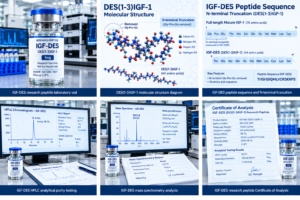
IGF-DES Research Peptide: An Overview
The IGF-DES research peptide, commonly referred to as IGF-1 DES or des(1-3)IGF-1, is a truncated variant of insulin-like growth factor-I (IGF-I) that has been studied in biochemical, cellular, and animal research.
The name describes its defining structural difference from native IGF-I. The molecule lacks the first three N-terminal amino acids of mature IGF-I: glycine, proline, and glutamate (Gly-Pro-Glu). As a result, des(1-3)IGF-I contains 67 amino-acid residues rather than the 70 residues found in mature human IGF-I. The truncated form has been identified in biological systems and has been investigated as a distinct IGF-I variant.
For laboratories and researchers, understanding this structural distinction is important. IGF-DES is not simply another name for full-length IGF-1, IGF-1 LR3, or mecasermin. Each represents a different molecular form with its own structural and analytical characteristics.
A research-oriented IGF-DES page should therefore focus on identity, peptide structure, sequence characterization, analytical verification, purity, documentation, and the published research context rather than making therapeutic or performance claims.
What Is IGF-DES?
IGF-DES, or des(1-3)IGF-1, is a truncated form of IGF-I in which the N-terminal Gly-Pro-Glu sequence has been removed.
The scientific literature has described des(1-3)IGF-I as a naturally occurring truncated form of IGF-I. Research has identified the variant in biological materials and investigated its biochemical behavior relative to intact IGF-I.
The removal of the N-terminal tripeptide is scientifically significant because this region contributes to interactions with IGF-binding proteins. Research has reported substantially reduced binding of des(1-3)IGF-I to certain IGF-binding proteins compared with native IGF-I.
This difference makes IGF-DES useful as a research model for investigating how structural changes to a growth-factor peptide can alter molecular interactions, protein availability, and biological activity in experimental systems.
For SEO purposes, researchers may encounter several names for the same research subject:
- IGF-DES
- IGF-1 DES
- DES(1-3)IGF-1
- des(1-3)IGF-I
- DES IGF-1
- truncated IGF-1
- destripeptide IGF-1
Using these variants naturally throughout an article helps search engines understand the topic while making the page easier for researchers to find.
IGF-DES Research Peptide at a Glance
| Attribute | Research Information |
|---|---|
| Common name | IGF-DES / IGF-1 DES |
| Formal terminology | des(1-3)IGF-1 / des(1-3)IGF-I |
| Parent molecule | Human IGF-I |
| Structural difference | N-terminal Gly-Pro-Glu removed |
| Residue count | 67 amino acids |
| Native IGF-I comparison | Mature IGF-I contains 70 amino acids |
| Research category | Growth-factor / peptide research |
| Primary research interest | IGF structure, binding proteins and receptor signaling |
| Analytical considerations | HPLC, mass spectrometry and identity testing |
| Documentation | Product-specific COA recommended |
| Intended context | Laboratory and scientific research |
The 67-residue identity follows the established description of des(1-3)IGF-I as mature IGF-I lacking the first three residues.
Understanding DES(1-3)IGF-1
The designation DES(1-3)IGF-1 is essentially a structural description.
“DES” indicates deletion, while “(1-3)” identifies the first three residues removed from the parent IGF-I sequence.
Those residues are:
Glycine – Proline – Glutamate
or:
Gly-Pro-Glu (GPE)
The remaining sequence corresponds to the downstream portion of mature IGF-I. This structural change is the central feature researchers should use when differentiating IGF-DES from other IGF-related materials.
Historical research reported that the truncated molecule exhibited substantially different interactions with IGF-binding proteins and greater activity in certain experimental systems than intact IGF-I. Importantly, these observations come from specific experimental models and should not be converted into generalized human efficacy claims.
IGF-DES vs. Full-Length IGF-1
One of the most important SEO and scientific distinctions is the difference between IGF-DES and full-length IGF-1.
Full-length mature IGF-I contains 70 amino-acid residues. IGF-DES lacks the first three N-terminal residues and therefore contains 67 residues.
This apparently small structural change can have substantial consequences for biochemical interactions.
Research has focused particularly on the reduced interaction of des(1-3)IGF-I with IGF-binding proteins. Because binding proteins influence the availability and distribution of IGF-I-related molecules, the truncated form provides researchers with a useful model for studying the relationship between molecular structure and biological availability.
IGF-DES should therefore not be represented as interchangeable with:
- Full-length IGF-1
- Recombinant human IGF-1
- Mecasermin
- IGF-1 LR3
- MGF
- PEG-MGF
- Other IGF fragments or analogues
These distinctions are especially important when reviewing a certificate of analysis or interpreting analytical data.
IGF-DES Peptide Sequence
Sequence identity is an important part of characterizing an IGF-DES research peptide.
The defining sequence modification is the absence of the first three residues of mature IGF-I. In simplified terms:
Mature IGF-I: residues 1–70
IGF-DES: residues 4–70
The truncated sequence therefore begins with the residue corresponding to position 4 of mature IGF-I.
Researchers should confirm the exact sequence and molecular form supplied by the manufacturer or laboratory before using any calculated molecular weight, theoretical mass, or sequence-dependent analytical value.
This is particularly important because peptide and protein products can exist in different forms, including:
- Truncated variants
- Modified analogues
- Salts
- Counter-ion forms
- Oxidized material
- Aggregated material
- Formulation-specific preparations
A product label alone should not be treated as a substitute for analytical documentation.
IGF-DES Molecular Structure
IGF-DES retains the broader structural framework of IGF-I while lacking the N-terminal tripeptide.
The three-dimensional structure of IGF-related proteins is maintained through intramolecular disulfide bonds. Consequently, analytical characterization should consider both the amino-acid sequence and the correct structural state.
For research laboratories, structural characterization may include:
- Sequence confirmation
- Molecular-mass determination
- Chromatographic purity
- Mass-spectrometric analysis
- Assessment of degradation products
- Evaluation of aggregation
- Confirmation of the intended truncated form
These measurements are more useful than relying solely on a generic database value copied from a different IGF analogue.
IGF-DES Molecular Weight
Searches for IGF-DES molecular weight can produce inconsistent results because different databases, suppliers, and reference pages may report calculated values using different molecular forms.
For this reason, a professional product page should avoid presenting an unverified molecular weight as though it were universally applicable.
The most reliable approach is to distinguish:
- Theoretical molecular mass
- Average molecular weight
- Monoisotopic mass
- Product-specific measured mass
- Formulation or salt effects
For an IGF-DES research material, the product-specific COA and mass-spectrometry result should take priority when confirming identity.
This is particularly important for a 67-amino-acid truncated protein because even a small sequence difference can materially change the expected molecular mass.
IGF-DES Research Applications
IGF-DES has primarily attracted research interest because it provides a model for examining how structural modifications influence IGF-related biochemical behavior.
1. Peptide and Protein Structure Research
IGF-DES can be studied as an example of how deletion of a short N-terminal sequence can modify protein interactions without completely redesigning the parent molecule.
2. IGF-Binding Protein Research
The interaction between IGF-I variants and IGF-binding proteins is an important research area. Des(1-3)IGF-I has been investigated specifically because deletion of the N-terminal tripeptide reduces affinity for several binding proteins.
3. Receptor-Signaling Research
Researchers can use IGF-related peptides to investigate relationships between molecular structure, receptor interaction, and downstream signaling in controlled experimental systems.
4. Cell Biology
Published research has examined IGF-DES in cultured-cell models, including experiments comparing its biological activity with intact IGF-I.
5. Protein Characterization
IGF-DES can also serve as a subject for analytical workflows involving chromatographic separation, mass spectrometry, peptide mapping, and identity confirmation.
6. Comparative IGF Research
Researchers may compare IGF-DES with full-length IGF-I and other IGF analogues to investigate how different structural modifications influence biochemical behavior.
These applications describe research contexts rather than therapeutic uses.
IGF-DES and Analytical Testing
A high-quality IGF-DES research peptide page should emphasize analytical verification.
Common analytical techniques include:
HPLC
High-performance liquid chromatography can be used to assess chromatographic purity and identify major peaks associated with the intended peptide material.
HPLC results should be interpreted alongside the analytical method, chromatographic conditions, sample preparation, and reporting criteria.
Mass Spectrometry
Mass spectrometry can provide information about the measured molecular mass of the material.
For IGF-DES, mass spectrometry is especially useful because it can help differentiate the intended truncated form from:
- Full-length IGF-I
- Other truncation products
- Oxidized species
- Degradation products
- Unexpected molecular variants
Peptide Mapping
Depending on the laboratory workflow, peptide mapping can provide additional sequence-related evidence.
Identity Testing
A strong analytical package should connect the product name with a clearly defined molecular identity.
IGF-DES Certificate of Analysis
A Certificate of Analysis (COA) is one of the most important documentation elements for a research peptide.
For IGF-DES, researchers should look for information such as:
- Product name
- Batch or lot number
- Testing date
- Purity result
- Identity testing
- Analytical method
- HPLC information
- Mass-spectrometry information
- Appearance
- Storage conditions
- Laboratory or testing organization
A COA should correspond to the specific batch being evaluated.
Generic certificates that do not identify the relevant lot provide less useful evidence than batch-specific documentation.
When possible, researchers should compare the product label, lot number, COA, analytical results, and expected molecular identity.
IGF-DES 2mg: Quantity vs. Molecular Identity
The phrase IGF-DES 2mg refers to the amount of material in a product presentation. It does not create a different molecular form.
In other words:
IGF-DES 2mg ≠ a different peptide from IGF-DES
The “2mg” designation describes quantity, while DES(1-3)IGF-1 describes molecular identity.
This distinction is useful for SEO because users searching for “IGF-DES 2mg” may be looking for a product page, while users searching for “IGF-DES molecular weight” or “DES(1-3)IGF-1 sequence” are more likely looking for technical information.
A strong site architecture can serve both audiences without creating duplicate or competing pages.
Research Quality Considerations
When evaluating IGF-DES research material, researchers should consider more than the stated purity percentage.
Important quality questions include:
Is the molecular identity clearly defined?
The product should clearly identify whether it is des(1-3)IGF-1 rather than another IGF analogue.
Is analytical testing available?
HPLC and mass-spectrometry information can provide useful evidence for purity and identity.
Is the COA batch-specific?
A batch-specific COA is preferable to generic documentation.
Is the sequence documented?
The defining N-terminal deletion should be consistent with the stated molecular identity.
Is the product clearly labeled for research?
Research materials should be clearly separated from approved medicines and consumer products.
IGF-DES Research Status
The published literature on des(1-3)IGF-I includes biochemical, cellular, and animal research. Historical research described its altered binding-protein interactions and increased activity in particular experimental systems.
However, preclinical findings should not be presented as evidence of established human therapeutic efficacy.
Current research-oriented reviews characterize the evidence base as predominantly preclinical and distinguish IGF-DES from approved full-length IGF-I products.
For an SEO product page, this distinction is valuable because it provides scientifically responsible information while avoiding unsupported medical claims.
IGF-DES vs. IGF-1 LR3
Another important SEO distinction is IGF-DES vs. IGF-1 LR3.
Both are modified IGF-related research materials, but they are not the same molecule.
IGF-DES is characterized by removal of the N-terminal Gly-Pro-Glu tripeptide.
IGF-1 LR3, by contrast, contains a different set of structural modifications.
Therefore, researchers should never substitute one product for another based solely on the shared “IGF-1” terminology.
Product pages should use separate URLs, titles, descriptions, technical profiles, and COA documentation for each compound.
Frequently Asked Questions
What is an IGF-DES research peptide?
IGF-DES research peptide generally refers to des(1-3)IGF-1, a truncated form of IGF-I lacking the N-terminal Gly-Pro-Glu tripeptide. It has been investigated in biochemical, cellular, and animal research.
What does DES(1-3)IGF-1 mean?
DES(1-3)IGF-1 means that residues 1 through 3 of the parent IGF-I molecule have been removed. Those residues are Gly-Pro-Glu.
How many amino acids does IGF-DES contain?
Des(1-3)IGF-I is generally described as a 67-amino-acid truncated form of mature 70-amino-acid IGF-I.
Is IGF-DES the same as IGF-1?
No. IGF-DES is a truncated variant of IGF-I, while full-length IGF-I retains the complete mature sequence.
Is IGF-DES the same as IGF-1 LR3?
No. IGF-DES and IGF-1 LR3 are structurally different IGF-related molecules.
What should an IGF-DES COA include?
A useful COA should identify the product and batch and ideally provide analytical information such as purity, identity testing, HPLC results, and mass-spectrometry data.
What is the molecular weight of IGF-DES?
Theoretical molecular-mass values can vary according to the molecular form and calculation method. For publication-quality product information, the expected mass should be confirmed against the exact sequence and batch-specific analytical documentation rather than copied from another IGF analogue.
Is IGF-DES approved as a medicine?
IGF-DES should not be presented as interchangeable with approved full-length IGF-I medicines. Current research-oriented sources distinguish des(1-3)IGF-I from mecasermin and describe the evidence base as predominantly preclinical.
Why is IGF-DES studied?
Researchers have investigated IGF-DES because its N-terminal truncation changes its interaction with IGF-binding proteins, providing a useful model for studying IGF structure, binding, availability, and signaling.