

What Is Oxytocin 10mg Research?
Oxytocin is a naturally occurring cyclic nonapeptide consisting of nine amino acids. PubChem identifies oxytocin with the sequence CYIQNCPLG, molecular formula C43H66N12O12S2, and molecular weight of approximately 1007.2 g/mol.
The molecule contains a disulfide bridge between cysteine residues 1 and 6, creating its characteristic cyclic structure.
For an Oxytocin 10mg Research page, the strongest SEO approach is to focus on:
- Peptide identity
- Molecular structure
- Peptide sequence
- Molecular weight
- Molecular formula
- CAS number
- Receptor research
- Analytical characterization
- COA documentation
- Research-material considerations
The 10mg designation describes the quantity associated with a particular product presentation. It should not be presented as a recommended clinical dose.
Oxytocin 10mg Research at a Glance
| Property | Oxytocin |
|---|---|
| Primary keyword | Oxytocin 10mg Research |
| Peptide type | Cyclic nonapeptide |
| Amino-acid length | 9 residues |
| Sequence | CYIQNCPLG |
| Molecular formula | C43H66N12O12S2 |
| Molecular weight | 1007.2 g/mol |
| CAS number | 50-56-6 |
| PubChem CID | 439302 |
| Structural feature | Cys1–Cys6 disulfide bridge |
| Research areas | Peptide chemistry, receptor biology, neuroscience, neuroendocrinology |
These molecular identifiers are supported by the current PubChem record.
Oxytocin Peptide Sequence
The canonical oxytocin sequence is:
CYIQNCPLG
The nine residues are:
- Cysteine
- Tyrosine
- Isoleucine
- Glutamine
- Asparagine
- Cysteine
- Proline
- Leucine
- Glycine
The cysteine residues at positions 1 and 6 form an intramolecular disulfide bridge. PubChem identifies oxytocin as a heterodetic cyclic peptide and provides the sequence CYIQNCPLG.
This sequence is useful for peptide identification, scientific databases, analytical research and molecular documentation.
Oxytocin Molecular Structure
Oxytocin is not simply a linear nine-amino-acid chain.
I
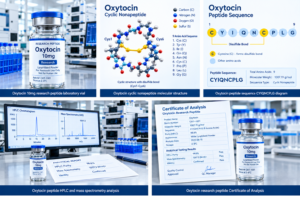
, producing a cyclic portion of the molecule. PubChem’s structural record represents oxytocin as:
H-Cys-Tyr-Ile-Gln-Asn-Cys-Pro-Leu-Gly-NH₂
with the cysteine residues connected through the disulfide linkage.
This structural feature is important when researchers evaluate molecular identity and analytical characterization.
Oxytocin Molecular Weight
The reported molecular weight of oxytocin is:
1007.2 g/mol
PubChem lists an exact mass of approximately 1006.4365 Da and a molecular weight of 1007.2 g/mol.
Molecular-weight information can support:
- Mass-spectrometry interpretation
- Peptide identification
- Analytical research
- Chemical database searches
- Reference-material comparisons
- Scientific documentation
It is important to distinguish the molecular weight of oxytocin from the quantity of a product.
Oxytocin molecular weight: 1007.2 g/mol
Oxytocin 10mg: product quantity
These are different measurements.
Oxytocin Molecular Formula
The molecular formula for oxytocin is:
C43H66N12O12S2
This formula represents the elemental composition of the molecular form recorded by PubChem.
Molecular-formula information is useful for:
- Chemical identification
- Molecular calculations
- Analytical chemistry
- Database research
- Mass-spectrometry work
- Scientific documentation
Researchers should verify the exact molecular form being described, particularly when comparing oxytocin with salt forms or other formulations.
Oxytocin CAS Number
The commonly listed CAS Registry Number for oxytocin is:
50-56-6
PubChem lists 50-56-6 as an identifier for oxytocin.
A CAS number can help researchers locate compound information across chemical databases and scientific documentation.
For reliable identification, however, researchers should consider the CAS number together with:
- Sequence
- Molecular formula
- Molecular weight
- Molecular structure
- Batch information
- Analytical documentation
Oxytocin Research and Receptor Biology
Oxytocin has been extensively studied in molecular and biological research.
Relevant research areas include:
Receptor biology
Research can examine oxytocin interactions with the oxytocin receptor and related cellular signaling.
Peptide chemistry
The sequence, cyclic structure and disulfide linkage make oxytocin relevant to peptide chemistry.
Neuroendocrinology
Oxytocin is an important subject in research concerning neuroendocrine signaling.
Neuroscience
Researchers have investigated oxytocin-related signaling within the nervous system.
Reproductive biology
Oxytocin has a substantial research history in reproductive physiology.
For SEO content, these areas should be presented as fields of scientific investigation, rather than claims that a research product produces a particular therapeutic result.
Oxytocin 10mg Research Material
The phrase Oxytocin 10mg Research can refer to research material presented in a quantity of 10mg.
The exact characteristics of a particular product should be established from its:
- Product specification
- Manufacturer documentation
- Batch information
- Certificate of Analysis
- Physical form
- Intended-use statement
- Applicable regulatory requirements
A research product should not automatically be represented as equivalent to a prescription pharmaceutical merely because it contains oxytocin.
This distinction is particularly important because synthetic oxytocin is also an established prescription pharmaceutical. FDA labeling identifies Oxytocin Injection, USP as a prescription product and describes its pharmaceutical formulation and clinical use.
Oxytocin COA and Analytical Testing
A Certificate of Analysis (COA) can provide important information when evaluating research material.
A useful COA may contain:
Product identity
The compound name and relevant identification information.
Batch or lot number
The lot number should correspond to the material being supplied.
Purity
Analytical purity may be reported using HPLC or another appropriate analytical technique.
Mass confirmation
Mass spectrometry may be used to support molecular identity.
Testing information
The document may identify the analytical methods and testing performed.
Quantity
Product documentation should correspond to the stated product quantity.
For SEO purposes, avoid publishing a universal purity percentage unless it is supported by current batch-specific documentation.
Oxytocin Research Peptide Quality Considerations
When comparing oxytocin research materials, researchers may review several factors.
Molecular identity
Check the listed:
- Sequence
- Molecular formula
- Molecular weight
- CAS number
Batch documentation
A batch-specific COA provides more useful information than a generic product specification.
Analytical testing
Review available HPLC, mass spectrometry or other characterization data.
Physical form
Confirm whether the material is supplied as a lyophilized peptide, solution or another formulation.
Labeling
Review the intended-use statement and product documentation.
Regulatory distinction
Do not assume that research material has the same regulatory status or formulation as an approved pharmaceutical.
Oxytocin Lyophilized Research Peptide
Some research peptide materials may be supplied in a lyophilized or freeze-dried format.
For any specific product, researchers should rely on the manufacturer’s documentation for:
- Storage requirements
- Stability information
- Packaging
- Handling
- Analytical specifications
- Intended use
A lyophilized research peptide should not automatically be described as equivalent to a pharmaceutical formulation.
Pharmaceutical Oxytocin vs Research Material
This distinction should be prominent on an Oxytocin 10mg Research page.
Pharmaceutical oxytocin
Synthetic oxytocin is an established prescription pharmaceutical. FDA labeling describes Oxytocin Injection, USP as a prescription product and specifies its formulation and clinical uses.
Research oxytocin
A research product must be evaluated according to its own labeling, documentation, specifications and applicable regulations.
Therefore, a website should avoid suggesting that an unspecified Oxytocin 10mg Research product is interchangeable with an FDA-approved pharmaceutical.
A suitable research-focused statement is:
Oxytocin is a well-characterized cyclic nonapeptide that has been extensively investigated in peptide chemistry, receptor biology, neuroendocrinology and related laboratory research.