

PNC-27 Research Peptide Overview
PNC-27 research peptide is a synthetic 32-amino-acid chimeric peptide that has been investigated in laboratory and preclinical research involving p53-derived peptide sequences, HDM-2 interactions, cellular membranes, and peptide structure.
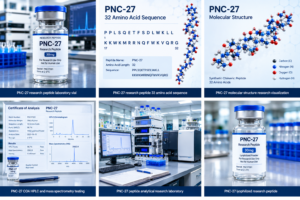
as a construct containing residues 12–26 of human p53 connected to a membrane-residency or cell-penetrating sequence. Research has investigated how this molecular architecture relates to peptide localization, HDM-2 binding, and membrane-associated activity in experimental models.
The published PNC-27 sequence is:
PPLSQETFSDLWKLLKKWKMRRNQFWVKVQRG
For researchers evaluating a PNC-27 research peptide, the most useful product information includes molecular identity, amino-acid sequence, molecular weight, molecular formula, CAS identification, quantity, purity information, analytical testing, and batch-specific documentation.
The term 30mg, when used in a product such as PNC-27 30mg, refers to the stated quantity of research material. It should not be interpreted as a dosage recommendation.
PNC-27 is presented on this page strictly in the context of laboratory research and analytical use.
What Is PNC-27?
PNC-27 is a synthetic chimeric peptide designed from two principal sequence components.
The first component corresponds to residues 12–26 of human p53, a region associated with interaction with HDM-2. The second component is a membrane-penetrating or membrane-residency sequence attached to the p53-derived region.
This two-part structure distinguishes PNC-27 from a peptide consisting solely of a short p53 fragment.
Researchers have investigated the compound using a variety of experimental approaches, including structural analysis, peptide–protein interaction studies, cellular models, and microscopy.
A peer-reviewed study published in 2022 examined the structure of PNC-27 in relation to HDM-2 and reported experimental observations concerning membrane-pore formation in cancer-cell models.
Earlier research also examined the peptide’s HDM-2-binding properties and membrane-associated behavior.
These findings provide scientific context for PNC-27 research, but experimental observations should not be interpreted as evidence of an approved human therapeutic application.
PNC-27 Research Peptide Molecular Profile
The following specifications are commonly associated with PNC-27 in scientific and research-product references:
| Property | PNC-27 Information |
|---|---|
| Compound | PNC-27 |
| Type | Synthetic chimeric peptide |
| Length | 32 amino acids |
| Sequence | PPLSQETFSDLWKLLKKWKMRRNQFWVKVQRG |
| Molecular weight | Approximately 4,031–4,032 g/mol |
| Molecular formula | C₁₈₈H₂₉₃N₅₃O₄₄S |
| CAS number | 1159861-00-3 |
| Research format | Commonly supplied as lyophilized material |
| Research context | Peptide structure, protein interactions and cellular research |
Current research-product documentation reports a molecular weight of approximately 4,032 g/mol, with the molecular formula C₁₈₈H₂₉₃N₅₃O₄₄S and CAS 1159861-00-3.
Researchers should always compare these reference specifications with the current documentation for the specific lot being evaluated.
PNC-27 Peptide Sequence
The published sequence of PNC-27 is:
PPLSQETFSDLWKLLKKWKMRRNQFWVKVQRG
The peptide contains 32 amino-acid residues.
Its sequence can be considered in two principal sections.
P53-derived region
PPLSQETFSDLWKLL
This 15-residue segment corresponds to residues 12–26 of human p53 and forms the HDM-2-associated portion described in the published research.
Membrane-residency region
KKWKMRRNQFWVKVQRG
This C-terminal region is described in the literature as a membrane-penetrating or membrane-residency sequence.
The combination of these regions creates the chimeric architecture that has been investigated in PNC-27 research.
For laboratory procurement, sequence confirmation is important because related p53-derived peptides can have overlapping sequences while differing in length, terminal structure, or attached domains.
PNC-27 Molecular Weight
The molecular weight of PNC-27 is approximately 4,031–4,032 g/mol.
Scientific publications and current research references can display slightly different values depending on calculation conventions and how the molecular entity is represented. Current commercial reference documentation lists the molecular weight as 4032 g/mol.
Molecular weight is particularly relevant to analytical peptide characterization.
Researchers may compare the expected molecular mass against mass-spectrometry results supplied with a particular batch.
A molecular-weight value by itself, however, does not establish product purity. Identity and purity should be evaluated using the available analytical documentation.
PNC-27 Molecular Formula
The commonly reported molecular formula for PNC-27 is:
C₁₈₈H₂₉₃N₅₃O₄₄S
The molecular formula provides another useful identifier when comparing research references and product documentation.
When reviewing a PNC-27 research peptide, researchers can consider the formula alongside:
- Peptide sequence
- Molecular weight
- CAS number
- HPLC data
- Mass-spectrometry data
- Lot number
- COA documentation
This combined approach provides more useful identification information than relying on the product name alone.
PNC-27 CAS Number
The commonly referenced CAS Registry Number for PNC-27 is:
1159861-00-3
Current research-product documentation associates this identifier with PNC-27.
Including the CAS number in laboratory purchasing and documentation can help distinguish PNC-27 from other experimental peptides.
Researchers should still verify the CAS number against the supplier’s current documentation because peptide products can differ in sequence, terminal modification, salt form, or other molecular characteristics.
PNC-27 and p53 Research
The scientific interest surrounding PNC-27 is closely associated with the p53-derived portion of the molecule.
The p53 protein is extensively studied in molecular and cellular biology. PNC-27 incorporates a short region of p53 that has been investigated for its interaction with HDM-2.
Research has therefore examined PNC-27 in experimental settings involving:
- p53-derived peptide sequences
- HDM-2 binding
- Protein–peptide interactions
- Peptide structure
- Membrane localization
- Membrane-associated activity
- Cellular models
- Experimental oncology research
A 2022 publication described structural and microscopy experiments examining PNC-27 and HDM-2-associated membrane behavior.
A separate peer-reviewed study investigated PNC-27’s relationship with membrane-associated HDM-2 and reported experimental cellular effects.
These studies are valuable for understanding the scientific history of PNC-27, but they remain experimental research rather than evidence of an approved medical use.
PNC-27 and HDM-2 Research
HDM-2 is an important molecular target in the published PNC-27 literature.
PNC-27 contains the p53-derived sequence associated with the p53/HDM-2 interaction. Research has examined whether PNC-27 can adopt an HDM-2-binding configuration and how that interaction may relate to its behavior at cellular membranes.
The 2022 study reported structural modeling and experimental microscopy consistent with PNC-27/HDM-2 complexes in membrane-associated experimental systems.
For SEO and scientific content, the appropriate terminology is therefore:
- “PNC-27 HDM-2 research”
- “PNC-27 p53-derived peptide”
- “PNC-27 protein interaction research”
- “PNC-27 membrane research”
- “PNC-27 preclinical research”
These terms describe the research context without implying clinical effectiveness.
PNC-27 Research Peptide and Preclinical Studies
PNC-27 has been investigated in experimental cellular and animal models.
Some published studies report effects in cancer-cell models and experimental disease models. For example, research has investigated PNC-27 in relation to membrane-associated HDM-2 and cellular responses.
It is important to distinguish preclinical research from human clinical evidence.
Results obtained in cell cultures or animal models do not establish:
- Human safety
- Human efficacy
- Appropriate human dosage
- Long-term safety
- Pharmacokinetics
- Clinical effectiveness
- Regulatory approval
For a responsible research-peptide product page, these distinctions should remain clear throughout the content.
PNC-27 COA: What Researchers Should Look For
A Certificate of Analysis (COA) is one of the most useful documents to review when evaluating a research peptide.
A strong PNC-27 COA or analytical report may contain information such as:
- Product identity
- Lot number
- Batch number
- Labeled quantity
- Measured quantity
- HPLC purity
- Mass-spectrometry results
- Analytical method
- Testing laboratory
- Test date
- Product format
For example, one current PNC-27 30mg batch published by a commercial research supplier reports independent testing, HPLC purity, measured mass, lot identification, and testing date.
Those figures apply specifically to that documented batch and should not be generalized to every PNC-27 research peptide.
For SEO content, this is an important distinction: a supplier should publish the actual COA associated with the specific lot whenever possible.
HPLC Testing for PNC-27
High-performance liquid chromatography, commonly abbreviated HPLC, is frequently used in peptide quality analysis.
For a research peptide, HPLC can provide information about chromatographic purity under the selected analytical conditions.
Published PNC-27 research reported material characterized as greater than 95% pure using HPLC and mass-spectrometric analysis.
That historical research result describes the material used in that particular study.
It should not be presented as the purity specification of every commercially available PNC-27 product.
For a product page, the most appropriate approach is to present current batch-specific analytical data where available.
Mass Spectrometry and PNC-27 Identity
Mass spectrometry can be used to assess whether measured molecular mass is consistent with the expected peptide identity.
For PNC-27, the expected molecular weight is approximately 4,032 g/mol.
Researchers can compare:
Expected identity → expected molecular mass → analytical result
This can provide useful evidence when evaluating a research peptide.
Mass spectrometry and HPLC answer different analytical questions, so a combination of identity and purity testing can provide a more complete quality picture than either label information or a single analytical measurement alone.
PNC-27 Lyophilized Research Peptide
PNC-27 is commonly offered by research suppliers in lyophilized form.
Lyophilization, or freeze-drying, is widely used for laboratory peptide materials because it provides a dry product format suitable for storage and subsequent laboratory handling according to the applicable product documentation.
Current PNC-27 research-product documentation identifies the material as lyophilized powder.
Storage and handling should always follow the specific supplier’s documentation, label, COA, and laboratory procedures.
This page does not provide administration, dosing, or reconstitution instructions.
PNC-27 30mg Research Product
The keyword PNC-27 30mg represents a specific product quantity frequently associated with commercial research-peptide searches.
The “30mg” designation should be understood as a quantity of research material.
It does not represent a recommended human or veterinary dose.
For a laboratory buyer, relevant product information may include:
- 30mg labeled quantity
- PNC-27 identity
- Sequence
- Molecular weight
- CAS number
- Formula
- Purity information
- COA
- Lot number
- Analytical testing
- Lyophilized format
A current commercial listing for PNC-27 30mg provides molecular information and batch documentation, including a published COA for a specific lot.
How to Evaluate a PNC-27 Research Peptide Supplier
Choosing research material should involve more than comparing product names or prices.
1. Verify the sequence
Confirm that the listed amino-acid sequence matches the intended PNC-27 construct.
2. Check molecular information
Review molecular weight, formula, CAS number, and peptide length.
3. Review the COA
Look for documentation tied to the actual batch or lot.
4. Examine analytical testing
Check whether HPLC and mass spectrometry or comparable identity/purity information are available.
5. Verify the quantity
For a PNC-27 30mg product, confirm that the stated quantity is clearly documented.
6. Check lot traceability
A lot number should connect the physical product with its analytical documentation.
7. Review research-use language
The product should be clearly identified as research material rather than marketed as a medication or consumer supplement.
PNC-27 Research Applications
PNC-27 has appeared in scientific research involving several areas of experimental peptide biology.
Peptide structure research
Researchers can study sequence, molecular architecture, and structural characteristics.
Protein–peptide interaction research
PNC-27’s p53-derived region provides a basis for experimental investigation of HDM-2 interactions.
Membrane research
Published work has investigated PNC-27 in relation to cellular membranes and membrane-associated structures.
Cellular research
PNC-27 has been evaluated in experimental cell models, particularly within research examining membrane-associated HDM-2.
Analytical research
Researchers can investigate peptide identity, molecular mass, purity, and batch consistency using analytical methods.
These categories describe scientific research areas rather than specific experimental protocols or medical applications.