

What Is PEG-MGF Research Peptide?
PEG-MGF research peptide refers to a research material described as a PEGylated form of mechano growth factor (MGF), where a polyethylene glycol (PEG) component is associated with the peptide.
The terminology requires some care. MGF is associated with a peptide derived from the C-terminal region of an IGF-1 splice form. Scientific literature describes MGF in the context of an IGF-1 splice variant, while research has also examined the isolated MGF-related peptide.
PEG-MGF, however, is not necessarily a single universally standardized chemical entity. The PEG component can influence the molecular mass, analytical behavior and chromatographic profile of the resulting conjugate. Current analytical references describe PEG-MGF as a polymer conjugate and emphasize that PEG is polydisperse, meaning the material can present as a distribution rather than one perfectly defined molecular species.
For researchers, this distinction is important.
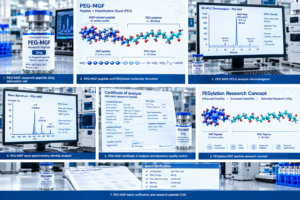
describes the nominal quantity supplied, but the label alone does not establish the precise molecular composition, PEG distribution, chromatographic purity or identity of the material. Those characteristics should be evaluated using the batch-specific analytical documentation.
PEG-MGF and the MGF Research Background
Mechano growth factor, commonly abbreviated MGF, is associated with an IGF-1 splice variant. Scientific literature has described the MGF-related peptide as a 24-amino-acid C-terminal peptide associated with the IGF-1Ec splice form.
This biological background provides the foundation for research involving MGF-related peptide materials.
However, it is important to distinguish research involving unmodified MGF-related peptides from research involving a PEGylated MGF construct.
These are not automatically interchangeable research materials.
PEGylation introduces a polymer component that can alter the physical and analytical characteristics of a peptide. Therefore, findings involving MGF or an MGF-related peptide should not automatically be presented as evidence about a particular PEG-MGF material.
For an SEO product page, this distinction also helps maintain scientifically responsible wording.
Instead of presenting PEG-MGF as a clinically established product, researchers can evaluate it as a laboratory research material whose identity and analytical properties should be established for the specific batch being studied.
What Does PEGylation Mean?
PEGylation refers broadly to the attachment or association of polyethylene glycol with another molecule.
In peptide research, PEGylation can produce a substantially different analytical profile compared with the unmodified peptide. The PEG component contributes additional molecular mass and can influence chromatographic separation and mass-spectrometric behavior.
For PEG-MGF, the exact PEG specification matters.
Important variables can include:
- PEG molecular size
- PEG architecture
- Number of PEG chains
- Attachment chemistry
- Attachment location
- Linker chemistry
- Degree of conjugation
- Residual unconjugated peptide
- Residual free PEG
- Related reaction products
Consequently, “PEG-MGF” should not automatically be treated as a complete chemical specification.
A strong research supplier should provide enough information for the laboratory to understand what material was supplied and how the reported analytical results were obtained.
PEG-MGF 2mg: Understanding the Product Format
PEG-MGF 2mg is a common research-product search term and generally refers to a vial containing a nominal 2mg quantity of the specified research material.
The 2mg designation is a quantity specification—not a complete analytical specification.
Researchers evaluating a 2mg PEG-MGF product should consider the following:
- Product identity
- Exact lot or batch number
- Declared peptide sequence or construct
- PEG specification
- Analytical method
- Chromatographic purity
- Identity testing
- Related substances
- Water content where applicable
- Certificate of Analysis availability
- Testing laboratory
- Test date
This approach makes it possible to distinguish product quantity from material characterization.
A certificate should also correspond to the exact batch rather than simply being a generic document. A current PEG-MGF COA published by Lyze Labs, for example, identifies a specific source batch and explicitly states that its analytical results apply to that batch.
PEG-MGF Molecular Weight
Molecular weight is one of the more complicated SEO and analytical topics surrounding PEG-MGF.
A conventional unmodified peptide can often be described using a relatively specific molecular mass calculated from its amino-acid sequence. PEGylated materials are more complicated because PEG is commonly polydisperse.
One current analytical dataset describes a PEG-MGF construct using a 24-residue peptide associated with a 5 kDa mPEG component and reports a reference monoisotopic mass around 7,894 Da for that particular defined construct.
That figure should not automatically be presented as the universal molecular weight of every product sold under the PEG-MGF name.
The exact molecular weight depends on the specific construct being supplied, including the PEG component and attachment chemistry.
This is why a high-quality PEG-MGF research page should avoid publishing one molecular-weight number without identifying the underlying chemical configuration.
Why molecular-weight reporting can differ
Differences may arise from:
- PEG chain distribution
- Conjugation state
- Linker composition
- Counterions
- Analytical method
- Theoretical versus measured mass
- Average versus monoisotopic mass
- Whether the reported value represents the peptide component or complete conjugate
For laboratory work, the batch-specific COA and analytical report are therefore more useful than a generic molecular-weight number copied from an unrelated product listing.
PEG-MGF Purity
PEG-MGF purity is another area where researchers should read the analytical method carefully.
For conventional synthetic peptides, reversed-phase HPLC area percentage is commonly used as a chromatographic purity measurement.
PEGylated materials can be more difficult.
A current analytical index specifically notes that the PEG component is polydisperse and that the principal chromatographic feature may appear as a broad distribution rather than a conventional narrow peptide peak. The same source separates free MGF, PEGylation distribution and total peptide content rather than treating every purity measurement as directly interchangeable.
This means that a statement such as “99% pure PEG-MGF” should always be interpreted in the context of:
- Testing method
- Detector
- Chromatographic conditions
- Peak integration
- Defined specification
- Batch number
- Related substances
- Whether the result refers to peptide area or another measurement
Current commercial COAs illustrate the importance of batch-specific documentation. One August 2026 certificate reports 99.27% RP-HPLC purity for a specific PEG-MGF batch, while another commercial analytical record reports different analytical characteristics for a defined PEG-MGF construct.
These numbers should be understood as batch- and method-specific results, not universal specifications for every PEG-MGF product.
PEG-MGF HPLC Analysis
Reversed-phase high-performance liquid chromatography, or RP-HPLC, is one of the principal analytical techniques used for peptide characterization.
For a PEG-MGF research material, HPLC can help laboratories evaluate chromatographic composition and identify major and minor components.
A useful PEG-MGF HPLC report may include:
- Column information
- Mobile phases
- Gradient
- Flow rate
- Detection wavelength
- Retention time
- Main peak
- Related peaks
- Integration method
- Reported area percentage
- Batch number
Current analytical records show that PEG-MGF chromatographic profiles can contain species associated with free MGF, differently conjugated material, free PEG and other related components.
For this reason, the chromatogram itself can be more informative than a single headline percentage.
PEG-MGF Mass Spectrometry
Mass spectrometry provides another important layer of analytical information.
For conventional peptides, mass spectrometry can compare the measured molecular mass with the theoretical mass derived from the peptide sequence.
PEGylated materials can require more sophisticated interpretation because the PEG component may generate a distribution of related molecular species.
A current analytical dataset for a defined PEG-MGF construct reports high-resolution LC-MS data with an observed mass close to the theoretical value for that specific conjugate.
This illustrates why a laboratory evaluating PEG-MGF should ask:
- What exact construct was tested?
- What theoretical mass was used?
- Was the peptide or complete conjugate measured?
- What instrument was used?
- Was high-resolution MS employed?
- What was the measured mass?
- What was the mass error?
- Were charge states reported?
Mass spectrometry should therefore be interpreted together with the product specification and HPLC results.
How to Read a PEG-MGF COA
A PEG-MGF Certificate of Analysis (COA) is one of the most useful documents for evaluating research material.
A strong COA should identify the material and provide traceability to the specific batch.
Important COA fields
Product name:
The name used for the material.
Batch or lot number:
The identifier that connects the certificate to the physical material.
Test date:
When the analytical testing was performed.
Quantity:
The nominal amount supplied.
Purity:
The reported chromatographic or analytical purity under the stated method.
Identity:
The analytical evidence supporting material identity.
Molecular characterization:
Where applicable, mass spectrometry or another identity method.
Appearance:
A description of the physical material.
Water or residual solvent testing:
Useful where relevant to the formulation.
Testing laboratory:
The organization responsible for the analysis.
A current PEG-MGF certificate published in August 2026, for example, identifies the batch, certificate number, test date and RP-HPLC result rather than presenting the result as a generic product-wide specification.
That distinction is valuable when evaluating research materials.
Batch-Specific Verification Matters
A COA should match the lot number on the material being evaluated.
This is particularly important for PEG-MGF because analytical characteristics can depend on the precise conjugate and manufacturing batch.
Researchers should avoid assuming that a certificate from one lot automatically represents another lot.
A practical verification workflow is:
- Record the product name.
- Record the vial lot number.
- Obtain the corresponding COA.
- Confirm the COA lot number matches.
- Review the analytical methods.
- Review the reported identity.
- Review purity and related substances.
- Check the testing date.
- Compare the material description with the laboratory’s research requirements.
This creates a traceable documentation chain from product receipt to experimental record.
PEG-MGF Research Applications: Appropriate Scientific Wording
PEG-MGF should be presented carefully in research content.
The underlying MGF literature has explored biological questions involving MGF-related peptides, but evidence concerning an exact PEG-MGF construct should not automatically be inferred from studies of other MGF or IGF-related materials.
For SEO and scientific accuracy, appropriate research descriptions can include:
- peptide characterization
- analytical method development
- chromatographic profiling
- mass-spectrometric analysis
- peptide-conjugate research
- structure-related investigation
- formulation research
- stability-oriented analytical studies
- comparative peptide analysis
- laboratory method development
The page should avoid turning experimental research terminology into claims about human outcomes.
PEG-MGF vs. MGF
Although the names are related, MGF and PEG-MGF should not be treated as identical materials.
| Characteristic | MGF-related peptide | PEG-MGF |
|---|---|---|
| Basic peptide context | MGF-related sequence | MGF-related peptide with PEG component |
| Polymer modification | No | Yes |
| Analytical complexity | Peptide-focused | Peptide + polymer conjugate |
| Molecular mass | More sequence-defined | Depends on PEG specification |
| Chromatography | Conventional peptide analysis | May show polymer-conjugate distribution |
| Mass spectrometry | Generally more straightforward | Can require interpretation of PEG distribution |
| COA importance | High | Especially important |
| Batch characterization | Important | Critical for exact construct |
The central point is simple: PEGylation changes the analytical identity of the research material.
PEG-MGF Research Peptide Quality Checklist
Before selecting a PEG-MGF research material, laboratories can use the following checklist:
Identity
- Is the product clearly identified?
- Is the peptide sequence documented?
- Is the PEG configuration described?
Analytical testing
- Is RP-HPLC provided?
- Is mass spectrometry available?
- Are related substances reported?
- Are analytical methods identified?
Traceability
- Does the COA match the batch?
- Is the testing date documented?
- Is the testing laboratory identified?
Product documentation
- Is the nominal quantity stated?
- Is the physical form described?
- Are storage requirements supplied by the manufacturer?
- Is the research-use status clearly stated?
Data interpretation
- Does “purity” have a defined analytical meaning?
- Is the reported molecular weight for the complete conjugate or peptide portion?
- Are PEG distribution and related species addressed?
This checklist is more useful than relying on a single percentage printed on a product page.
Research-Use-Only Statement
PEG-MGF research peptide products should be described and marketed strictly as laboratory research materials. They are not presented on this page as drugs, dietary supplements, medical treatments, or products intended to diagnose, treat, cure, mitigate or prevent disease.
Research materials should be handled only by appropriately qualified personnel in accordance with applicable institutional procedures, laboratory safety requirements and relevant laws and regulations.
No dosing, administration, self-experimentation or human-use instructions are provided.
Why Analytical Documentation Matters for PEG-MGF
The strongest product pages for specialized research peptides do more than repeat a purity percentage.
They explain what the number means.
For PEG-MGF, this is particularly relevant because the PEG component introduces additional analytical complexity. Current analytical datasets demonstrate that PEG-MGF characterization may involve multiple related species and that PEGylation distribution can affect chromatographic interpretation.
A well-documented research product should therefore be evaluated using multiple pieces of evidence:
Identity + HPLC + MS + COA + batch traceability
Together, these provide a much stronger analytical picture than any single specification.
Frequently Asked Questions About PEG-MGF
What is PEG-MGF?
PEG-MGF is a research material described as a PEGylated form of mechano growth factor or an MGF-related peptide. The precise chemical identity depends on the peptide and PEG configuration used.
What does PEG-MGF 2mg mean?
PEG-MGF 2mg generally describes a product containing a nominal 2mg quantity of the specified research material. The 2mg amount does not by itself establish purity, molecular weight or molecular identity.
What is the molecular weight of PEG-MGF?
There is not necessarily one universal molecular weight for every material labeled PEG-MGF. The value depends on the exact PEG component, conjugation and analytical definition. A current analytical reference for one defined 24-residue + 5 kDa mPEG construct reports a monoisotopic mass of approximately 7,894 Da.
How is PEG-MGF purity measured?
RP-HPLC can be used to assess chromatographic composition, but PEGylated materials require careful interpretation because PEG can be polydisperse. The analytical method and definition of purity should always accompany the reported percentage.
What is a PEG-MGF COA?
A Certificate of Analysis is a batch-specific document describing analytical results for a particular research material. It may include identity, purity, molecular characterization and other quality-control measurements.
Why is the batch number important?
The batch number connects the physical product to its analytical documentation. A COA for one batch should not automatically be assumed to characterize another batch.
Is PEG-MGF the same as MGF?
No. PEG-MGF includes a PEG component, while MGF-related peptide research may concern the unmodified peptide. Their analytical characteristics should therefore be considered separately.
Can a PEG-MGF purity percentage be compared directly between suppliers?
Not necessarily. Different laboratories may use different chromatographic methods, definitions and specifications. For PEGylated materials, the analytical method is especially important when interpreting purity values.
Is PEG-MGF intended for human use?
This page describes PEG-MGF strictly as a laboratory research material. It should not be represented as an approved medicine, therapeutic product or human-use substance.
What should researchers look for when evaluating PEG-MGF?
Researchers should look for clear product identity, batch traceability, an applicable COA, analytical testing, documented purity methodology and appropriate molecular characterization.