

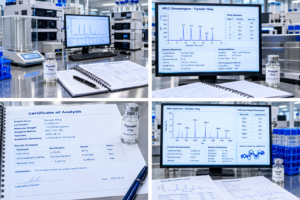
Thymalin 10mg research peptide is a search term used by people looking for detailed information about Thymalin research material, including product specifications, analytical testing, purity, certificates of analysis, and laboratory-use considerations.
For researchers evaluating a peptide or peptide-derived material, the quantity printed on a vial is only one part of the quality assessment. Identity, composition, analytical methodology, lot traceability, purity reporting, and supporting documentation can be equally important.
Thymalin also requires particular attention to terminology. Unlike a conventional synthetic peptide represented by one universally agreed amino-acid sequence, published and commercial descriptions of Thymalin can refer to a thymic polypeptide preparation or low-molecular-weight peptide fraction. One recent analytical monograph describes Thymalin as a thymic peptide extract of undefined composition and notes that chromatographic fingerprinting and molecular-weight characterization can be more appropriate than treating it as one single molecular entity.
That distinction matters when interpreting claims such as “purity,” “molecular weight,” or “HPLC tested.”
This guide explains what researchers should look for when evaluating Thymalin 10mg research peptide material, including COA documentation, HPLC analysis, identity testing, molecular characterization, storage considerations, and research-use requirements.
What Is Thymalin 10mg Research Peptide?
Thymalin is generally described in the research literature as a polypeptide preparation associated with thymic tissue. A PubMed-indexed publication describes Thymalin as a polypeptide complex isolated from the thymus and investigated in experimental work involving hematopoietic-cell differentiation.
The phrase “Thymalin 10mg” generally refers to a product presentation containing a nominal 10mg quantity.
However, researchers should not automatically interpret 10mg as meaning:
- 10mg of one defined peptide sequence
- 10mg of a single molecular species
- 10mg of biologically active material
- 10mg of a pharmaceutical-grade substance
- 10mg with a particular molecular weight
Those characteristics must be established from product-specific documentation.
This is especially important because current commercial and analytical descriptions are not uniform. Some suppliers describe Thymalin as a peptide fraction or complex, while others market it using conventional single-peptide terminology.
For SEO content and, more importantly, for scientific accuracy, the safest approach is to evaluate the specific batch and specification sheet rather than assume that every Thymalin product has identical composition.
Thymalin 10mg Research Applications
Thymalin-related research can involve several areas of laboratory investigation.
Peptide and Molecular Research
Researchers can examine peptide or polypeptide preparations using analytical methods designed to characterize composition, chromatographic behavior, molecular-size distribution, and other measurable properties.
The specific research application should determine which analytical endpoints are relevant.
Immunology Research
Thymalin has appeared in scientific literature involving immune-related experimental models. For example, a PubMed-indexed study investigated its effects on differentiation markers in human hematopoietic stem cells.
Such literature should be interpreted according to the experimental model used. Results from laboratory or preclinical studies should not automatically be translated into conclusions about human clinical effects.
Analytical Research
A Thymalin research material may also be evaluated as part of a broader analytical workflow involving:
- HPLC
- Reverse-phase chromatography
- Size-exclusion chromatography
- Mass spectrometry
- Molecular-weight distribution analysis
- Peptide fingerprinting
- Batch comparison
The correct method depends on the composition of the material being tested.
Thymalin 10mg Purity
Thymalin purity requires careful interpretation.
For a conventional single synthetic peptide, purity is often reported using chromatographic peak-area measurements. For a multi-component or peptide-fraction material, however, a single chromatographic percentage may not fully describe the composition.
An analytical monograph specifically cautions that a chromatographic purity figure cannot be meaningfully compared without knowing the method that generated it. It also distinguishes reverse-phase fingerprinting from size-exclusion characterization of molecular-weight distribution.
Therefore, when reviewing a Thymalin 10mg COA, researchers should ask:
- What analytical method was used?
- What exactly does the reported percentage represent?
- Is the material a single defined peptide or a peptide fraction?
- Is identity established independently?
- Is the result batch-specific?
- Is a chromatogram available?
- Does the report identify the testing laboratory?
A number such as “99% purity” should not be evaluated in isolation.
Thymalin 10mg HPLC Testing
HPLC, or high-performance liquid chromatography, is one of the most important analytical tools used for peptide characterization.
For conventional peptides, reverse-phase HPLC can separate components based on their interaction with the chromatographic stationary and mobile phases.
For Thymalin, the interpretation can be more complicated because some descriptions characterize it as a peptide complex or fraction rather than one defined sequence.
A suitable analytical report may therefore include:
- HPLC method
- Column information
- Detection wavelength
- Retention times
- Chromatogram
- Reference comparison
- Peak integration
- Sample identification
- Batch or lot number
- Testing date
HPLC Purity vs. Fingerprint
These terms should not automatically be treated as synonyms.
A purity result attempts to quantify the relative amount of a defined analytical component under a specified method.
A fingerprint compares a characteristic chromatographic pattern against an established reference.
Current analytical descriptions of Thymalin illustrate this distinction. One published laboratory report describes a multi-peak fingerprint similarity measurement rather than presenting that value as a conventional single-molecule purity percentage.
This distinction is valuable for researchers comparing different Thymalin products.
Thymalin 10mg COA
A Certificate of Analysis (COA) is one of the most important documents to examine when evaluating research material.
A strong batch-specific COA may identify:
- Product name
- Catalog number
- Batch or lot number
- Nominal quantity
- Analytical method
- Purity or fingerprint result
- Identity testing
- Molecular characterization
- Testing date
- Laboratory identification
- Specification or acceptance criteria
Some current commercial COAs for Thymalin report batch-specific analytical endpoints and explicitly distinguish chromatographic fingerprint similarity from chemical purity.
Why Batch Matching Matters
Researchers should compare the lot number printed on the physical product with the lot number shown on the COA.
A COA for a different batch should not automatically be treated as analytical evidence for the material currently being evaluated.
A useful documentation chain is:
Product → Lot Number → COA → Analytical Result → Research Record
This approach improves traceability and can make experimental documentation easier to reproduce.
Thymalin Molecular Weight
Searches for “Thymalin molecular weight” require special care.
If Thymalin is supplied as a peptide fraction or complex, there may not be one universally applicable molecular weight in the same sense as a single synthetic peptide.
One analytical description characterizes Thymalin using molecular-weight distribution rather than treating it as one molecular species.
Commercial documentation also varies. For example, a recent COA describes a Thymalin material as a peptide complex and reports a molecular-weight range rather than a single molecular mass.
Therefore, researchers should use the molecular characterization provided for the specific material being evaluated.
Avoid inserting an arbitrary molecular-weight number into a product page merely because another supplier reports one.
Thymalin 10mg Mass Spectrometry
Mass spectrometry can provide valuable molecular information, but the usefulness of the method depends on the nature of the sample.
For a single defined peptide, mass spectrometry can help confirm whether the observed molecular ion corresponds with the expected molecular mass.
For a complex peptide fraction, the analytical objective may instead involve:
- Detecting multiple molecular species
- Establishing a molecular fingerprint
- Characterizing molecular-weight distribution
- Comparing samples with a reference
- Investigating major components
This is why researchers should read the complete analytical method rather than assuming that every “MS tested” statement means the same thing.
HPLC and mass spectrometry can complement each other:
HPLC: chromatographic separation and pattern/purity-related information.
Mass spectrometry: molecular-mass and identity-related information.
Using orthogonal analytical methods can provide a more informative characterization profile.
Thymalin 10mg Research Quality Checklist
Before selecting a Thymalin research material, consider the following checklist.
1. Product Identity
Is the product clearly identified as Thymalin?
2. Quantity
Does the label specify 10mg?
3. Composition
Does the supplier explain whether the material is a defined peptide, peptide complex, or peptide fraction?
4. Batch Number
Is the product traceable to a specific lot?
5. COA
Is a batch-specific certificate available?
6. Analytical Method
Does the COA identify the testing methodology?
7. HPLC
Is a chromatogram or chromatographic fingerprint available?
8. Molecular Characterization
Is molecular-mass or molecular-size information provided where appropriate?
9. Testing Laboratory
Is the testing organization identified?
10. Research-Use Labeling
Is the product clearly designated for laboratory research rather than human or veterinary use?
Thymalin 10mg Storage Considerations
Research peptides and peptide preparations can be sensitive to environmental conditions.
Storage considerations may include:
- Temperature
- Moisture
- Light exposure
- Container integrity
- Storage duration
- Freeze-thaw exposure
- Product formulation
However, researchers should avoid applying a generic storage rule to every Thymalin product.
The correct storage requirements should come from the specific product documentation.
For laboratory traceability, researchers can also maintain records of:
- Date received
- Lot number
- Storage location
- Storage conditions
- Date opened
- Analytical documentation
- Experimental reference
Good documentation helps connect the material used in an experiment to the original batch information.
Thymalin 10mg Research Peptide in the USA
For U.S. researchers, product labeling and intended use are particularly important.
A product sold as a research material should not automatically be interpreted as an FDA-approved pharmaceutical or medicine.
Similarly, laboratory research material should not be presented as:
- A treatment
- A prescription alternative
- A dietary supplement
- A medical therapy
- A human-use product
- A veterinary treatment
The appropriate regulatory and institutional requirements depend on the specific material and research activity.
Researchers should review applicable laboratory policies, supplier documentation, institutional requirements, and relevant laws before using any research material.
Thymalin 10mg vs. Conventional Synthetic Peptides
One of the most important distinctions for researchers is the difference between a defined synthetic peptide and a peptide preparation.
| Characteristic | Thymalin Material | Defined Synthetic Peptide |
|---|---|---|
| Composition | May be a peptide fraction/complex | Usually one defined sequence |
| Molecular weight | May require distribution analysis | Usually a defined molecular mass |
| HPLC | May provide fingerprint information | Often used for purity |
| Mass spectrometry | May characterize multiple species | Often confirms molecular identity |
| COA | Batch-specific documentation important | Batch-specific documentation important |
| Identity | May rely on fingerprint/reference | Often sequence + MS |
| Purity interpretation | Product-specific | Usually more standardized |
| Research status | Must be verified by supplier | Must be verified by supplier |
This difference makes product-specific analytical documentation particularly important for Thymalin.
Why Thymalin COA and HPLC Data Matter
A product page that simply states “high purity” provides limited scientific information.
Researchers benefit from knowing:
What was tested?
How was it tested?
Which batch was tested?
What does the reported result actually measure?
Does the result correspond to the material being supplied?
These questions are more useful than relying on a single marketing percentage.
For example, current Thymalin analytical records demonstrate why identity, fingerprint similarity, active content, and chromatographic measurements may need to be treated as separate endpoints.
Research-Use-Only Statement
Thymalin 10mg research peptide content on this page is provided strictly for laboratory and scientific research purposes. The material discussed is not presented as a drug, medicine, dietary supplement, cosmetic, or therapeutic product. It is not intended for human or veterinary consumption, administration, diagnosis, treatment, cure, or prevention of disease.
Researchers are responsible for following applicable laboratory safety procedures, institutional requirements, product-specific documentation, and relevant laws and regulations.
Frequently Asked Questions About Thymalin 10mg Research Peptide
What is Thymalin 10mg research peptide?
Thymalin 10mg refers to a research material labeled with a nominal 10mg quantity. Depending on the supplier, Thymalin may be described as a thymic peptide preparation, polypeptide complex, or peptide fraction. Researchers should verify the specific product definition through its documentation.
Is Thymalin a single peptide?
Not necessarily. Published analytical descriptions characterize Thymalin in some contexts as a multi-component thymic peptide preparation rather than one universally defined synthetic peptide.
What does 10mg mean?
The 10mg designation generally describes the nominal quantity of material supplied. It does not independently establish purity, molecular identity, sterility, or biological activity.
What is Thymalin purity?
Thymalin purity depends on the analytical definition and method used. For a complex or peptide fraction, a chromatographic fingerprint may be more informative than treating the material as one single molecular species.
Does Thymalin 10mg have a COA?
COA availability depends on the supplier. Researchers should prefer batch-specific documentation that identifies the lot and analytical methods.
Why is HPLC important for Thymalin?
HPLC can provide chromatographic information useful for evaluating the composition or fingerprint of a research material. The precise interpretation depends on the method and product definition.
What is the molecular weight of Thymalin?
There may not be one universal molecular weight if the material is a peptide complex or fraction. Researchers should use the molecular characterization reported for the specific product and analytical method.
Can mass spectrometry be used to analyze Thymalin?
Yes. Mass spectrometry can contribute molecular characterization, although the appropriate interpretation depends on whether the material is a single peptide or a multi-component preparation.
Is Thymalin 10mg for human use?
This page discusses Thymalin strictly as laboratory research material. It does not recommend or provide instructions for human or veterinary use.
What should I look for when buying Thymalin 10mg for research?
Look for clear product identity, batch traceability, a lot-matched COA, analytical methodology, HPLC or fingerprint data, molecular characterization where appropriate, and clear research-use labeling.