

Introduction: Why IGF-DES Purity Matters
When evaluating IGF-DES purity, researchers should look beyond a single percentage printed on a product page. Purity is an analytical measurement associated with a particular sample, batch, analytical method and reporting convention. A product described as “99% pure” should therefore be supported by appropriate batch documentation rather than treated as a universal characteristic of every IGF-DES material.
IGF-DES is commonly used as a name for des(1-3)IGF-I, a truncated analogue of insulin-like growth factor-I. Scientific literature has characterized des(1-3)IGF-I using chromatographic and sequence-based analytical approaches, while modern analytical workflows can use liquid chromatography coupled with high-resolution mass spectrometry for identification and characterization.
For research procurement, the most useful quality questions include:
- What is the reported IGF-DES purity?
- Which HPLC method was used?
- Is the result reported as area percentage?
- Was molecular identity confirmed by mass spectrometry?
- Does the COA correspond to the exact batch?
- Are related substances or impurities reported?
- Is the stated quantity different from actual peptide content?
- Does the analytical documentation provide enough information to evaluate the material?
This guide explains those considerations in a research-focused, non-therapeutic context.
What Is IGF-DES?
IGF-DES is commonly associated with des(1-3)IGF-I, an IGF-I analogue in which the first three amino acids of mature IGF-I are absent. Research literature has described recombinant des(1-3)IGF-I and its characterization by chromatographic and sequence-based methods.
The terminology can vary between suppliers and scientific sources. Names such as:
- IGF-DES
- IGF-1 DES
- DES IGF-1
- DES(1-3)IGF-1
- des(1-3)IGF-I
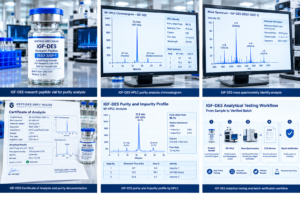
Online IGF-DES purity
may be used to describe the same general research compound.
Because peptide naming can be inconsistent, researchers should confirm the exact molecular identity, sequence and analytical documentation rather than relying solely on a product name.
What Does IGF-DES Purity Mean?
IGF-DES purity generally refers to the proportion of the target compound relative to chromatographically detected components under a specified analytical method.
For example, if an RP-HPLC chromatogram reports a principal peak representing 99.0% of the integrated chromatographic area, that result may be reported as approximately 99.0% HPLC purity.
However, an HPLC purity percentage should not automatically be interpreted as:
- 99% total vial content,
- 99% peptide by mass,
- 99% molecular identity confirmation,
- 99% biological activity,
- or 99% absence of every possible contaminant.
The analytical method matters.
This distinction is especially important for peptide research materials because a chromatographic purity result and a quantitative peptide-content measurement answer different questions.
IGF-DES HPLC Purity
Reverse-phase high-performance liquid chromatography (RP-HPLC) is one of the principal analytical techniques used to evaluate peptide purity.
In a typical peptide HPLC workflow, the sample is separated based on interactions between the peptide and the chromatographic stationary phase. The resulting chromatogram can contain a principal target peak together with smaller peaks associated with related substances or other components.
A report might include:
| Analytical Item | What It Can Indicate |
|---|---|
| Main peak area % | Relative chromatographic purity |
| Retention time | Position of the principal peak |
| Related peaks | Potential impurities or related species |
| Total impurity area | Combined reported impurity signal |
| Column information | Method reproducibility |
| Detection wavelength | Analytical detection conditions |
| Chromatographic gradient | Separation conditions |
A strong COA should ideally identify the analytical method rather than simply state “purity: 99%.”
Why the HPLC method matters
Two laboratories can obtain different results from the same material if their:
- columns differ,
- mobile phases differ,
- gradients differ,
- detection conditions differ,
- integration parameters differ,
- sample preparation differs,
- or reporting conventions differ.
Consequently, IGF-DES HPLC purity should always be interpreted together with the method used to generate it.
IGF-DES Purity Is Batch-Specific
One of the most important concepts for evaluating research material is that purity is generally batch-specific.
A supplier may advertise a specification such as ≥98% or ≥99% HPLC purity, but that specification is not the same thing as the analytical result for a particular lot.
The strongest documentation connects:
Product → Batch/Lot → Analytical Test → Result → Certificate
For example, a current commercial COA published online for one IGF-1 DES(1-3) batch reports a batch-specific RP-HPLC result of 99.27%. That document explicitly identifies the result as applying to its particular source batch rather than being a universal value for all IGF-DES products.
This is an example of how a research supplier can present batch-level documentation. It should not be interpreted as evidence that every IGF-DES batch from every supplier has 99.27% purity.
Recommended wording for an SEO product page
Instead of:
“IGF-DES is always 99% pure.”
Use:
“IGF-DES purity is batch-specific and should be verified using the applicable Certificate of Analysis and analytical testing documentation.”
This is more scientifically accurate and more defensible for research-oriented content.
HPLC Purity vs. Total Peptide Content
These two terms are frequently confused.
HPLC purity
HPLC purity generally describes the relative chromatographic area attributed to the target peak under a defined method.
Total peptide content
Total peptide content attempts to quantify how much peptide material is present in the sample, which may include the target peptide and potentially related peptide species depending on the method.
A sample could therefore have a high HPLC area percentage but a lower total peptide content because of water, counterions, residual solvents or other non-peptide material.
For this reason, researchers should avoid interpreting:
99% HPLC purity = 99% of the vial is target peptide by weight.
Those measurements are not necessarily equivalent.
IGF-DES Purity Test: What Should Be Checked?
A useful IGF-DES purity test can involve more than one analytical technique.
Important documentation may include:
1. RP-HPLC
Used to assess chromatographic purity and identify the primary chromatographic peak.
2. Mass spectrometry
Mass spectrometry can provide molecular-mass information useful for confirming whether the observed material is consistent with the expected compound.
Scientific studies have demonstrated detection of des(1-3)IGF-I using LC-MS and high-resolution mass spectrometry.
3. Peptide mapping
For larger peptide/protein-like materials, peptide mapping can provide additional information about sequence-related identity.
4. Water-content analysis
Karl Fischer analysis may be used to determine residual water in a lyophilized material.
5. Residual-solvent testing
Where appropriate, chromatographic methods such as gas chromatography can be used to evaluate residual solvents.
6. Related-substance analysis
A detailed chromatogram can help identify and quantify reported related peaks.
The appropriate analytical package depends on the material, manufacturing process and intended research application.
IGF-DES Mass Spectrometry and Identity Confirmation
HPLC can indicate chromatographic purity, but it does not by itself prove molecular identity.
That is why mass spectrometry is valuable as a complementary technique.
Research methods have successfully used immunoaffinity purification followed by nano-liquid chromatography and high-resolution mass spectrometric detection to identify des(1-3)IGF-I and related IGF analogues.
A useful analytical package can therefore combine:
Chromatography + Mass Spectrometry
HPLC addresses separation and chromatographic purity, while MS can provide molecular-mass evidence supporting identity.
For research procurement, this combination can provide substantially more useful information than a simple statement such as “high purity.”
What Should an IGF-DES COA Include?
A Certificate of Analysis (COA) is one of the most useful documents for evaluating research material.
A well-structured IGF-DES COA may contain:
- Product name
- Product or catalog number
- Batch/lot number
- Manufacturing or testing date
- Appearance
- HPLC purity
- Analytical method
- Mass spectrometry result
- Molecular weight or expected mass
- Related substances
- Water content, where applicable
- Storage information
- Testing laboratory
- Specification
- Actual result
- Pass/fail status
The batch number is particularly important.
A COA without a clear connection to the lot being purchased provides less useful evidence than a certificate directly traceable to the material.
How to Read an IGF-DES COA
When reviewing an IGF-DES COA, use a structured approach.
Step 1: Check the compound name
Make sure the certificate identifies the same compound listed on the product page.
Step 2: Check the batch number
The COA should correspond to the lot being evaluated.
Step 3: Check the purity method
Look for terms such as:
RP-HPLC, HPLC, or another clearly identified analytical method.
Step 4: Check the reported result
Do not confuse the specification with the actual result.
For example:
Specification: ≥99%
Result: 99.27%
These are different pieces of information.
Step 5: Check identity testing
Look for MS or another suitable identity-confirmation technique.
Step 6: Check related substances
A detailed COA may provide information about individual or total impurities.
Step 7: Review additional quality tests
Depending on the material, water content, residual solvents or other tests may be relevant.
What Counts as High-Purity IGF-DES?
There is no single percentage that should automatically be treated as the universal definition of “high-purity IGF-DES.”
Commercial research specifications can differ.
The more important question is:
What specification was established, what method was used, and what was the actual batch result?
For example, a currently published commercial COA provides one batch-specific result of 99.27% by RP-HPLC.
Another independent 2026 analytical report for an IGF-1 DES(1-3) lot reported 98.22% RP-HPLC area purity, while also illustrating why identity and content measurements should be considered separately.
These examples demonstrate an important SEO and scientific point:
“IGF-DES purity” is not one universal number.
Actual results depend on the specific material and analytical documentation.
IGF-DES Purity and Impurities
Peptide impurities can arise from synthesis, purification, storage or chemical modification.
Potential related species may include:
- truncated sequences,
- deletion products,
- oxidation products,
- modified peptide forms,
- process-related impurities,
- residual solvents,
- water,
- counterions,
- or other non-target components.
High-resolution analytical methods can be especially valuable when structurally similar compounds need to be distinguished.
Research examining IGF-I analogues has demonstrated the usefulness of high-resolution mass spectrometry for detecting target compounds and related forms. One study specifically noted the importance of monitoring native and oxidized peptide forms in analytical testing of IGF-I analogues.
This reinforces why a simple purity percentage should not be viewed in isolation.
IGF-DES Purity vs. IGF-DES Identity
Purity and identity answer different questions.
Purity asks:
How much of the chromatographically measured material corresponds to the principal component under the stated method?
Identity asks:
Is the principal component actually the expected IGF-DES molecule?
A comprehensive quality strategy should therefore address both.
An ideal research documentation package can include:
HPLC → Purity
MS → Molecular identity
Additional testing → Supporting quality information
This layered approach provides stronger evidence than relying on one analytical result.
Why Exact Molecular Identity Matters
IGF-DES should not be casually treated as interchangeable with:
- full-length IGF-1,
- IGF-1 LR3,
- other IGF-I fragments,
- modified IGF-I analogues,
- or unrelated growth-factor peptides.
The scientific literature distinguishes des(1-3)IGF-I from other IGF-I analogues and has developed analytical methods specifically capable of differentiating these compounds.
For SEO content, this distinction is valuable because users searching for IGF-DES purity may also search for molecular weight, sequence, COA and analytical testing.
A strong content architecture should connect these topics without treating the compounds as interchangeable.
IGF-DES Research Material Quality Checklist
Before purchasing or evaluating research material, consider the following checklist:
Identity
- Is the compound clearly identified?
- Is DES(1-3)IGF-I specified?
- Is the expected molecular identity documented?
Purity
- Is an HPLC result available?
- Is the analytical method stated?
- Is the result batch-specific?
Identity Confirmation
- Is mass spectrometry available?
- Does the observed mass support the expected identity?
Documentation
- Is there a current COA?
- Does the COA correspond to the lot?
- Are testing dates provided?
Impurity Information
- Are related substances reported?
- Is the main impurity identified when possible?
- Are additional analytical tests disclosed?
Research Positioning
- Is the material clearly presented for laboratory research?
- Does the supplier avoid unsupported therapeutic claims?
IGF-DES Purity and Research-Use Positioning
For a research-focused website, the language surrounding IGF-DES is important.
IGF-DES should be presented as a research material rather than as a consumer therapeutic product.
The page should avoid:
- dosing instructions,
- administration instructions,
- injection guidance,
- treatment recommendations,
- disease-treatment claims,
- bodybuilding claims,
- performance-enhancement claims,
- claims that a research material is approved for human use.
This approach also improves the credibility of the SEO page because it keeps the content focused on analytical characterization, molecular identity, laboratory research and quality documentation.