

KPV Research Peptide refers to the tripeptide Lys-Pro-Val, commonly abbreviated as KPV and also identified as α-MSH(11–13). PubChem lists KPV as a tripeptide with the sequence K-P-V, molecular formula C₁₆H₃₀N₄O₄, and molecular weight of approximately 342.43 g/mol.
KPV has attracted scientific interest because it represents a short sequence derived from the C-terminal region of alpha-melanocyte-stimulating hormone (α-MSH). Researchers have investigated KPV and related peptide fragments in experimental models involving inflammatory signaling, cellular activity, peptide transport, and other biological processes.
A responsible
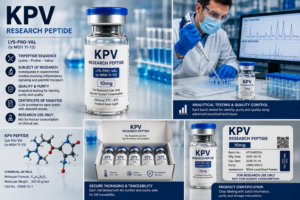
resource should clearly distinguish between:
- Laboratory research
- Cell-based studies
- Animal and preclinical research
- Human clinical evidence
- Product quality and analytical documentation
This page focuses on scientific identity, published research, peptide quality, analytical testing, Certificates of Analysis, lot traceability, and responsible research-use communication.
Research-use notice: KPV is discussed here for scientific and laboratory research purposes. This article does not provide dosing, injection, reconstitution, treatment, or administration instructions.
What Is KPV Research Peptide?
KPV is a tripeptide composed of three amino acids:
Lysine – Proline – Valine
The sequence is commonly represented as:
KPV
It is also associated with the designation α-MSH(11–13), referring to the C-terminal region of alpha-melanocyte-stimulating hormone from which the sequence is derived. PubChem identifies Lys-Pro-Val as a tripeptide and lists α-MSH(11–13) among its related names.
The relatively small size of KPV makes it an interesting subject for experimental research. However, a short peptide sequence alone does not determine how a research material should be interpreted. Product identity, purity, analytical characterization, experimental conditions, and the biological model can all affect research outcomes.
When discussing KPV Research Peptide, it is therefore important to separate the molecular identity of KPV from claims about what the peptide may or may not do in a particular biological system.
Understanding the KPV Peptide Sequence
The three letters in KPV represent:
- K — Lysine
- P — Proline
- V — Valine
The sequence is chemically identified as L-Lysyl-L-prolyl-L-valine. Its relationship to the C-terminal sequence of α-MSH has been explored in scientific literature for decades.
Early research examining α-MSH-related peptides investigated the importance of its C-terminal amino-acid sequence and contributed to the scientific interest in shorter peptide fragments, including Lys-Pro-Val.
For SEO purposes, these related terms can be used naturally throughout the page:
- KPV peptide
- Lys-Pro-Val
- KPV tripeptide
- α-MSH(11–13)
- KPV research
Using these scientifically relevant variations helps search engines understand the topic without repeatedly forcing the exact phrase KPV Research Peptide into every paragraph.
Why Is KPV Studied?
KPV has been investigated because researchers have observed biological activity associated with α-MSH-derived peptide sequences in experimental systems.
Published work has explored KPV in relation to:
- Inflammatory signaling
- Cytokine-related pathways
- Cellular responses
- NF-κB-associated research
- Peptide transport
- Skin and keratinocyte models
- Animal models of inflammation
For example, a 2003 study examined KPV in mouse models of experimentally induced inflammation and compared its activity with other α-MSH-related peptides. The findings suggested that KPV behaved differently from the melanocortin-receptor-dependent mechanisms investigated for other related peptides.
A separate study investigated signaling responses involving KPV in cultured human keratinocyte systems.
These findings are scientifically interesting, but they should not be converted into claims of proven therapeutic effectiveness. Results from cellular and animal models cannot automatically predict safety or effectiveness in humans.
The KPV Research Landscape
The current KPV research landscape consists primarily of experimental and preclinical investigation.
Researchers have explored questions such as:
- How does KPV interact with cellular signaling systems?
- Does KPV operate through the same mechanisms as full-length α-MSH?
- What transport pathways may influence KPV activity?
- How does KPV behave in specific cell and animal models?
The evidence available for one research question should not automatically be generalized to another.
For example, a finding in a mouse inflammation model is not equivalent to a clinical outcome in humans. Similarly, observations in cultured cells may help generate hypotheses but cannot independently establish therapeutic benefit.
This distinction is especially important for peptide research content because search results may combine:
- Scientific papers
- Research-use materials
- Cosmetic ingredients
- Compounding discussions
- Consumer health claims
A high-quality KPV Research Peptide page should prioritize the evidence hierarchy and clearly identify when findings are experimental.
KPV and Inflammatory Signaling Research
One of the major areas of scientific interest surrounding KPV involves inflammatory signaling.
The 2003 study by Getting and colleagues investigated KPV in experimental inflammation models and reported findings distinct from the melanocortin receptor mechanisms examined for other α-MSH-related peptides.
This led to further scientific interest in understanding possible mechanisms.
However, describing experimental findings requires careful wording.
Appropriate language:
- “KPV has been investigated in experimental inflammation models.”
- “Studies have explored KPV’s relationship with inflammatory signaling.”
- “The molecular mechanisms remain an area of scientific investigation.”
Language to avoid:
- “KPV cures inflammation.”
- “KPV is a proven treatment.”
- “KPV guarantees anti-inflammatory results.”
The difference is important because the first group accurately describes research activity, while the second makes therapeutic claims that are not established by experimental research alone.
KPV and Cellular Signaling
Researchers have also studied KPV in cellular systems to investigate possible signaling mechanisms.
A published study involving human keratinocyte cells examined α-MSH, KPV, and related peptides in connection with intracellular signaling responses.
These types of studies are valuable because they can help researchers investigate:
- Cellular responses
- Signal-transduction pathways
- Receptor involvement
- Molecular mechanisms
- Differences between related peptides
However, biological signaling is often complex.
Results may differ depending on:
- Cell type
- Experimental conditions
- Peptide concentration
- Exposure duration
- Analytical method
- Model design
Therefore, a single laboratory finding should not be interpreted as a universal property of KPV across all biological systems.
Understanding KPV Research and Mechanisms
One of the interesting questions surrounding KPV is whether its activity can be fully explained by the same pathways associated with α-MSH.
Experimental literature has explored this question, and some studies have reported findings suggesting that KPV may differ from other melanocortin-related peptides in the mechanisms investigated.
This makes KPV a useful topic for research involving:
- Peptide structure–activity relationships
- Cellular signaling
- Molecular mechanisms
- Experimental pharmacology
- Peptide transport
- Comparative peptide biology
At the same time, mechanistic uncertainty is not evidence of a therapeutic effect. It simply identifies areas where additional scientific investigation may be useful.
KPV Research Peptide Quality
Scientific research depends not only on the peptide being studied but also on the quality and identity of the research material.
A KPV Research Peptide product should be evaluated using more than promotional phrases such as:
- Premium quality
- Laboratory tested
- High purity
- Research grade
Meaningful quality evaluation may involve several different factors.
Product Identity
The product should clearly identify the material as KPV or Lys-Pro-Val.
Relevant information may include:
- Product name
- Peptide sequence
- Chemical identity
- Nominal quantity
- Lot or batch number
Analytical Documentation
Where available, documentation should explain the testing performed and connect the results to the relevant product or lot.
Purity
Purity may be an important characteristic, but the number should be considered alongside the analytical method used to generate it.
Lot Traceability
Researchers should be able, where applicable, to connect the physical material with relevant analytical documentation.
Understanding KPV Purity
KPV purity is a valuable research keyword and an important quality consideration.
However, purity alone does not answer every question about a peptide product.
When reviewing a reported purity value, researchers may ask:
- Which analytical method was used?
- Does the result correspond to the specific lot?
- Has peptide identity been confirmed?
- Are specifications clearly distinguished from measured results?
- Is the documentation internally consistent?
Potential analytical approaches may include:
- Chromatographic analysis
- Mass-based characterization
- Identity testing
- Impurity evaluation
The appropriate testing strategy depends on the material and the intended research application.
Instead of focusing only on the question:
“What is the purity percentage?”
Researchers may obtain more useful information by asking:
What analytical evidence supports the identity and characteristics of this specific KPV research material?
KPV Analytical Testing
Analytical testing can help support confidence in a research material before it is incorporated into an experimental workflow.
Relevant documentation may address:
Identity
Does the available analysis support that the material corresponds to the expected peptide?
Purity
What proportion of the tested material is attributed to the intended peptide according to the stated analytical method?
Molecular Characterization
Are molecular characteristics supported through appropriate analytical techniques?
Lot-Specific Results
Can the analytical results be connected to the actual lot being used in research?
The phrase “tested” is most useful when accompanied by information about what was tested and how the result relates to the specific product.
KPV Certificate of Analysis
A Certificate of Analysis (COA) can provide useful information about the analytical evaluation of a research material.
Depending on the supplier and testing program, a KPV COA may include:
- Product identification
- Lot or batch number
- Analytical specifications
- Test results
- Purity information
- Testing date
- Analytical methodology
How to Review a KPV COA
1. Confirm the Product
The product described in the documentation should match the physical material.
2. Match the Lot Number
A lot number can help connect the specific product with the corresponding analytical record.
3. Separate Specifications From Results
A specification is an acceptance criterion. A result is the measured analytical outcome.
4. Review the Available Method Information
Understanding how a result was obtained provides important context.
5. Check Consistency
The following information should align:
- Product name
- Lot number
- Product specifications
- Analytical records
- Physical labeling
Lot-specific documentation can be particularly useful when maintaining research records across multiple experiments.
Packaging and Lot Traceability
Clear packaging supports both identification and laboratory recordkeeping.
A research-oriented KPV product may include:
- Product name
- Nominal quantity
- Lot number
- Product identification
- Storage documentation
- Research-use information
Lot traceability can assist with:
- Experimental documentation
- Inventory management
- Batch comparisons
- Investigation of unexpected results
- Matching materials to analytical records
Researchers should inspect materials according to applicable laboratory procedures.
Potential concerns may include:
- Missing lot numbers
- Inconsistent product names
- Damaged packaging
- Analytical documents that do not match the supplied material
Packaging integrity alone does not establish clinical safety, therapeutic effectiveness, or regulatory approval.
Storage and Handling Documentation
Storage requirements should be based on the specific product and its current documentation.
Researchers should avoid assuming that generic storage information applies to every KPV material.
Relevant considerations may depend on:
- Product form
- Packaging
- Formulation
- Stability data
- Supplier documentation
- Laboratory procedures
Useful research records may include:
- Date received
- Lot number
- Documented storage conditions
- Handling history
- Relevant deviations
This page does not provide instructions for reconstitution, dosing, injection, or human or veterinary administration.
How to Evaluate a KPV Research Peptide Supplier
When evaluating a supplier, transparent scientific documentation is generally more useful than broad marketing claims.
Consider the following factors.
Clear Product Identity
The product should be consistently identified across:
- Product page
- Product label
- Specifications
- Analytical documentation
Analytical Transparency
Relevant testing information should be available where appropriate.
Lot-Level Traceability
The supplied material should be identifiable through lot or batch documentation.
Documentation Consistency
Product names, quantities, lot numbers, and analytical records should align.
Responsible Research Language
Scientific findings should be described accurately without transforming preliminary or preclinical results into guaranteed medical outcomes.
Research-Use and Regulatory Considerations
Regulatory status depends on the jurisdiction, intended use, formulation, and specific product.
In the United States, KPV-related bulk drug substances were discussed at the FDA’s Pharmacy Compounding Advisory Committee meeting on July 23, 2026. The FDA materials identify KPV free base and KPV acetate as substances considered for possible inclusion on the 503A Bulks List, with nominated uses involving wound healing and inflammatory conditions. Advisory committee consideration is not equivalent to FDA approval of a finished KPV drug product.
The FDA describes the Pharmacy Compounding Advisory Committee as providing advice on scientific, technical, and medical issues related to drug compounding; its recommendations are advisory rather than drug approvals.
Therefore, a responsible KPV product page should avoid unsupported statements such as:
- “FDA-approved KPV”
- “Clinically proven KPV treatment”
- “Safe for injection”
- “Guaranteed therapeutic results”
More accurate research-focused language includes:
- “Subject of laboratory and preclinical research”
- “Investigated in experimental models”
- “Evidence varies according to the research application”
- “Experimental findings should not be interpreted as guaranteed clinical outcomes”